

Most gardeners treat heavy clay like a life sentence for their plants, but for the right species, this nutrient-dense ground is actually a powerhouse for growth. We know the frustration of watching a new boundary line turn yellow and fail after a wet Irish winter. It’s exhausting to dig into ground that feels like concrete in summer and a swamp in December, leading many to believe that a thick, private screen is simply out of reach for their site.
You don’t have to settle for a stunted or patchy boundary. Finding the right hedging for clay soil Ireland requires a shift in strategy, focusing on root resilience and smart ground preparation rather than just brute force. In this 2026 guide, you’ll learn how to identify the most durable species for heavy ground and how to prepare your site for long-term health. We will look at hardier options like Hornbeam and Portuguese Laurel that thrive where others fail, ensuring you achieve a lush, low-maintenance hedge that improves your soil structure over time.
Key Takeaways
- Identify which evergreen and deciduous species, such as Portuguese Laurel and Hornbeam, are best suited to withstand the heavy, damp conditions of Irish clay.
- Learn the essential ground preparation techniques for hedging for clay soil Ireland to prevent waterlogging and root rot during wet winters.
- Discover why planting in wide, shallow trenches rather than deep holes is the key to establishing a healthy root system in compacted ground.
- Understand the importance of timing your planting and sourcing nursery-grown stock that is already acclimatised to local weather patterns.
- Gain insights into how selecting the correct hedge species can naturally improve your soil structure and drainage over time.
The Challenges of Clay Soil for Irish Hedges
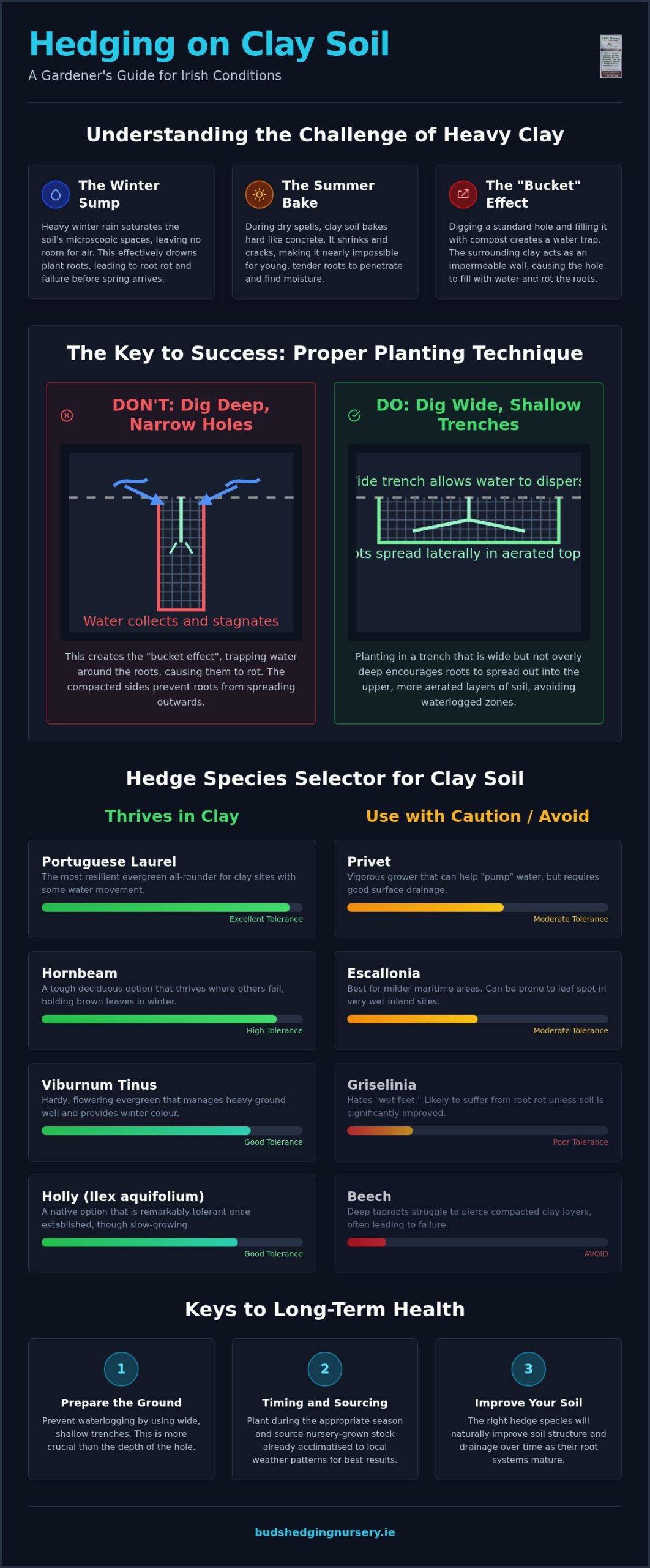
Clay soil is a common hurdle for Irish gardeners. It consists of microscopic mineral particles that bind together tightly. These tiny particles leave very little space for air. In the context of a Hedge or hedgerow, this lack of oxygen is a primary cause of failure. When it rains, these microscopic spaces fill with water instead of the air that roots need to breathe. Without oxygen, the biological processes required for growth simply stop.
In Ireland, we frequently face the “Winter Sump” effect. Heavy winter rainfall sits on the surface or saturates the upper layers of clay. Without natural drainage, roots effectively drown. This leads to root rot, where the plant’s foundation turns mushy and dies before spring arrives. Conversely, summer brings its own set of issues. Clay bakes hard. It shrinks and cracks, making it nearly impossible for young, tender roots to penetrate the ground during dry spells.
A common mistake is digging a standard planting hole and filling it with loose, rich compost. In heavy ground, this creates a “bucket” effect. The surrounding clay acts as an impermeable wall. Rainwater flows into the loose soil of the hole and stays there, unable to escape. Choosing the right hedging for clay soil Ireland starts with understanding these physical limitations and avoiding the trap of creating a waterlogged pit for your new plants.
Identifying Your Soil Type
You can confirm your soil type with a simple “sausage test.” Take a handful of damp soil and try to roll it into a thin cylinder between your palms. If it holds its shape without crumbling, you have high clay content. To check drainage, perform a percolation test. Dig a hole 30cm deep, fill it with water, and let it drain completely. Fill it again and time how long it takes to empty. If it takes more than four hours, your drainage is poor. You should also look for signs of anaerobic soil. If the earth looks grey or blue and has a sour, sulphurous smell, it’s a clear sign of stagnant water and a lack of oxygen.
The Impact on Different Root Systems
Different plants have different ways of anchoring themselves. Taproots, which grow straight down, often struggle to pierce through compacted clay layers. This is why species like Beech often fail in heavy ground. Successful hedging for clay soil Ireland usually relies on plants with strong lateral root systems. These roots spread outward through the upper, more aerated layers of soil rather than fighting the deep compaction. It’s also worth noting that clay stays cold much longer than sandy soil. This thermal mass delays spring growth, as the heavy ground takes longer to warm up after a frost, meaning your hedge might be slower to bud than those in lighter soils.
Reliable Evergreen Hedging Species for Clay and Damp Sites
Selecting the right hedging for clay soil Ireland means looking for plants that don’t succumb to root rot at the first sign of a puddle. Viburnum Tinus is a standout choice for these conditions. It is a hardy, flowering evergreen that manages heavy ground well whilst providing much-needed winter colour through its white and pink blooms. Similarly, Holly (Ilex aquifolium) is a native option that shouldn’t be overlooked. While it grows slowly, it is remarkably tolerant of difficult, heavy ground once its roots are established. For those in maritime or milder areas, Escallonia offers a dense, glossy screen. However, be cautious in very wet inland sites where it can be prone to leaf spot.
Portuguese Laurel: The All-Rounder
Portuguese Laurel (Prunus lusitanica) is perhaps the most resilient evergreen for clay sites, provided there is at least some movement of water. Its root system is naturally more adaptable than that of the common Cherry Laurel, which often yellows and loses leaves in waterlogged spots. This adaptability makes it a staple for Irish gardens facing drainage issues. According to the RHS list of hedges for heavy clay soil, this species is a top recommendation for its durability and tidy growth habit. On very heavy sites, you must manage drainage to prevent “shot hole” fungus. This condition occurs when the plant is under stress, causing small sections of the leaf to die and fall out. For a deeper look at this variety, see our Portuguese Laurel: The Complete Guide for Irish Gardens 2026.
Griselinia and Privet: Caveats for Heavy Ground
Not all popular evergreens handle clay with the same ease. Griselinia is often requested for its bright, apple-green foliage, but it truly hates “wet feet.” If you plant it in clay without significant soil improvement, it will likely suffer from root rot. In contrast, Privet (both Green and Golden) is a vigorous grower that offers a practical solution. Because it grows so quickly, it can actually help “pump” excess moisture out of the ground during the growing season, helping to dry out the immediate area. If you are prioritising a fast-growing boundary that provides year-round cover, check our Best Hedging for Privacy in Ireland: A Practical 2026 Buying Guide.
Our plants are grown to be hardy and ready for the challenges of the local environment. If you are unsure which variety fits your specific site, you can view our full range of hedging to see what we currently have in stock.
Deciduous and Native Hedging for Heavy Ground
While evergreen screens are often the first choice for privacy, many deciduous species possess tougher root systems better suited for the physical demands of heavy ground. Hornbeam (Carpinus betulus) is the gold standard for hedging for clay soil Ireland. It is a rugged, dependable plant that manages the compaction and seasonal waterlogging of clay with ease. For the most difficult “wet corners” of a site where water sits for weeks, Alder (Alnus glutinosa) is the ultimate choice. It is one of the few species that actually prefers damp conditions. If you want to add winter interest, Dogwood (Cornus) thrives in heavy soils and provides spectacular stem colours once the leaves fall.
Hornbeam vs. Beech: The Clay Soil Debate
Many gardeners hope for a crisp Beech hedge, but Beech (Fagus sylvatica) often fails in clay. It requires free-draining ground; in heavy clay, the roots suffocate, and the foliage turns a sickly yellow before the plant eventually dies. Hornbeam is the practical alternative. It looks remarkably similar to Beech with its serrated green leaves, but it is far more resilient. One key feature is its marcescence. Like Beech, Hornbeam holds onto its brown, dried leaves throughout the winter if it is kept pruned. This ensures your boundary remains private even in the coldest months. For those with lighter soil who still prefer the classic look, you can read our Beech Hedging Plants Ireland: The Complete 2026 Buying Guide.
Native Mixed Hedging for Biodiversity
For long boundary runs or farmland, a native mixed hedge is often the most cost-effective and storm-proof solution. Whitethorn (Hawthorn) is the backbone of these mixes. It is a rugged native that anchors itself deeply into heavy clay, creating a stock-proof barrier that supports local wildlife. Combining Whitethorn with Hazel and Guelder Rose creates a varied, healthy boundary that can withstand the harshest Irish weather.
Many landowners are now sourcing these species through the Native Trees Scheme plants program. This scheme supports the planting of small native forests and hedges without the need for an afforestation licence. Using native species ensures your hedge is perfectly adapted to the local climate and soil conditions. These plants are grown in our nursery to be hardy, making them much more likely to establish quickly in challenging ground than generic garden centre stock.
How to Plant and Establish Hedges in Clay Soil
Success with hedging for clay soil Ireland depends more on your shovel work than the weather. Even the hardiest species will struggle if they are dropped into a compacted, waterlogged pit. Proper establishment is about creating an environment where roots can breathe during the winter and stay hydrated during the summer. Follow these practical steps to ensure your new boundary thrives from the first season.
- Step 1: Timing. Never work clay soil when it is frozen or “claggy.” If the mud sticks to your boots and spade in heavy clumps, it is too wet. Working saturated clay destroys its structure and leads to long-term compaction.
- Step 2: Trenching. Avoid digging individual holes. Instead, dig a wide, shallow trench. This prevents the “bucket effect” where water gathers in a single spot. A wide trench encourages the lateral root growth that clay-tolerant plants prefer.
- Step 3: Soil amendment. Mix horticultural grit and well-rotted organic matter into the soil you’ve removed from the trench. Don’t use pure compost; a 50/50 mix with your native soil is better. This physically separates the clay particles and improves air circulation.
- Step 4: Mound planting. This is a vital technique for heavy ground. Plant your hedge so the top of the root ball sits 5cm to 10cm above the natural ground level. Backfill to create a gentle slope. This ridge allows excess water to drain away from the stem.
- Step 5: Mulching. Apply a thick layer of bark mulch after planting. This prevents the clay from baking and cracking in the summer sun, which can snap the tender new roots of a young hedge.
Improving Drainage Without Plastic Pipes
You can improve the root zone through “vertical mulching.” Use a garden fork to make deep, vertical holes around the planting area and fill them with coarse grit. This creates permanent channels for air and water. When digging your trench, always “rough up” the sides with your spade. If the spade leaves a smooth, shiny surface (known as glazing), it acts like a ceramic pot and blocks roots from spreading. Roughing the edges allows roots to pierce the surrounding ground more easily.
Managing Bare Root Plants in Heavy Ground
Bare root season is the most cost-effective time to plant hedging for clay soil Ireland. However, you must keep the roots moist and covered in a cool, sheltered spot if the ground is too wet to dig immediately. For a full breakdown of the planting calendar, see our Bare Root Tree Season Ireland: The Complete 2026 Planting Guide. When you are ready to plant, firm the soil with a light step. Don’t stomp on wet clay; this removes all the oxygen and creates a solid block that roots cannot penetrate.
To get the best results on difficult ground, you need plants that have been hardened off in a real nursery environment. You can order your nursery-grown hedging today to ensure your plants are ready for the Irish climate.
Sourcing Quality Hedging from a Specialist Nursery
Success with hedging for clay soil Ireland depends heavily on the origin of the plants. Many retail outlets sell stock that has been imported from milder climates. These plants are often “soft” and struggle to adapt to the heavy, cold ground found in many Irish gardens. Sourcing from a specialist plant nursery Ireland ensures that your hedging has been grown in a real-world environment. It is already hardy and ready to face the local weather patterns.
A specialist grower offers a level of expertise that general garden centres cannot match. We understand the physical properties of clay and can provide a bespoke planting plan based on your specific site. This includes advice on spacing and soil preparation that we have gathered through decades of hands-on experience. We also manage the logistics of delivery to ensure that bare root plants are out of the ground for the shortest time possible, which is critical for successful establishment in heavy soils.
Bare Root vs. Pot-Grown for Clay
Choosing between bare root and pot-grown stock is often a matter of timing and budget. For large-scale projects, bare root plants provide the best value. They are lifted directly from our fields during the dormant season and should be planted whilst the clay is still workable. Because they haven’t been confined to a pot, their root systems are often more expansive and better prepared to anchor into heavy ground. Pot-grown plants offer more flexibility for late-season planting but require more attention to watering during the summer months when clay can bake hard and shrink away from the root ball.
The Buds Nursery Cavan Standard
At Buds Nursery Cavan, we manage 60 acres of field-grown hedging and trees. Our 30 years of experience in the trade have taught us exactly what works in challenging Irish conditions. We don’t just sell plants; we provide a reliable service that prioritises the quality of the output. This dedication to the craft is why we have become a dependable fixture for gardeners and landowners across the country. Our national delivery service ensures that our hardy, nursery-grown stock can reach you in peak condition, regardless of where you are located. We focus on the fundamentals, ensuring every plant that leaves our nursery is healthy and ready to form a lasting boundary.
Establishing a Resilient Boundary for Your Irish Garden
Heavy clay doesn’t have to be a barrier to a functional and attractive landscape. Success starts with matching the root system to your drainage profile and using the practical techniques, such as mound planting, discussed in this guide. By improving soil structure and selecting hardy stock, you can establish a boundary that thrives despite the seasonal waterlogging common in the Irish climate.
Securing the right hedging for clay soil Ireland is a long-term investment in your home’s privacy and local biodiversity. At Buds Nursery Cavan, we apply over 30 years of experience to every plant we grow on our 60-acre site. Our trees and hedges are raised to be resilient and ready for immediate planting. We offer a comprehensive national delivery service to ensure these hardy plants reach you in peak condition.
Explore our full range of clay-tolerant hedging at Buds Nursery Cavan and start transforming your heavy ground today. With the right species and professional guidance, your site will soon support a thick, healthy hedge that stands the test of time.
Frequently Asked Questions
Which hedge is best for heavy clay soil in Ireland?
Hornbeam and Portuguese Laurel are the top performers for heavy ground. Hornbeam handles the physical compaction of clay whilst Portuguese Laurel offers a hardy evergreen alternative. For native boundaries, Whitethorn and Alder are excellent choices as they naturally adapt to damp conditions. Selecting these species ensures a long-lived boundary. These plants are grown on our 60-acre nursery specifically to withstand the challenging Irish climate and soil profiles.
Will Laurel grow in clay soil?
Portuguese Laurel is very successful in clay, but Cherry Laurel often struggles with “wet feet.” Portuguese Laurel has a more adaptable root system that tolerates the lack of oxygen in heavy ground. If your site is particularly wet, ensure you use the mound planting technique described earlier. This keeps the main root mass above the saturated zone. It’s a reliable choice for evergreen hedging for clay soil Ireland if managed correctly.
Can I plant Beech in wet clay?
Beech generally fails in wet clay because its roots are highly sensitive to waterlogging. In heavy ground, Beech roots rot quickly, leading to yellowing leaves and eventual plant death. If you have heavy clay, Hornbeam is the professional choice. It looks almost identical to Beech and even holds its brown leaves through winter, but it possesses the toughness required to thrive in damp, compacted Irish soils.
How do I improve clay soil before planting a hedge?
Improve clay by mixing in horticultural grit and well-rotted organic matter to a 50/50 ratio with your native soil. This physically breaks up the tiny clay particles and introduces essential air pockets. Avoid adding pure compost to a small hole, as this creates a “sump” that collects water. Instead, work your amendments into a wide trench. This method encourages roots to spread laterally into the surrounding ground.
What is the fastest growing hedge for clay soil?
Privet and Alder are among the quickest to establish in heavy ground. Privet is a vigorous grower that can handle clay well and helps pump excess moisture from the soil during the growing season. Alder is exceptionally fast in very wet spots where other plants would drown. Both species can provide a functional screen within a few seasons if they are planted correctly and given a thick mulch to prevent summer cracking.
Is Hornbeam better than Beech for damp ground?
Yes, Hornbeam is significantly better than Beech for damp or heavy ground. While Beech requires free-draining soil, Hornbeam is naturally adapted to the heavier conditions found across many parts of Ireland. It maintains a similar aesthetic, including the ability to hold its winter foliage when pruned. This makes it the superior choice for anyone seeking a traditional deciduous hedge on a site prone to seasonal waterlogging or high clay content.
Can I plant a hedge in winter on clay soil?
You can plant in winter provided the clay isn’t frozen or saturated to a “claggy” state. Planting during the dormant season (November to March) is ideal for bare root hedging for clay soil Ireland. However, if the ground is so wet that it sticks to your spade in heavy clumps, wait for a drier spell. Working saturated clay destroys its structure, making it even harder for young roots to establish.
Do I need to add compost when planting in clay?
You should use well-rotted organic matter rather than standard multi-purpose compost. Mix the organic matter with grit and your own soil to create a balanced backfill. Using only compost can cause the root ball to sink as the material breaks down, and it may trap too much moisture. A blend ensures the plant transitions smoothly from the nursery soil into your garden’s specific clay profile without suffering from root shock.