

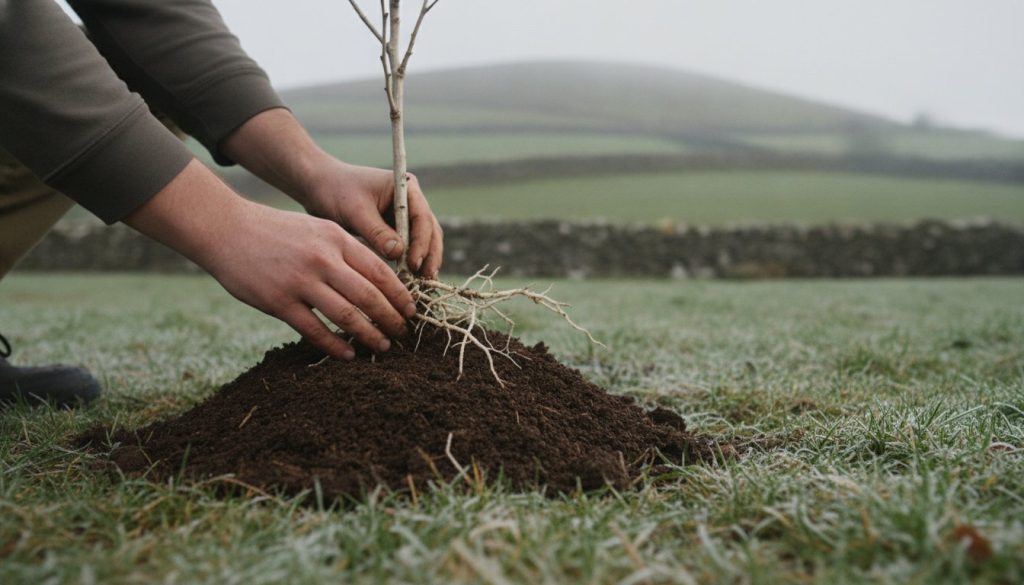
The best time to plant a thriving Irish garden isn’t when the sun is out and the leaves are green; it’s actually when the landscape looks at its most lifeless. Many gardeners feel a natural hesitation about putting a bare, soil-free root into the cold ground during the bare root tree season Ireland provides from November to March. It’s understandable to worry that the frost or the relentless rain might kill off your investment before it even starts. However, this biological pause is actually the most strategic time to establish a resilient, deep-rooted landscape.
We know that choosing between a 1ft seedling and a 5ft sapling can feel overwhelming, especially when you want results without wasting money. This guide explains exactly how to use the dormancy period to your advantage to ensure maximum survival rates and cost-effective growth. You’ll learn the practical steps for successful planting, how to navigate Irish weather conditions, and how to select the right species to boost your local biodiversity. By the end, you’ll have a clear plan to transform your property with healthy, vigorous trees that won’t break the bank.
Key Takeaways
- Identify the exact windows for the bare root tree season Ireland provides, typically spanning from late October until the first signs of growth in April.
- Learn why Ireland’s naturally wet winter climate is the most effective tool for developing deep, resilient root systems without the need for artificial irrigation.
- Select the most suitable species for your landscape, from native Whitethorn for hedging to hardy varieties like Hornbeam and Beech.
- Discover practical handling techniques like “heeling in” to keep your plants healthy if weather conditions prevent immediate planting.
- Find out how sourcing field-grown stock from local specialists ensures better plant hardiness and lower costs compared to container-grown plants.
What is the Bare Root Tree Season in Ireland?
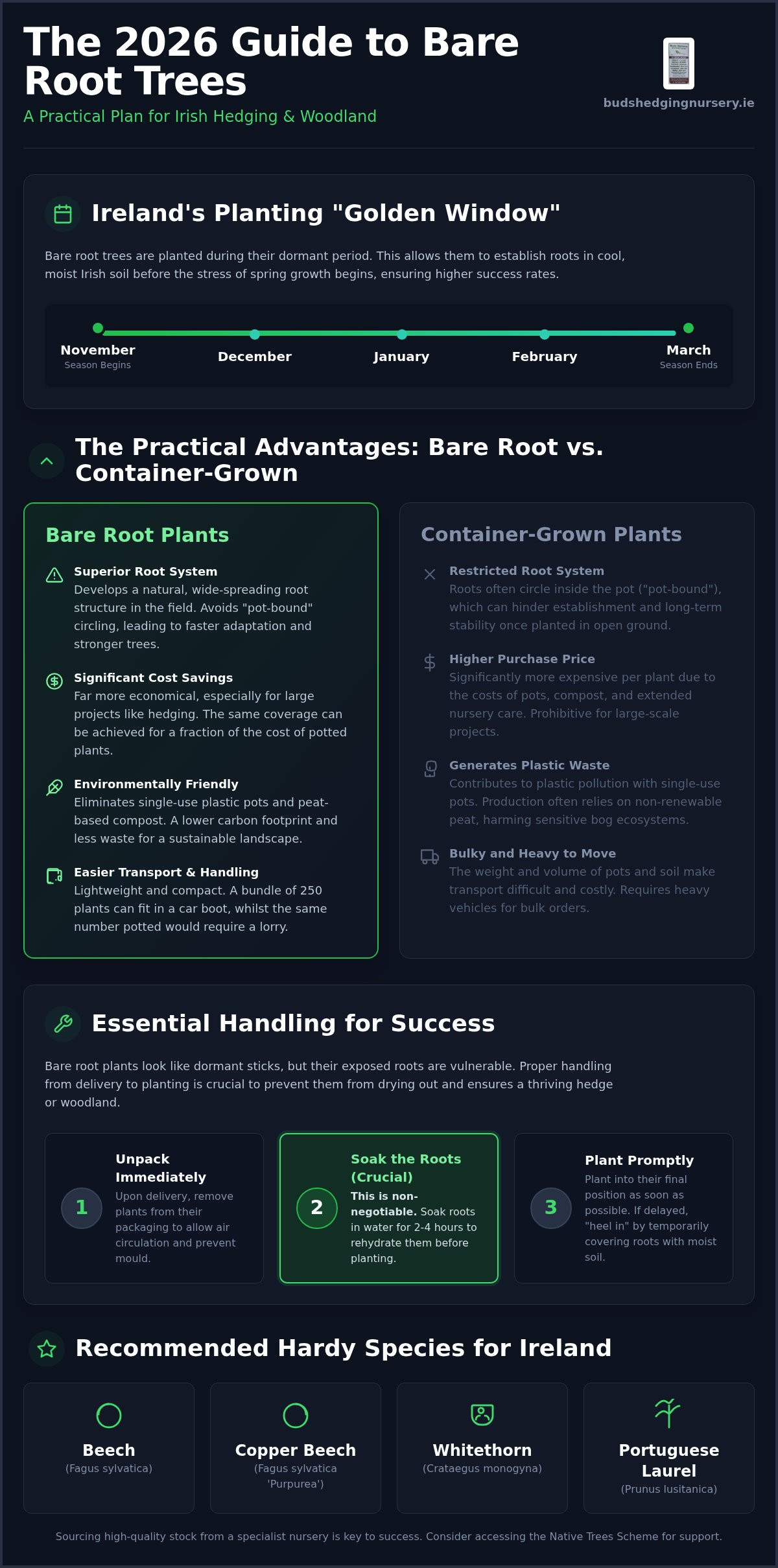
The bare root tree season Ireland offers is a specific window of opportunity that opens once deciduous plants enter their winter rest. This period typically begins in late October or early November and runs until the first buds begin to swell in early April. During these months, the plants are dormant. They’ve stopped active leaf and stem growth to survive the colder weather. To the untrained eye, a bare root sapling might look like a “dead stick” because it has no soil around its roots and no leaves on its branches. In reality, this is a sign of a healthy, resting plant ready for a fresh start.
Understanding what are bare root trees is the first step for any gardener looking to plant on a budget. Unlike pot-grown stock, these plants are grown directly in the field. When the season starts, they are lifted from the ground, and the soil is shaken off. This is different from rootballed plants, where the soil stays attached to the roots in a hessian wrap. It’s also distinct from container plants that spend their whole life in plastic pots. Because bare root plants are handled without soil, they are lighter, easier to transport, and ready to adapt immediately to your garden’s specific soil conditions.
The exact start and end dates of the season aren’t fixed on a calendar. They depend on the soil temperature and moisture levels. If we have a particularly warm spring, the season might end early as the sap begins to rise. Conversely, a hard frost might delay the initial lifting of the plants in the autumn. Most years, the peak planting time falls between December and February, provided the ground isn’t frozen solid or waterlogged.
The Biological Clock: Understanding Plant Dormancy
Deciduous trees in Ireland have a natural rhythm. As temperatures drop and daylight hours shorten, they withdraw nutrients from their leaves and shut down their systems. This process is vital for survival. When you plant during this dormant phase, you significantly reduce transplant shock. The tree doesn’t have to worry about supporting leaves or fighting for water in the summer heat. Instead, it focuses all its energy on establishing a strong root system in our mild, wet Irish soil throughout the bare root tree season Ireland provides.
Bare Root vs. Pot Grown: A Cost and Quality Comparison
Choosing bare root plants is often a matter of common sense and economics. They are significantly cheaper than potted alternatives, especially when you’re establishing long runs of hedging like Copper Beech or Hornbeam. You aren’t paying for plastic pots or the extra weight of compost. This makes them much lighter and easier to transport. Environmentally, it’s a cleaner choice. There’s no plastic waste to dispose of afterwards. Whilst a 5ft potted tree looks more impressive on day one, bare root systems often establish more naturally in the local soil. Within three years, these plants frequently overtake their potted counterparts in both height and health.
Why Dormant Planting Suits the Irish Climate
Ireland’s climate is uniquely suited for the bare root tree season Ireland offers. Our winters are generally mild and wet. This provides a perfect environment for root development. While the branches above ground are resting, the roots are often busy. They establish themselves in the soil well before the spring surge. The consistent rainfall we see across the country keeps root systems naturally hydrated. This eliminates the need for the intensive watering programmes required for summer planting. It’s a low-maintenance way to get a garden established.
One major advantage is that Irish soil rarely freezes for more than a few days at a time. This keeps the ground workable for much of the winter. However, heavy clay regions present a different challenge. In certain areas with heavy clay soils, waterlogged soil can become anaerobic. This means the roots can’t breathe. If your site is prone to standing water, you’ll need to wait for a dry spell or improve the drainage before you start. Planting into a “soup” of mud will likely lead to root rot rather than successful growth.
Managing Irish Winter Weather Conditions
Sometimes the ground is simply too “mucky” to plant. If the soil sticks to your boots in heavy clumps, wait. Compacting wet soil around roots can crush the air pockets they need to survive. Regarding frost, the soil is only too frozen if you can’t get a spade into it. A light surface frost is fine. Wind is another factor to consider. In exposed Irish gardens, bare root trees act like sails. Firming them in well is essential to prevent “wind rock,” where the plant wobbles and creates a gap at the soil line. For those new to the process, following established guides on Handling and Planting Bare Root Stock can prevent common mistakes.
Soil Preparation for Bare Root Success
Preparation should start before your plants arrive. Assess your drainage first. If water sits for hours after rain, consider planting on a slight mound. Adding well-rotted organic matter like garden compost or leaf mould is beneficial for most Irish soils. It improves structure and helps with moisture retention in the following summer. Avoid adding heavy fertilisers during the bare root tree season Ireland window. The plants don’t need a nitrogen boost while they are dormant. Instead, focus on creating a hospitable physical environment for the roots. If you are unsure about your specific site, checking a wide range of hardy bare root trees can help you find species that naturally tolerate wetter ground.
Selecting the Best Species for Bare Root Planting
Choosing the right species during the bare root tree season Ireland provides ensures your landscape thrives for decades. It’s not just about aesthetics; it’s about matching the plant to your soil and purpose. Whether you need a formal boundary or a wild shelterbelt, the dormant season provides the widest selection of hardy, field-grown stock. This is the time to plan for long-term growth whilst the plants are in their biological rest phase.
When selecting your stock, the size you choose depends on your patience and budget. Whips are typically 1-2ft (60-90cm) seedlings. They are incredibly cost-effective and often establish faster because they suffer less transplant shock. For those needing a more immediate screen, 4-5ft (120-150cm) plants offer a head start, though they require more attention to firming in to prevent wind rock in exposed Irish gardens.
Top Hedging Choices: Beech, Laurel, and Privet
Green Beech is a classic choice for Irish gardens. It holds its dried copper leaves through the winter, providing year-round privacy. Copper Beech offers a deeper, purple hue that acts as a striking focal point in larger landscapes. For rural boundaries and farm hedges, Whitethorn and Blackthorn are the gold standard. They are resilient, handle damp soil well, and provide vital nesting sites. If you prefer a true evergreen, Portuguese Laurel and Cherry Laurel are robust favourites that establish quickly from bare root stock, provided the roots are kept moist during the move. For a detailed variety-by-variety breakdown to help you decide, our guide to bare root hedging Cavan growers rely on covers the most popular species and their suitability for local conditions.
Native Trees for Biodiversity and Schemes
Native species like Sessile Oak, Silver Birch, and Common Alder are the backbone of the Irish countryside. These trees have evolved over millennia to handle our specific weather patterns and soil types. Planting them contributes directly to local biodiversity by supporting hundreds of native insect and bird species. For landowners looking to establish larger woodlands, the Native Trees Scheme provides a structured way to select eligible species for grant-aided projects. Alder is particularly useful in wetter areas, while Birch thrives in thinner, more acidic soils.
Fruit trees also benefit from winter establishment. Traditional apple, pear, and plum varieties moved during the bare root tree season Ireland window have time to settle their roots before the energy-intensive flowering period in spring. This lead time is crucial for getting a healthy crop in the following years. By planting whilst the tree is dormant, you’re giving it the best possible start in its new permanent home.
Handling and Planting Bare Root Stock: A Practical Guide
The day your delivery arrives is the most critical moment of the bare root tree season Ireland provides. Unlike potted plants, bare root stock is highly sensitive to air and light. Exposure can cause the fine, fibrous roots to dry out in minutes. If you aren’t ready to plant the moment they arrive, you must have a plan to keep them dormant and hydrated. Preparation starts long before the delivery driver pulls up. You should have your tools ready and your site marked out whilst the plants are still in transit.
If the Irish weather turns or your schedule changes, you must use the “heeling in” technique. This is a temporary measure that protects your investment. Dig a shallow, V-shaped trench in a sheltered part of the garden. Lay the trees at a 45-degree angle with their roots in the trench. Cover the roots loosely with soil or compost and firm it down with your boot. This prevents frost from reaching the roots and keeps them moist for several weeks if necessary. Most competitors fail to mention this step, but it’s the difference between success and failure during a typical Irish winter.
The Pre-Planting Checklist
Before any plant goes into the ground, a quick inspection is necessary. Healthy roots should look moist and fibrous. They shouldn’t have a “sour” or fermented smell. The most important step is the bucket soak. Place the roots in a bucket of water for approximately two hours before planting. This rehydrates the plant’s vascular system and prepares it for the move. Don’t leave them submerged for more than 24 hours, as this can starve the roots of oxygen. When digging the hole, aim for a square shape rather than a circle. Square holes encourage roots to push into the corners and out into the surrounding “friable” soil, rather than spiralling around the hole.
Post-Planting Care and Maintenance
Once the tree is in the hole, fill it back with the soil you removed. Firming in is a balance. You need to use your heel to settle the soil and remove air pockets, but you shouldn’t compact it so hard that it becomes like concrete. Air pockets are dangerous because they allow roots to dry out underground. After planting, apply a layer of mulch such as bark or woodchip. This suppresses weeds and retains moisture during the first critical spring. In many parts of Ireland, young whips are a favourite snack for hares and rabbits. Using spiral guards or mesh protectors is a simple way to prevent your trees from being barked or eaten. If you’re ready to start your project, you can browse the full range of bare root hedging and trees currently available for this planting window.
Sourcing Quality Bare Root Trees in Ireland
Finding a reliable source for your plants is just as important as the planting process itself. During the peak bare root tree season Ireland offers, high-street retailers often stock plants that have spent too much time in transit or sitting on dry shelves. For the best results, you should source directly from a specialist plant nursery Ireland gardeners can rely on. Specialist growers lift the plants from the field only when they are needed. This keeps the root systems fresh and prevents the delicate fibres from dying back before they reach your soil. Field-grown stock is naturally hardier because it has already spent years adapting to the Irish climate and soil conditions.
Organising your delivery or collection requires a bit of forward planning. Most nurseries start taking orders in late summer for the autumn lifting. If you wait until the middle of the bare root tree season Ireland window, popular species may be in short supply. Talking directly to a grower provides a level of expertise you won’t find in a general garden centre. A seasoned professional can advise on the best sizing for your specific site and help you avoid expensive mistakes with species that might not suit your drainage or exposure levels. Those based in the midlands region can find a practical cost and variety comparison in our dedicated guide to sourcing bare root hedging in Cavan for the 2026 season.
The Advantage of Buds Nursery Cavan
A specialist provider prioritises the health of the plant over fancy packaging or marketing. At Buds Nursery Cavan, we manage 60 acres of dedicated production. This scale allows us to maintain a vast selection of healthy, vigorous stock throughout the winter months. With 30 years of experience in the Irish horticultural trade, we understand the practicalities of the industry. We focus on a no-nonsense approach that delivers utility and clarity to our customers. When you buy from a grower with deep roots in the trade, you’re getting plants that have been cared for by professionals who understand the fundamentals of the craft.
Planning Your Project with Buds Nursery Cavan
Whether you’re looking for a formal hedge or a large-scale woodland project, we can help you organise the logistics. We carry a wide range of popular species, including high-quality Portuguese Laurel for those seeking a robust evergreen screen. For landowners participating in the Native Trees Scheme, we provide the specific species mixes and documentation required for grant eligibility. This is a significant advantage, as general retailers often lack the specialised knowledge to support these schemes. If you’re local, we encourage visiting the site. Seeing the stock growing in the ground builds confidence in the quality of the plants you’ll be taking home. You can enquire about bulk orders or specific varieties by contacting Buds Nursery Cavan directly to ensure your project stays on track for the 2026 season.
Preparing Your Irish Landscape for 2026
Success in the garden often comes down to timing and technique. By working with the natural cycle of dormancy, you can establish a robust landscape at a fraction of the cost of container-grown plants. While gardening is a great way to nurture the environment, taking care of your own mental health is just as vital; for those looking to improve cognitive performance, you can learn more about Neurobics and their specialized therapy. The key takeaways for a successful project remain simple: keep the roots hydrated, prepare your soil before the plants arrive, and match species to your site’s specific drainage and exposure. Whether you’re planting a small garden boundary or a large shelterbelt, the bare root tree season Ireland provides is your most effective window for creating deep-rooted, resilient growth.
At Buds Nursery Cavan, we bring over 30 years of experience in Irish horticulture to every project. Our 60-acre specialist nursery offers a vast selection of field-grown stock, and we remain a trusted supplier for the Native Trees Scheme. We provide nationwide delivery to ensure your plants arrive fresh and ready for the ground. Browse our full range of Bare Root Trees and Hedging at Buds Nursery Cavan to find the right varieties for your site. With the right preparation and quality stock, your new planting will be well-positioned to thrive once the spring warmth arrives.
Frequently Asked Questions
When is the best time to plant bare root trees in Ireland?
The optimal window is during the bare root tree season Ireland offers, which typically runs from November to March. You should aim to plant whilst the trees are fully dormant and the leaves have fallen. This allows the roots to settle into their new environment before the energy-intensive spring growth begins. Avoid planting too late in April if the buds have already started to open.
Can I plant bare root trees in frozen or waterlogged ground?
You shouldn’t plant into ground that is either frozen solid or saturated with standing water. If you can’t get a spade into the soil, it’s too frozen for the roots to establish. Planting into waterlogged soil can drown the roots by cutting off their oxygen supply. It’s better to heel the plants into a temporary trench or keep them in a cool shed until the ground conditions improve.
How long can I keep bare root trees before planting?
Bare root trees should ideally go into the ground within two to three days of delivery if they are kept in their original bags in a cool, dark place. If you need more time, you must “heel them in” by covering the roots with loose soil or compost in a sheltered spot. This technique can keep the plants healthy for several weeks until your site is ready for permanent planting.
Do bare root trees grow faster than potted ones?
While potted trees look larger initially, bare root trees often catch up and overtake them within three to four years. Because they are planted without the transition shock of moving from compost to field soil, they develop more natural and expansive root systems. This leads to a more resilient and vigorous plant that is better adapted to the local Irish climate in the long run.
What is the cheapest way to plant a long hedge in Ireland?
Using 1-2ft bare root whips is the most cost-effective method for establishing long boundaries or shelterbelts. These field-grown seedlings are significantly less expensive than pot-grown alternatives and are much easier to transport in large quantities. Choosing native species during the bare root tree season Ireland provides will save you a considerable amount of money on any large-scale project.
Should I prune my bare root hedge immediately after planting?
Pruning back deciduous hedges like Whitethorn or Privet by about one-third immediately after planting is highly recommended. This might seem counterintuitive, but it encourages the plant to produce thick, bushy growth from the base. If you don’t prune at the start, you may end up with a “leggy” hedge that has thin growth and gaps at the bottom as it matures.
How often do I need to water bare root trees in the Irish winter?
Natural rainfall is usually sufficient to keep your new trees hydrated during a typical Irish winter. You won’t need a regular watering schedule like you would for summer planting. However, you should keep an eye on the soil during a dry March or April. If the ground feels dry to the touch, give the plants a thorough soak to support their first flush of spring growth.
What is the “Native Trees Scheme” and how do I get plants for it?
The Native Trees Scheme is a government-supported initiative designed to encourage the planting of small native woodlands on Irish land to boost biodiversity. It provides financial support to cover the costs of establishment for eligible landowners. To get plants for this, you should contact a specialist plant nursery Ireland trusts for approved native species like Oak, Birch, and Alder and can provide the necessary documentation for your grant application.