

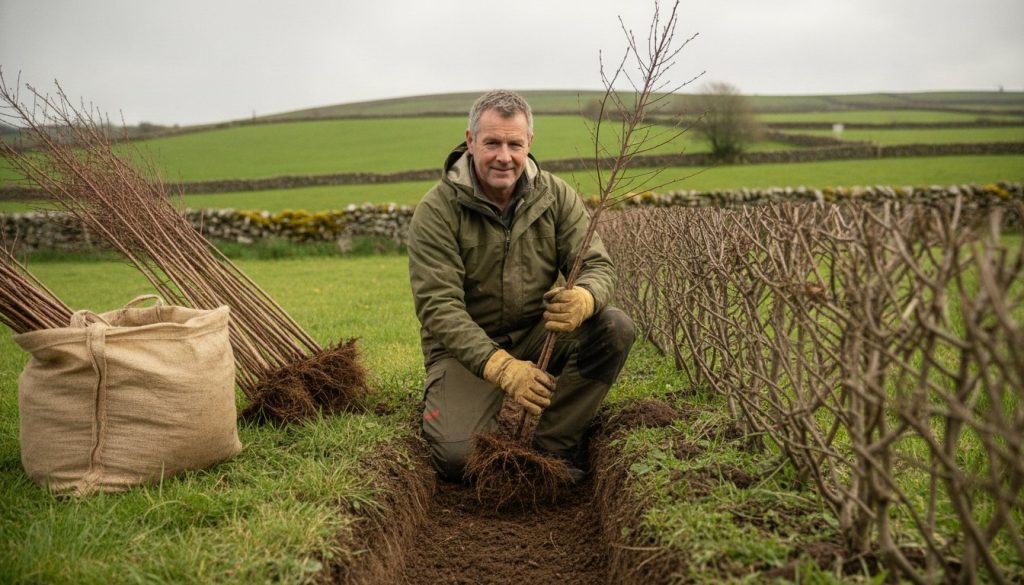
Why pay four times the price for a container-grown plant when a dormant, leafless stem often develops a deeper and more resilient root system? For those looking to secure a boundary or add privacy, sourcing bare root hedging Cavan offers the most practical route to a thick, professional-grade hedge without the prohibitive costs of pot-grown alternatives.
It’s natural to feel a bit hesitant about planting during the coldest months or to worry that a bare root transplant might not “take” in our local soil. We understand that the limited planting window between November and April can feel like a gamble if you aren’t sure which species suit the Irish climate best. This guide simplifies that process. You will discover the most cost-effective and reliable ways to establish your hedging this season, backed by thirty years of nursery experience.
We’ll provide a clear comparison of popular varieties like Copper Beech and Portuguese Laurel, explain the essential timing for the 2026 season, and share the specific techniques used by growers to ensure a high success rate. Whether you’re planting a few metres or a full native scheme, these insights will help you achieve a thriving garden boundary at a fraction of the usual expense.
Key Takeaways
- Understand the seasonal cost advantages of bare root stock and why it often outperforms pot-grown plants by the second year.
- Select the right species for bare root hedging Cavan, matching options like Copper Beech or Whitethorn to your specific soil type.
- Learn why Hornbeam is the essential alternative for the heavier, wetter soils often found across Irish landscapes.
- Discover the critical rules for handling and trench preparation to prevent root desiccation and ensure your hedge takes successfully.
- Benefit from professional guidance on sourcing directly from a 60-acre production nursery with over 30 years of experience.
Understanding Bare Root Hedging: The Seasonal Advantage for Irish Gardens
Bare root stock refers to plants that have been grown directly in open fields rather than in plastic containers. These plants are lifted from the soil once they enter their dormant state, usually after the first hard frosts of autumn. Understanding Bare Root Hedging is the first step for any landowner planning a significant project. When you source bare root hedging Cavan, you’re buying plants that have been hardened by local conditions, ensuring they’re ready for the transition to your garden or farm boundary.
The bare root tree season in Ireland typically runs from November through to March. Some hardier species, such as Beech, can be planted into early April if the spring remains cool. During these months, the plant’s metabolic activity slows down significantly. It isn’t actively growing leaves or new shoots, which allows it to focus its energy on root establishment once it’s back in the ground. This method also eliminates the need for heavy plastic pots and the peat-based composts used in container growing, making it a far more sustainable choice for large-scale landscaping projects.
Why Timing is Critical for Bare Root Success
Timing is everything when working with field-grown stock. Whilst the air is cold, the soil often retains enough residual heat to encourage fine root hairs to begin settling before the spring surge. Planting whilst the plant is ‘asleep’ significantly reduces transplant shock. Because the plant isn’t trying to support a canopy of leaves, it doesn’t lose moisture through transpiration as quickly. To ensure you get the best 2026 stock, it’s wise to order early. High-quality varieties like Portuguese Laurel or Copper Beech are often in high demand by mid-season, and early orders secure the strongest specimens from the nursery rows.
Cost-Effectiveness for Long Boundaries
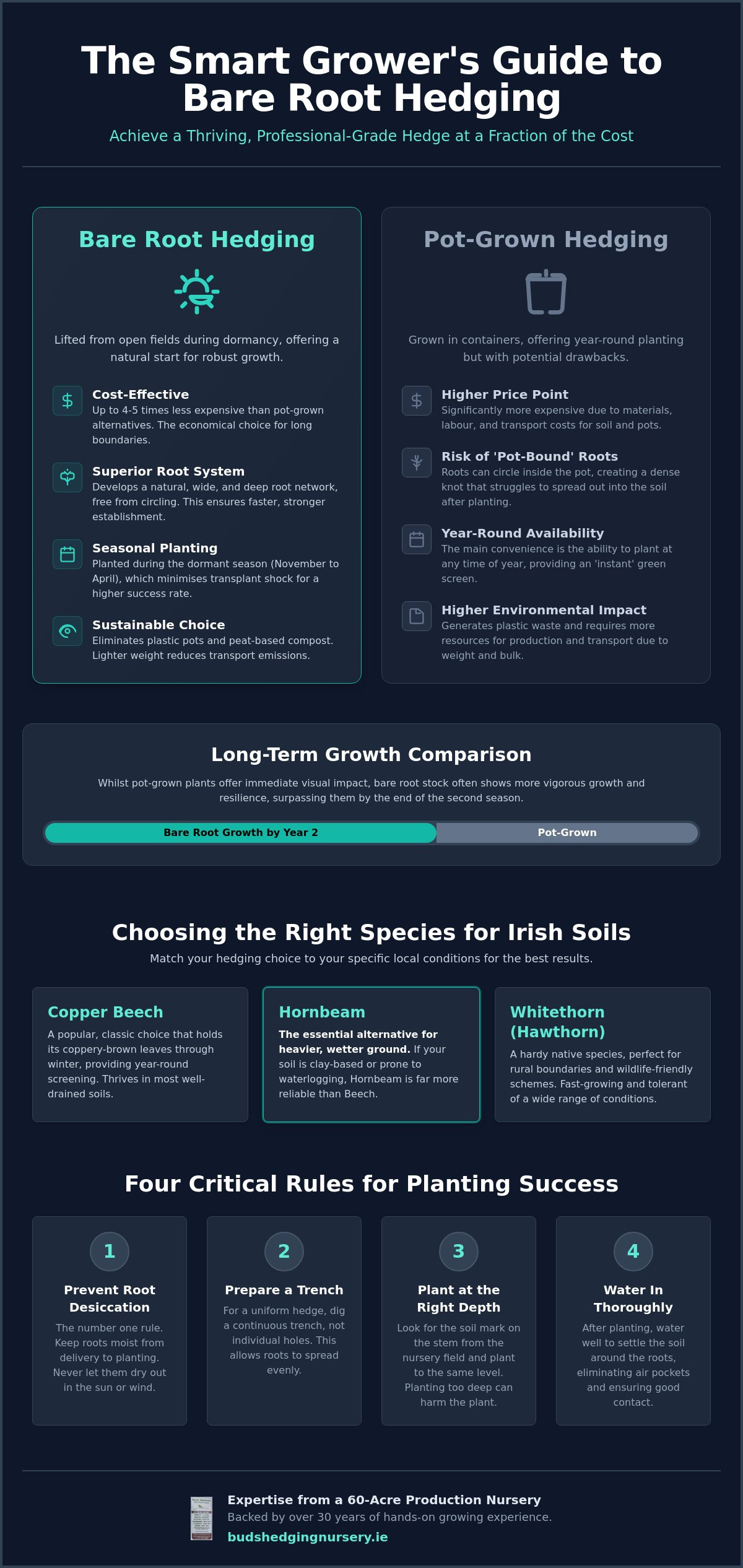
For those managing long boundaries, the financial difference is stark. Bare root plants are lighter to transport and take up less space, which keeps delivery costs down. A single pot-grown plant can often cost five times as much as its bare root equivalent. This makes it the favourite choice for farmers and owners of large rural properties who need to cover significant distances. Bare root hedging is the most economical way to plant hundreds of metres of boundary. By choosing this method, you can afford to plant at a higher density, leading to a thicker, more secure hedge in a shorter timeframe.
Bare Root vs. Pot-Grown Hedging: A Direct Comparison for 2026
Choosing between bare root and pot-grown stock is the most significant decision for any planting project. Whilst pot-grown plants offer year-round flexibility, they often come with a higher price and potential root restrictions. In contrast, bare root hedging Cavan is lifted directly from the field, preserving a more natural, expansive root architecture. This difference in root structure is vital for long-term health. A plant grown in open ground develops a wide network of roots that are ready to anchor into your soil immediately upon planting.
Pot-grown plants can sometimes become pot-bound. This happens when roots circle the inside of the container, creating a tight knot that struggles to spread once transplanted. Bare root plants avoid this entirely. They arrive as dormant stems with their roots exposed and ready for a fresh trench. For large-scale projects, the logistics are much simpler. You can transport hundreds of bare root plants in a standard van, whereas the same number of pot-grown plants would require multiple heavy loads due to the weight of the soil and plastic containers.
The Pros and Cons of Each Method
Your choice depends on your budget and how quickly you need a finished look. Bare root is the clear winner for cost and root health, but it requires planting during the dormant winter months. Pot-grown plants allow you to plant in mid-summer if needed, providing an immediate green screen, though you will pay a premium for that convenience.
- Bare root: Lower unit cost; superior root spread; limited to winter planting.
- Pot-grown: Year-round availability; instant impact; higher cost and risk of circling roots.
Establishment and Long-Term Health
There is a common myth that pot-grown plants are hardier. In reality, bare root plants often overtake their container-grown counterparts by the end of the second growing season. Because they adapt to the local soil chemistry whilst still dormant, they suffer less from the shock of a new environment. When you source from a Specialist Plant Nursery Ireland, you get the benefit of plants that have been hardened by the local climate.
We stock both options to suit different project needs. If you’re unsure which method fits your site, you can speak with our team for a practical recommendation based on your specific ground conditions.
Choosing the Right Species: Beech, Hornbeam, and Whitethorn Compared
Selecting the right species for your site is as important as the planting method itself. In the context of bare root hedging Cavan, local soil conditions vary significantly from free-draining hills to heavier, clay-rich valley floors. Green Beech and Copper Beech are the traditional choices for formal, crisp boundaries. They offer a structured look that suits both residential gardens and large estates. For those participating in environmental projects, these can be integrated with Native Trees Scheme plants to satisfy grant requirements whilst enhancing local biodiversity.
Whitethorn, commonly known as Hawthorn, remains the most popular choice for agricultural boundaries and rural gardens. It is incredibly resilient and provides a dense, thorny barrier that is virtually stock-proof once established. Unlike the uniform look of a Beech hedge, Whitethorn changes with the seasons, offering white blossoms in late spring and red berries in autumn. It serves as a vital corridor for local wildlife, making it a staple in any native planting project.
Beech vs. Hornbeam: Which Retains Leaves Better?
Both species exhibit a trait called marcescence. This means they hold onto their dried, brown leaves throughout the winter months, providing year-round privacy even though they are deciduous. Beech is the favourite for many due to its vibrant copper winter colour, but it is sensitive to “wet feet.” If your ground is prone to holding water or has a high clay content, Hornbeam is the essential alternative. It looks remarkably similar to Green Beech but thrives in heavier, wetter Irish soils where Beech might struggle. For a detailed breakdown of maintenance, you can consult our guide on bare root beech hedging Cavan.
Native Hedging Mixes for Biodiversity
A mixed native hedge is the best way to attract local pollinators and birds to your garden. By combining Whitethorn with species like Blackthorn, Hazel, and Holly, you create a diverse ecosystem that offers food and shelter throughout the year. To achieve a thick, professional-grade boundary, we recommend a double-staggered row. This typically requires 5 to 6 plants per metre. This density ensures that as the plants mature, they knit together to form an impenetrable barrier. This approach is far more effective for wildlife than a single-species wall and fits perfectly into the traditional Irish landscape.
Handling and Planting Bare Root Stock for Maximum Survival
The moment your bare root hedging Cavan arrives, the clock starts. Unlike pot-grown plants, these roots have no soil to protect them from the elements. Exposure to wind or sun for even fifteen minutes can cause the delicate root hairs to desiccate and die. If you cannot plant immediately, you must heel them in. This involves digging a temporary shallow trench in a sheltered spot, placing the bundles at an angle, and covering the roots with loose soil or sand to keep them moist and protected from frost.
Preparation of the site is equally vital. A trench is always superior to individual holes for hedging. It allows for consistent soil enrichment and easier alignment. Dig your trench at least 30cm deep and 40cm wide. If your soil is particularly poor, mix in some well-rotted organic matter, but avoid fresh manure which can burn young roots. This preparation ensures the roots have a friable environment to colonise as soon as the soil temperatures rise in spring.
Step-by-Step Planting Guide
Success depends on attention to detail during the physical act of planting. Following a methodical approach reduces the risk of transplant shock and ensures a uniform hedge line.
- Step 1: Root Protection. Keep the plants in their delivery bags until the very second they go into the ground. If you’re working amongst a large field, only take out what you can plant in ten minutes.
- Step 2: The Trench. Spread the roots out naturally. Avoid J-rooting, which occurs when roots are forced into a hole that is too shallow, causing them to point upwards. This stunts growth and can lead to plant failure.
- Step 3: Firming In. Once the soil is back in the trench, firm it down with your heel. You aren’t trying to compact it like concrete, but you must remove air pockets. Air pockets around roots lead to frost heave and root death.
Maintenance in the First Year
The first twelve months are the most critical. Whilst bare root plants are resilient, they are in a race against local weeds for nutrients and water. A bare root hedge requires diligent weeding in year one to ensure 95% survival rates. Competition from grass is the primary reason for hedge failure in Irish gardens. Keep a one-metre strip clear of vegetation for at least the first two growing seasons.
Watering is also essential during the first dry spell in spring, usually around April or May. Even if the air feels cool, a week without rain can stress a new hedge that hasn’t yet established its deep root system. Don’t be afraid to prune back certain species like Whitethorn or Privet by a third immediately after planting. This encourages dormant buds at the base to break, resulting in a much thicker hedge from the ground up.
If you need specific guidance on the best species for your site, contact our nursery team for professional advice based on thirty years of growing experience.
Why Experience Matters: Sourcing from an Established 60-Acre Nursery
Buying direct from a production nursery offers advantages that garden centres simply cannot match. At our 60-acre site in Cavan, we control the growing process from the initial planting to the final lifting. This scale allows us to produce a vast range of stock, including staples like Copper Beech, Green Beech, and specialised options like Portuguese Laurel. When you source bare root hedging Cavan from a grower, you’re receiving plants that haven’t been sitting in a distribution centre; they are fresh from the ground and full of vitality.
Experience is the most valuable tool in horticulture. Established in 1994, our nursery has over 30 years of history navigating the specific challenges of the Irish climate. We’ve seen which species thrive in heavy clay and which require more sheltered positions. This longevity means our advice is based on three decades of practical results rather than textbook theory. For large-scale residential or agricultural orders, we manage delivery logistics to ensure your plants arrive in prime condition. We prioritise keeping roots damp and protected during transit, using professional handling techniques that preserve the plant’s health from our fields to your site.
The Buds Nursery Difference
Our plants are grown right here in the local climate. This ensures they are ‘hardened off’ and fully acclimatised to the weather patterns they’ll face in your garden. There isn’t any shock from being moved from a poly-tunnel in a different climate to an exposed Irish field. We encourage customers to visit our Glassdrummon site. Seeing the scale of the 60-acre production rows provides transparency and peace of mind. You can see the health of the stock and the professional standards we maintain before you make an investment in your property’s boundary. Our inventory spans from the glossy evergreen foliage of Photinia Red Robin to the traditional, hardy Whitethorn used in native mixes.
Securing Your 2026 Hedging
The dormant season moves quickly, and the best stock is often secured early in the year. If you’re unsure about species selection or the quantity required for your site, our team is available to provide expert guidance. We understand the practicalities of the Native Trees Scheme and can help you select the right mix to meet environmental requirements. Our production centre is open Tuesday to Saturday, providing a reliable point of contact for both hobbyists and professional landowners. We don’t just sell plants; we provide the technical knowledge to ensure they grow into a thick, healthy hedge.
Ready to establish a resilient, professional-grade boundary? Contact Buds Nursery Cavan today to discuss your hedging requirements and secure your stock for the 2026 season.
Establishing Your Professional Hedge for the 2026 Season
Successful hedging relies on three fundamentals. You must choose the right species for your soil, plant during the dormant season, and source hardy, locally grown stock. By opting for bare root hedging Cavan, you gain a significant cost advantage whilst ensuring your plants develop deep, natural root systems. Whether you are planting a formal Beech boundary or a native mix, the principles of proper trench preparation and diligent weeding remain the same.
Our 60-acre production nursery has been a fixture of the local landscape since 1994. With over 30 years of nursery experience, we are specialists in native and ornamental hedging already acclimatised to Irish weather. We provide the technical guidance needed to ensure your project succeeds. This includes everything from species selection to delivery logistics for large orders. This expertise ensures your investment results in a thick, healthy boundary.
Visit Buds Nursery Cavan for Expert Hedging Advice to discuss your specific site requirements. We look forward to helping you grow a healthy, thriving hedge that will serve your property for decades to come.
Frequently Asked Questions
When is the best time to plant bare root hedging in Ireland?
The best time to plant bare root hedging in Ireland is during the dormant season, which typically runs from November through to March. This is whilst the plants are ‘asleep’ and can be moved without the shock of active growth. Some species, such as Beech, can often be planted into early April if the spring remains cool and the buds haven’t yet burst.
How long can I keep bare root trees before planting them?
You should aim to plant bare root trees within two to three days of delivery to prevent the roots from drying out. If weather conditions prevent immediate planting, you must ‘heel them in’ by covering the roots with loose soil or sand in a sheltered, well-drained spot. This method can keep the plants safe for several weeks until your site is ready for the final trench.
Do bare root hedges grow slower than pot-grown ones?
Bare root hedges do not grow slower than pot-grown alternatives in the long term. Whilst a pot-grown plant might look more ‘finished’ on day one, bare root stock often establishes a more robust root system once in the ground. By the end of the second growing season, bare root hedging Cavan frequently overtakes pot-grown plants in both height and density because the roots adapt more naturally to the local soil.
What is the best spacing for a bare root beech hedge?
For a thick, professional-grade Beech hedge, we recommend a double-staggered row with 5 to 6 plants per metre. This density ensures the hedge knits together quickly to provide privacy and shelter. If you are planting a single row for a narrower space, 3 to 4 plants per metre is usually sufficient, though it will take longer to become fully opaque.
Should I prune my bare root hedging immediately after planting?
Yes, pruning back deciduous species like Whitethorn, Privet, or Quickthorn by about a third immediately after planting is highly beneficial. This encourages the plant to produce new shoots from the base rather than just growing from the top. This practice is essential for creating a thick, bushy hedge that is dense right down to the ground level from its first year.
Can I plant bare root hedging in frozen or waterlogged ground?
You should never plant into frozen or waterlogged ground as this can lead to root rot or frost heave. If the soil is too wet to walk on without leaving deep imprints, or if a spade cannot penetrate the frost, it’s best to wait. Keep your bare root hedging Cavan stock heeled in or stored in a cool, frost-free shed until the ground conditions improve and the soil is workable.
What is the ‘Native Trees Scheme’ and can I buy plants for it here?
The Native Tree Area Scheme is a current government grant designed to encourage landowners to plant small areas of native trees to support biodiversity and carbon sequestration. You can certainly source the required species here, as we are specialists in the Native Trees Scheme plants. These mixes typically include Whitethorn, Alder, and Hazel, all grown on our 60-acre production site to suit Irish conditions.