

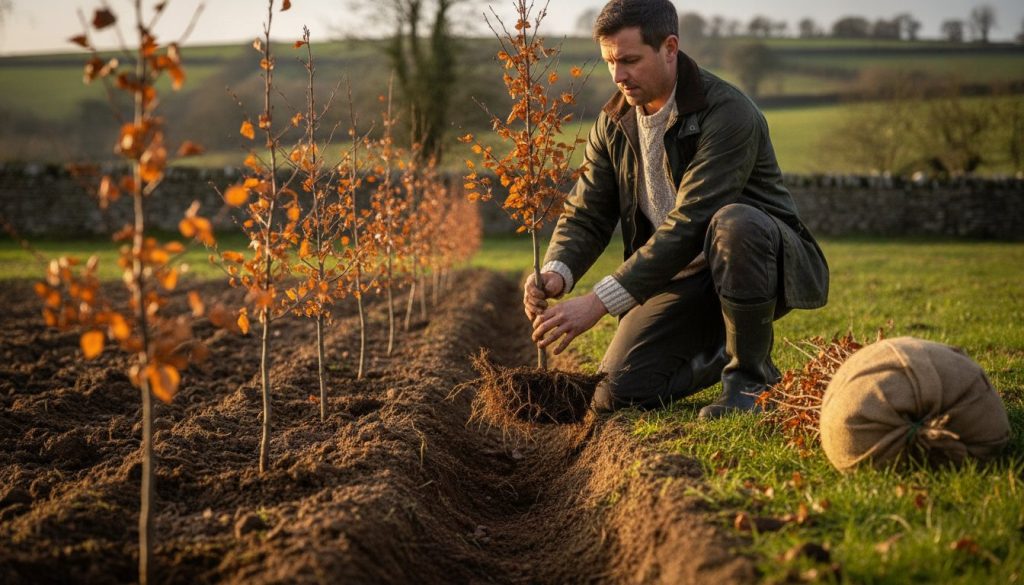
What if the secret to a perfect, wind-breaking boundary isn’t the amount of fertiliser you use, but the exact timing of your shovel hitting the dirt? For many homeowners looking to establish bare root beech hedging, the varying conditions across Ireland can present unique challenges, with heavier, damp soil and unpredictable winter frosts being common concerns. You likely understand the worry of investing time and money into a new hedge only to see it struggle because the roots weren’t handled correctly during the critical dormant window. It’s a common concern, especially when you’re aiming for that classic look that provides privacy without losing its structure in the colder months.
At Buds Nursery Cavan, we’ve put together this professional-grade checklist to remove the guesswork and help you take advantage of the significant cost savings found between November and March. You’ll learn how to prepare your ground, manage spacing for maximum density, and ensure your plants survive the transition into the 2026 growing season. We’re covering everything from soil drainage solutions for Irish conditions to the specific planting depths required for a hedge that retains its striking winter colour for years to come. This guide provides the practical steps needed to turn a bundle of dormant plants into a thick, healthy garden feature.
Key Takeaways
- Learn why the mid-November to late February window is the gold standard for planting to ensure your hedge thrives.
- Discover how choosing bare root beech hedging Cavan growers offer can significantly reduce costs for long boundaries compared to potted alternatives.
- Master essential site preparation steps, including clearing a 60cm strip and testing soil nutrients to ensure your hedge establishes quickly.
- Follow professional techniques to protect exposed roots from the wind and sun whilst planting to prevent avoidable plant loss.
- Learn to navigate the “April Gamble” by understanding the increased water demands of late-season planting in Irish soil.
What is Bare Root Beech Hedging and Why Choose It?
Bare root plants are exactly what the name suggests. These are field-grown specimens lifted from the ground during their dormant stage, usually between November and March. When you source bare root beech hedging Cavan growers have cultivated in local soil, you receive plants with the earth shaken off and the roots exposed. This might look sparse compared to a potted plant, but it is the most practical and traditional method for establishing a long-lasting boundary in the Irish landscape.
There are several reasons why experienced growers prefer this method over container-grown alternatives:
- Cost-effectiveness: Bare root stock is significantly cheaper than potted plants. For farmers or homeowners with long boundaries to secure, the savings are substantial. You can often plant three or four times the distance for the same investment.
- Sustainability: This method is much better for the environment. There are no plastic pots to dispose of and the plants are lighter to transport, which reduces the carbon footprint of your project.
- Better Establishment: Because these plants aren’t “root-bound” in a plastic container, their root systems can spread naturally into your garden soil from the moment they are planted. This often results in a more resilient and stable hedge once the growing season begins.
Green Beech vs Copper Beech
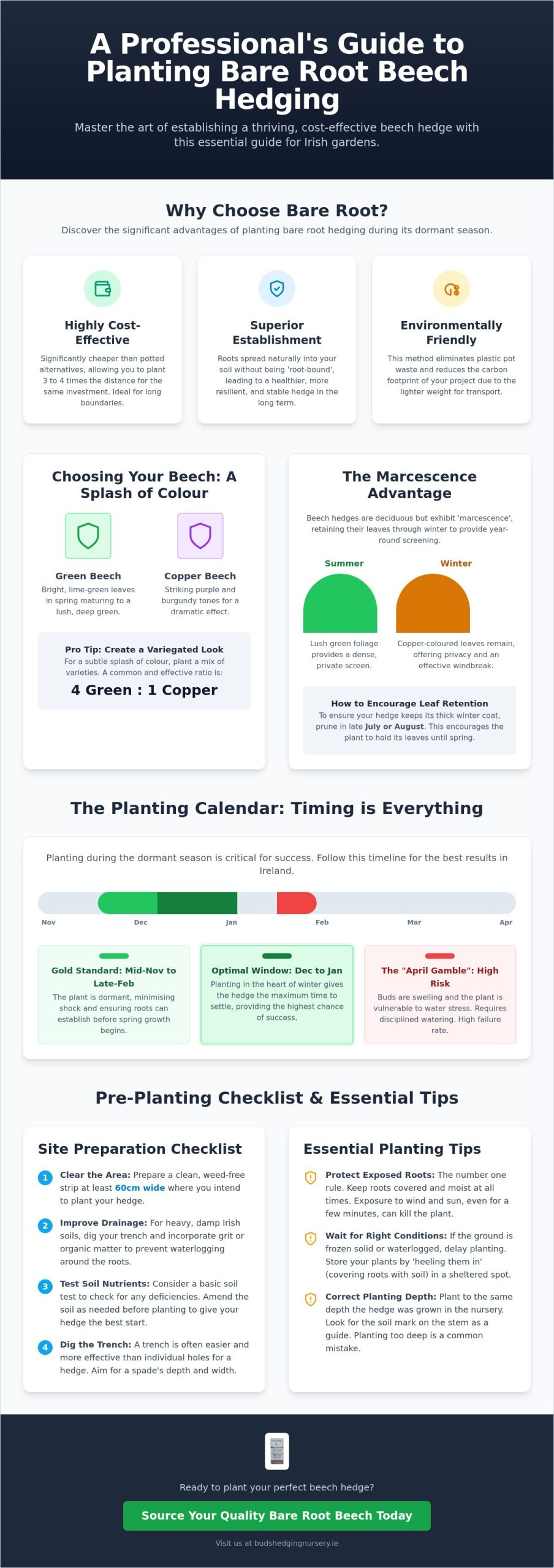
The European beech (Fagus sylvatica) is most commonly found in two varieties for hedging. The standard Green Beech offers a bright, lime-green leaf in spring that matures into a deep, lush green. Its relative, the Copper Beech (Fagus sylvatica ‘Purpurea’), provides striking purple and burgundy tones. Whilst many prefer a uniform look, mixing the two varieties can create a beautiful variegated effect. A common approach is to plant a ratio of four green plants to every one copper plant, adding a subtle splash of colour to a rural bare root beech hedging Cavan project. For a detailed comparison of Copper Beech alongside other popular varieties suited to the local climate, our guide to sourcing bare root hedging in Cavan provides a practical breakdown of costs and species selection.
The “Marcescence” Factor
One of the main reasons beech is so popular in Ireland is a trait called marcescence. Although beech is a deciduous tree, it retains its dead, copper-coloured leaves throughout the winter months when kept as a pruned hedge. This provides an excellent windbreak and maintains privacy even in the middle of January. To ensure your hedge keeps this thick winter coat, timing is key. Pruning in late July or August encourages the plant to hold onto its leaves until the new buds push them off the following spring.
Timing Your Planting: The Bare Root Season in Ireland
Successful hedging starts with a calendar, not a spade. In Ireland, the window for planting bare root stock is strictly tied to the dormant season. This period generally runs from mid-November through to late February. During these months, the plants are effectively “asleep,” which allows them to be lifted from the nursery fields and replanted in your garden without the shock that occurs when a plant is in full leaf. Planting during this window is the most reliable way to ensure your new boundary takes hold quickly. For a broader understanding of how to make the most of this period, our complete guide to the bare root tree season Ireland offers detailed advice on maximising survival rates across all species.
Whilst the season can technically stretch into March, the gold standard for bare root beech hedging Cavan projects is to have your plants in the ground before the first signs of spring. Planting during the heart of winter ensures the roots have several months to settle into their new environment before they’re required to support new growth. If you’re planning a large boundary, you should aim for that December to January window to give yourself the best chance of success.
The “April Gamble”
Waiting until April to plant is what we call the “April Gamble.” By this time, soil temperatures are rising and the buds on the beech are beginning to swell. According to the RHS guide to growing beech, plants in this stage are far more susceptible to water stress. If you do plant this late, you’ll need to be incredibly disciplined with watering throughout the entire first summer. Without consistent moisture, the failure rate for late-planted beech increases significantly, especially during the drier spells we often see in late spring.
Weather and Storage Considerations
You can’t always plant the day your delivery arrives. If the ground is frozen solid or heavily waterlogged, which is a frequent occurrence in heavier Irish soils, you must wait. Never force a plant into a hole filled with water; it will simply rot. Instead, you should “heel in” your plants. This involves digging a temporary shallow trench in a sheltered spot, laying the plants in at an angle, and covering the roots with loose soil or compost. This keeps the roots moist and protected until the weather clears and the ground is workable.
The Importance of Dormancy
During dormancy, the plant’s sap has retreated to the root system. This physiological state is vital because it means the plant isn’t actively trying to produce leaves or grow taller. When you move a dormant plant, you’re essentially relocating it whilst its “engine” is switched off. You’ll know the window is closing when you see the long, cigar-shaped buds of the beech start to turn a lighter colour and expand. Once those buds break, the risk of transplant shock goes up.
Ordering Advice for Cavan and Beyond
The best way to ensure you get the heights and quantities you need is to order your bare root hedging early, ideally in October. This allows you to organise your delivery for a weekend when the forecast shows a clear 48-hour window. Avoid planting during high winds, as this can dry out the exposed roots before they even hit the soil. A calm, overcast day is the ideal environment for a long day of bare root beech hedging Cavan work.
The Site Preparation Checklist: Soil and Spacing
Preparing the ground is the most laborious part of the process, but it’s where the success of your hedge is decided. For those installing bare root beech hedging Cavan soil conditions often require a bit more attention due to the higher clay content found in many local areas. You shouldn’t simply stick a plant into a grass sod and hope for the best. Instead, follow this preparation checklist to give your new boundary the best possible start.
- Clear a 60cm strip: Remove all grass, weeds, and old roots in a strip at least 60cm wide. Grass is a fierce competitor for moisture and nutrients during the first two years.
- Test your soil: Beech thrives in well-drained, neutral to slightly alkaline soil. If your ground is very acidic, a light dusting of lime can help. According to the Woodland Trust’s profile of Common Beech, this species is particularly sensitive to waterlogged conditions, so checking your drainage is vital.
- Add Potash: Incorporating a small amount of Potassium or Potash into the soil helps with root development and disease resistance.
- Identify wet spots: Walk your perimeter after heavy rain. If water sits on the surface for more than 24 hours, you’ll need to address the drainage before planting.
Managing Heavy or Damper Soils
In parts of Cavan where the soil is particularly heavy, you might find that standard planting leads to root rot. The “Raised Drill” technique is a practical solution. This involves creating a slight mound or ridge of soil about 15cm high and planting your beech into the top of it. This keeps the main root mass above the water table during the wettest winter months. Adding horticultural grit or well-rotted organic matter can also improve the soil structure. If your site is consistently wet and a raised drill isn’t feasible, you should consider Hornbeam. It looks very similar to beech but is far more resilient in damp, “heavy” ground. Our practical comparison guide for bare root hedging Cavan growers rely on covers which alternative species perform best in challenging local soil conditions.
Spacing and Quantity Calculations
Getting your numbers right prevents mid-project shortages and ensures a thick, private screen. For a standard garden hedge, a single row with 3 to 4 plants per metre is usually sufficient. This creates a neat, narrow boundary. If you’re looking for a thick, stock-proof barrier or a dense windbreak, a double staggered row is the better choice. For this, you’ll need 5 to 7 plants per metre, spaced about 40cm apart in a “W” pattern. Always measure your entire perimeter twice before ordering your bare root beech hedging Cavan stock to ensure you have enough to finish the job in one go.
Step-by-Step Guide to Planting Bare Root Beech
Once you’ve prepared your ground as discussed earlier, the actual planting process is a race against the elements. The fine feeder roots of bare root beech hedging Cavan growers provide are incredibly sensitive. Even five minutes of exposure to a biting Irish wind can cause “wind-burn,” which kills the delicate fibres before the plant even hits the soil. Keep your bundles in their delivery bags until the very second you’re ready to place them in the trench.
Dig your trench approximately 40cm wide and 30cm deep. This is usually plenty for most bare root beech hedging Cavan stock. Always use a garden fork to loosen the soil at the bottom of the trench. This allows the roots to penetrate the subsoil easily, which is especially important in the heavier clay often found in local gardens. If you’re planting a double row, you’ll need a wider trench to accommodate the staggered pattern.
Finding the correct depth is non-negotiable. Look for a slight change in colour on the stem of the plant, often called the “soil mark.” This indicates the depth at which the beech was growing in the nursery. You should aim to plant at this exact level. Planting too deep can rot the stem; planting too shallow exposes the roots to frost and drying winds.
Root Protection and Dipping
To give your plants a head start, keep a bucket of water nearby. Dipping the roots for a few seconds before planting ensures the fibres are fully hydrated. Some professionals use a root-dip gel containing mycorrhizal fungi to encourage rapid growth, but simple hydration is the most important step. Only take out five plants at a time. This prevents the rest of the batch from sitting exposed whilst you work your way down the line.
Backfilling and Initial Watering
Backfill the trench using the original soil mixed with a small amount of well-rotted compost. Avoid high-nitrogen fertilisers at this stage. These can burn young roots and encourage soft growth that won’t survive a late frost. Once the trench is half-full, give it a good soak. This helps settle the soil around the roots. Finish filling and perform the “Heel Test” by firming the soil down with your heel. If you can pull the plant out with a light tug, it’s not secure enough. You can source reliable bare root trees grown specifically for the Irish climate to ensure a high success rate.
Sourcing Quality Bare Root Beech from Buds Nursery Cavan
Buying directly from the grower is the most reliable way to ensure your new hedge survives its first year. At Buds Nursery Cavan, we manage over 60 acres of dedicated production in the heart of the county. Growing our own stock means the plants are already acclimatised to the Irish climate and the specific soil conditions of the region. When you source bare root beech hedging Cavan families have relied on for over 30 years, you’re getting plants with a proven track record for hardiness and growth.
We provide a wide range of options to suit different project scales and budgets. This includes standard Green Beech and the striking Copper Beech, with sizes ranging from young whips to more mature plants for those who want an immediate impact. Because we grow on such a large scale, we can supply everything from a small garden boundary to kilometres of farm hedging for the Native Trees Scheme.
Why a Specialist Nursery Matters
The biggest risk with bare root stock is the time spent between the field and the final planting site. As a specialist nursery, we lift our plants to order. This minimises the time the roots are out of the ground and ensures the stock arrives at your gate in peak condition. We also prioritise correct grading. You won’t find a mix of weak and strong plants in our bundles; we ensure every plant is uniform in height and stem thickness so your hedge grows level and looks professional from day one.
Our experience also means we’re here to help long after the sale is finished. If you’re unsure about the first pruning or how to manage a particularly dry spring, we provide straightforward, practical advice based on decades of working the land. This level of accountability is something you simply won’t find with random online sellers or general retailers.
Visit or Order Online
You can visit our Glassdrummon site to see the quality of our stock for yourself. We are open Tuesday to Saturday, though it’s always best to call ahead during the busy winter lifting season to check current availability. For those further afield, we offer national delivery for large bare root beech hedging Cavan orders. We package our plants securely to keep the roots hydrated during transit, bringing Cavan-grown quality to gardens across the country. If you’re still deciding between deciduous and evergreen boundaries, you can learn about other evergreen options in our Portuguese Laurel Guide.
Securing Your Boundary for the 2026 Season
Building a resilient hedge is a long-term investment that starts with getting the fundamentals right during the winter months. By following this checklist, you’ve learned that the secret to success lies in respecting the dormant window and performing meticulous site preparation. Whether you’re managing heavy clay or calculating precise spacing for a double row, these practical steps ensure your boundary thrives from the outset. Sourcing your bare root beech hedging Cavan stock from an established grower reduces the risk of transplant shock and ensures you receive plants acclimatised to our local conditions.
Buds Nursery Cavan has been a reliable fixture in the Irish landscape since 1994. With 60 acres of production and decades of horticultural experience, we provide the expert guidance needed for the unique Irish climate. We offer national delivery on all orders, ensuring your plants arrive fresh and ready for the spade. Browse our Bare Root Beech stock and get a quote today to start your project. With the right preparation and quality stock, you’ll soon have a thick, healthy hedge that provides privacy and shelter for years to come.
Frequently Asked Questions
When is the best time to plant bare root beech hedging in Ireland?
The best time to plant is between November and March whilst the plants are dormant. This specific window ensures the root system has time to settle before the energy-intensive growing season begins in spring. You should avoid planting if the ground is currently frozen solid or heavily waterlogged after periods of intense rain. Aiming for the middle of winter usually provides the most reliable results for establishment.
How far apart should I plant bare root beech?
For a standard single row, you should plant 3 to 4 specimens per metre to create a neat boundary. If you require a thicker, stock-proof barrier or a dense windbreak, use a double staggered row with 5 to 7 plants per metre. Getting your spacing right for bare root beech hedging Cavan projects prevents unsightly gaps and ensures a dense, private screen as the hedge matures over the coming years.
Can I plant beech hedging in heavy clay soil?
You can plant beech in heavy clay, but you must ensure the roots don’t sit in stagnant water for long periods. Using a raised drill or mound keeps the main root mass above the water table during wet Irish winters. If your site is consistently saturated and drainage is a major issue, consider planting Hornbeam instead, as it handles damp ground much better than beech.
Why are my bare root beech plants not showing leaves in April?
Beech is naturally one of the latest hedging plants to come into leaf, often waiting until late April or even early May. Don’t panic if your neighbours’ laurel or privet hedges are green whilst yours still looks dormant. You can check for life by gently scratching a small piece of bark with your fingernail. If it’s green underneath, the plant is healthy and just waiting for warmer soil.
How long does it take for a bare root beech hedge to become private?
It typically takes 3 to 5 years for a new hedge to provide a significant privacy screen. The speed of establishment depends heavily on your initial soil preparation and consistent aftercare during the first two seasons. Regular pruning in the early years is also essential. It encourages the plant to bush out from the base rather than just putting all its energy into growing upwards.
Do I need to water my bare root hedge after planting in winter?
You must water your hedge immediately after planting to settle the soil and remove air pockets around the roots. Whilst winter rain often provides enough moisture, you need to monitor the plants closely during dry spells in March and April. Newly established bare root beech hedging Cavan stock is particularly vulnerable to drying out during its first spring before the root system has fully extended into the subsoil.
What is the difference between green and copper beech hedging?
The main difference is the leaf colour throughout the growing season. Green Beech has bright green leaves that turn a warm copper in autumn, whilst Copper Beech maintains deep purple or burgundy tones. Both varieties share the same growth habits and both will retain their brown leaves throughout the winter if pruned correctly. Mixing them in a 4-to-1 ratio can create a beautiful variegated effect in your garden.
Can I plant bare root beech if there is a frost forecast?
You can plant if a frost is forecast, provided the ground isn’t already frozen solid at the time you start. If you can’t get a spade into the dirt, it’s best to wait for a thaw. If you’ve already received your delivery during a cold snap, “heel in” the plants in a sheltered spot or keep them in a cool, frost-free shed until the ground becomes workable again. Our guide to the bare root tree season Ireland experiences from November to March covers additional cold-weather storage and planting strategies in detail.