

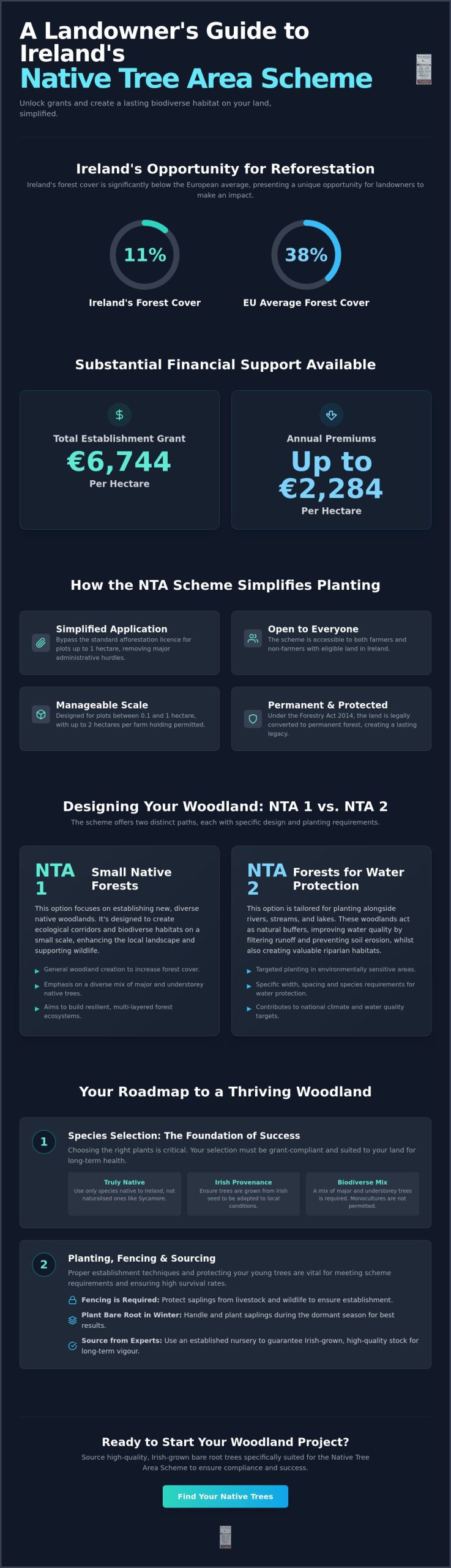
Did you know that Ireland’s forest cover stands at just 11 per cent, which is significantly lower than the EU average of 38 per cent? While the government is offering substantial incentives to change this, many landowners feel held back by technical jargon. It is common to feel overwhelmed by the distinction between NTA 1 and NTA 2, or to worry that selecting the wrong native trees scheme plants will result in a rejected grant. You want to improve your land, but the fear of making a mistake with bare root stock often stalls progress.
This guide simplifies the entire process so you can move forward with confidence. You’ll discover how to use the Native Tree Area Scheme, including how to access the total establishment grant of €6,744 per hectare and annual premiums of up to €2,284. We will show you exactly which species qualify for your soil type and how to ensure your woodland thrives. We are covering all the essentials: planting densities, fencing requirements, species selection, and long term maintenance. This is a clear, practical roadmap to a successful, biodiverse habitat.
Key Takeaways
- Learn how to bypass the standard afforestation licence for plots up to 1 hectare using the simplified NTA application process.
- Identify the specific native trees scheme plants that qualify for grant aid based on your soil type and project goals.
- Understand the design differences between NTA 1 and NTA 2, including the specific width and spacing requirements for each woodland type.
- Master the timing and handling of bare root saplings to ensure high survival rates and meet scheme compliance during the winter months.
- Discover why sourcing Irish-grown stock from an established nursery is critical for the long-term vigour and success of your new habitat.
Understanding the Native Tree Area (NTA) Scheme in Ireland
The Native Tree Area (NTA) Scheme is a practical initiative under the Forestry Programme 2023-2027. It’s designed to simplify the process of planting small woodlands. Unlike larger forestry projects, the NTA removes the hurdle of a formal afforestation licence for plots between 0.1 and 1 hectare. This makes it a direct, accessible pathway for landowners to plant native trees scheme plants without the usual administrative delays. The Department of Agriculture, Food and the Marine (DAFM) oversees the scheme, ensuring that every new woodland meets national environmental standards. Whether you’re a farmer looking to diversify or a non-farmer with a bit of land, this scheme is open to anyone with eligible ground in Ireland. You can establish up to 2 hectares per farm holding, providing a manageable way to add value to your property.
Why the NTA Scheme was Created
Ireland has a unique history of forestry in Ireland that has left the landscape with relatively low tree cover compared to our European neighbours. The NTA scheme aims to fix this by creating ecological corridors. These aren’t just isolated clumps of trees; they connect existing habitats, allowing wildlife to move safely across the countryside. Beyond biodiversity, these small forests play a vital role in meeting national climate targets. Trees act as carbon sinks, sequestering CO2 as they grow. For the small-scale landowner, it’s a straightforward way to contribute to a greener future without needing a massive estate or complex machinery. It’s about making small, impactful changes that add up across the country.
The Forestry Act 2014 and Your Responsibilities
While the application is simplified, the commitment is serious. Under the Forestry Act 2014, once you establish a woodland, the land use change is considered permanent. This means you can’t simply clear the trees in a few years to return to grazing or tillage. The Act ensures that these new habitats are protected for the long term, requiring a felling licence for any future removal. It’s a legacy project. You’re not just planting for today; you’re creating a permanent feature of the Irish landscape. The Forestry Act 2014 effectively means that any native trees scheme plants established under this programme are legally protected as permanent forest cover from the moment they are planted.
- Direct Entry: No need for the standard afforestation licence for plots up to 1 hectare.
- Eligibility: Open to both farmers and non-farmers.
- Oversight: Managed and funded by the DAFM.
- Permanence: Land is legally converted to forestry in perpetuity.
This scheme bridges the gap between large-scale commercial forestry and small-scale garden planting. It offers a middle ground that rewards landowners for their environmental contribution while keeping the paperwork to a minimum. By focusing on native species, it ensures that the new woodlands are resilient and suited to the Irish climate.
Eligible Species: Choosing the Right Native Trees Scheme Plants
Selecting the right stock is about more than just ticking boxes for a grant application. It is about ensuring the long term survival of your woodland. For a project to succeed in the Irish climate, provenance is everything. Using plants grown from Irish seed ensures the trees are adapted to our specific weather patterns and soil conditions. When you source native trees scheme plants, you must distinguish between truly native species and naturalised ones. While trees like Sycamore or Beech are common in our landscape, they are often excluded from native woodland grants because they were introduced by humans centuries ago. Stick to the list approved by the Teagasc Native Tree Area Scheme to ensure your site meets the biodiversity criteria required for payment.
Diversity is a core requirement for both NTA 1 and NTA 2. You cannot simply plant a monoculture of one species. A healthy mix creates a resilient habitat that can withstand pests and diseases. Generally, the department looks for a combination of major forest trees and smaller understorey species. This structure mimics a natural forest, providing multiple layers of cover for birds, insects, and mammals. If you are unsure about the best mix for your specific acreage, you can find high quality, Irish grown bare root trees that are specifically suited for these schemes.
Core Species for NTA 1: Small Native Forests
For general woodland creation on dry or wet mineral soils, certain species form the backbone of the project. Sessile and Pedunculate Oak are the traditional choices for the upper canopy. These are slow growing but provide immense ecological value. To get cover established quickly, we include pioneer species like Common Birch and Alder. These grow rapidly and improve the soil for other plants. Hazel and Rowan are excellent additions for the understorey. Hazel produces nuts for wildlife, whilst Rowan offers berries and beautiful white flowers in spring, ensuring the forest is productive at every level.
Pioneer Species for NTA 2: Water Protection Corridors
NTA 2 focuses on protecting our waterways. The species chosen here must handle wetter ground and help stabilise riverbanks. Alder and Willow are the primary choices; their root systems are incredibly effective at filtering runoff and preventing erosion. Along the margins, Whitethorn and Blackthorn create thick, thorny barriers. These protect the aquatic habitat from livestock and human interference. For landowners who want to extend this protective planting to their field boundaries, understanding whitethorn hedging Ireland wide using mixed native hedging packs is an excellent complement to any NTA 2 project. It is vital to avoid invasive species in these sensitive areas. Stick to the proven pioneers that have naturally lined Irish riverbanks for millennia to ensure your water protection corridor functions as intended.
- NTA 1 Focus: Oak, Birch, Alder, Hazel, and Rowan for biodiversity.
- NTA 2 Focus: Willow, Alder, and thorny scrub for bank stability.
- Stock Type: Bare root saplings are the industry standard for cost and success.
- Spacing: Minimum density of 1,100 trees per hectare is typically required.
NTA 1 vs. NTA 2: Designing Your Native Woodland
Designing your site requires a clear understanding of the physical layout mandated by the Department. The two scenarios within the scheme serve different environmental purposes. NTA 1 focuses on the creation of small native forests on farmed land to boost local biodiversity. NTA 2 is specifically designed for water protection, creating river-side corridors that filter runoff. According to the Official Native Tree Area Scheme Guidelines, NTA 1 requires a minimum width of 20 metres. In contrast, NTA 2 is more flexible, allowing for widths between 10 and 20 metres to accommodate the winding nature of Irish waterways. Both scenarios require a minimum area of 0.1 hectares, ensuring even small corners of a farm can be utilised for native trees scheme plants.
A successful design also incorporates Areas of Biodiversity Enhancement (ABEs). These are not just empty spaces; they are deliberate gaps in the canopy like open glades, internal tracks, or retained stone walls. These ABEs can make up to 15 per cent of your total area. They allow light to reach the forest floor, which encourages the growth of wildflowers and provides hunting grounds for birds of prey. When you organise your planting centre, you should plan these open spaces to maximise the “edge effect,” where the most diverse activity occurs between the trees and the open ground.
NTA 1 Design: Creating a Diverse Ecosystem
For a standard NTA 1 plot, the department usually requires a mix of 85 per cent main species and 15 per cent secondary species. This ensures the woodland has a dominant character, typically Oak or Birch, whilst maintaining enough variety to support a wide range of insects and birds. Planting density is a critical factor for grant compliance. You’ll need to plant at least 1,100 trees per hectare, which equates to a 3m x 3m spacing. If your plot borders an existing field, you might consider Establishing a Native Hedge Mix for Biodiversity to create a soft transition between the new woodland and your agricultural land. For those who also need a robust, stock-proof boundary alongside their woodland, Berberis hedging Ireland offers a thorny, colourful option that provides both security and seasonal interest throughout the year.
NTA 2 Design: Protecting Irish Waterways
NTA 2 designs are all about creating “undisturbed” riparian margins. These strips of native trees scheme plants act as a physical buffer, trapping silt and nutrients before they enter the water. This is vital for local fish populations, particularly trout and salmon, as it keeps spawning beds free from sediment. Because these areas are often prone to flooding, the species mix must be water-tolerant. Alder and Willow are the workhorses here, as their root systems are particularly adept at binding soil along riverbanks. Unlike NTA 1, the focus is less on a timber crop and more on a functional, protective barrier that keeps our rivers clean and cool.
- NTA 1 Width: Minimum 20 metres.
- NTA 2 Width: 10 to 20 metres.
- Density: 1,100 trees per hectare (3m x 3m spacing).
- ABEs: Up to 15 per cent of the area can be unplanted for biodiversity.
Planting and Establishment: Ensuring Scheme Compliance
Success in the Native Tree Area Scheme depends on your timing. In Ireland, the planting window is strictly tied to the bare root tree season Ireland provides from November to March. This is when the trees are dormant and can be moved with minimal stress. Attempting to plant outside this window often leads to high failure rates and could jeopardise your grant payments. When your native trees scheme plants arrive, you must be ready to get them into the ground or store them correctly to protect their delicate root systems. Careful planning ensures you meet the Department’s requirements whilst giving your woodland the best start.
Handling Bare Root Stock Correctly
Exposure to wind and sun can kill a sapling’s roots in minutes. If you aren’t planting immediately, use the ‘heeling in’ technique. This involves digging a temporary trench, placing the bundles inside, and covering the roots with loose soil to keep them moist. Bare root plants are preferred for large-scale scheme planting because they are cost-effective to transport and establish more robust root systems in native soil compared to container-grown alternatives.
Successful Planting Techniques
For most Irish soils, slit planting is the most efficient method. You simply drive a spade into the ground, create a notch, insert the sapling, and firm it in with your heel. Pit planting is better for stony ground where a simple slit won’t suffice. Regardless of the method, the ‘root collar’—the mark where the stem meets the roots—must be exactly at ground level. Planting too deep causes rot, whilst planting too shallow leads to drying out. For high-quality stock that arrives in peak condition, you can buy bare root trees directly from our nursery.
Fencing and Protection Schemes
You must protect your investment. The DAFM requires fencing to meet IS 436 standards to qualify for the full grant. Depending on your local pressure, you’ll need to choose between standard stock fencing for cattle and sheep or taller mesh if deer are a problem in your county. In areas with high hare populations, tree shelters or spiral guards are essential. These prevent the bark from being stripped, which is a common cause of sapling death in the first two years. Maintaining these barriers is just as important as the initial installation.
The first three years are the most critical for establishment. Weed control is your primary task during this time. Grass and weeds compete for nutrients and water, often smothering young native trees scheme plants if left unchecked. Regular inspections will help you spot issues early, ensuring your new woodland meets the survival rates required for the second installment of your grant.
Sourcing Your Native Plants from an Experienced Nursery
Choosing your supplier is a decision that impacts the success of your woodland for decades. When you invest in native trees scheme plants, you need stock that is hardened to the specific challenges of the Irish climate. We have spent 30 years cultivating trees at Buds Nursery Cavan on our 60-acre site, ensuring every sapling we produce is resilient and ready for the field. Buying directly from a specialist plant nursery Ireland provides a level of traceability and quality control that you won’t find in general garden centres. We monitor our plants from seed to sale, focusing on robust root development and stem strength rather than just height.
An experienced nursery understands the nuances of NTA compliance. We don’t just provide a list of trees; we help you curate a mix that satisfies the Department’s species rules whilst considering the practicalities of your land. Whether you are dealing with heavy clay, exposed hillsides, or riparian margins, our team provides the grounded advice needed to ensure your application is successful and your forest actually thrives. We handle the logistics for large scheme orders, coordinating deliveries so that your bare root stock arrives exactly when your ground preparation and fencing are complete.
The Value of Specialist Knowledge
Every site in Ireland has its own character. A “one size fits all” approach to species selection often leads to poor establishment and wasted effort. We take the time to match species to your specific conditions, whether you need wind-tolerant birch for an exposed site or alder for a damp corner. Understanding how different trees interact is part of the service. For those looking to enhance their boundaries alongside a new woodland, you can read more about the Best Native Irish Trees for Farmland Boundaries to see how different species serve functional roles on a working farm.
Preparation for the Planting Season
Timing is everything when dealing with bare root stock. The most popular native trees scheme plants often sell out early in the season. We recommend placing your orders well before the November window opens to secure the best quality plants. This early coordination allows us to prepare your order for a single, efficient delivery, reducing the time the plants spend out of the ground. Proper preparation ensures that once the fencing is secure, you can move straight into planting without delay. Ready to start your project? Contact Buds Nursery Cavan for expert guidance on native trees and let our experience work for you.
Start Your Native Woodland Project Today
Establishing a new woodland is a long-term commitment that rewards both the landowner and the local environment. Success depends on navigating the Department’s requirements and choosing the right native trees scheme plants for your specific site. By focusing on Irish-grown stock and adhering to the bare root tree season Ireland provides from November to March, you ensure your project meets grant standards whilst building a resilient habitat. Proper fencing and early weed control remain the most effective ways to protect your investment during those first critical years.
Beyond land management, many individuals are looking for other ways to lead a sustainable lifestyle in Ireland. If you are considering switching to a greener way of travel, The Cycle Centre has published an essential guide to choosing a commuter bike for the years ahead.
We have been growing trees for the Irish climate since 1994. With over 30 years of experience and 60 acres of dedicated nursery stock, we provide the practical expertise you need for large-scale planting. Our team is available on-site from Tuesday to Saturday to offer straightforward guidance on species selection and site preparation. Explore our range of Native Trees Scheme plants and expert hedging to find the best stock for your land. With the right planning and high-quality plants, you can create a legacy that benefits the Irish landscape for generations to come.
Frequently Asked Questions
What is the minimum area required for the Native Tree Area Scheme?
The minimum area required for the Native Tree Area Scheme is 0.1 hectares. Each individual plot must be between 0.1 and 1 hectare in size. Landowners can establish a maximum of 2 hectares across their entire farm holding. These small plots are designed to be manageable whilst still providing significant biodiversity benefits and contributing to national forest cover targets.
Do I need a professional forester to apply for the NTA scheme?
You must use a registered forester to apply for the NTA scheme on your behalf. The Department of Agriculture, Food and the Marine requires a professional to assess the site, select the correct species mix, and submit the application forms. This ensures the project meets all environmental and technical standards. While the process is simplified compared to larger afforestation projects, professional oversight remains a mandatory part of the grant approval.
Which species are considered ‘native’ for the 2026 scheme grants?
Approved species for the 2026 scheme include Sessile and Pedunculate Oak, Common Birch, Alder, Rowan, Hazel, and Scots Pine. The specific selection depends on whether your land consists of dry or wet mineral soil. It is vital to use native trees scheme plants of Irish provenance to ensure they are adapted to the local climate. Naturalised species like Beech or Sycamore do not qualify for these specific native woodland grants.
Can I plant a native hedge instead of a forest under the NTA scheme?
The NTA scheme is specifically for the creation of small native forests and cannot be used for standalone native hedges. While you can plant a hedge as a boundary to your new woodland, the scheme’s primary goal is to establish a canopy of trees. For NTA 1, you need a minimum width of 20 metres, which is much wider than a standard hedge. These requirements ensure the creation of a functional forest habitat rather than just a field margin.
How much are the grants for fencing under the Native Tree Area Scheme?
Fencing grants vary depending on the materials used and whether they meet IS 436 standards. For NTA 1, the rate for a stock fence is €6.00 per metre for IS 436 certified fencing or €5.00 per metre for non-certified options. There is also a deer tree shelter grant of up to €1,600 per hectare if high deer pressure is identified on your site. These payments help offset the cost of protecting your new trees from livestock and wildlife.
What happens if some of my scheme plants die in the first year?
If your trees die in the first year, you must replace them to maintain a survival rate of at least 80 per cent. This is a requirement to claim the second installment of the establishment grant, which is €1,686 per hectare and claimable four years after planting. Regular maintenance, such as weed control and checking tree shelters, will help you avoid high failure rates. We recommend ordering extra stock early from a specialist plant nursery in Ireland to have replacements ready if needed.
Is the NTA scheme open to residential gardens as well as farms?
The NTA scheme is open to both farmers and non-farmers, but the land must be suitable for agricultural use and meet the 0.1-hectare minimum. It is not intended for standard residential gardens. The scheme focuses on creating small forests on land that has been used for farming. If you have a large paddock or an acre of unused agricultural ground attached to your property, you may be eligible to plant native trees scheme plants under this programme.
When is the best time of year to plant trees for the scheme?
The best time to plant for the scheme is during the bare root season, which runs from November to March. Trees are dormant during these months, allowing them to be moved and planted with the least amount of stress. Planting in the winter ensures the root systems can establish themselves before the spring growth begins. You should aim to have your ground preparation and fencing completed before December to take full advantage of the entire planting window. For those also planning to establish a boundary alongside their new woodland, our guide to whitethorn hedging Ireland wide covers everything you need to know about selecting and planting mixed native hedging packs during the same winter season.