

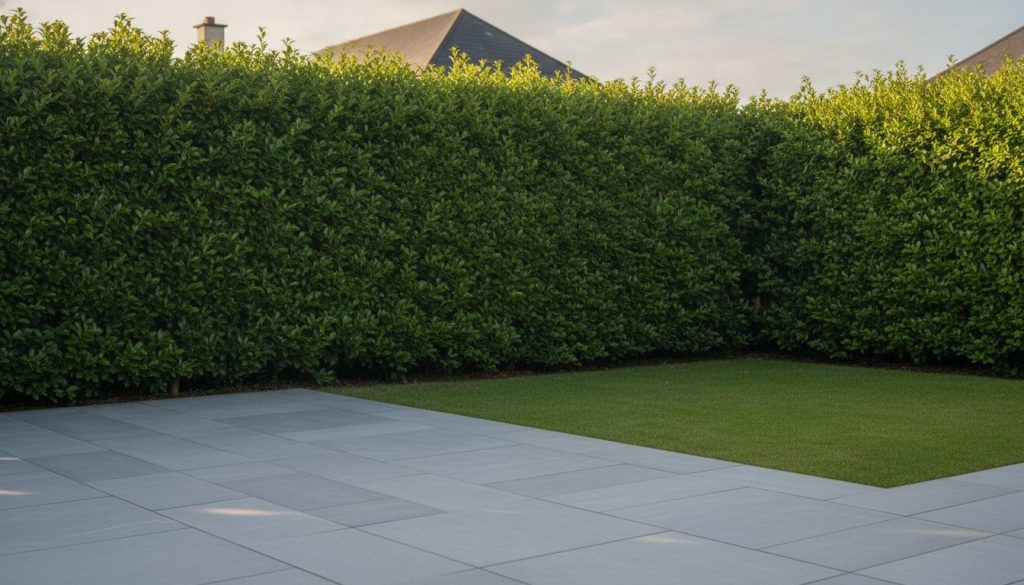
You’ve finally sat down to enjoy a quiet evening in the garden, only to realise you’re in full view of the neighbours’ upstairs window or battling a gale that’s rattling your fence panels. It’s a common frustration for Irish homeowners, especially when dealing with heavy clay soil or high winds that make standard fencing feel flimsy. Finding the best hedging for privacy Ireland offers means looking beyond just how fast a plant grows; you need a solution that thrives in our specific, often damp climate while providing a year-round barrier.
We understand that choosing the right variety can feel overwhelming when you’re balancing growth speed with long-term resilience. This guide simplifies the process by highlighting the most reliable evergreen options, such as Portuguese Laurel and Photinia Red Robin, which we’ve grown and tested in our own 60-acre nursery. You’ll discover exactly how to space your plants for a dense finish and why the timing of your planting matters for both your budget and the health of the hedge. We’ll cover everything from bare root basics to year-round container options to help you secure your property and increase its value.
Key Takeaways
- Identify why evergreen species are the preferred choice for year-round garden seclusion and noise reduction in the Irish climate.
- Learn how to select the best hedging for privacy Ireland, comparing hardy options like Portuguese Laurel and dense-growing Privet.
- Discover which salt-tolerant and flexible species are suitable for challenging coastal or exposed, windy sites.
- Understand the cost benefits of planting during the bare root season versus the flexibility of year-round pot-grown alternatives.
- Gain insight into why sourcing acclimatised plants from a specialist nursery ensures better establishment and long-term resilience.
Choosing the Best Hedging for Privacy in Ireland
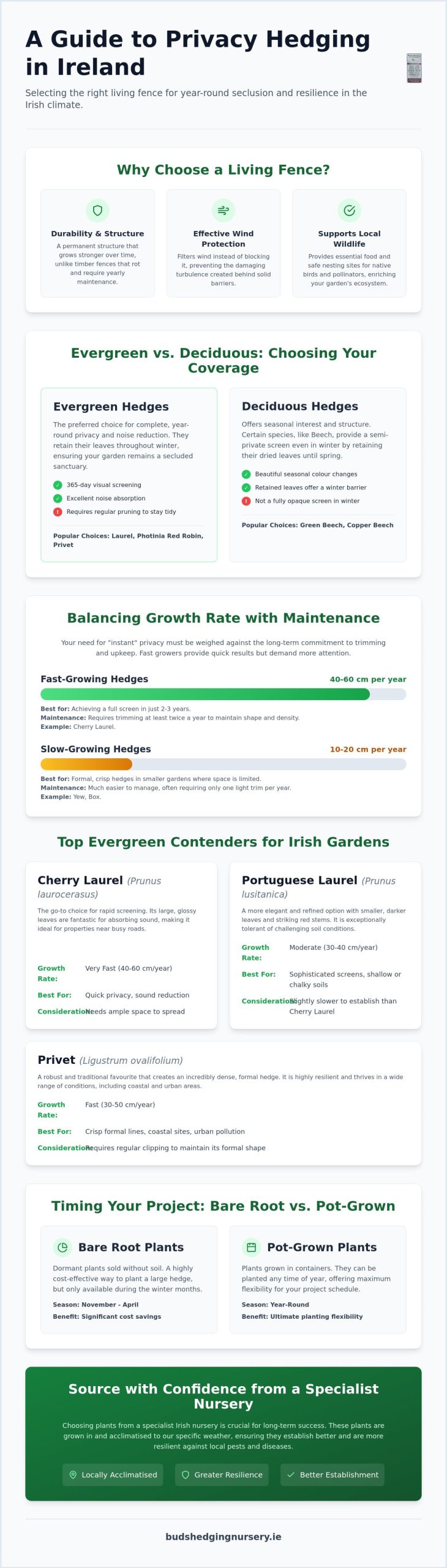
A privacy hedge is essentially a living fence. It serves two main purposes: visual screening and noise reduction. For many Irish gardens, a thick wall of green is the most effective way to block out traffic noise or create a private sanctuary. Unlike wooden panels that might fail during an Atlantic storm, a hedge is a permanent structure that grows more resilient over time. When selecting the best hedging for privacy Ireland has to offer, you must account for our specific climate. Heavy rainfall and high winds are standard. Your choice needs to be hardy enough to handle damp soil and gusty conditions without thinning out.
A living fence offers several advantages over traditional timber boundaries:
- Durability: They don’t rot or require yearly staining and painting.
- Wind protection: They filter wind rather than blocking it entirely, which prevents the damaging turbulence often found behind solid fences.
- Wildlife support: They provide essential nesting sites and food for local birds and pollinators.
Before you commit to a species, consider the eventual height and spread. It’s a common mistake to plant too closely or choose a variety that outgrows the space. Over-crowding leads to poor air circulation and can encourage pests. You want a screen that provides seclusion without becoming a maintenance burden that requires constant hacking back. Practical planning at the start prevents years of frustration later.
Evergreen vs Deciduous: Which is Better?
Evergreen species like Laurel or Photinia Red Robin are the top choice for 365-day coverage. They keep their leaves year-round, ensuring your garden isn’t exposed during the winter months. They do require regular pruning to keep them tidy and dense. Deciduous options, such as Green or Copper Beech, offer a different appeal. Whilst they lose the “green” look in winter, they actually retain their dried, copper-coloured leaves until the new growth appears in spring. This leaf retention makes Copper Beech a viable semi-privacy option for those who enjoy seasonal changes but still need a visual barrier. For a full breakdown of varieties, spacing, and soil requirements, see our guide to beech hedging plants Ireland gardeners rely on for year-round screening with seasonal colour.
The Importance of Growth Rate
Speed is often the priority for new homeowners or those with overlooked patios. Fast-growing species like Cherry Laurel can provide a full screen within two to three years if maintained properly. They’re excellent for quick results. However, they will need trimming at least twice a year once they reach your desired height. Slower growers like Box or Yew take much longer to reach maturity but are far easier to manage. They provide a formal, crisp aesthetic that suits smaller urban gardens where space is tight. Balancing the need for “instant” privacy with the reality of long-term maintenance is the key to a successful garden layout.
Top Evergreen Contenders: Laurel and Privet
Laurel and Privet are the reliable workhorses of Irish gardens. They represent the best hedging for privacy Ireland homeowners can choose for year-round screening. These species are particularly well-suited to our damp, temperate climate. They establish quickly and maintain a dense structure that effectively blocks out the wind and the gaze of passers-by. While there are many varieties available, Laurel remains the most popular choice for its sheer resilience and broad leaves.
Privet offers a different aesthetic. It is a traditional favourite that responds exceptionally well to clipping. If you want a crisp, formal line along your boundary, Privet is hard to beat. It creates a very tight mesh of branches that is almost impossible to see through once established. It is a robust option that handles urban pollution and coastal air with equal ease. Its ability to thrive in varied conditions makes it a staple for Irish property boundaries.
Portuguese Laurel vs Cherry Laurel
Choosing between these two depends on your site conditions and your patience. Cherry Laurel (Prunus laurocerasus) is the go-to for rapid height acquisition. Its large, glossy leaves are excellent at absorbing sound; this makes it ideal for gardens near busy roads. It can grow between 40cm and 60cm a year under the right conditions. However, its vigorous nature means it needs plenty of space to spread. It is the backbone of large-scale screening projects across the country.
Portuguese Laurel (Prunus lusitanica) is often considered the more elegant sibling. It features smaller, darker leaves and striking red stems. It is significantly more tolerant of shallow or chalky soils where other laurels might struggle. While it grows slightly slower than Cherry Laurel, it creates a more sophisticated, refined screen that requires less frequent trimming. For a detailed breakdown of its care and planting, see our Portuguese Laurel: The Complete Guide for Irish Gardens 2026.
Golden and Green Privet
Green Privet is a practical, cost-effective choice for long boundaries. It is incredibly hardy and grows well in almost any soil type found in Ireland. If you find a solid green wall too heavy, Golden Privet is a fantastic alternative. It adds a bright splash of yellow-green colour that catches the light even on overcast days. Both varieties need to be managed correctly to prevent them from becoming thin or “leggy” at the bottom.
To ensure your Privet stays thick from the base up, you must prune it regularly from a young age. Cutting the top and sides encourages the plant to put its energy into lower branch development. This creates the dense, impenetrable barrier that most people are looking for. At our 60-acre nursery, we specialise in growing these varieties to ensure they are fully acclimatised before they reach your garden. You can view our full range of nursery-grown hedging to find the right fit for your property.
Selecting Hedges for Challenging Irish Conditions
Finding the best hedging for privacy Ireland offers requires looking at the reality of our weather. Generic gardening advice often fails to account for the salt spray of the Wild Atlantic Way or the heavy clay found in many inland counties. If you plant the wrong species in these conditions, you’ll likely face browning leaves or stunted growth. A successful privacy screen needs to be matched to your specific site, whether that’s a wind-swept coastal plot or a garden with poor drainage.
In many parts of Ireland, the soil is naturally heavy and retains water. This is a common cause of failure for new hedges. We’ve seen many projects struggle because the drainage wasn’t considered. Choosing plants that tolerate “wet feet” is essential for long-term health. Similarly, exposed sites need plants with flexible stems. Rigid structures can snap during winter storms, leaving gaps in your visual barrier.
Coastal Specialists: Griselinia and Escallonia
If you’re gardening near the sea, salt tolerance is your priority. Griselinia Hedging Plants Ireland are the premier choice for coastal screening. Unlike many other evergreens, Griselinia has leathery, apple-green leaves that don’t brown when hit by salt-laden winds. It grows quickly and maintains a neat, dense habit. For those who want a bit of colour, Escallonia Hedging Plants are another excellent option. They provide small, vibrant flowers throughout the summer whilst offering a sturdy evergreen frame that stands up well to seaside conditions.
Wind-Resistant Screening
For inland gardens that face high winds, Photinia Red Robin is a popular choice. It offers striking red new growth and is hardy enough for moderate exposure. However, if your soil is particularly heavy or prone to waterlogging, Hornbeam is often superior to Beech. While they look similar, Hornbeam (Carpinus betulus) is far more resilient in damp Irish soils. It retains its brown leaves through the winter just like Beech, providing that essential privacy frame when you need it most.
You might also consider a mixed native hedge. Integrating species like Whitethorn and Holly can create a “country-style” screen that is incredibly tough. These plants have spent centuries adapting to the Irish climate. They provide a dense, thorny barrier that is excellent for security while supporting local biodiversity. At our 60-acre nursery, we produce a wide range of these hardy varieties, ensuring they are ready for whatever the Irish weather throws at them.
Bare Root vs Pot Grown: Timing Your Privacy Project
Timing your planting correctly is just as important as choosing the right species. When homeowners look for the best hedging for privacy Ireland offers, they often overlook how the plants are delivered. You have three main options: bare root, rootballed, or pot-grown. Your choice will dictate your planting schedule, your physical workload, and your total project budget. Understanding these differences helps you avoid common pitfalls and ensures your new screen establishes quickly.
Bare root plants are dug directly from the soil during their dormant stage. Rootballed plants are similar but include a ball of earth wrapped in hessian, typically used for larger, mature specimens like Cherry or Portuguese Laurel. Pot-grown plants are exactly what they sound like; they have been cultivated in containers and are ready to go into the ground at any time. Each method has its place depending on the scale of your garden and the time of year you decide to start.
The Advantages of Bare Root Hedging
Bare root season typically runs from November to March or early April. This is when plants are “asleep” and can be moved with minimal stress. If you have a large boundary or a long driveway to secure, this is by far the most economical method. You can often plant three bare root whips for the price of a single large potted plant. It’s the traditional way to plant and remains a favourite for those working on a budget. This is especially true for beech hedging plants Ireland buyers looking to establish a long, cost-effective boundary with vibrant seasonal colour.
Handling these plants is much easier than dealing with heavy pots. They are lightweight and don’t require multiple people to move. Because they are grown in open fields, like our 60-acre site in Cavan, they develop hardy, natural root systems that adapt well to local soil. For a deeper look at this planting window, see our Bare Root Tree Season Ireland guide.
When to Choose Pot-Grown Plants
Potted plants are the best choice if you miss the winter window. You can plant them in mid-summer, provided you can commit to regular watering. They experience almost zero root disturbance because the entire root system stays intact within the compost. This often leads to faster establishment, as the plant begins growing the moment it hits the soil. It is a reliable way to get a head start on your privacy screen outside of the traditional season.
Certain species are more sensitive than others. We often recommend buying Photinia Red Robin plants Ireland gardeners rely on, or Griselinia, in pots to ensure a higher success rate, as they don’t always take well to being moved as bare roots. If you’re replacing a single dead plant in an established hedge or starting a small urban project in May, pot-grown is the way to go. You can browse our nursery-grown potted hedging to find the right size for your garden today.
Sourcing Quality Plants from a Specialist Irish Nursery
Buying direct from a specialist grower is the most reliable way to ensure your garden project succeeds. When you search for the best hedging for privacy Ireland offers, you’ll find that plants grown in local soil are far superior to garden centre imports. At Buds Nursery Cavan, our plants are raised on 60 acres of dedicated production land. This means they are fully acclimatised to the Irish climate before they ever reach your gate. They have already survived the same wind, rain, and frost that they will face in your garden.
General retailers often stock a limited range of sizes and varieties. A specialised nursery provides much more variety. You can choose from young, cost-effective whips or more mature, rootballed specimens for an immediate screen. We provide expert guidance on spacing for every species we sell. This prevents you from overbuying or, conversely, planting too sparsely and leaving gaps. Getting the density right from the start is the only way to achieve a thick, secure wall of green.
The Benefits of 30 Years of Growing
We’ve been growing hedging since 1994. This experience allows us to help you avoid common mistakes, such as the “hedging gap” where a screen is thin at the base. We specialise in the most effective privacy varieties, ensuring each plant has the root structure needed for long-term health. Our team also understands the requirements for the Native Trees Scheme. We can advise eligible landowners on selecting the right native species to meet scheme requirements whilst still achieving their privacy goals.
Planning Your National Delivery
Organising safe transport for delicate living stock is a logistical priority. Buds Nursery Cavan provides national delivery across Ireland, ensuring that our nursery-grown plants arrive in peak condition. Whether you’ve ordered a few pots of Photinia Red Robin or a large quantity of bare root beech, we manage the transport with care. It is important to prepare your ground before the delivery arrives. Having your trenches dug or your planting holes ready means your stock can go into the soil immediately, which reduces transplant stress.
For large-scale privacy projects or complex sites, we recommend contacting the nursery directly. We can discuss your specific requirements, from soil type to desired height, and provide a tailored quote. Our focus is on professional transparency and efficiency. We want to ensure you receive the right quantity of high-quality plants for your specific boundary. You can reach out to us for expert advice on your planting plan or to check current availability for the upcoming season.
Securing Your Garden Boundary
Creating a living screen is a long-term investment in your property’s security and comfort. By selecting the best hedging for privacy Ireland provides, you move away from temporary fixes and towards a resilient, evergreen boundary. Success depends on matching the right species to your specific soil and exposure whilst choosing the planting method that fits your schedule and budget. The focus should always be on plant health and correct spacing to ensure a dense finish that stands up to the Irish weather.
Buds Nursery Cavan has been growing these hardy varieties since 1994. With 60 acres of dedicated production, we specialise in high-quality hedging that is fully acclimatised to our local climate. Our team provides expert national delivery across Ireland, ensuring your plants arrive ready for the soil. Sourcing direct from the grower guarantees better establishment and long-term resilience for your garden boundary.
Browse our full range of privacy hedging and order for national delivery to start your project with nursery-grown stock.
We look forward to helping you transform your garden into a private, secure sanctuary.
Frequently Asked Questions
What is the fastest growing hedge for privacy in Ireland?
Cherry Laurel is the fastest growing hedge for privacy in Ireland, typically adding 40cm to 60cm of height each year. It establishes quickly and produces large, glossy leaves that form a dense visual barrier within two to three seasons. This rapid growth makes it the preferred choice for homeowners who need to block out neighbours or road noise as quickly as possible.
Which evergreen hedge is best for a windy garden?
Hornbeam and Griselinia are excellent choices for exposed sites because they have flexible stems that won’t snap during winter storms. Hornbeam is particularly effective in heavy, inland soils where it retains its brown leaves through the winter for privacy. Griselinia is the preferred evergreen for wind-swept coastal properties because its leathery leaves don’t brown when hit by salt spray.
How far apart should I space my privacy hedging?
You should generally plant three plants per metre to achieve a thick, impenetrable screen. For a standard 15-metre boundary, this would require approximately 45 to 60 plants depending on the maturity of the stock. This spacing ensures the root systems have enough room to establish whilst the foliage knits together quickly to block out the view from neighbouring properties.
Can I plant a privacy hedge in the winter?
Yes, winter is the ideal time to plant bare root hedging in Ireland, specifically between November and March. Planting during this dormant season is the most cost-effective way to establish the best hedging for privacy Ireland homeowners can buy for large boundaries. Pot-grown plants can be planted year-round, but they require much more frequent watering if they go into the ground during the summer months.
Do I need planning permission for a tall hedge in Ireland?
There is no specific legislation in the Republic of Ireland that sets a maximum height for hedges or requires planning permission for them. However, it’s important to remember that legal recourse for disputes over high hedges is limited to common law rights and nuisance claims through the courts. It’s always best to maintain your hedge at a reasonable height to avoid blocking a neighbour’s light or causing boundary disputes.
How do I stop my laurel hedge from getting too wide?
Regular pruning twice a year is the only way to manage the width of a vigorous laurel hedge. You should trim the sides at a slight angle so the base is wider than the top. This technique ensures sunlight reaches the bottom branches, which prevents the hedge from becoming thin or leggy at the base. Always avoid cutting hedges between March 1st and August 31st to protect nesting birds.
What is the best hedge for a coastal garden with salt spray?
Griselinia littoralis is the most reliable choice for coastal privacy due to its exceptionally high salt tolerance. Its leathery, apple-green leaves are naturally designed to withstand salt-laden Atlantic breezes without browning or dropping. Escallonia is another strong contender for seaside gardens, offering vibrant summer flowers alongside its evergreen screening capabilities.
Is Portuguese Laurel better than Cherry Laurel for privacy?
Neither variety is strictly better, but they suit different garden requirements. Cherry Laurel provides faster height and superior noise reduction because of its large, broad leaves. Portuguese Laurel offers a more refined, formal look with striking red stems and is significantly more tolerant of shallow or chalky soils where Cherry Laurel might struggle to thrive.