

A successful native hedge is a managed ecosystem, not just a row of plants. While most homeowners plant a boundary for privacy, the true value lies in creating a corridor that supports our local wildlife. Selecting pollinator friendly hedging Ireland involves more than just picking a few shrubs; it requires a specific balance to ensure the boundary remains resilient against the damp, windy conditions typical of the Irish climate. If the species mix is incorrect, you often end up with a boundary that looks thin or fails to establish in heavier soils.
It’s common to feel overwhelmed by the variety of bare root options or the specific rules for 2026 environmental schemes. You likely want a secure, functional garden boundary that looks natural and doesn’t require constant chemical treatments. This guide provides a straightforward roadmap for your planting project. We’ll explain the essential 75/25 backbone-to-filler ratio, which species currently qualify for government grants, and the practical steps needed to ensure your native hedge thrives for decades to come.
Key Takeaways
- Learn the essential 75/25 ratio for a native hedge, ensuring Whitethorn or Blackthorn provides the structural security your boundary needs.
- Understand why the bare root season from November to March is the most cost-effective time to establish long runs of hedging in Ireland.
- Discover how to select a pollinator friendly hedging Ireland mix that supports local biodiversity whilst creating a resilient, chemical-free garden barrier.
- Master the double staggered row planting technique to achieve a dense, secure hedge using five plants per linear metre.
- Find out how to qualify for the 2026 Native Trees Scheme and source healthy, field-grown stock from a specialist 60-acre nursery.
What defines a Native Hedge Mix in Ireland?
A native hedge mix is a collection of indigenous Irish shrubs and trees planted in a specific ratio. These mixes are designed to mimic the traditional field boundaries found across the countryside for centuries. A native hedge mix serves as the essential backbone of the Irish rural landscape. While the history of hedges began with the need to contain livestock and mark townland borders, their modern role is far more complex. Today, they are valued for their ability to provide wind protection, sequester carbon, and offer a secure boundary that requires fewer chemicals to maintain than ornamental alternatives.
Establishing pollinator friendly hedging Ireland can trust depends on choosing species that belong here. By using a variety of plants rather than a single species, you create a resilient ecosystem. This diversity ensures that if one plant faces a particular pest, the rest of the boundary remains intact. It’s a practical, long-term solution for any garden or agricultural project.
The Importance of Irish Provenance
Selecting plants grown from Irish seed is a vital step for any successful planting project. These indigenous species have spent thousands of years adapting to our damp climate and specific soil conditions. They’re naturally more resilient to local pests and diseases than plants imported from abroad. Using local provenance also ensures that the plants’ seasonal cycles match the needs of our wildlife. For instance, native Whitethorn will flower exactly when our local bee populations are most active. Sourcing from a specialist nursery also reduces the risk of importing serious threats like Fireblight into your garden, which is often a concern with stock brought in from mainland Europe.
Biodiversity and Wildlife Benefits
A mixed native hedge acts as a vital wildlife corridor. With over 689,000 km of hedgerows across the country, these boundaries allow animals to move safely between habitats. A pollinator friendly hedging Ireland mix provides a continuous supply of food and shelter throughout the year. Birds use the dense thorns of Blackthorn and Whitethorn for nesting, while small mammals like hedgehogs find refuge in the leaf litter at the base. The seasonal interest is constant; you’ll have spring blossoms for insects, thick summer foliage for cover, and a rich supply of autumn berries for birds. Even during the winter months, the woody structure provides essential protection for hibernating species against the Irish elements.
The Anatomy of a Perfect Native Hedge Mix
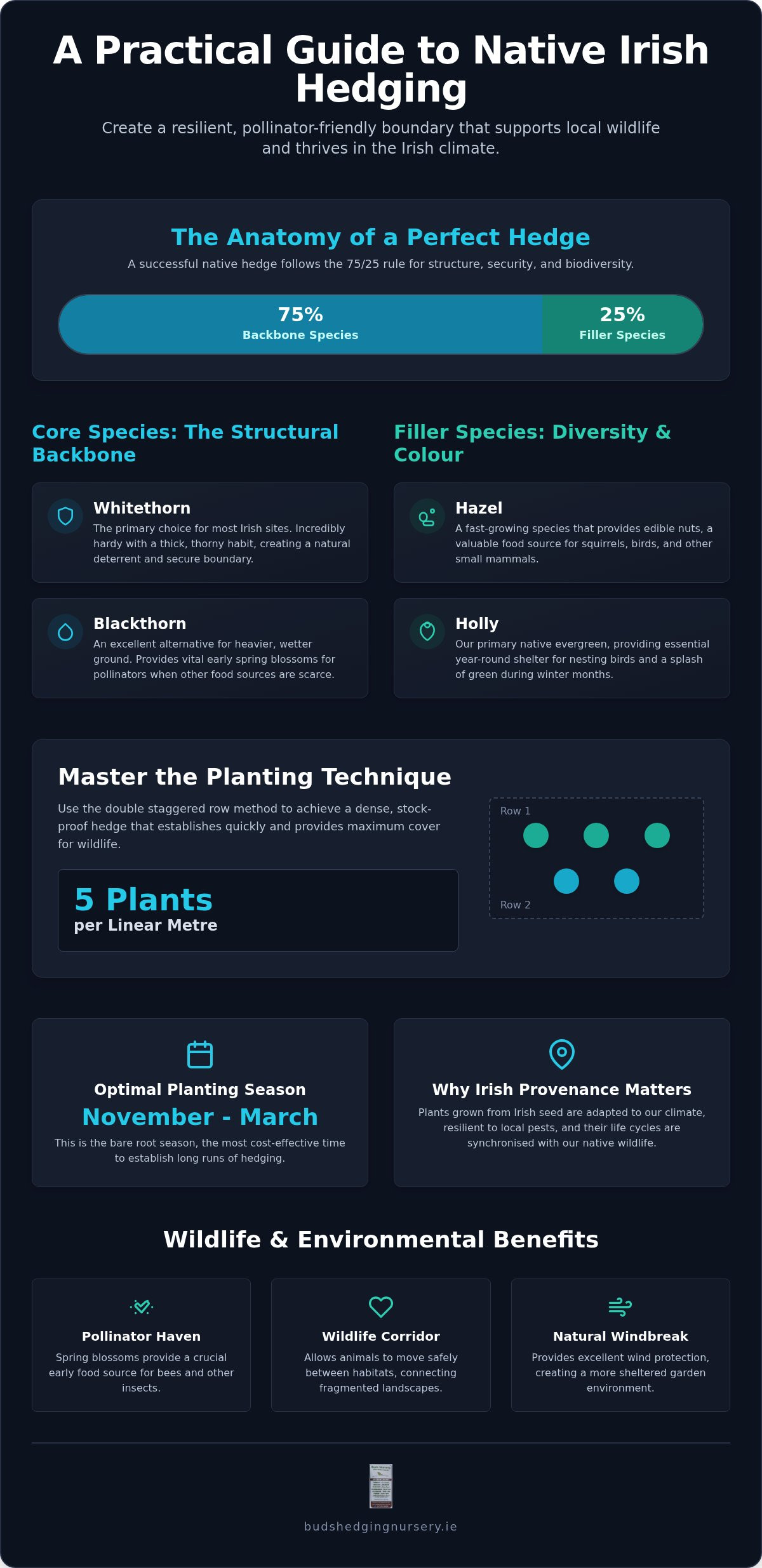
To build a hedge that lasts, you need a specific blueprint. The industry standard for a functional boundary is the 75/25 rule. This means 75% of your mix should consist of a “backbone” species, typically Whitethorn or Blackthorn. The remaining 25% consists of variety species to boost biodiversity. This structure ensures the hedge remains dense enough to be stock-proof and secure whilst allowing pollinator-friendly native hedgerows to flourish. Without this high percentage of thorny core species, the hedge often becomes “leggy” and loses its ability to function as a secure barrier over time.
Selecting the right pollinator friendly hedging Ireland requires understanding how these plants interact. A mix isn’t just about aesthetics; it’s about creating a layered habitat that provides food and shelter from early spring through to the harshest winter months. By following a proven ratio, you ensure your garden boundary is as practical as it is beneficial for local wildlife.
Core Species: The Structural Backbone
Whitethorn (Crataegus monogyna) is the primary choice for most Irish sites. It’s incredibly hardy and develops a thick, thorny habit that acts as a natural deterrent for intruders and livestock alike. If you’re dealing with heavier, wetter ground, Blackthorn (Prunus spinosa) is an excellent alternative. It produces white blossoms early in the spring, providing vital nectar when other food sources are scarce. Both species are favoured because they respond well to traditional management like laying or coppicing. These techniques involve cutting and training the stems to encourage new growth from the base, which keeps the hedge thick and secure for decades. For many environmental schemes, a high percentage of Whitethorn is a mandatory requirement to ensure long-term structural integrity.
Filler Species: Diversity and Colour
The remaining 25% of your mix is where you add variety and seasonal interest. Hazel is a popular addition for its fast growth and the edible nuts it provides for squirrels and birds. For winter interest, Holly is essential. It’s our primary native evergreen, providing year-round shelter for nesting birds and a splash of green during the dormant months. You might also include Crab Apple or Rowan. These species add vertical variety and produce a heavy crop of fruit in late autumn, which is a critical food source for migratory birds. Integrating these species creates a multi-layered environment that supports a much wider range of insects and mammals than a single-species hedge ever could. If you’re unsure which species suit your specific soil type, it’s worth visiting our 60-acre site to see these plants in a nursery environment and get a feel for the different growth habits.
Bare Root vs Potted: Choosing the Right Format
Bare root plants are the standard choice for professional growers and farmers across Ireland. These plants are grown directly in the field, lifted when dormant, and sold without soil around their roots. This dormant season typically runs from November to March. Establishing pollinator friendly hedging Ireland is most successful when you work with this natural cycle. It’s a simple matter of biology; planting whilst the sap is down allows the root system to settle into the soil before the energy demands of spring foliage begin. For a deeper look at the logistics of this window, see our Bare Root Tree Season Ireland: The Complete 2026 Planting Guide.
Establishment rates for bare root stock are often superior to potted alternatives in the long run. Because the roots aren’t confined to a plastic container, they don’t develop the circular, restricted growth patterns common in potted plants. Once in the ground, bare root whips adapt quickly to the heavy, wet soils common in many Irish counties. This direct contact with the local soil profile ensures a more resilient boundary that can withstand the winter winds. This approach aligns with the All-Ireland Pollinator Plan guidance on native hedgerows, which emphasises the use of hardy, field-grown stock to support local ecosystems.
Bare Root Advantages for Large Sites
Cost efficiency is the most significant factor for large-scale projects. You aren’t paying for the plastic pot, the peat-based compost, or the extra weight during transport. When buying in bulk, often in packs of 100 or more, the savings compared to potted plants are substantial. These plants are lightweight and easy to handle, making national delivery across the country straightforward. From an environmental perspective, bare root is the clear winner. You significantly reduce plastic waste on your property, supporting broader sustainability goals whilst creating a functional, pollinator friendly hedging Ireland can be proud of.
When to Consider Potted Native Plants
Potted plants have a specific role, particularly for smaller garden boundaries or for filling gaps during the summer months. If a section of your hedge fails or is damaged in May or June, bare root stock won’t be available. In these cases, container-grown plants allow for year-round planting. Potted specimens are also useful if you require instant height. Whilst bare root whips are usually 60cm to 90cm tall, you can source mature potted Holly or Beech to provide immediate screening. For small urban gardens where handling large bundles of bare root plants is impractical, the convenience of a potted plant often outweighs the higher unit cost.
Planting and Maintaining Your Native Hedge
Successful establishment starts with the soil. You cannot simply push a plant into a waterlogged field and expect it to thrive. Clearing a metre-wide strip of all grass and weeds is the first step. This reduces competition for nutrients and moisture during the critical first growing season. For those seeking pollinator friendly hedging Ireland, this preparation ensures the diverse species in your mix have the best start. If your primary goal is creating a boundary for screening, you might also find our Best Hedging for Privacy in Ireland: A Practical 2026 Buying Guide useful for comparing different growth habits.
One common mistake is letting the hedge grow tall too quickly. Pruning the leading stems back by a third immediately after planting is essential. This “First Cut” sounds counterintuitive, but it stimulates dormant buds at the base of the plant. It creates a thick, impenetrable barrier from the ground up rather than a row of thin, spindly trees. Without this initial prune, the hedge often becomes leggy and fails to provide the security or shelter required.
Step-by-Step Planting Guide
For large agricultural runs, slit planting is the most efficient method. You use a spade to create a simple “T” or “L” shape in the ground, insert the plant, and firm it in. For garden boundaries, digging a proper trench is far better. It loosens the soil and allows roots to spread naturally. Always keep bare root stock in their bags until the moment of planting. Irish winds dry out exposed roots in minutes. Once the plants are in the ground, firm the soil well with your heel to remove air pockets. Applying a thick layer of organic mulch or woodchip will suppress weeds and retain moisture throughout the spring.
The Three-Year Establishment Plan
Maintenance is a three-year commitment. During Year 1, your focus is entirely on root growth and rigorous weed control. Competition from grass is the leading cause of plant failure in new Irish hedges. In Year 2, you should lightly trim the side branches. This encourages lateral growth and increases the density of the pollinator friendly hedging Ireland needs for nesting birds and insects. By Year 3, you can begin shaping the hedge into a traditional A-frame. A wider base ensures sunlight reaches the bottom leaves. This prevents the hedge from becoming bare at ground level, ensuring a secure and attractive boundary for the long term. If you need help calculating the number of plants for your site, contact our nursery team for practical advice on spacing and species selection.
Sourcing Quality Native Mixes from Buds Nursery
Choosing the right supplier is as important as selecting the species themselves. At Buds Nursery, we manage 60 acres of land dedicated to growing hardy, field-grown stock. With over 30 years of experience, we specialise in high-volume bare root production specifically for the Irish climate. When you source pollinator friendly hedging Ireland from a specialist grower, you’re getting plants that have been hardened off in local conditions. This makes a significant difference in establishment rates compared to plants that have spent their lives in polytunnels or imported from warmer climates.
Our role goes beyond just selling plants. We provide on-site guidance to help you move from a generic species list to a tailored mix that suits your specific soil type and drainage. Whether you’re dealing with heavy clay or a more exposed coastal site, we can adjust the 75/25 ratio to ensure your boundary remains resilient. We also handle the logistics for large-scale projects, offering reliable delivery options for native hedging across the country during the dormant season.
Participating in the Native Trees Scheme
The Native Tree Area (NTA) Scheme is a major focus for many landowners in 2026. This scheme supports the planting of small areas of native trees and offers annual premiums of up to €2,284 per hectare for 10 years. To qualify, you must adhere to strict species requirements and planting densities. We are key participants in this programme and stock all the essential species like Whitethorn, Blackthorn, Hazel, and Holly. Our team helps farmers and landowners with the necessary documentation to ensure your project meets Department of Agriculture standards. For a detailed look at the specific plants allowed, refer to our A Practical Guide to Native Trees Scheme Plants in Ireland.
Visiting the Nursery Site
We believe there’s no substitute for seeing the stock in the field. Browsing a digital catalogue can’t compare to inspecting the root development and stem thickness of our field-grown whips. Our no-nonsense approach means you get professional advice based on the practicalities of the trade. We don’t offer online e-commerce checkout because we prefer to ensure every customer gets the right stock for their specific site requirements. The nursery is open for on-site selection and collection from Tuesday to Saturday. Please note that we are closed on Mondays and Sundays. Visiting us allows you to see the scale of our 60-acre operation and choose the exact pollinator friendly hedging Ireland needs for your next boundary project.
Securing Your Garden Boundary for the Future
Establishing a resilient boundary requires more than just digging holes. Success depends on maintaining the 75/25 ratio of structural species like Whitethorn to diverse filler plants. By focusing on the bare root season from November to March, you ensure your pollinator friendly hedging Ireland project has the best chance to establish deep roots before the spring. Remember that the first three years of maintenance, especially that initial hard prune, are what transform a row of whips into a thick, secure ecosystem.
With over 30 years of Irish growing experience on our 60-acre specialist nursery site, we understand the practicalities of field-grown stock. We can help you navigate the 2026 scheme requirements and select a mix that thrives in your specific soil. Contact Buds Nursery for expert advice on your native hedge mix and start planning your boundary today. A well-planted native hedge is a long-term investment that will serve your garden and the local wildlife for decades to come.
Frequently Asked Questions
How many plants do I need for a native hedge mix per metre?
You need five plants per linear metre to create a dense, functional boundary. We recommend planting in a double staggered row with roughly 33cm between each plant. This layout ensures the hedge fills out from the base and leaves no gaps for livestock or pets to push through. Using this density is standard for most pollinator friendly hedging Ireland projects, providing enough structural variety whilst maintaining a secure barrier as the plants mature.
What is the best month to plant a native hedge in Ireland?
The best time to plant is between November and March during the dormant season. This is when bare root stock is lifted and available from our nursery. Planting whilst the sap is down allows the root system to settle into the Irish soil without the stress of supporting new leaf growth. Avoid planting if the ground is frozen or waterlogged; wait for a clear window when the soil is workable but still cold and dormant.
Do native hedges keep their leaves in winter?
Most native species like Whitethorn, Blackthorn, and Hazel are deciduous and will lose their leaves in late autumn. However, you can include evergreen species like Holly to provide winter cover. Some species, such as Beech or Hornbeam, may retain their brown, dried leaves throughout the winter if they are kept trimmed as a hedge. This provides a level of year-round privacy and essential shelter for small garden birds during the coldest months of the year.
Can I include evergreen plants like Holly in a native mix?
Yes, Holly is a vital component of a diverse native hedge. It is our primary native evergreen and provides excellent winter shelter and nesting sites for birds. We typically suggest including Holly as about 10% to 15% of your total mix. It grows more slowly than Whitethorn, so it won’t overwhelm the other species but will add necessary year-round structure and colour to your pollinator friendly hedging Ireland boundary for decades to come.
How long does it take for a native hedge to become stock-proof?
A native hedge typically becomes stock-proof within four to six years, provided it is managed correctly. This timeline depends heavily on the First Cut and annual winter pruning to encourage density at the base. If you let the plants grow tall too quickly without trimming, the bottom will remain thin and permeable. Consistent weed control in the first three years is also essential to ensure the plants grow vigorously enough to form a solid, functional barrier.
Is Whitethorn the same as Hawthorn?
Yes, Whitethorn and Hawthorn are common names for the same species, Crataegus monogyna. In Ireland, Whitethorn is the term most frequently used by farmers and nurseries, whilst Hawthorn is common in general gardening. It’s the most important species in any native mix due to its hardy nature and thorny habit. It provides the structural strength needed for a secure boundary whilst producing the spring blossoms that support a wide range of our local Irish pollinators.
What is the Native Trees Scheme and how do I apply?
The Native Tree Area Scheme is a Department of Agriculture initiative that supports planting small areas of native trees, usually between 0.1 and 1 hectare. It offers annual premiums of up to €2,284 per hectare for a ten-year period. Applications are generally made through a registered forester or via the Agfood portal. As participants in the scheme, we provide the specific Whitethorn-based mixes and documentation required to meet the current 2026 national environmental standards.
How often should I trim a newly planted native hedge?
You should trim your new hedge once a year during the winter months whilst the plants are dormant. The most important cut is the initial one at planting, where you reduce the height to encourage bushy growth from the base. In the following two years, light trimming of the side branches and leading shoots helps the hedge thicken. Once established, you can move to a three-year rotation to allow more flowers and berries to develop.