

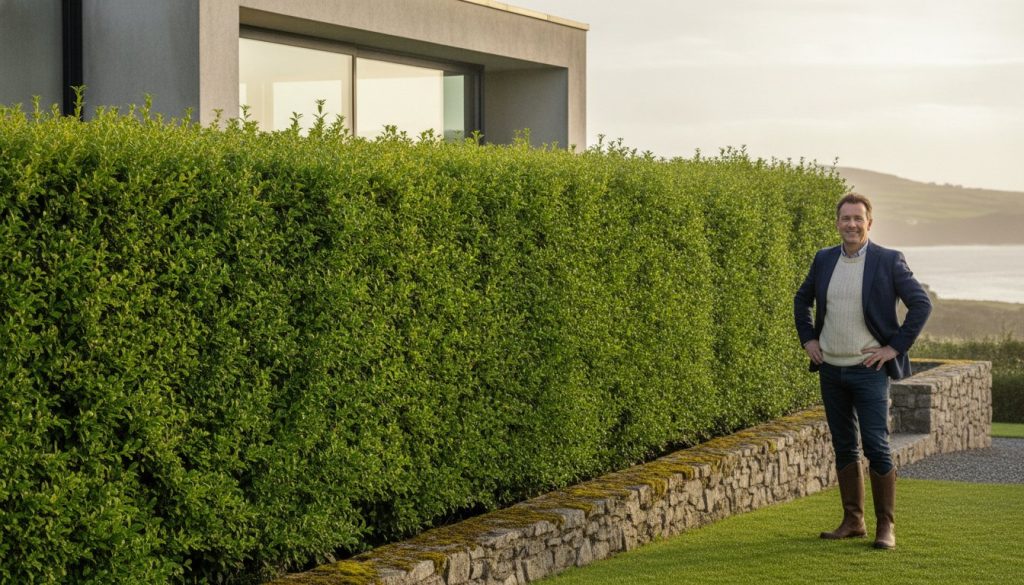
A common mistake in Irish gardening is assuming that a privacy screen must be either high-maintenance or prone to taking over the entire garden. If you live near the coast, you’ve likely seen the vibrant, apple-green leaves of Griselinia littoralis standing firm against salt-laden winds that would wither lesser plants. When it comes to griselinia hedging Ireland offers a unique set of challenges, from damp winters to sudden frost, but this New Zealand native has proven itself as a reliable, neat, and attractive solution for decades.
It’s understandable if you’re worried about spacing your plants correctly or protecting a new hedge from a cold snap in more inland counties. You want a thick, evergreen barrier that provides privacy without the constant pruning required by more aggressive species. This 2026 guide draws on 30 years of growing experience at our 60-acre nursery to show you exactly how to achieve a lush finish. We will walk you through the essential planting steps, the best ways to improve drainage to avoid “wet feet,” and the simple maintenance routine that keeps your hedge healthy year-round. From choosing the right pot size to understanding the seasonal cutting ban, you’ll find everything needed to grow a perfect screen.
Key Takeaways
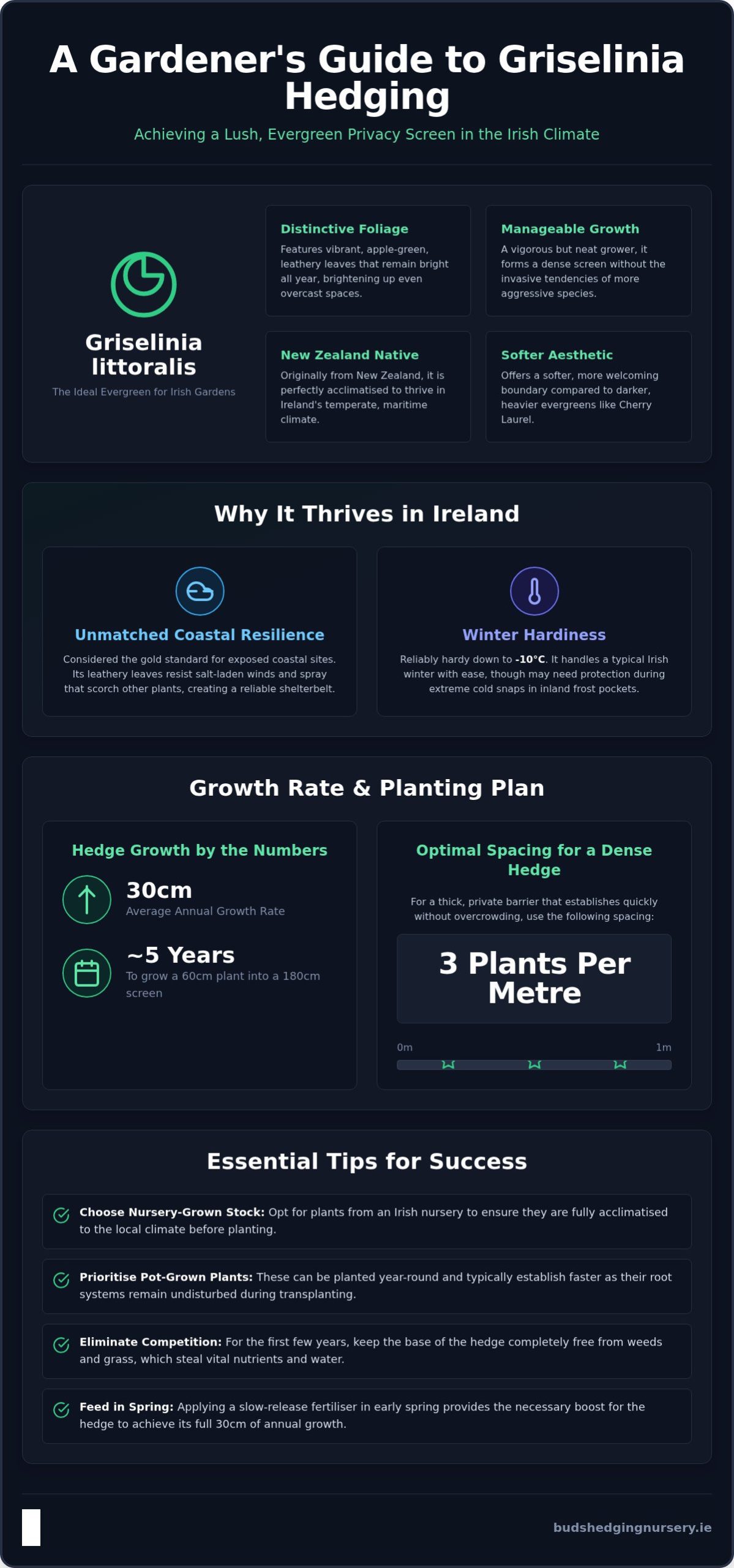
- Understand why Griselinia littoralis is the preferred choice for coastal gardens and how its natural salt tolerance provides a durable, evergreen screen.
- Learn about the 30cm average annual growth rate and how to protect your plants when temperatures drop toward -10°C.
- Compare griselinia hedging Ireland with alternatives like Portuguese Laurel to determine the best fit for your soil type and maintenance preferences.
- Master the optimal spacing of three plants per metre to ensure a dense, private barrier that establishes quickly without overcrowding.
- Discover the benefits of choosing nursery-grown stock to ensure your plants are fully acclimatised to the local Irish climate before planting.
What is Griselinia Hedging and Why is it Popular in Ireland?
Griselinia littoralis is a vigorous evergreen shrub that has become a staple of the Irish landscape. Originally from New Zealand, it thrives in our temperate, maritime climate. The plant is easily identified by its distinctive apple-green, leathery leaves which remain vibrant throughout the year. For those looking into griselinia hedging Ireland provides the ideal conditions for these plants to establish quickly and form a dense, uniform barrier. It’s a practical alternative to the darker, more aggressive Cherry Laurel. Griselinia offers a softer aesthetic while remaining functional as a privacy screen that requires less frequent pruning to keep it in check.
This species is particularly prized for its manageable growth habit. While it’s vigorous, it doesn’t have the invasive tendencies of some other fast-growing hedges. It fills out horizontally to create a solid wall of green, ensuring total privacy from neighbours or passing traffic. This makes it a top choice for urban gardens where space is at a premium and a tidy appearance is necessary. It’s a hardworking plant that delivers year-round colour without demanding constant attention from the gardener.
The Aesthetic Appeal of Apple-Green Foliage
The light-reflecting quality of the foliage is a significant draw for Irish homeowners. These pale green leaves catch the available light, helping to brighten up dark garden corners even on overcast days. This creates a “soft” boundary that feels welcoming rather than imposing. Many traditional evergreens can look heavy or gloomy in a small space, but the brightness of Griselinia keeps a garden feeling open. For added visual interest, you might consider variegated varieties. These feature creamy-white margins on the leaves, offering a decorative touch that stands out amongst more uniform green hedges.
Coastal Resilience: A Hedge for the Atlantic Coast
Ireland’s Atlantic coastline is a difficult environment for most garden plants. High winds and salt spray often cause leaf burn or desiccation in more sensitive species. Griselinia is widely considered the gold standard for these exposed sites. Its leathery leaf texture serves as a natural defence mechanism. This thick skin prevents moisture loss and resists the corrosive effects of salt. It’s common to see it thriving in gardens from Donegal down to Cork where other hedges struggle to survive.
On exposed sites, an established hedge acts as a vital shelterbelt. It protects delicate shrubs and flowers by filtering the wind’s force rather than creating a turbulent air wall. Griselinia is Ireland’s most reliable evergreen for salt-heavy winds. Because it grows in a naturally neat, upright fashion, it maintains its structural integrity even when buffeted by consistent coastal gales. It stays lush and green while other plants turn brown from the salt air.
Understanding Growth Rates and Hardiness in the Irish Climate
Established Griselinia grows at an average rate of 30cm per year. This makes it a medium-speed grower, sitting comfortably between the slower Box and the rapid Leylandii. When planning for griselinia hedging Ireland, gardeners should consider the starting plant type. Pot-grown specimens can be planted year-round and usually establish faster than rootball plants because their root systems remain undisturbed. While a maintained garden hedge is often kept at 2 metres, this shrub has the potential to reach 6 metres if left unclipped.
How Fast Will Your Hedge Reach Maturity?
Don’t expect maximum growth immediately after planting. The first 12 months are a settling-in period where the plant focuses on developing a strong root network. If you start with 2-foot (60cm) plants, it typically takes about five years to achieve a solid 6-foot (180cm) privacy screen. You can encourage faster vertical growth by keeping the base of the hedge completely free from weeds and grass. Competing vegetation steals nutrients and water, which significantly slows down development in the early years. Applying a slow-release fertiliser in early spring also helps the hedge put on its full 30cm of annual height.
The Hardiness Debate: Inland vs Coastal Sites
The “semi-hardy” label often causes confusion. In a typical Irish winter, temperatures rarely drop below -5°C, which Griselinia handles without issue. It’s generally hardy down to -10°C. However, inland counties and low-lying “frost pockets” can see temperatures dip further during extreme weather events. According to this Gardeners’ World plant profile, the plant’s resilience is highest in coastal areas where the sea air keeps temperatures stable.
If you live in the Midlands or a particularly cold valley, a prolonged spell at -12°C can cause leaf browning or stem dieback. You can mitigate this by planting in well-drained soil; wet roots are far more susceptible to freezing damage than dry ones. Whilst the mild South-West provides a perfect environment, achieving a successful result with griselinia hedging Ireland often depends on understanding these local climatic limits. Those in colder regions might consider a hardier alternative like Portuguese Laurel if their site is prone to severe, stagnant frosts.
Griselinia vs. Laurel vs. Beech: Which Hedge Should You Choose?
Selecting the right boundary for your garden requires balancing visual appeal with the practicalities of your soil and site exposure. While Portuguese Laurel is often the go-to for inland gardens due to its dark, glossy foliage and red stems, Griselinia offers a brighter, more contemporary look. Both are excellent evergreens, but they serve different aesthetic purposes. If you want a dense, year-round screen that feels light and airy, Griselinia is hard to beat. However, if your garden has heavy, clay-based soil, you might find that Beech hedging plants Ireland are a more traditional and hardy choice, even if they lose their green colour in winter.
Regarding the “privacy factor,” evergreens usually win. Griselinia creates a solid, opaque wall faster than many native species. It’s often listed amongst the best hedging for privacy Ireland homeowners can choose, particularly because it maintains its thickness from the base to the top. For most installations of griselinia hedging Ireland requires only a single annual prune in late spring or early summer, making it a low-effort solution for busy households.
The Maintenance Comparison: Time vs. Result
Maintenance is a major deciding factor for most gardeners. Cherry Laurel is a vigorous grower that often requires two or even three clips a year to prevent it from encroaching on paths. In contrast, Griselinia is a far more “polite” guest. It grows steadily but doesn’t send out the same wild, unruly shoots that demand constant attention. This makes it ideal for smaller urban gardens where you need to maximise every square inch of space.
The leaf size also impacts the final look. Because Griselinia has medium-sized leaves, they aren’t shredded by hedge trimmers in the same way that large-leaved Cherry Laurel leaves are. This results in a much neater, cleaner finish after a trim. You don’t get the brown, jagged edges that can make a freshly cut laurel hedge look untidy for several weeks.
Site Suitability: Soil and Aspect
Site conditions often dictate the choice more than personal preference. As noted in the BBC Gardeners’ World guide to Griselinia, this species performs best in full sun or very light shade. If your garden is heavily shaded by tall trees or north-facing walls, a Laurel might be more resilient. Griselinia needs that light to maintain its vibrant, apple-green hue.
Drainage is another critical factor. None of these species thrive with “wet feet,” but Griselinia is particularly sensitive to waterlogged soil. If your site is prone to standing water during a typical Irish winter, you’ll need to improve the drainage before planting. Laurels are slightly more tolerant of damp conditions, but even they will struggle if the roots are submerged for long periods. Always assess how your soil behaves after heavy rain before committing to a specific variety.
Planting and Maintaining Your Griselinia Hedge
Success with griselinia hedging Ireland starts with the ground. To plant a new hedge, dig a trench approximately 40cm deep and twice the width of the root system. This ensures the roots can spread easily into the surrounding soil. For a standard privacy screen, we recommend planting three specimens per metre. This spacing, roughly 18 inches apart, allows the plants to knit together quickly while leaving enough room for each to draw sufficient nutrients from the soil. Once the plants are in place, backfill the trench with a mix of native soil and high-quality planting compost.
The first 18 months are critical for establishment. During this time, the hedge relies on you for consistent moisture. Check the soil weekly; if it feels dry two inches below the surface, give the base of the plants a deep soak. Avoid light sprinkling, as this encourages shallow roots that are more vulnerable to drought and frost. A balanced fertiliser applied in early March will provide the necessary boost for the growing season ahead.
Soil Preparation and Drainage in Irish Gardens
Heavy clay is a common challenge across Ireland. Because it retains water, it can lead to root rot in Griselinia during the wet winter months. You can improve the structure of heavy soil by digging in plenty of horticultural grit and organic matter before you start planting. Adding a handful of bone meal to the bottom of each hole also helps stimulate strong, healthy root development. Griselinia requires free-draining soil to survive an Irish winter.
Pruning for Density: The Secret to a Thick Hedge
Maintaining the structural integrity of your garden plants often requires professional insight into tree health and pruning techniques. To see how experts manage diverse species and ensure long-term vitality, you can check out We Love Trees for a look at professional arborist standards.
Many gardeners make the mistake of waiting until the hedge reaches its desired height before they start pruning. To create a thick, bushy base, you should prune the sides of the plants early. This encourages lateral budding and prevents the hedge from becoming “leggy” or thin at the bottom. The best time for your annual trim is late spring or early summer. This timing allows the new growth to harden off before the following winter.
If you’re dealing with a neglected hedge, proceed with caution. While Griselinia is resilient, it doesn’t always regenerate reliably from very old, bare wood. It’s better to prune it back in stages over two or three years rather than performing a drastic “hard” prune all at once. If you need healthy, well-established plants to start your project, you can order nursery-grown Griselinia for national delivery from our specialist nursery.
Sourcing Quality Griselinia from an Irish Specialist Nursery
Choosing where to buy your plants is just as important as how you plant them. Many mass-market retailers sell imported stock that hasn’t been hardened off for our specific local conditions. When you source from a specialist plant nursery Ireland grown stock is already used to our maritime climate. This acclimatisation significantly increases survival rates, especially during the first winter. For those looking for griselinia hedging Ireland, national delivery services make it practical to receive large quantities directly to your gate, whether you’re planting a small garden screen or a long farm boundary.
You can choose between bare-root and pot-grown formats. Bare-root plants are a seasonal option, available only during the dormant winter months, and are a budget-friendly choice for long boundaries. Pot-grown Griselinia can be planted at any time of year and generally suffers less transplant shock. We provide national delivery across the country, ensuring your plants arrive in peak condition and ready for the soil.
The Advantage of 30 Years of Growing Experience
With 30 years of growing experience across our 60-acre site, we prioritise root health over rapid top growth. A plant might look tall in a garden centre, but if the root system is cramped or underdeveloped, it’ll struggle once it’s in the ground. Buds Nursery Cavan produces stock that is raised to be hardy and resilient. Expert guidance is available on-site from Tuesday to Saturday to help you select the right size for your site and budget. We focus on the quality of nursery-grown stock over mass-market imports because we know what works in the Irish landscape.
Planning Your Project: Delivery and Timing
Timing is everything for large-scale hedging projects. Understanding the bare root tree season Ireland helps you plan your budget and planting schedule. Bare-root Griselinia is often the most economical way to cover large distances, but the planting window is limited to the winter months. If you’re organising a bulk delivery for a new boundary or farm screen, make sure you have a clear area for the delivery vehicle to offload and that your trench is prepared in advance.
Final checklist before visiting the nursery or placing an order:
- Measure the total length of your boundary in metres.
- Calculate the total number of plants required based on the three-per-metre rule mentioned earlier.
- Confirm you have the necessary compost and horticultural grit for soil preparation.
- Ensure you have a plan for consistent watering for the first 18 months of establishment.
Building Your Perfect Privacy Screen
Achieving a lush, apple-green boundary in the Irish climate is straightforward when you follow the right planting and maintenance principles. By prioritising free-draining soil and maintaining a consistent watering schedule during the first 18 months, you ensure your hedge remains healthy and thick from the base up. Whether you’re dealing with salt-heavy coastal winds or looking for a neat, urban solution, this species offers a unique blend of resilience and aesthetic softness that few other evergreens can match.
When you’re ready to start your project, choosing griselinia hedging Ireland from a specialist grower makes all the difference. Our 60-acre nursery produces premium, hardy stock backed by over 30 years of Irish growing expertise. We offer national delivery on all orders, ensuring your plants arrive in peak condition regardless of your location. View our range of quality Griselinia and evergreen hedging at Buds Nursery Cavan to find the perfect size for your garden. With the right stock and a little patience, you’ll soon enjoy a beautiful, low-maintenance screen that lasts for decades.
Frequently Asked Questions
Is Griselinia hedging fast-growing?
Established Griselinia is a medium-to-fast grower, typically adding 30cm of height each year once settled. While it doesn’t match the aggressive speed of Leylandii, it’s far quicker than Box or Yew. If you start with 2-foot plants, you can expect a full 6-foot privacy screen within five years. Keeping the base free from weeds during the first two seasons is the most effective way to ensure it reaches its maximum annual growth rate.
How far apart should I plant Griselinia littoralis?
You should plant Griselinia littoralis at a density of three plants per metre for a standard hedge. This spacing, roughly 45cm or 18 inches apart, allows the root systems to establish without competing too fiercely for nutrients. It ensures the foliage knits together quickly to form a solid, opaque barrier. Planting too closely can lead to poor air circulation and fungal issues, whilst wider spacing will delay the time it takes to achieve total privacy.
Will Griselinia grow in shade?
This species performs best in full sun or very light shade. Whilst it can survive in darker areas, the growth often becomes leggy and the foliage loses its vibrant, apple-green hue. For a dense, healthy hedge, you need at least a few hours of direct light daily. If your garden is heavily overshadowed by tall trees or north-facing walls, a more shade-tolerant alternative like Portuguese Laurel might be a more practical choice for your site.
Can Griselinia survive a hard frost in Ireland?
Griselinia is hardy down to approximately -10°C, which covers most Irish winters. However, it can struggle during extreme cold snaps if temperatures drop further, particularly in inland counties or low-lying frost pockets. Ensuring the soil is free-draining is the best way to help the plant survive. Wet roots are far more susceptible to freezing damage. If a severe frost is forecast, younger plants in exposed gardens may benefit from a temporary covering of horticultural fleece.
When is the best time to prune a Griselinia hedge?
The best time to prune is late spring or early summer, typically after the first flush of growth has finished. This timing allows any new shoots to harden off before the winter frosts arrive. When maintaining griselinia hedging Ireland residents must also be mindful of the Wildlife Act, which prohibits cutting hedges between 1st March and 31st August to protect nesting birds. Always check the interior of the hedge for active nests before you begin any trimming.
Is Griselinia salt-tolerant for coastal gardens?
Yes, it’s widely considered the gold standard for coastal gardens due to its exceptional salt tolerance. The thick, leathery texture of the leaves acts as a natural barrier against salt burn and desiccation from Atlantic winds. Unlike many other evergreens that turn brown when exposed to sea spray, Griselinia remains lush and vibrant. This resilience makes it the most reliable choice for gardens located within a few hundred metres of the shoreline across the island.
How often should I water my new Griselinia hedge?
You should give your new hedge a deep soak once a week during its first 18 months in the ground. During particularly dry spells in the summer, you may need to increase this to twice a week. It’s better to provide one thorough watering that reaches the deep roots rather than frequent, light sprinkles. Always check the soil moisture levels two inches below the surface before watering to ensure the ground isn’t becoming waterlogged or stagnant.
What is the difference between Griselinia and Laurel?
The main difference lies in foliage colour, site tolerance, and maintenance. Griselinia features bright, apple-green leaves and thrives in coastal salt air, whereas Cherry Laurel has larger, darker leaves and handles heavy shade better. Griselinia is generally more “polite,” requiring only one clip per year to maintain its shape. In contrast, vigorous laurels often need more frequent pruning. Choosing griselinia hedging Ireland often comes down to wanting a neater, brighter look that requires less work.