

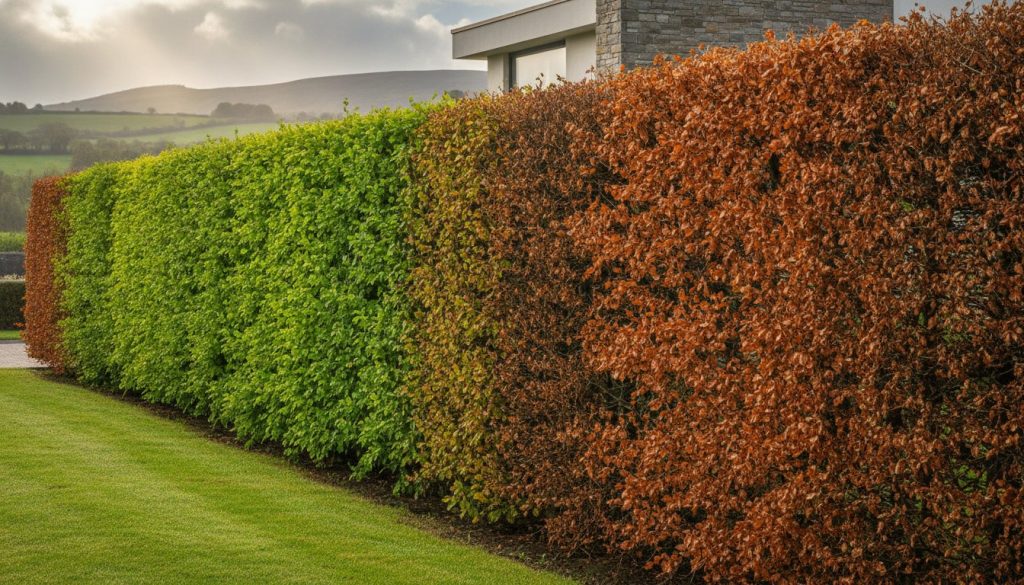
Most gardeners assume you need a wall of laurel or leylandii for winter privacy, but the humble beech tree offers a far more textured alternative that keeps its screen all year. When selecting beech hedging plants Ireland homeowners often look for that classic mix of vibrant green summer leaves and the rich, copper tones of winter. You likely want a boundary that feels alive rather than static, yet you might be worried about whether your soil can handle a wet Irish winter or if you’re actually looking for hornbeam instead.
It’s a practical concern when balancing garden privacy with a sensible planting budget. This guide will show you how to establish a thick, wind-resistant boundary that thrives in our local climate while providing year-round screening and seasonal colour. We’ll cover the essential differences between green and copper varieties, the financial benefits of bare root planting, and the specific drainage requirements to ensure your hedge survives the wettest months of the year.
Key Takeaways
- Identify the distinct differences between Green and Copper Beech to select the variety that best suits your garden aesthetic and soil conditions.
- Learn how the natural process of marcescence allows beech hedging plants Ireland to provide a reliable privacy screen whilst displaying rich seasonal colours.
- Maximise your planting budget by choosing bare root stock during the dormant season from November to March, which is the most economical way to plant long boundaries.
- Follow professional techniques for soil preparation and drainage to ensure your new hedge establishes quickly and survives wet Irish winters.
- Gain insights from a specialist grower with 30 years of experience in producing hardy, wind-resistant hedging on a 60-acre nursery.
Understanding Beech Hedging: Why it is a Favourite in Ireland
The European beech (Fagus sylvatica) has been a cornerstone of the Irish landscape for centuries. You’ll find it lining historic estate drives and marking townland boundaries across the country. It’s a reliable choice for beech hedging plants Ireland gardeners trust because it adapts so well to our temperate climate. While it’s technically a deciduous tree, it possesses a unique trait called marcescence. This means that instead of dropping its leaves at the first frost, the foliage turns a rich copper colour and clings to the branches throughout the winter. It only sheds these old leaves when the new green buds push through in spring. This provides a dense, year-round screen that protects your garden from prying eyes and harsh winds.
Beech is a powerhouse for structural shelter. In exposed areas, a double-row beech hedge acts as a superior windbreak. It doesn’t just block the wind; it filters it. This reduces the turbulence that often occurs behind solid walls or fences. You’ll see the hedge transform through the seasons. It starts with a translucent lime green in May, matures into a deep forest green, and finishes with a spectacular golden-bronze display in late October. This seasonal shift adds a dynamic element to the garden that static walls simply can’t match.
The Biodiversity Value of Beech Hedges
Native wildlife thrives in these hedges. Small garden birds like robins and dunnocks find the tight, twiggy structure perfect for nesting. It’s safe from larger predators. In late autumn, the hedge produces beech mast. These small, triangular nuts are a vital food source for birds and small mammals preparing for winter. When you plant a hedge, you aren’t just building a wall. You’re creating a wildlife corridor that connects different habitats amongst our gardens, supporting local ecosystems whilst providing your own private sanctuary.
Beech vs Evergreen: The Privacy Debate
Gardeners often debate whether to choose an evergreen like laurel or a deciduous beech. Laurel provides a solid, glossy green wall. It’s effective but can sometimes feel heavy or imposing in a smaller space. Beech offers a more textured, organic appearance. Even in the depths of January, the copper leaves provide a visual block. If you’re weighing up your options, our guide on best hedging for privacy Ireland offers a deeper comparison of different species. For many, the movement and seasonal shifts of beech make it the superior choice for a living boundary. Gardeners who want a faster-establishing alternative may also want to explore privet hedging Ireland options, which can offer reliable screening with different seasonal characteristics.
Green Beech vs Copper Beech: Choosing Your Aesthetic
When selecting beech hedging plants Ireland homeowners typically choose between two main varieties. Green beech (Fagus sylvatica) is the traditional workhorse of the Irish countryside. It’s a cost-effective option for long boundaries and provides a vibrant, translucent green screen during the summer. For those looking for a more ornamental or dramatic look, Copper beech (Fagus sylvatica Purpurea) offers deep purple and burgundy foliage that matures into a dark, rich hue. Both varieties share the same growth habits and the reliable winter leaf retention discussed in the previous section. According to the Royal Horticultural Society beech growing guide, these plants are equally hardy and can be maintained at any height from one metre to over five metres.
In many larger Irish gardens and estates, we see a “tapestry hedge” effect. This is achieved by mixing the two varieties, often in a ratio of four green plants to one copper plant. This creates a textured, broken pattern that looks less formal than a solid wall of a single colour. It’s a practical way to add visual interest to a long driveway or a boundary that might otherwise feel monotonous. Regardless of the colour you choose, the maintenance requirements remain the same; a single annual trim in late summer is usually sufficient to keep the hedge neat and ensure it holds its leaves through the winter months.
The Copper Beech Advantage
The dark foliage of copper beech provides an excellent backdrop for lighter green shrubs or silver-leaved plants. It’s a popular choice for formal garden design and is frequently used to frame driveway entrances. While the initial cost for copper beech is higher than the green variety, the high-impact aesthetic often justifies the investment for front-of-house planting. You can learn more about specific spacing and growth rates in our guide on copper beech hedging plants.
The Hornbeam Alternative for Wet Soils
The primary reason beech hedges fail in Ireland is “wet feet.” Beech requires well-drained soil; if your site consists of heavy clay that stays waterlogged during the winter, the roots will likely rot. In these conditions, we recommend Hornbeam (Carpinus betulus). It looks very similar to green beech but is much tougher in damp, heavy soils. It also retains its brown leaves during the winter, though perhaps not as densely as beech. For sites with poor drainage, check our resource on hornbeam hedging for sale.
Selecting the right variety for your specific ground conditions is the most important step in ensuring a healthy hedge. If you’re unsure about your soil type, talk to our nursery staff for straightforward advice based on three decades of growing experience.
Buying Guide: Bare Root vs Potted Beech Hedging
Bare root plants are the industry standard for large-scale hedging projects. In Ireland, the season typically runs from November to March, whilst the plants are dormant. This is the most cost-effective way to source beech hedging plants Ireland gardens require for long boundaries. Since these plants are grown in open ground and lifted without soil, transport costs are lower and the plants are often hardier than those grown in artificial environments. You’ll find that bare root stock establishes a deep, resilient root system once it settles into your local soil.
To achieve a dense, professional-looking screen, you must calculate the right quantity before ordering. We recommend the following densities:
- Single Row: 3 to 4 plants per metre. This works well for narrow spaces or where a thinner boundary is acceptable.
- Double Staggered Row: 5 to 7 plants per metre. This is the gold standard for a thick, windproof barrier. Space the two rows about 30cm to 40cm apart in a “W” pattern.
Potted or rootball beech offers an alternative for those planting outside the dormant season. Potted plants can go into the ground any time of year, provided you keep them well-watered during dry spells. Rootball specimens are larger plants lifted with a ball of soil wrapped in hessian. These are ideal for filling gaps in an existing hedge or for homeowners who need instant height and privacy immediately after planting. Homeowners comparing their options at this stage sometimes also consider privet hedging in Ireland, which is another species well-suited to bare root planting during the dormant season.
Sizing and Maturity: What to Order
We generally advise customers to choose the 60-90cm (2-3ft) size. This is the “sweet spot” for both cost and establishment speed. Younger transplants adapt to their new environment much faster than older, larger trees. Don’t be tempted to buy overly mature beech (over 1.5 metres) unless you have a professional irrigation system in place. These larger plants often suffer from severe transplant shock and may struggle to grow for several years. A smaller, healthy 2ft plant will often overtake a larger, stressed plant within three growing seasons.
Timing Your Purchase
Success starts with timing. It’s vital to order early for the bare root tree season Ireland experiences each winter. High-quality stock often sells out by mid-January. Planting whilst the tree is dormant ensures the roots have several months to settle into the Irish soil before the energy demands of spring begin. At Buds Nursery, we organise our deliveries to coincide with the best planting windows, ensuring your plants arrive fresh and ready to go straight into the ground.
How to Plant and Establish Your Beech Hedge
Successful establishment begins with the ground, not the plant. When preparing to install beech hedging plants Ireland growers must prioritise drainage and weed control. Clear a strip at least one metre wide of all grass and perennial weeds. This reduces competition for nutrients and moisture. If your soil is heavy clay, incorporate sharp grit or well-rotted organic matter to improve the structure. As mentioned previously, beech is sensitive to waterlogging; the roots will rot if they sit in standing water during a wet Irish winter.
For long runs of hedging, trench planting is far superior to digging individual holes. Dig a continuous trench approximately 30cm deep and 40cm wide. This allows you to space the plants evenly and ensure they are all set at the correct depth. Use the soil mark on the stem as your guide. Planting too deep can suffocate the roots, whilst planting too shallow can cause them to dry out. We recommend mixing organic compost with the backfill soil and applying a root stimulant to encourage rapid root colonisation.
The first year is the danger zone for any new boundary. Even in Ireland, a dry spell in April or May can kill a new hedge before it has a chance to settle. Check the soil moisture twice a week during the first growing season. If the ground feels dry five centimetres below the surface, give the hedge a thorough soaking at the base. Avoid wetting the foliage during the heat of the day to prevent leaf scorch.
Pruning for Thickness and Leaf Retention
Don’t be afraid to use the shears early. Immediately after planting, trim the top 10 to 15 per cent off each plant. This might feel counterintuitive when you want height, but it forces the plant to send energy into side shoots, creating a bushy base from the outset. The secret to that iconic winter leaf retention is the timing of your annual trim. Prune your hedge in late August. This timing ensures the leaves are mature enough to remain on the branches whilst dormant. Always maintain a tapered shape, keeping the top slightly narrower than the base. This allows sunlight to reach the bottom branches, preventing the hedge from becoming thin and leggy at ground level.
Common Problems and Solutions
Keep an eye out for the beech aphid, also known as woolly aphid. It appears as a white, cotton-like substance on the underside of leaves. It’s rarely fatal and can usually be managed with a blast of water or an organic fatty-acid spray. Mildew can also occur during humid Irish summers, appearing as a white powdery coating. Improving airflow through correct pruning usually solves this. If your hedge drops its leaves early in autumn, it’s often a sign of stress from a lack of water during a late summer dry spell. For high-quality stock grown specifically for our climate, order your bare root beech directly from our nursery.
Sourcing Quality Beech from Buds Nursery
Buds Nursery operates as a specialist grower rather than a standard reseller. We manage a 60-acre site with over 30 years of heritage in the trade. This long-standing experience allows us to produce high-quality beech hedging plants Ireland gardeners and farmers can trust for long-term results. We take a “no-nonsense” approach to our work. We focus on the health and structural integrity of the plant rather than decorative marketing. When you buy from us, you’re dealing with professionals who have spent decades working with the Irish soil.
We are active participants in the native trees scheme plants programme. This is particularly relevant for customers involved in large-scale environmental projects or those looking to restore traditional Irish boundaries. Our stock is hardy and grown to withstand the local elements. For those who cannot visit us in person, we provide a reliable nationwide delivery service. If you prefer to select your own plants, on-site collection is available from Tuesday to Saturday. We recommend calling ahead to check the current availability of specific sizes, especially during the busy bare root season.
Large Scale and Farm Hedging
Beech is a vital component in many agricultural environmental schemes, such as ACRES or GLAS. These projects often require specific planting densities and species mixes to support local biodiversity. We frequently supply bulk quantities of whitethorn and beech mixes to create stock-proof, wind-resistant boundaries for farms across the country. We welcome commercial and agricultural enquiries for national projects. Our team can provide the necessary guidance to ensure your order meets the specific requirements of your environmental scheme.
Why Visit Our Specialist Nursery?
There is significant value in seeing the maturity and health of the stock first-hand. A visit to our 60-acre site allows you to compare different sizes and varieties before you commit to a purchase. You can speak directly with our seasoned growers to get practical advice tailored to your garden’s specific conditions. Whilst you’re here, you can also browse our wider range of companion plants. We stock everything from fruit trees to ornamental shrubs, allowing you to source all your planting requirements from one reliable location with deep roots in the industry.
Start Planning Your Permanent Garden Boundary
Selecting the correct beech hedging plants Ireland homeowners trust involves more than just picking a leaf colour. You’ve learned how to distinguish between green and copper varieties, the critical importance of soil drainage, and why bare root planting during the dormant season is the most practical choice for your budget. By following the August pruning secret, you’ll ensure your hedge retains its textured copper screen throughout the winter months whilst providing a vital habitat for local wildlife.
At Buds Nursery, we combine 60 acres of dedicated growing land with over 30 years of horticultural expertise. We don’t just sell plants; we provide the expert nationwide delivery and on-site guidance required to make your project a success. Whether you’re establishing a small urban screen or a large-scale rural windbreak, our stock is grown to thrive in the Irish climate and settle quickly into your soil.
Browse our full range of Beech Hedging and Native Trees today to secure your stock for the upcoming season. We look forward to helping you grow a boundary that brings seasonal interest and privacy to your garden for decades to come.
Frequently Asked Questions
Is beech hedging evergreen or deciduous?
Beech is technically a deciduous plant, but it behaves differently from most other species by retaining its dead leaves throughout the winter. This unique trait, called marcescence, means the foliage turns a rich copper colour in autumn and stays on the branches until the new buds push them off in spring. It provides a reliable year-round privacy screen that rivals many evergreen alternatives.
How fast does a beech hedge grow in Ireland?
Once established, a beech hedge typically grows between 30cm and 60cm per year. The growth rate for beech hedging plants Ireland gardeners install depends heavily on soil quality and maintenance. In fertile, well-drained ground with regular feeding, you’ll see the hedge reach a functional height of two metres within four to six growing seasons.
When is the best time of year to plant beech hedging?
The optimal window for planting is during the dormant season, which runs from November to March. This allows you to use bare root plants, which are more cost-effective and settle into the Irish soil more reliably than potted versions planted in summer. Avoid planting during periods when the ground is frozen or completely waterlogged.
Can beech hedging grow in shade or wet soil?
Beech is perfectly happy in full sun or partial shade, but it cannot tolerate wet or waterlogged soil. If your garden has heavy clay that stays damp throughout the winter, the roots will likely rot. In these specific conditions, we always recommend planting hornbeam instead, as it looks very similar but is much tougher in wet ground.
How far apart should I space beech hedging plants?
For a standard single row, you should space the plants at a rate of 3 to 4 per metre. If you want a thicker, more substantial boundary, we recommend a double staggered row. This requires 5 to 7 plants per metre, planted in two parallel lines about 30cm apart to create a dense “W” pattern.
Does copper beech grow slower than green beech?
There is very little difference in the growth rates of green and copper beech. Whilst some growers suggest copper beech takes slightly longer to establish in the first year, both varieties will reach maturity at the same pace. Your choice should be based on your preferred aesthetic rather than any perceived difference in growth speed.
How often should I prune my beech hedge to keep it thick?
A single annual prune is usually sufficient to maintain a healthy, thick hedge. The best time to do this is in late August. Trimming at this time of year encourages the plant to keep its leaves during the winter months. If you prune too early in the summer, the hedge may produce new growth that drops its leaves when the frost hits.
Why are my beech hedge leaves turning brown in summer?
Brown leaves during the summer months are usually a sign of drought stress or a woolly aphid infestation. If the weather has been particularly dry, the hedge likely needs a deep soaking at the roots. If you notice a white, waxy substance on the underside of the leaves, it’s a sign of aphids, which can be managed with organic sprays or a blast of water.