

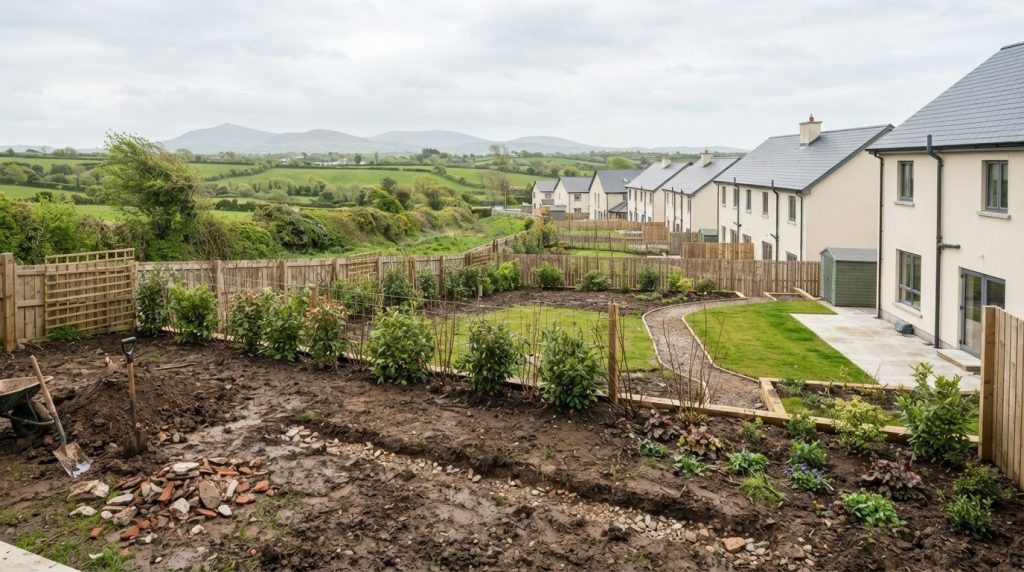
Rushing to plant delicate ornamental borders is the most expensive mistake you can make on a newly finished housing estate. When working out what to plant in a new build garden Ireland presents a very distinct set of ground conditions. Heavy machinery compacts the subsoil into an impenetrable clay pan, builder’s rubble often lurks beneath a thin skin of turf, and persistent winter rain quickly turns bare plots into waterlogged quagmires.
It is deeply frustrating to look out at exposed boundary fences and overlooking bedroom windows, worried that expensive plants will rot in cold clay before their first spring. You don’t need fragile showpiece shrubs yet; you need tough, wind-tested pioneer hedging that breaks strong gusts, tolerates alkaline debris, and anchors into disturbed soil. This practical guide details the most resilient bare root hedging, durable evergreen screens, and rugged ground cover suited to Irish new builds, giving you a clear plan to establish fast privacy and shelter without wasting money.
Key Takeaways
- Breaking through compacted subsoil pans is crucial before planting, as heavy machinery leaves hard ground that drowns young roots during wet Irish winters.
- Deciding what to plant in a new build garden Ireland starts at the boundary, where tough evergreen hedging establishes immediate shelter and blocks overlooking windows.
- Hardy ground cover plants and pioneer shrubs furnish raw borders quickly, stabilising loose topsoil and choking out opportunistic site weeds.
- A proper five-step ground preparation process clears buried builder’s rubble and fractures hardpans without dragging infertile subsoil to the surface.
- Dormant bare root hedging provides the most practical, budget-friendly solution for establishing long, healthy shelterbelts across open estate plots.
Understanding the Irish New Build Garden: Soil, Drainage, and Exposure
Most housing developments in Ireland share a common ground profile. Original agricultural topsoil gets stripped away before work begins, leaving subsoil exposed to tracked excavators, dumpers, and heavy foot traffic. By the time builders hand over the keys, that subsoil has been compressed into an impermeable crust. Developers then spread a thin layer of topsoil over the surface and lay instant turf. Beneath that green turf sits a dead, compacted pan that rejects root penetration and traps water during prolonged autumn and winter downpours.
The ground chemistry adds another complication. Mortar washings, cement slurry, and buried brick rubbles elevate the soil pH around house footings and boundary walls. Acid-loving plants struggle immediately in these spots. Before planning what to plant in a new build garden Ireland homeowners must look at ground mechanics rather than nursery catalogues. Planting into raw site soil without remediation leads to root rot, wind-rock, and dead shrubs by midwinter.
Diagnosing Compacted Subsoil and Surface Waterlogging
Testing your plot takes very little effort. Dig a trial hole roughly 30cm deep and fill it to the brim with water:
- Good drainage: The water drains away within 30 to 60 minutes.
- Compacted subsoil: The water level drops barely an inch over two hours, indicating a smeared clay layer.
- Obstructions: Your spade hits hard builder’s rubble or limestone gravel before reaching full depth.
If water remains standing overnight, your site suffers from an impervious hardpan. Young roots simply cannot breathe in saturated, oxygen-depleted clay.
Assessing Wind Exposure and Urban Estate Funnels
Atlantic weather patterns bring dominant south-westerly winds across the island. In an open housing estate stripped of mature hedgerows, these winds accelerate dramatically between parallel rows of two-storey houses. This creates violent wind funnels that strip moisture from evergreen leaves and snap fragile young stems.
Solid timber fence panels seem like a simple fix, but they create severe down-draughts and turbulent eddies on the leeward side. Semi-permeable hedging, inspired by the resilient shelterbelts found in the wider native flora of Ireland, filters up to 50% of incoming wind velocity without causing turbulence. Establishing tough, pioneer boundary hedging forms the protective microclimate you need before attempting more delicate ornamental borders.
The Best Boundary Hedging Plants for Privacy in Irish New Builds
Securing your boundary should always be your first priority. Timber panel fences give immediate separation, but they cannot filter high winds and often buckle during winter gales. A living hedge acts as a permanent windbreak, filters estate noise, and screens neighbouring upstairs windows. When deciding what to plant in a new build garden Ireland homeowners achieve the best balance of speed and cost by putting in dormant bare root stock between November and March. You can review our detailed guide to the best hedging for privacy in Ireland to explore complete screening options for estate boundaries.
Evergreen Workhorses: Portuguese Laurel and Cherry Laurel
Cherry laurel (Prunus laurocerasus) produces large, thick leaves that form a solid privacy barrier quickly. It copes well with damp, poor subsoil, though its vigorous habit requires regular clipping to prevent it eating into narrow lawns. For smaller suburban sites, check our practical Portuguese laurel guidance. Portuguese laurel (Prunus lusitanica) grows at a steady, manageable pace, features attractive pink-red stems, and handles alkaline builder’s rubble without yellowing.
Classic Structure: Green Beech and Copper Beech
Deciduous hedges provide outstanding shelter on open sites where heavy gusts batter evergreens. Traditional beech hedging plants Ireland growers produce are marcescent, meaning they hold their dried, coppery leaves right through winter until fresh foliage arrives in spring. Green beech handles cold wind exceptionally well, while copper beech brings rich purple foliage that stands out cleanly against off-white render and modern grey stone cladding.
Coastal and Resilient Choices: Griselinia and Escallonia
For gardens in milder or coastal districts, specific evergreens deliver fast results without suffering salt burn:
- Griselinia littoralis: Shows bright, apple-green foliage and fills out rapidly, though it requires decent drainage to avoid root damage during sodden winters.
- Escallonia: Offers glossy, compact leaves and rich summer flowers, deflecting harsh sea breezes while supporting local bumblebees.
Once you secure your perimeter shelterbelt, determining what to plant in a new build garden Ireland becomes significantly simpler, as the hedge creates the calm microclimate that border plants need to survive.
Hardy Shrubs and Ground Cover to Furnish Raw Garden Borders
Once boundary screens are established, the next challenge is softening the bare borders inside the plot. Builder-spread topsoil is typically low in organic matter and prone to wild swings between waterlogging and surface crusting. Selecting delicate perennials at this stage often leads to disappointment. When deciding what to plant in a new build garden Ireland homeowners achieve far better results by planting rugged, structural shrubs that can tolerate imperfect drainage whilst softening the hard visual lines of concrete posts and timber panels.
Colourful and Resilient Border Shrubs
A functional shrub border needs to provide seasonal structure without demanding constant soil pampering. Several proven varieties excel in new build conditions:
- Photinia Red Robin: An evergreen stalwart producing vibrant ruby-red foliage flushes every spring, breaking up dull timber fence lines with intense colour.
- Viburnum Tinus: Exceptionally tough and wind-tolerant, carrying dark green foliage and dense clusters of pink-white flowers throughout dark winter months.
- Berberis Darwinii and Berberis Rose glow: Spiny, dense shrubs that offer brilliant seasonal colour alongside physical boundary deterrence beneath vulnerable low windows.
- Hypericum Hidcote and Weigela florida purpurea: Dependable choices that provide prolific summer flowers, with Weigela offering dark bronze-purple leaves that contrast cleanly against pale estate masonry.
Weed-Suppressing Ground Cover Varieties
Bare, disturbed ground acts as a magnet for aggressive opportunists like scutch grass, creeping thistle, and dandelions. Leaving unplanted soil between young shrubs simply guarantees a constant battle with a hoe. Planting hardy ground cover plants forms a dense living carpet that blocks sunlight from weed seeds and locks down crumbly, loose topsoil across exposed estate gradients.
Low-growing evergreen varieties spread rapidly, reducing soil erosion caused by heavy downpours on newly graded lawns. They also keep soil temperatures stable and lock in essential moisture during dry summer spells. Combining tough structural shrubs with functional ground cover plants takes the guesswork out of what to plant in a new build garden Ireland, creating a clean, low-maintenance planting scheme that gains strength every season.

How to Prepare and Plant a New Build Garden: A 5-Step Process
Preparing the ground thoroughly ensures your new boundary hedge establishes without stalling. Even the toughest species will struggle if their root systems sit in an anaerobic sump created by machinery. Choosing what to plant in a new build garden Ireland is only half the job; remediating the site soil determines whether those plants establish strong roots or rot within their first twelve months.
Step 1 to 3: Ground Remediation and Soil Cultivation
Remediating builder-disturbed soil requires physical work before any greenery goes into the ground:
- Step 1: Clear site debris: Strip away surface turf and rake out buried concrete blocks, plastic pipes, slate, and builder’s gravel. These create severe root obstructions and elevate soil alkalinity.
- Step 2: Fracture the clay pan: Drive a heavy garden fork deep into the subsoil at 30cm intervals, levering the handle backwards to crack the compacted layer. Do not invert the soil profile; bringing sticky subsoil to the surface buries whatever workable topsoil you have.
- Step 3: Incorporate organic material: Blend coarse grit and well-rotted farmyard manure through the top 20cm. This introduces vital soil biology, feeds earthworms, and opens natural percolation channels through heavy ground.
Step 4 and 5: Planting Technique, Spacing, and Protection
For long estate boundaries, excavate a continuous trench 45cm wide rather than digging individual post holes, which act like water-filled clay buckets. Space hedging plants 33cm to 45cm apart in a single line, or plant a double staggered row at 40cm centres for a dense, immediate screen. Planting is best carried out during the dormant winter months; consult our bare root tree season Ireland guide for exact timing and root-care practices. Stake bare root trees with a low angled stake pointing into the prevailing wind to prevent root-rock.
Finally, finish by applying a 75mm layer of coarse bark mulch across the cultivated border. Mulching suppresses aggressive weeds, retains soil moisture during dry spells, and buffers roots from sudden frosts. Keep the mulch pulled 5cm back from plant stems to avoid collar rot. To secure wind-tested shelter for your perimeter this season, order bare root hedging directly from our nursery.
Sourcing and Establishing Healthy Plants Across Ireland
Sourcing your stock from the right grower matters just as much as soil remediation. Plants imported from mild maritime regions abroad often suffer severe shock when placed directly into exposed Irish housing estates. Working with an experienced specialist plant nursery Ireland gardeners trust ensures you receive field-grown, wind-tested stock acclimated to cold winters, driving Atlantic rains, and heavy clay ground.
Choosing Between Bare Root and Container-Grown Stock
Deciding between bare root and containerised plants comes down to planting season and budget:
- Bare root hedging: Available from November to March while plants are dormant. Lifting plants directly from open nursery fields preserves balanced root networks that establish rapidly in autumn and winter soil. Supplying long estate boundaries with bare root stock delivers substantial savings compared to potted plants.
- Container-grown shrubs: Potted stock can be planted right through the year, making it ideal if you get the keys to your home during late spring or summer. They provide instant structure in feature borders, though they demand vigilant watering during warm periods.
For extensive site boundaries, bare root remains the most sensible answer when deciding what to plant in a new build garden Ireland, leaving more of your landscaping budget intact for internal borders.
Aftercare: The First Twelve Months in a New Garden
The first twelve months make or break your garden. Even hardy shelterbelts require active management while their root systems anchor into dense ground. Set up a disciplined watering routine during the critical first spring. A thorough, deep soaking once or twice a week encourages roots to explore downward into the fractured subsoil, rather than light surface sprinkles that leave plants vulnerable to drought.
Inspect your perimeter frequently after severe winter storms. Atlantic gusts create wind-rock, churning the soil around tender root collars and opening air gaps that dry out fibrous roots. Walk the planting line to tread and firm the ground back into place. For deciduous hedges like beech or hornbeam, trimming the top third back directly after winter planting stimulates thick basal branching, preventing the hedge from becoming bare and leggy at the bottom. Getting what to plant in a new build garden Ireland right requires this steady aftercare, turning raw, exposed estate borders into thick, mature screens that add enduring property value.
Transform Your New Build Plot Into a Resilient Living Garden
Turning a raw construction site into a sheltered, thriving outdoor space takes patience and the right initial choices. Remediating compacted clay and establishing dense boundary screens must always come before delicate decorative border planting. When deciding what to plant in a new build garden Ireland homeowners achieve lasting success by focusing on tough, wind-tested pioneer hedging and durable ground cover that tolerate disturbed ground and harsh winter rain.
Supplying robust, field-grown plants across Ireland for over three decades, our 60-acre specialist nursery focuses on hardy hedging, ornamental shrubs, and trees grown to handle challenging construction site soils. Choosing stock conditioned for local Atlantic weather protects your investment and ensures your shelterbelt establishes quickly. Explore our farm-grown hedging and trees today to secure dense, reliable privacy screening and add lasting value to your home.
Frequently Asked Questions
Why do plants struggle to grow in new build gardens in Ireland?
Plants struggle primarily because heavy tracked construction machinery compacts the subsoil, creating an impenetrable barrier. Builders frequently strip away rich native topsoil, leaving a shallow skim of turf over compressed clay, rubble, and alkaline mortar washings. In persistent Irish rain, this compacted base acts like a concrete bowl, holding stagnant water all winter. Roots suffocate from lack of oxygen and quickly rot before spring arrives.
Can I plant hedging directly into the lawn of a new build?
You shouldn’t plant directly into existing turf. Lawn grass competes aggressively with young hedging roots for nitrogen, moisture, and space. Cut away a strip of grass at least 60cm wide along your boundary line before digging. Loosen the compacted soil beneath, incorporate organic matter, and lay down bark mulch. This prevents grass from choking out your hedge during its critical first season.
What is the fastest growing privacy hedge for an Irish new build estate?
Cherry laurel and Green Leylandii produce the fastest evergreen shelter, putting on between 60cm and 90cm of growth annually once settled. However, Cherry Laurel is generally easier to control in confined estate plots. For properties needing wind tolerance alongside rapid cover, choosing what to plant in a new build garden Ireland often comes down to Cherry Laurel or fast-growing Griselinia for milder, coastal districts.
When is the best time of year to plant a new build garden in Ireland?
The ideal planting window runs from November through March during the bare root dormant season. Planting during wet winter months allows root systems to settle into moist soil without suffering heat stress or drought. Potted container shrubs can be planted year-round, but they require diligent, daily watering if planted during dry summer spells. Winter planting consistently delivers the highest survival rates on exposed estate plots.
Is bare root hedging better than potted plants for a new property?
Bare root hedging is far more cost-effective when establishing long perimeter boundaries. Field-grown plants develop balanced root systems that adapt readily to dense site soil once planted during winter dormancy. Container-grown shrubs cost more per plant, but they give instant height and can be installed during late spring or summer when homeowners usually receive keys. For extensive perimeters, bare root remains the practical standard.
How do I deal with heavy clay soil before planting in a new development?
Never rely on light rotovating, which only creates a slick smear layer. Instead, use a garden fork to manually fracture the compacted subsoil pan 30cm to 40cm down. Dig continuous trenches rather than round holes to prevent water ponding around root balls. Mix coarse horticultural grit and well-rotted manure into the backfill, and finish with a thick bark mulch to condition the soil profile over time.
Do I need permission from my neighbour to plant a boundary hedge in Ireland?
You don’t need formal planning permission to plant a hedge entirely inside your own boundary line. However, maintaining good relations is essential. Always set plants back roughly one metre from shared dividing lines so mature branches don’t encroach next door. Considering neighbourly light and sightlines simplifies what to plant in a new build garden Ireland, preventing future boundary disputes over excessive height or maintenance access.