

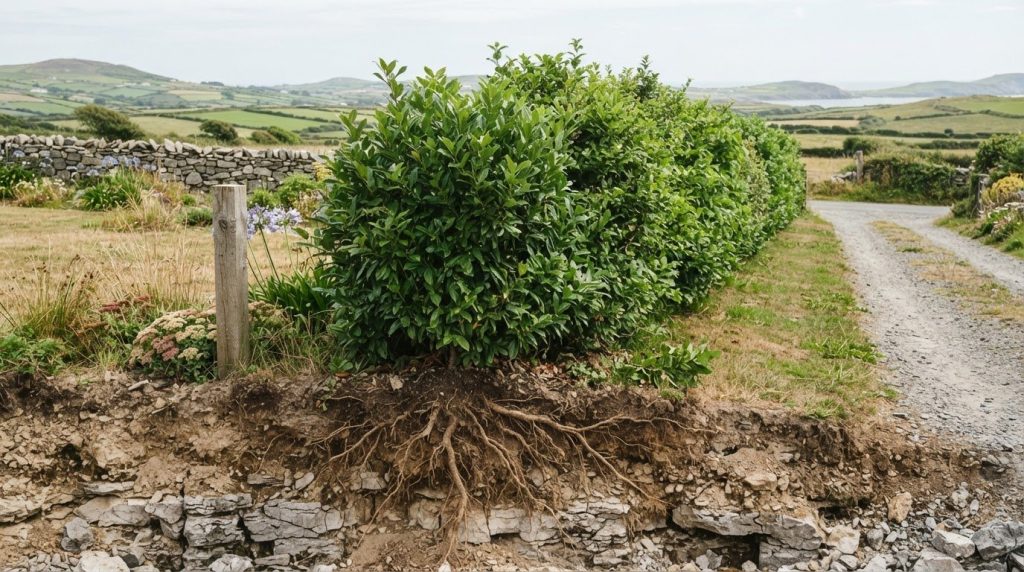
Thick, waxy leaves don’t determine whether a hedge survives an extended dry spell; deep root systems do. When sourcing drought tolerant hedging Ireland properties require, many homeowners mistakenly look for arid-climate species, only to watch them struggle through unpredictable seasonal shifts. If you’ve watched freshly planted boundaries wilt in free-draining sand or shallow limestone soils, you know the frustration of losing valuable plants to a sudden dry spring.
The reality is that practical drought tolerance doesn’t mean planting desert shrubs. It means selecting hardy, field-grown stock capable of seeking out deep groundwater once settled. In this guide, you will discover which resilient varieties genuinely withstand dry spells across Irish soils while maintaining reliable, long-term garden privacy. We examine proven evergreen and deciduous species, detail essential root establishment techniques, and highlight practical choices suited to poor ground and tough coastal exposure.
Key Takeaways
- Understand why choosing the right drought tolerant hedging Ireland gardens require depends on deep soil drainage rather than Mediterranean plant traits.
- Compare proven evergreen and deciduous hedging varieties, including Portuguese Laurel, Griselinia, and Hornbeam, that hold dense cover during dry spells.
- Assess site conditions accurately, matching hardy species to poor sandy soils, shallow limestone, or drying coastal winds.
- Master essential ground preparation and watering practices during early establishment to drive root systems deep into the subsoil.
- Calculate precise plant spacings per linear metre and evaluate root quality when sourcing healthy, field-hardened stock.
Understanding Drought Resilience in Irish Soils and Climate
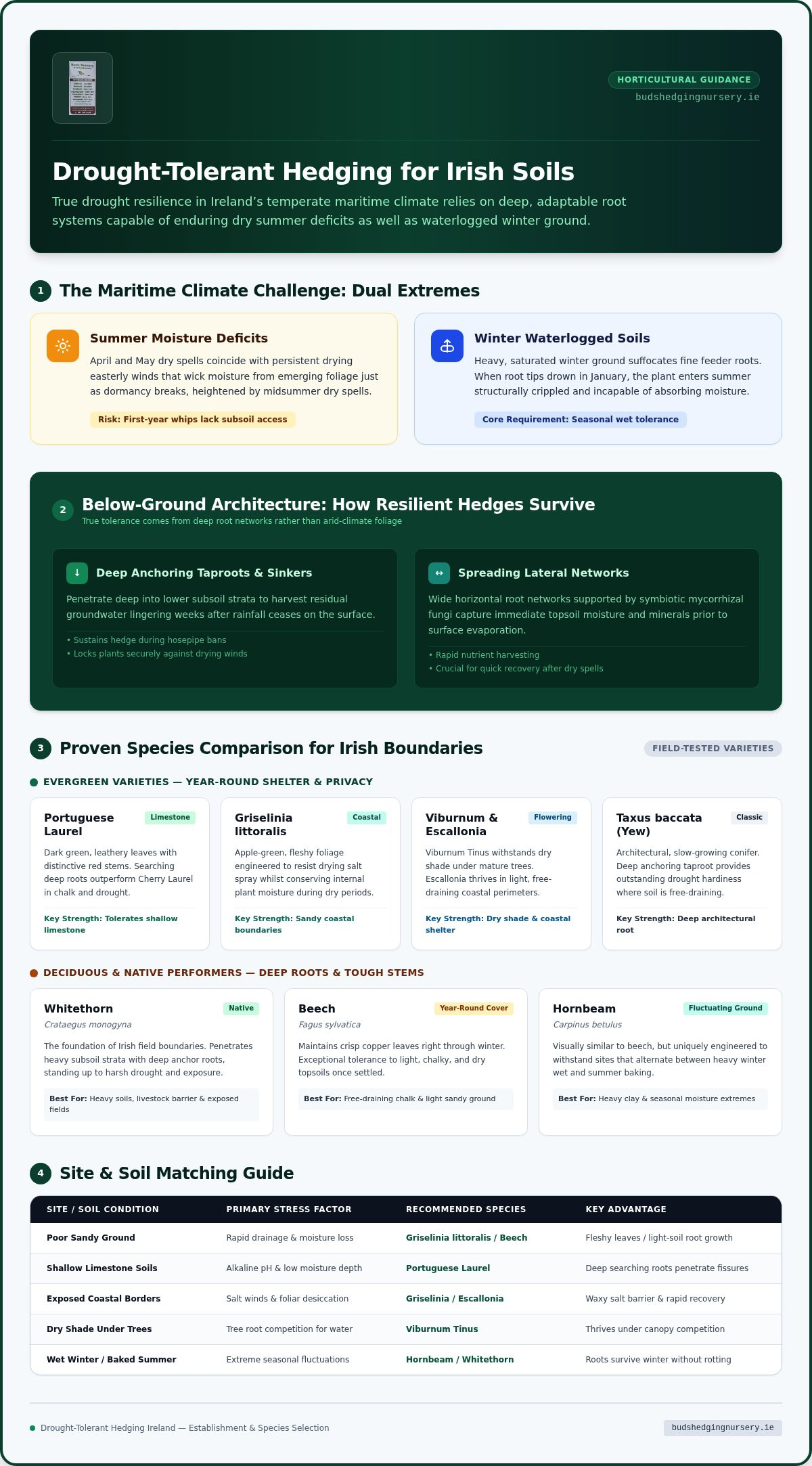
In a temperate maritime climate, drought tolerance has a very specific meaning. It doesn’t mean planting arid Mediterranean scrub that rots in heavy ground. Instead, successful drought tolerant hedging Ireland homeowners rely on must survive two opposing extremes: prolonged summer moisture deficits and waterlogged winter soils. A plant unable to endure saturated ground in January won’t survive a dry spell in June.
The Reality of Seasonal Dry Spells in Ireland
While annual rainfall figures remain high overall, seasonal precipitation patterns have shifted noticeably. Dry spells in April and May often coincide with persistent, drying easterly winds. These winds wick moisture directly from tender foliage just as plants break dormancy. When municipal hosepipe bans take effect during midsummer dry spells, established plants survive unaided. However, newly planted hedges lack the root depth required to pull water from lower soil profiles. During their first full growing season, young whips and potted stock remain entirely dependent on surface moisture.
Root Architecture: How Resilient Hedges Find Water
True resilience happens below the surface. As a hedge matures, it builds a two-part root structure:
- Deep anchoring roots: Taproots and vertical sinkers penetrate into cooler subsoil strata where residual moisture lingers through weeks of zero rainfall.
- Spreading lateral networks: Wide-reaching lateral roots, aided by symbiotic mycorrhizal fungi, harvest moisture and minerals from topsoil before surface water evaporates.
Winter soil structure directly dictates summer performance. Heavy, compacted ground that holds standing water suffocates delicate root tips through cold months. This root dieback leaves the hedge structurally crippled. When dry weather arrives, the plant cannot draw sufficient moisture because its feeder roots drowned months earlier. Selecting the right drought tolerant hedging Ireland sites require means choosing species with adaptable root systems capable of handling seasonal wet without compromising deep downward growth.
Top Drought Tolerant Hedging Species Compared for Irish Gardens
Selecting reliable drought tolerant hedging Ireland gardens need means choosing plants that match boundary height, privacy requirements, and soil depth. The Royal Horticultural Society’s practical guidelines on drought-resistant plants highlight how woody perennials handle dry soil once settled. The right hedge balances tough root systems with dense, manageable top growth across differing boundary conditions.
Evergreen Options: Year-Round Privacy with Low Water Needs
Evergreen hedges maintain reliable shelter throughout dry summers and wet winters without excessive leaf drop.
- Portuguese Laurel: Forms a dense boundary with dark green, leathery leaves on red stems. It establishes deep, searching root systems that tolerate both chalky limestone ground and severe summer dry spells far better than Cherry Laurel.
- Griselinia littoralis: Outstanding for sandy soils and exposed coastal perimeters. Its fleshy, apple-green foliage resists drying salt winds and conserves moisture during extended dry periods.
- Escallonia and Viburnum Tinus: Both varieties deliver year-round screening alongside summer or winter flowering. Viburnum Tinus tolerates dry shade beneath mature trees, while Escallonia thrives in free-draining coastal soils.
- Taxus baccata (English Yew): A classic architectural conifer. Slow-growing and long-lived, its deep taproot makes it exceptionally drought-hardy, provided the soil does not sit permanently waterlogged.
Deciduous and Native Performers: Deep Roots and Tough Stems
Deciduous varieties often outperform evergreens in erratic weather due to their extensive rooting habits.
- Whitethorn (Crataegus monogyna): The cornerstone of Irish field boundaries. It drives deep anchor roots through heavy subsoils, offering superb resistance to both severe summer drought and livestock pressure.
- Beech hedging plants: Fagus sylvatica suits light, chalky, or free-draining soils. It retains its crisp copper leaves throughout winter, providing year-round screening while remaining resilient to dry topsoil.
- Hornbeam (Carpinus betulus): Looks almost identical to beech but excels where ground fluctuates between winter wet and summer baking. Its dense fibrous root network tolerates heavy, cracked summer clays.
Thorny and Defensive Hedging for Arid Spots
Prickly hedges provide an effective security barrier while requiring minimal summer moisture. Berberis Darwinii and Firethorns (Pyracantha) both carry tough, small leaves and rigid spines that limit moisture loss. For striking colour in exposed, arid borders, Berberis Rose Glow offers marbled pink and purple foliage without sacrificing hardiness. These dense, tangled branch structures break strong drying winds and provide secure nesting sites for native birds.
When selecting varieties for challenging ground, ordering directly from specialist bare root and potted hedging growers ensures you receive sturdy, field-hardened plants suited to national climate demands.
Selecting the Right Drought Tolerant Hedge for Your Site Conditions
Every boundary presents its own microclimate. Simply picking a hardy species won’t guarantee survival if the plant doesn’t suit your garden’s specific drainage profile and exposure. Sourcing successful drought tolerant hedging Ireland plots demand requires matching root structures to natural soil composition while factoring in prevailing winds and boundary goals.
Matching Hedging to Free-Draining, Sandy, and Stony Soils
Coarse sand and stony ground allow rainfall to percolate straight past shallow root zones. In thin topsoils resting directly over limestone karst or bedrock, taproots cannot punch downward. Plants must spread horizontally to capture seasonal precipitation. Escallonia and Griselinia are natural choices here. Both handle poor, light soils without suffering chlorosis or sudden moisture stress, maintaining strong growth where heavier-feeding plants stall.
Wind Exposure and Coastal Boundaries
Coastal breezes and fierce easterly gales act like industrial dehumidifiers. Wind draws water vapour directly out through stomata faster than compromised roots can replace it. On open coastal perimeters, choose species with protective adaptations:
- Waxy foliage: Griselinia possesses thick, rubbery leaves that seal in sap and shrug off drying airborne sea salts.
- Small leaf surface area: Escallonia features glossy, compact foliage that cuts down wind resistance and transpiration losses.
Setting out a staggered double row rather than a single line filters wind velocity effectively. This creates a sheltered internal boundary that keeps delicate garden beds from desiccating.
Balancing Drought Resistance with Dense Privacy Screening
Many homeowners want dense, year-round seclusion without the constant drag of garden hoses during summer bans. For detailed recommendations on total boundary coverage, compare our guide on the best hedging for privacy. Achieving solid visual screening on dry ground requires precise plant spacing. Planting too close together forces root systems to fight over limited subsoil water, causing bottom foliage to brown and thin out. Planting Portuguese Laurel at 60 to 75 centimetres apart gives each root system ample ground to hunt for water, producing a thick, impenetrable hedge that stays vibrant through dry spells.
Planting and Establishment: Building Drought Resilience from Day One
Drought tolerance is cultivated, not purchased off the shelf. A hedge marked as drought-hardy can easily wither during its first season if planted incorrectly. For drought tolerant hedging Ireland properties need to stand strong year after year, your planting and early maintenance routine must guide the roots straight into deep subsoil rather than keeping them stranded near the surface.
Ground Preparation and Soil Improvement
Excavating a continuous trench rather than digging individual, isolated holes encourages roots to spread outward without hitting compacted edges. Blend well-rotted manure or organic compost evenly through the excavated soil. This increases moisture retention without turning the trench into an impermeable sump. Hold off on high-nitrogen synthetic fertilisers during dry periods. Chemical fertilisers push rapid leafy top growth while scorching delicate hair roots that desperately need water to survive.
Bare Root vs Containerised Plants for Dry Sites
Plant format heavily influences early drought resistance. Planting during the dormant bare root tree season between November and March offers significant advantages. Bare root stock settles into damp, cool ground without root restriction. By the time spring dry spells arrive, the root system has already pushed into surrounding soil strata. Potted hedging offers planting flexibility throughout the year. However, container-grown plants dry out rapidly in warm weather because their root balls remain isolated from native soil until secondary roots break free.
Early Watering Regimes and Mulch Application
Building resilient root networks requires deliberate, focused watering during the initial two years. Follow these straightforward steps to maximise moisture uptake:
- Soak deeply, water infrequently: Deliver a thorough drenching once a week rather than light daily sprinkling. Deep watering draws roots downwards toward moisture, whereas light surface watering encourages shallow, vulnerable root mats.
- Lay porous soaker hoses: Run a porous seep line along the base of the trench to deliver water straight to root level without evaporation losses.
- Apply coarse bark mulch: Spread a 75mm layer of composted wood mulch over the entire root zone to insulate the ground against baking sun. Keep the mulch pulled back roughly 50mm from plant stems to prevent bark rot.
To inspect healthy, dormant stock ready for autumn and winter planting, contact our nursery team to arrange a visit or delivery across the country.
Sourcing Quality Hedging Plants from an Established Irish Nursery
Healthy establishment begins with the physical quality of the stock you put into the ground. When securing drought tolerant hedging Ireland landowners depend on for decades of privacy, imported container plants grown under soft glasshouse conditions simply cannot compete with field-hardened stock. Inspecting root systems, stem calibers, and overall branch architecture before planting prevents expensive failures down the line.
Why Field-Grown Nursery Stock Outperforms Imports
Hedge plants lifted from open ground have spent their early years adapting directly to natural rainfall variations, seasonal chills, and exposed field winds. Buds Nursery Cavan brings over thirty years of dedicated growing experience across expansive Irish grounds. This long-term cultivation produces strong main stems and dense, fibrous root balls designed to settle quickly into native ground. Field-grown stock develops a natural hardiness that imported plants, forced quickly under artificial heat and irrigation, simply do not possess.
Calculating Quantities, Spacing, and Hedging Layouts
Getting your plant numbers right prevents both sparse gaps and overcrowded root competition during dry periods. Spacing depends directly on the chosen species and planting layout:
- Single row layout: Ideal for formal, narrow garden boundaries. Space bushy evergreens like Portuguese Laurel, Griselinia, and Taxus baccata at 60cm intervals. Compact or slow-growing varieties can be set closer, down to 30cm to 45cm apart.
- Staggered double row layout: The industry standard for native stock like Whitethorn, Beech, and Hornbeam, or where dense wind filtering is required. Plant in a zig-zag pattern across two parallel trenches 40cm apart, using four to six plants per linear metre.
- Boundary calculation formula: Multiply boundary length in metres by your chosen plant density (e.g., 30m boundary × 4 plants per metre = 120 plants). Always round up slightly to allow for occasional corner adjustments.
Arranging Expert Guidance and Nationwide Delivery
Visiting expansive nursery grounds allows you to examine mature specimens and observe growth habits firsthand. Practical horticultural advice is available on-site from Tuesday to Saturday, helping you match specific hedge varieties to your soil structure and prevailing aspect. For large domestic boundaries and commercial planting schemes, an arranged nationwide delivery service transports bare root and containerised orders directly to your site, timed carefully around optimal lifting schedules to keep root systems fresh and viable.
Secure Your Boundary Against Changing Seasons
A thriving garden screen relies on honest ground preparation and matching species to site conditions. By focusing on deep root establishment rather than frequent shallow watering, you protect your boundary against erratic spring dry spells and summer hosepipe bans. Proven performers like Portuguese Laurel, Griselinia, and native Whitethorn demonstrate that dense shelter and privacy don’t require constant irrigation once properly anchored.
Investing in the right drought tolerant hedging Ireland properties need begins with sturdy root systems. Backed by over thirty years of dedicated growing experience, our field-hardened stock is cultivated on open ground to withstand unpredictable Irish weather cycles. For larger domestic borders and commercial projects, our nationwide delivery service brings hardy bare root and containerised plants directly to your site. Explore our extensive hedging range and discuss your garden requirements with our nursery specialists to establish a resilient, lasting boundary.
Frequently Asked Questions
Which hedging plant is the most drought tolerant in Ireland?
Whitethorn (Crataegus monogyna) is the most drought-hardy native hedging plant in Ireland, while Portuguese Laurel is the top performing evergreen. Whitethorn produces deep, tenacious taproots that anchor into cool subsoil water reserves during extended heat. For year-round garden privacy, Portuguese Laurel handles shallow limestone and sandy ground far better than common laurel, retaining its deep green foliage through weeks without rain once established.
Do drought tolerant hedges need watering when first planted?
Yes, every newly planted hedge requires regular watering during its first one to two growing seasons. Drought tolerance is an acquired trait that only develops after the root architecture extends deep into the ground. During the initial spring and summer, young root balls sit near the surface where ground dries quickly. Providing a heavy, weekly soak encourages downward root development, ensuring plants survive future dry spells unaided.
Can evergreen privacy hedges survive dry summer conditions in sandy soil?
Yes, select evergreen species like Griselinia littoralis and Portuguese Laurel thrive in sandy, fast-draining soils during dry summers. Light, sandy soils drain moisture rapidly past surface roots, but Griselinia handles this environment exceptionally well due to thick, leathery leaves that restrict moisture evaporation. Portuguese Laurel also performs reliably if you incorporate well-rotted organic matter into the planting trench to improve natural moisture retention and support outward root spread.
How long does it take for a hedge to become truly drought tolerant?
It typically takes two to three full growing seasons for a hedge to develop true drought resilience. During the first two years, root systems are actively establishing lateral networks and driving sinker roots deeper into the subsoil. Until these deep anchors reach underlying moisture tables, the plants remain vulnerable to sudden rainfall deficits. Once the hedge forms an established root profile by year three, routine summer watering isn’t needed.
Is bare root hedging or potted hedging better for dry ground?
Bare root hedging is generally better for establishing long-term resilience on dry ground, provided it is planted between November and March. Bare root whips develop natural, unrestricted root systems directly into native soil over winter, establishing a sturdy foundation before warm weather begins. Potted plants can be planted later in the year, but their root balls dry out faster during summer heat and require careful irrigation until secondary roots break free.
Will a drought tolerant hedge survive waterlogged soil in an Irish winter?
Survival depends entirely on the chosen species, as some drought-hardy plants cannot tolerate standing winter water. Choosing effective drought tolerant hedging Ireland gardens require means balancing dry summers with saturated winters. Hornbeam and Whitethorn manage winter wet exceptionally well while holding firm during summer dry spells. Conversely, species like Taxus baccata (Yew) suffer fatal root rot if left in waterlogged ground through the winter, requiring free-draining ground.
How does mulching help hedging survive prolonged summer dry spells?
Mulching prevents soil evaporation and regulates ground temperature around the root zone during prolonged dry spells. Applying a 75mm layer of coarse bark or well-rotted organic mulch locks in residual winter moisture, shielding the topsoil from baking sun and drying winds. It also suppresses weeds that aggressively compete with young hedge roots for moisture. Keeping mulch slightly clear of plant stems ensures proper airflow while keeping the soil damp.