

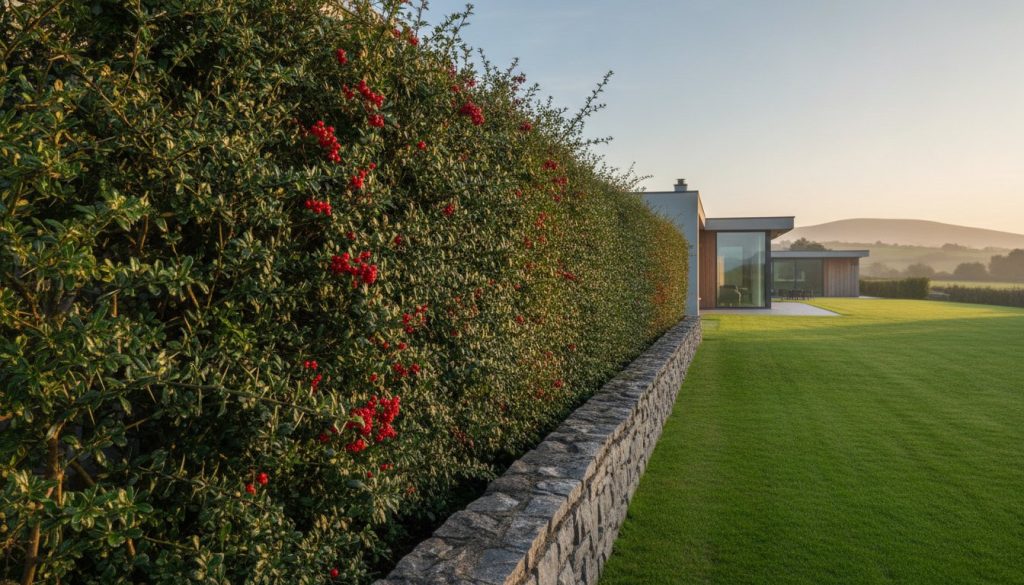
Can a garden boundary actually do more than just mark your property line? It’s natural to feel concerned about the security of your home or land. Many property owners find themselves stuck between wanting a secure perimeter and avoiding a space that looks like a fortress. By choosing the right security hedging plants with thorns, you can create a natural defence that is both attractive and virtually impossible to push through.
We understand that the prospect of maintaining prickly species can feel daunting, but the long-term peace of mind provided by a living barrier is well worth the effort. This guide provides a straightforward look at the most effective thorny species for the Irish climate, from the year-round cover of Berberis Darwinii to the seasonal strength of Whitethorn. You’ll learn which species grow thick enough to stop an intruder, the best planting densities for a solid barrier, and how to manage your hedge with confidence. We’ll also clarify the differences between evergreen and deciduous options to help you choose the right fit for your property’s specific needs.
Key Takeaways
- Identify the most effective security hedging plants with thorns, such as Berberis and Firethorns, to establish a robust physical defence.
- Learn why native species like Whitethorn and Blackthorn offer the best protection for large rural perimeters and local wildlife.
- Master the double-staggered row planting technique to create an impenetrable, gap-free barrier that improves over time.
- Understand the psychological impact of thorny boundaries in deterring intruders before they even attempt access.
- Discover the practical advantages of sourcing nursery-grown plants that are already hardened to the specific demands of the Irish climate.
Understanding the Role of Security Hedging with Thorns
Security hedging is much more than a decorative garden border. It is a functional, living barrier designed to protect your property by deterring and delaying unauthorised access. Unlike a timber fence that can be kicked through or a steel gate that can be climbed, a well-established hedge becomes a permanent, self-strengthening obstacle. It serves as a first line of defence for your home or land.
Most intruders are opportunists looking for the path of least resistance. A thick wall of security hedging plants with thorns presents a clear psychological deterrent. The prospect of ruined clothing and painful scratches is often enough to convince a trespasser to move on to an easier target. It makes your property look “too much trouble” to bother with, which is the ultimate goal of any security measure. To complement your external defences with professional door hardware and safety technology, you can visit JADE Safety.
In Ireland, using natural barriers also offers aesthetic and legal advantages. While there are no specific height limits for garden hedges in national law, you must ensure your boundary doesn’t obstruct public footpaths or road visibility. Choosing a living hedge over a high security fence often avoids the need for planning permission while providing a soft, green backdrop that supports local biodiversity. It is a no-nonsense solution that looks good and works hard.
Thorns vs. Density: Why You Need Both
The “sting” of a plant comes from the defensive mechanisms of thorny plants, but thorns alone are not enough to stop a person. If the branches are sparse, an intruder can simply use a board or heavy coat to push their way through. To be truly effective, you need high branch density to create a solid wall. Species like Berberis Darwinii or Firethorns (Pyracantha) are excellent because they produce a mass of interlocking, prickly stems. This combination makes it nearly impossible to part the branches without coming into contact with sharp spines.
Evergreen vs. Deciduous Security Barriers
Choosing the right type of security hedging plants with thorns often comes down to your specific site requirements. Evergreens, such as Holly or certain Berberis varieties, provide year-round foliage. This is ideal if you want privacy and a visual screen in addition to security. However, deciduous options should not be dismissed. Species like Whitethorn (Hawthorn) or Blackthorn are incredibly hardy and develop a dense, woody structure. In the winter months, the lack of leaves actually makes the intricate network of sharp thorns more visible and intimidating. Deciduous hedges are often the preferred choice for long, rural boundaries where structural strength is the priority.
The Most Effective Security Hedging Species
Selecting the right security hedging plants with thorns requires a balance between physical deterrents and structural resilience. For a hedge to be truly effective in the Irish climate, it must be hardy enough to withstand damp winters whilst maintaining a growth habit that resists being pushed aside. Many property owners make the mistake of choosing plants with large thorns but sparse branches. A truly “heavy-duty” hedge uses a network of interlocking stems to create a wall that is as much a physical barrier as it is a painful one.
Berberis (Barberry): The Ultimate Deterrent
Berberis is widely regarded by professional growers as one of the most formidable choices for property protection. Berberis darwinii is a particular favourite for its tough, evergreen leaves and clusters of incredibly sharp, needle-like spines. It grows into a dense, multi-stemmed shrub that is very difficult to breach. If you want to add visual interest without compromising on safety, Berberis Rose Glow offers striking mottled foliage. Its habit is naturally compact and stiff, meaning it doesn’t just scratch an intruder; it provides a rigid obstacle that doesn’t yield under pressure. These plants are exceptionally reliable and thrive in most soil types found across Ireland.
Pyracantha (Firethorns): Beauty with a Bite
Firethorns earn their name from the long, stiff thorns hidden amongst their glossy evergreen leaves. Whilst they produce beautiful white flowers in spring and vibrant berries in autumn, their primary value for security lies in their versatility. You can grow Pyracantha as a free-standing, thick hedge or train it against a wall or fence to prevent climbing. The thorns are strong enough to pierce heavy fabric, making it a “burglar-proof” addition to any boundary. As an added benefit, the dense structure and autumn berries provide excellent shelter and food for local bird populations, making it a functional choice for both security and wildlife.
Holly (Ilex aquifolium): The Traditional Choice
Holly is a classic component of the Irish landscape and remains one of the best natural defences available. Its thick, leathery leaves are equipped with sharp points that remain effective throughout the year. Although Holly is slower-growing than some other species, the resulting wood is incredibly dense and strong. Once established, a Holly hedge is nearly impossible to penetrate. It is an excellent choice for those who want a permanent, low-maintenance boundary that also offers total visual screening. For more information on using hedging to block line-of-sight, you can read our guide on the Best Hedging for Privacy in Ireland.
Choosing between these species depends on your specific site conditions and how much space you have available. If you are unsure which variety will suit your soil, visiting our specialist nursery allows you to see mature examples of these plants and judge their density for yourself before making a decision.
Native Thorny Hedging for Rural Security
For large rural properties or farm boundaries, native species offer a level of resilience that ornamental varieties often struggle to match. These security hedging plants with thorns have been the standard in the Irish landscape for centuries. They are adapted to our soil and weather, making them incredibly hardy and low-maintenance. Using bare root plants during the dormant season, typically from November to March, is the most cost-effective way to secure long perimeters. These plants are significantly more affordable than container-grown equivalents when bought in bulk.
Whitethorn (Hawthorn): The Backbone of Irish Fields
Whitethorn is the traditional choice for creating a “stock-proof” barrier. Its growth habit is naturally dense and stiff, forming an interlocking structure that is very hard to push through. In spring, it provides a flush of white blossom, followed by red haws in autumn. Whilst it is deciduous, the intricate network of woody stems and sharp thorns remains a formidable obstacle throughout the winter months. It responds very well to regular trimming, which only serves to increase its density over time. This makes it an ideal choice for a permanent, structural boundary.
Blackthorn (Prunus spinosa): An Impenetrable Thicket
If you require a boundary that is truly impenetrable, Blackthorn is hard to beat. It carries exceptionally long, sharp thorns that can easily pierce skin and thick clothing. Unlike Whitethorn, Blackthorn has a tendency to sucker, meaning it spreads outwards to create a deep, wide thicket. This makes it ideal for areas where you want a “wilder” look and have the space to let the hedge expand. It is often the first to flower in late winter, providing vital early nectar for insects before its leaves appear. It is a no-nonsense plant for high-security areas.
One of the greatest advantages of native hedging is the support it provides for local biodiversity. Out of the 110 bird species regularly recorded during the breeding season in Ireland, 35 of those species nest in hedgerows, finding safety amongst the thorns. For those looking to plant at scale, the Native Trees Scheme Plants provides a structured way to access approved species. In many cases, using these native varieties ensures your project aligns with environmental standards while providing a robust, living defence.

Planting and Spacing for Maximum Deterrence
Creating a robust barrier with security hedging plants with thorns is a task that requires precise layout. A single row of plants is rarely enough to stop a determined intruder. The strength of a natural defence comes from its structural density, which is achieved through a layered planting approach. If you leave gaps at the base, the hedge becomes a visual screen rather than a physical obstacle. To prevent this, you must focus on the “architecture” of the hedge from day one.
Successful establishment also depends on soil preparation. We recommend digging a trench rather than individual holes to ensure the root systems have plenty of loose, aerated soil to expand into. Adding well-rotted organic matter or a slow-release fertiliser helps the plants settle quickly. This is especially important for thorny species, as you want them to develop thick, woody stems as fast as possible to close any potential entry points.
The Security Spacing Checklist
To create an impenetrable wall, we suggest using the double-staggered row method. This involves planting two parallel lines of hedging to create a “zig-zag” effect. For maximum security, aim for five plants per metre, which roughly equates to one plant every 40cm. Follow these steps for a professional finish:
- Step 1: Mark out two parallel lines 30cm apart using garden twine to keep your rows straight.
- Step 2: Space your plants in a “W” pattern along the lines, ensuring the plants in the second row sit in the gaps of the first.
- Step 3: Check the alignment from several angles to ensure no vertical gaps are left for an intruder to see through.
Maintaining the Barrier: Pruning for Density
A hedge that is left to grow unchecked will naturally become thin at the bottom and bushy at the top. This is the opposite of what you need for security. Regular trimming is essential to force the plant to produce new growth at the base. We advise a “little and often” approach during the first two or three years. By cutting back the leading shoots, you encourage the side branches to knit together, creating a solid mass of thorns that cannot be easily parted.
Handling these species requires respect for their defensive nature. Always wear heavy-duty leather gloves and eye protection when pruning. Thorny branches can be unpredictable when cut and may spring back towards you. If you are planning a large-scale project, sourcing your plants from an experienced grower ensures you start with healthy, sturdy stock that is ready to withstand the rigours of the Irish climate. Proper maintenance ensures your investment remains a formidable deterrent for decades.
Sourcing Quality Security Hedging in Ireland
Choosing where to buy your security hedging plants with thorns is as important as the species you select. A specialist nursery offers a level of quality and resilience that generic garden centres often cannot match. Plants grown in a nursery environment are tended by professionals who understand the specific growth habits required for a secure boundary. When you source plants that have been hardened to the Irish climate, you ensure they can withstand our damp winters and unpredictable springs. This local adaptation leads to a higher survival rate and faster establishment once the plants are in the ground.
At Buds Nursery, we operate across 60 acres of dedicated production space. This scale allows us to grow a vast range of security species in large quantities, ensuring consistency in size and health across your entire order. We encourage customers to visit the nursery in person. Seeing mature examples of thorny hedging allows you to judge the density and physical deterrent of different species before you commit to a purchase. It takes the guesswork out of planning your natural defence.
Bare Root vs. Pot Grown for Security
The choice between bare root and pot-grown plants usually depends on your budget and timeline. Bare root plants are only available during the dormant season. They are the most logical choice for long, defensive boundaries because they are easy to handle and cost-effective in large numbers. For a detailed look at the timing of these projects, see our guide to Bare Root Tree Season Ireland. If you need “instant” security or are planting outside the winter months, pot-grown plants are the better option. They can be planted year-round and provide a more immediate visual impact, though the initial investment per plant is higher.
Expert Guidance at Buds Nursery
Securing a property requires more than just buying plants; it involves understanding soil, spacing, and long-term maintenance. We have over 30 years of experience helping customers find the right solutions for their land. Whether you are protecting a small garden or a large rural perimeter, our team provides practical, no-nonsense advice. We also offer a national delivery service for large security hedging orders, ensuring your plants arrive in top condition regardless of your location. Visit Buds Nursery to find your perfect security hedge and speak with our experts about your specific requirements.
Building Your Permanent Natural Defence
A well-planned boundary is more than a line on a map; it’s a long-term investment in your property’s safety. By selecting the right security hedging plants with thorns, you create a barrier that is both physically intimidating and aesthetically pleasing. Whether you choose the year-round density of Berberis or the rugged structural strength of native Whitethorn, the key is to prioritise both sharp deterrents and thick growth. Using the double-staggered planting method ensures your hedge remains gap-free and effective for decades.
With over 30 years of horticultural expertise, we understand the practicalities of securing Irish land. Our 60-acre specialist nursery produces sturdy, climate-hardened stock ready for immediate planting. We offer national delivery on all hedging orders, making it straightforward to start your project wherever you are located. Explore our range of security hedging at Buds Nursery to find the species that best suits your site. A living defence only gets stronger with time, providing you with a reliable and low-maintenance boundary for years to come.
Frequently Asked Questions
What is the fastest-growing thorny hedge for security?
Firethorns (Pyracantha) and Berberis varieties are amongst the quickest to establish a robust barrier. These species can grow significantly each season when planted in well-prepared soil with adequate organic matter. Whilst they grow fast, regular trimming is still required to ensure the growth remains dense at the base rather than becoming leggy. This ensures your security hedging plants with thorns provide a solid physical obstacle within just a few growing seasons.
Are thorny security hedges legal to plant on a boundary?
Yes, it is legal to plant thorny hedges on your property boundary, provided they don’t interfere with public rights of way or road safety. In Ireland, there are no specific national laws limiting the height of garden hedges, but you should ensure they don’t block visibility for motorists or obstruct footpaths. It’s always best practice to discuss boundary planting with neighbours to maintain good relations and ensure the hedge is managed effectively on both sides.
How far apart should I plant Berberis for a secure hedge?
For a truly secure barrier, we recommend planting Berberis Darwinii at a density of five plants per metre in a double-staggered row. This involves spacing the plants roughly 40cm apart in two parallel lines. This specific architecture prevents gaps from forming as the plants mature. A single row at 30cm intervals can work for smaller gardens, but the double-staggered method provides the structural density needed to stop an intruder from pushing through the branches.
Which thorny hedge is evergreen and provides the best privacy?
Holly and Berberis Darwinii are the top choices for an evergreen hedge that combines security with total privacy. These species retain their prickly foliage throughout the year, ensuring your boundary remains impenetrable and screened from view even in the dead of winter. Holly is slower-growing but becomes exceptionally dense over time, whilst Berberis offers faster coverage and sharp spines that act as a permanent deterrent to unauthorised access across your property.
Can I mix different thorny species in one hedge?
Mixing different thorny species is an excellent way to create a more resilient and biodiverse security boundary. A combination of native plants like Whitethorn, Blackthorn, and Holly creates a varied physical deterrent that is very difficult to navigate. This approach also supports local wildlife by providing different flowering times and food sources. We often recommend a mixed native hedge for large rural perimeters where both security and environmental benefits are high priorities for the land owner.
How do I prune a thorny hedge safely?
Pruning thorny species requires the right safety gear, specifically thick leather gauntlets and wrap-around eye protection. You should use sharp, clean bypass loppers or shears to make clean cuts, which helps the plants heal faster. We suggest a “little and often” approach to encourage thick growth at the base. Always check for nesting birds before you start, as it’s an offence to disturb them during the nesting season from March to August in Ireland.
Is Whitethorn or Blackthorn better for a secure farm boundary?
Blackthorn is generally considered the more impenetrable option due to its exceptionally long thorns and tendency to sucker into a deep thicket. However, Whitethorn is the traditional backbone of Irish farm boundaries because it creates a stiffer, more structural barrier that is ideal for stock-proofing. For the best rural security, we often suggest a mix of both. This combination utilises the structural strength of Whitethorn with the aggressive defensive qualities of Blackthorn.
Do thorny hedges require a lot of maintenance?
No, once established, security hedging plants with thorns are remarkably low-maintenance compared to timber or steel fencing. Most thorny species only require an annual or bi-annual trim to maintain their shape and encourage density. Because these plants are hardy and adapted to the Irish climate, they don’t need regular watering or complex feeding schedules once their root systems are deep. They provide a permanent, self-repairing security solution that actually improves in strength as the plants age.