


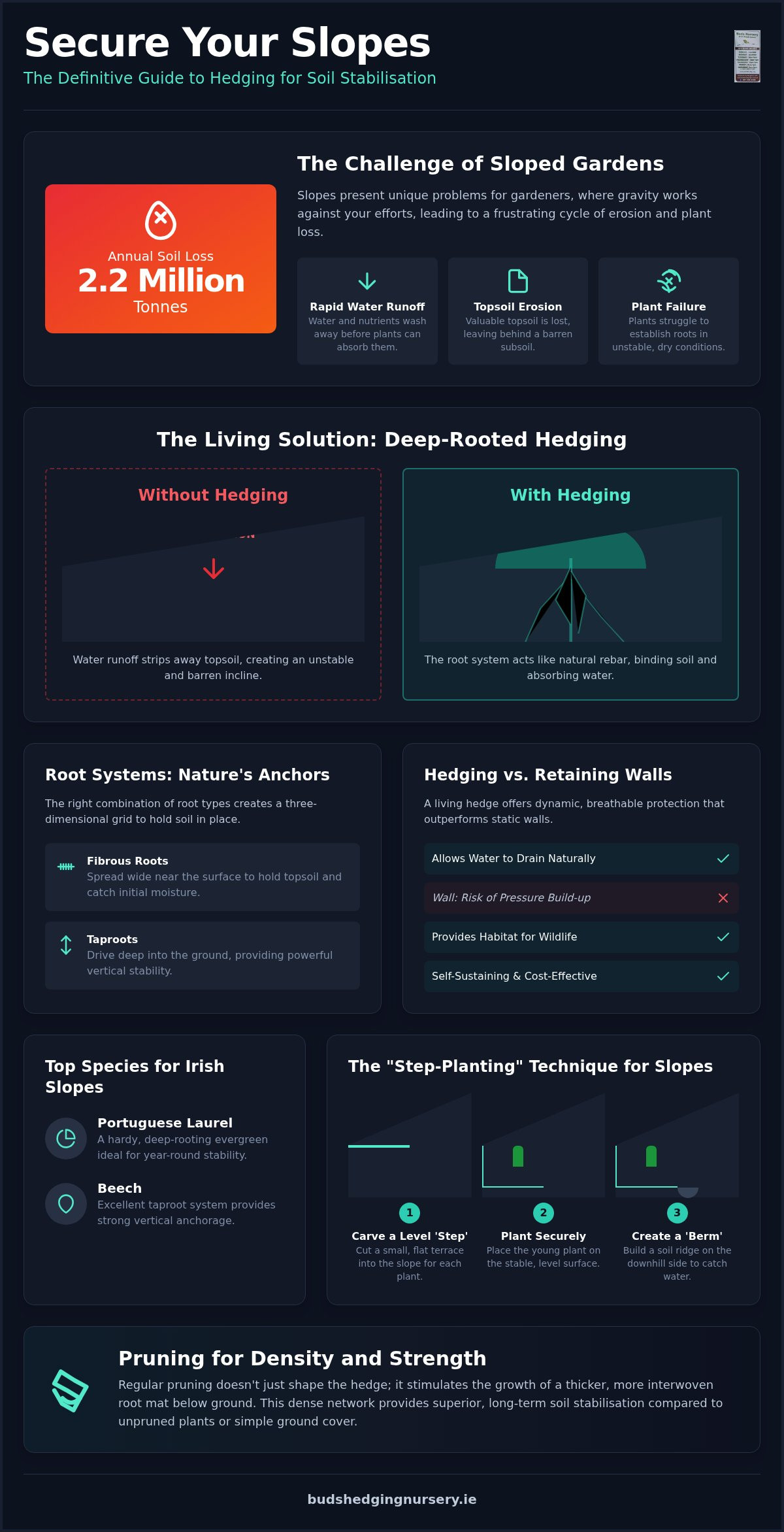
Did you know that an estimated 2.2 million tonnes of topsoil are lost to erosion every year? For anyone managing an incline, this statistic isn’t just a dry figure. It is the sight of your mulch washing away after a heavy downpour or the constant struggle of trying to maintain a steep bank. Gardening on a slant presents unique challenges. Fast water runoff. Soil loss. Plants failing to establish. It’s frustrating to watch your hard work slide down a hill whilst the landscape shifts under your feet.
Selecting the correct hedging for a sloped garden can transform a problematic bank into a secure, low-maintenance boundary. A well-chosen hedge does more than just mark a line; its root system acts as a natural anchor to hold the earth together. In this guide, we’ll show you how to choose and plant the perfect species to stabilise your soil whilst creating a beautiful screen. We will cover deep-rooting varieties, practical planting techniques for Irish conditions, and how to reduce your garden maintenance for the long term. By the end, you’ll have a clear plan to turn your difficult slope into a stable and stylish garden feature.
Key Takeaways
- Understand how deep-rooting plants act as natural reinforcement to prevent soil erosion and manage water runoff on steep banks.
- Identify the best species of hedging for a sloped garden, focusing on hardy varieties like Portuguese Laurel and Beech that thrive in the Irish climate.
- Learn the “step-planting” technique to create stable mini-terraces, ensuring young plants establish securely without washing away.
- Discover how regular pruning for density creates a thicker root mat, providing superior long-term soil stabilisation compared to standard ground cover.
- Transform difficult, hard-to-mow inclines into beautiful, low-maintenance boundaries that add both privacy and structural integrity to your property.
Understanding the Challenges of Gardening on a Slope
Managing an incline requires a different mindset than a flat plot. When you are planning hedging for a sloped garden, you aren’t just looking for a boundary; you’re looking for a structural solution. Slopes are dynamic environments. Gravity is always at work, pulling soil, water, and nutrients downward. Without intervention, a beautiful bank can quickly become a scarred landscape of bare patches and exposed subsoil. Maintaining a grassy bank is also a physical struggle. Trying to balance a lawnmower on a steep angle is hazardous, and weeding an incline is exhausting. Hedging provides a superior alternative to expensive stone walls or high-maintenance grass.
The Problem with Water and Nutrients
On a steep incline, water doesn’t sit long enough to soak into the ground. Heavy Irish rain cycles often lead to sheet runoff, where the water gains momentum as it travels down the bank. This bypasses the root zones of shallow-rooting plants, leaving them parched even during wet spells. Along with the water goes your valuable topsoil and fertilisers. Nutrient-rich organic matter often ends up at the bottom of the hill rather than feeding your plants. Thirsty species often fail to thrive amongst steep inclines because they simply can’t access moisture before it’s gone.
Erosion: The Silent Threat to Your Garden
Bare soil is an invitation for trouble. Wind exposure on elevated sites dries out the surface, making it easier for rain to wash it away. You might notice small gullies forming or silt collecting at the foot of the bank. These are clear signs that your garden needs structural help. The Role of Hedging in Soil Stabilisation is vital here. Unlike a static retaining wall, a living hedge creates a permeable barrier. It allows water to pass through slowly whilst the roots bind the earth together like natural rebar. Identifying these signs early prevents long-term stability issues that could eventually threaten the integrity of your garden boundaries.
A well-established hedge creates a permanent, self-sustaining screen. It manages the slope’s natural behaviour without the need for constant, dangerous upkeep. By choosing the right species for hedging for a sloped garden, you create a functional asset that protects the land whilst enhancing the privacy of your home.
The Role of Hedging in Soil Stabilisation and Erosion Control
Hedges are more than just a visual boundary. They function as a biological engineering system where the root architecture acts like natural rebar to reinforce the earth. Whilst surface ground cover protects the top layer of soil from wind, it often lacks the depth to prevent a bank from shifting. Deep-rooting hedging plants provide a three-dimensional grid that binds the subsoil. This structural integrity is essential when planning hedging for a sloped garden. By breaking the speed of both wind and rain runoff, a mature hedge ensures that water enters the ground slowly rather than carving channels into your bank.
Root Systems as Structural Anchors
The effectiveness of a hedge depends on its root type. Fibrous roots spread wide to catch surface moisture and hold the topsoil. Taproots, however, drive deep into the ground to provide vertical stability. A combination of both is ideal for steep inclines. Establishing these anchors requires timing. The bare root tree season Ireland provides the best window for planting. During this dormant period, plants can focus their energy on developing a robust rhizosphere. This is the area of soil directly influenced by root secretions and microorganisms. It creates a sticky, stable environment that resists erosion even during heavy winter rains.
Hedging vs. Retaining Walls
Hard landscaping like timber or stone walls is often the first thought for a slope. These structures are expensive and can fail if drainage is poor. Hydrostatic pressure builds up behind a solid wall, which can lead to cracks or collapse. A hedge is a “living wall” that breathes. It allows excess water to drain naturally whilst the foliage creates a baffle against the elements. Research has shown the effectiveness of hedging in soil stabilisation and erosion control, proving that natural barriers can outperform man-made ones over time.
Beyond stability, hedges offer environmental benefits that a stone wall cannot. They provide nesting sites for birds and food for pollinators. They also sequester carbon, helping your garden contribute to local biodiversity. If you are looking for a cost-effective, long-term solution, you might browse our selection of hardy hedging to find the right fit for your terrain. A well-placed hedge is a permanent investment in the safety and style of your property.
Selecting the Best Hedging Species for Sloped Terrain
Not every plant can handle the unique pressures of an incline. When choosing hedging for a sloped garden, you must prioritise species with high root vigour and a hardy nature. Slopes are often more exposed to wind and experience faster soil drainage than flat ground. This means your chosen hedge needs to be resilient enough to withstand drying winds whilst its roots work to anchor the bank. Matching the growth rate of the plant to your maintenance capacity is also vital. A fast-growing hedge provides quick stability but requires more frequent trimming on what might be difficult, uneven ground.
Top Evergreen Choices for Stability
Evergreens are often the preferred choice for slopes because they provide year-round foliage. This canopy helps to break the impact of heavy rain before it hits the soil, reducing surface erosion. Portuguese Laurel is a standout performer in the Irish climate. It’s exceptionally hardy, handles exposed sites well, and produces a deep, structural root system. For those who need faster coverage, Cherry Laurel is a vigorous grower that establishes quickly to bind loose topsoil.
In coastal or particularly windy areas, Griselinia and Escallonia are excellent options. They offer thick, leathery leaves that resist salt spray and wind burn. If you’re also looking to block out neighbours on an elevated site, you can find more screening options in our guide on the best hedging for privacy Ireland. These species ensure your boundary remains green and functional throughout the winter months.
Deciduous and Native Options
Deciduous hedges shouldn’t be overlooked for sloped terrain. Green Beech and Copper Beech are classic choices that offer a unique advantage. Whilst they lose their sap in winter, they often retain their dried brown leaves until the new growth appears in spring. This provides a degree of wind protection and privacy year-round. Their root systems are notoriously strong, making them ideal for long-term stabilisation of steep banks.
For larger projects or rural boundaries, Whitethorn and Hornbeam are the reliable workhorses of the landscape. These are primary choices amongst the native trees scheme plants. They are incredibly tough and adapt well to various soil types, including the heavier clays often found on Irish hillsides. If you want to add a splash of colour to a difficult bank, Photinia Red Robin provides vibrant red new growth in spring whilst maintaining a dense, evergreen structure that helps keep the soil in place.
Selecting the right species is the first step. The next stage is ensuring the planting method accounts for the angle of the land to give these young plants the best start possible.
Step-by-Step Guide to Planting Hedging on Banks and Slopes
Planting hedging for a sloped garden requires more precision than working on level ground. If you simply dig a hole at an angle, the root ball will struggle to absorb water and the plant will grow lopsided. Preparation is the first priority. Clear all perennial weeds thoroughly before you begin. It’s much harder to manage invasive roots on a steep incline once your hedge is established. Whilst you should improve the soil with organic matter, avoid over-tilling the entire bank. You want to maintain as much natural soil structure as possible to prevent the bank from becoming unstable during the planting process.
The Mechanics of Step-Planting
The most effective way to ensure stability is through “step-planting”. This involves digging a level “shelf” or mini-terrace into the slope for each individual plant. By creating a flat base, you allow the root system to sit naturally. Ensure the stem of the plant is perfectly vertical, regardless of the angle of the hill. When you backfill the hole, pay extra attention to the downhill side. Firm the soil in well with your heel to remove air pockets. This creates a solid “shoulder” of earth that supports the plant and prevents water from simply washing the soil away from the roots.
Mulching and Stabilisation Mats
Until the root systems are fully established, the disturbed soil on your bank is vulnerable to heavy rain. Biodegradable jute or coir matting is an excellent tool here. You can pin these mats over the slope and plant through small slits. They hold the earth in place for several years whilst the roots grow deep enough to take over the job. For mulching, choose heavy, ornamental bark nuggets rather than light compost or fine woodchips. Light materials will wash to the bottom of the slope after the first Irish rain cycle. Mulching on a bank creates a protective layer that slows evaporation and ensures the soil remains moist enough for root development.
Watering on an incline can be tricky because gravity pulls moisture away before it can soak in. Build a small ridge of soil on the downhill side of each plant to act as a dam. This catches water and directs it straight to the root ball. For the best results on challenging terrain, order our hardy hedging plants that are grown to withstand the rigours of the Irish climate. Proper planting technique combined with resilient stock is the secret to a successful, long-lasting boundary on any slope.
Maintaining Your Sloped Hedge for Long-Term Success
Maintaining hedging for a sloped garden requires a methodical approach to preserve the structural integrity you have built. It isn’t just about aesthetics. Pruning and feeding directly impact the hedge’s ability to hold the soil in place. If the hedge becomes thin or leggy, its capacity to baffle wind and bind the earth diminishes. Regular care ensures the roots stay healthy and the foliage remains dense enough to protect the ground surface from heavy rain impact. This long-term commitment turns a difficult incline into a permanent, self-sustaining garden feature.
Safety is a major consideration on uneven ground. Always work across the slope rather than up and down when using power tools. Long-reach hedge trimmers are often safer than using ladders on an incline. Ensure you have firm footing before starting any work. If the bank is particularly steep, consider installing a few stable stepping stones to provide a secure platform for your annual maintenance routine. This prevents you from slipping and compacting the soil unnecessarily around the root zones.
Pruning and Shaping for Strength
A tapered shape is vital for hedges on a bank. You should always trim the top narrower than the base. This “A-shape” profile allows sunlight to reach the lower leaves, preventing the bottom of the hedge from becoming sparse and woody. Base-heavy growth is essential for shielding the soil from direct rain impact and suppressing weeds that might destabilise the surface. For specific advice on handling one of our most popular varieties for inclines, see our Portuguese laurel guide. Regular trimming also encourages a thicker root mat, which provides superior soil reinforcement over time.
Feeding and Long-Term Care
Nutrients can easily wash away on a slope before the plants can use them. Avoid using liquid feeds or fine powders that might run off during a downpour. Instead, use slow-release granular fertilisers. Apply them by lightly raking the granules into the soil on the uphill side of the stems. This ensures the nutrients move slowly toward the root zone during the next rain cycle rather than bypassing the plant entirely.
Keep a close eye on the soil between your plants after heavy winter storms. These weather events can sometimes create small gullies even in established hedges. If you spot soil movement, add more heavy bark mulch or consider adding low-growing ground cover species to fill the gaps. If you are unsure about the health of your bank or the vigour of your plants, you can always contact a specialist plant nursery Ireland for expert advice on soil health and plant management.
Transform Your Sloped Landscape
Managing a steep bank doesn’t have to be a constant struggle against the elements. By selecting the right species and using structural techniques like step-planting, you can turn an unstable slope into a secure and attractive boundary. A mature hedge provides far more than privacy; it acts as a living reinforcement system that binds the soil and manages water runoff naturally. Consistency is key. Keeping your hedge tapered and using slow-release nutrients will ensure your landscape remains stable for decades to come.
Choosing the right hedging for a sloped garden is a long-term investment in your property’s safety and style. At Buds Nursery Cavan, we bring over 30 years of horticultural expertise to every project. Our plants are specifically grown to thrive in the challenging Irish climate, ensuring they establish deep, resilient root systems. We provide nationwide delivery to help you get started on your garden transformation regardless of your location.
Explore our full range of hardy hedging plants at Buds Nursery Cavan and take the first step toward a more stable, beautiful landscape today.
Frequently Asked Questions
What is the best hedge for a very steep, dry bank?
Portuguese Laurel and Escallonia are excellent choices for these conditions. Portuguese Laurel is particularly hardy and adapts well to the drying winds often found on elevated sites. Escallonia offers salt tolerance and dense growth. Both species develop the robust root systems required for hedging for a sloped garden. They provide a year-round green screen whilst successfully anchoring the topsoil on banks where other more delicate garden plants might fail to thrive.
How do I stop my newly planted hedge from washing away in the rain?
Using biodegradable jute or coir matting is the most effective way to secure the soil surface during the establishment phase. You pin the matting over the bank and plant through small slits. This holds the earth in place for several years whilst the roots grow deep enough to provide natural stabilisation. Combined with the step-planting technique, this creates a secure environment that resists heavy rain cycles and prevents young plants from being uprooted by runoff.
Can I plant bare root hedging on a slope?
Yes, bare root hedging is actually ideal for sloped terrain. Planting during the dormant winter season allows the specimen to focus all its energy on developing a deep, expansive root system before the spring growth begins. This early root establishment is vital for long-term stability on an incline. Our nursery specialises in bare root trees and hedging plants that are grown to withstand the rigours of the Irish climate and challenging landscape conditions.
How far apart should I space hedging plants on a sloped garden?
Standard spacing of three to five plants per metre is generally sufficient. However, on steeper inclines, you might choose a slightly tighter spacing to encourage the root systems to knit together more quickly. This creates a denser root mat that provides superior erosion control. Always ensure you have enough room to dig a proper level shelf for each plant. Overcrowding can sometimes lead to competition for moisture on banks that drain quickly.
Do I need to install a retaining wall before planting a hedge?
A hedge often serves as a living alternative to a retaining wall, so a stone or timber structure is frequently unnecessary. While a wall provides immediate support, a hedge offers a long-term biological solution that allows for natural drainage. If the slope is exceptionally steep or unstable, a low toe-wall at the base can help, but for most residential gardens, the root architecture of a hardy hedge provides enough structural integrity to hold the bank.
How do I water a hedge on a slope without the water just running off?
The most practical method is to build a small crescent-shaped ridge of soil on the downhill side of each plant. This acts as a mini-dam that catches water and directs it straight down into the root ball rather than allowing it to sheet off the surface. Using a leaky hose or a slow drip system is also more effective than a high-pressure hose. This ensures the moisture has enough time to penetrate the soil deeply.
What are the fastest-growing hedges for soil stabilisation?
Cherry Laurel and Green Leylandii are amongst the fastest options for achieving quick coverage. Cherry Laurel is particularly useful for hedging for a sloped garden because it produces large, leathery leaves and vigorous roots that bind loose topsoil rapidly. If you need a native option, Whitethorn is also a fast grower that establishes quickly in Irish conditions. These species provide a functional screen and structural support within a few growing seasons of being planted.
Is it better to use pot-grown or bare root plants for sloped terrain?
Both have advantages, but bare root plants are often preferred for slopes because they are easier to plant into small, hand-dug terraces. They also tend to develop deeper initial root systems as they are planted during the dormant season. Pot-grown plants offer the flexibility of being planted year-round, which is useful if you need to stabilise a bank during the summer months. Regardless of your choice, ensure the plants are hardy and well-suited to the site.