

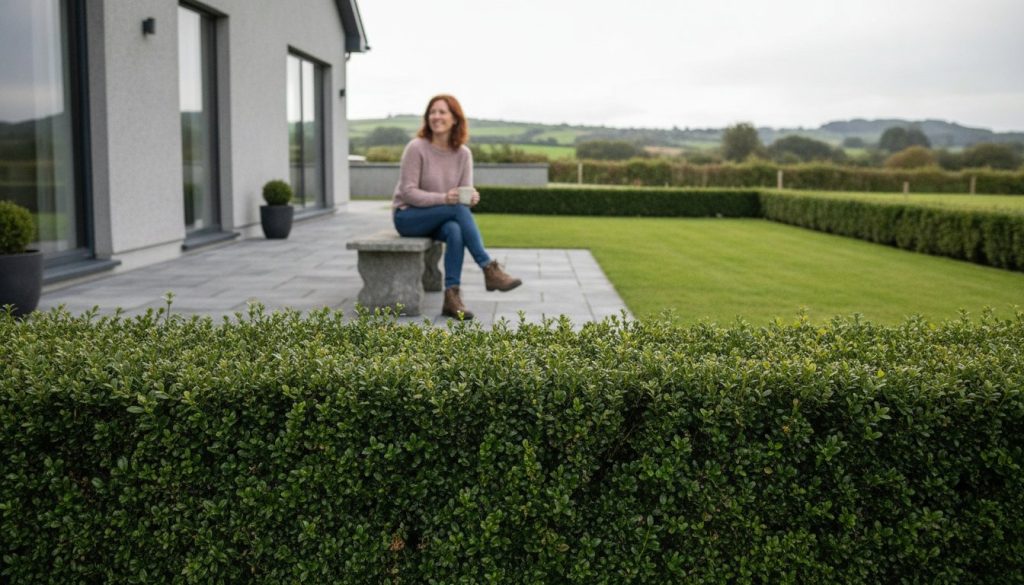
Most gardeners choose a hedge based on how fast it grows, but they usually end up regretting it by the second summer. While a rapid growth rate offers quick privacy, it often leads to a lifetime of heavy pruning and garden waste. It’s a common struggle to find that balance between a secure boundary and a plant that won’t take over your entire weekend. You want a garden that looks established and neat without the constant labour or the worry that a harsh Irish winter might kill off your investment.
Selecting the right low maintenance hedging plants is the secret to a beautiful, manageable garden. In this guide, we’ll show you how to match resilient species to your specific soil and site conditions. We’ll cover the best slow-growing evergreens like Portuguese Laurel and hardy alternatives for wet or windy spots. You’ll learn which varieties offer year-round structure and privacy whilst requiring only a single annual tidy-up, ensuring your garden remains a place of rest rather than a source of work.
Key Takeaways
- Learn why a moderate growth rate is often more practical than rapid height for long-term garden management and reduced waste.
- Identify the most resilient low maintenance hedging plants, such as Portuguese Laurel, to achieve year-round privacy with minimal pruning.
- Discover how deciduous species like Beech and Hornbeam provide seasonal colour whilst thriving in challenging or damp Irish soil conditions.
- Understand the specific spacing and establishment techniques that prevent overcrowding and lower your garden labour costs over time.
- Find out why sourcing hardy, Irish-grown stock from a specialist nursery ensures better plant survival rates compared to standard imports.
Defining Low Maintenance: Why Growth Rate and Resilience Matter
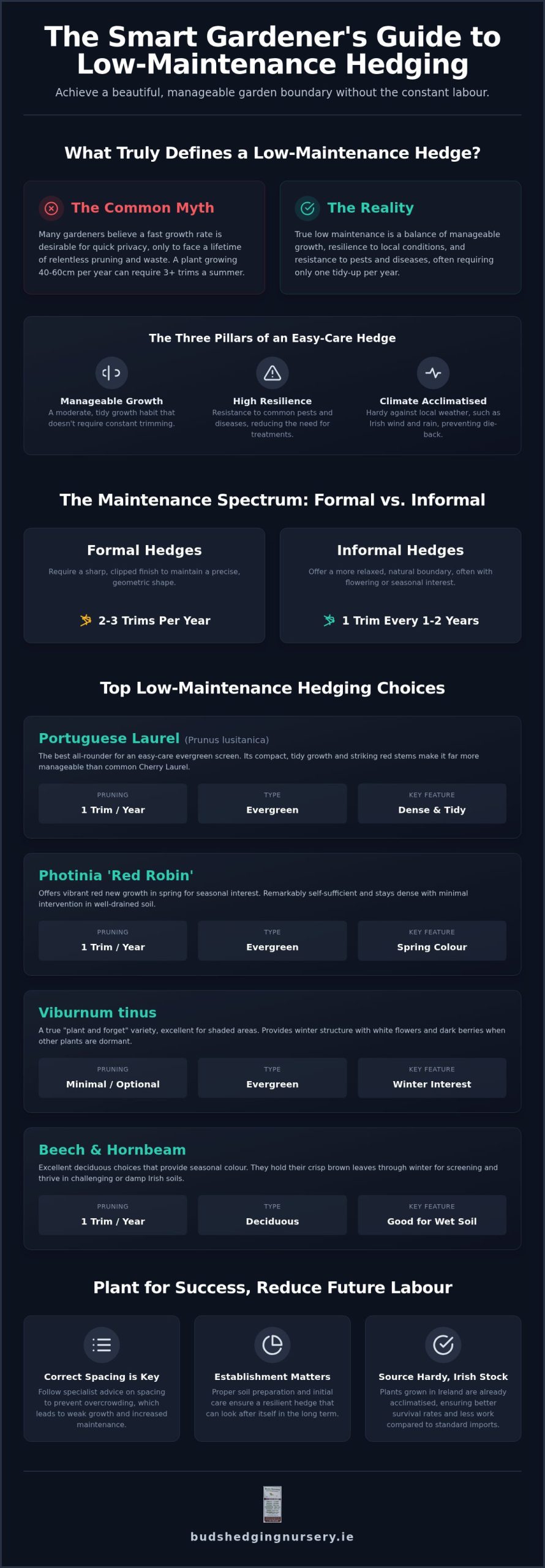
Defining what makes low maintenance hedging plants truly easy requires looking beyond the pruning shears. Many gardeners assume that a slow growth rate is the only factor that matters, but this is a common misconception. True low maintenance is a combination of a manageable growth habit and high biological resistance to local pests and diseases. A hedge that stays short but requires constant spraying for aphids or blight isn’t saving you any time; it’s just changing the type of work you have to do.
Growth rates are often misunderstood in the context of garden labour. Consider the difference in effort between species. A plant that grows 60cm a year but remains healthy without extra fertiliser is often better for a busy homeowner than a species growing only 20cm that needs regular feeding or soil conditioning. We also look for plants with self-limiting tendencies. These are species that naturally slow down their vertical growth once they reach maturity, making them ideal for garden borders amongst established flower beds where space is limited.
Our local weather plays a massive role in how much work a hedge requires. In Ireland, rain and wind are the primary stressors. A hedge that isn’t resilient to wet soil or Atlantic gusts will eventually fail, leading to the labour-intensive task of replacement planting. Choosing stock that is already acclimatised to our damp climate and salt spray ensures your boundary stays healthy with very little intervention. This resilience is the first real step in reducing your annual garden chores.
Slow Growth vs. Hardiness: Striking the Right Balance
It’s vital to distinguish between plants that grow slowly and those that simply tolerate neglect. A slow-growing plant isn’t necessarily hardy; some are quite delicate and struggle in poor soil or heavy frost. High hardiness reduces the need for disease management and prevents the gaps that occur when weaker plants die off. In a horticultural context, maintenance-free refers to a plant that requires only a single annual inspection and minimal corrective pruning to maintain its health and shape.
The Maintenance Spectrum: Formal vs. Informal Hedges
Formal hedges require a sharp, clipped finish to look their best. This usually means two or three precision trims every year to keep the lines straight. Informal boundaries offer a much more relaxed alternative. By choosing a flowering species like Escallonia, you can enjoy a colourful screen that only needs a light tidy-up every two years. This shift from formal to informal is one of the easiest ways to lower your garden labour costs whilst still maintaining a professional-looking garden boundary.
Evergreen Low Maintenance Favourites: Year-Round Privacy
Evergreen species are the most popular choice for privacy in Ireland. They offer a solid visual barrier through every season. Yet, many homeowners choose the common Cherry Laurel because it grows 40cm to 60cm a year, only to find themselves pruning it three times a summer to keep it under control. Selecting truly low maintenance hedging plants means looking for species that provide density without aggressive expansion. You want a plant that stays within its bounds whilst maintaining a healthy, thick appearance.
Portuguese Laurel: The King of Easy-Care Hedging
Prunus lusitanica, or Portuguese Laurel, is our primary recommendation for a manageable evergreen screen. Unlike its common Cherry Laurel cousin, it has a naturally compact and tidy growth habit. The leaves are smaller and darker, held on striking red stems. This structure makes it much easier to maintain a sharp, professional finish without the plant becoming leggy or unkempt. It generally requires only one prune in late summer to keep its shape for the following year. For those planning a new boundary, our Portuguese Laurel: The Complete Guide for Irish Gardens 2026 provides detailed advice on spacing and soil preparation.
Photinia and Viburnum: Colour and Structure with Minimal Effort
Photinia Red Robin is an excellent choice if you want seasonal interest without high demands. It produces vibrant red new growth in the spring. Whilst some fast-growing shrubs require heavy feeding to stay healthy, Photinia is remarkably self-sufficient once established. It stays dense with minimal intervention, provided it’s planted in a spot with decent drainage. Similarly, Viburnum Tinus is a plant and forget variety that is particularly useful for shaded corners of the garden. It produces white flowers and dark berries during the winter months, offering structure when other plants are dormant.
Griselinia littoralis remains a premier choice for coastal gardens or milder inland areas across Ireland. Its leathery, apple-green leaves are salt-tolerant and wind-resistant. It grows at a moderate pace, making it easy to keep at a specific height. When choosing low maintenance hedging plants, consider how the species handles local wind behaviour. To ensure your new screen thrives in these conditions, it’s always best to source stock from an established Irish hedging nursery where the plants are already toughened by the local climate and soil.
Deciduous and Native Options: Low Maintenance Seasonal Interest
Whilst evergreens like the Portuguese Laurel discussed previously are excellent for year-round screens, deciduous low maintenance hedging plants offer a different set of practical benefits. Many Irish gardeners prefer the changing aesthetic of a deciduous hedge, which transitions from vibrant spring greens to rich autumnal coppers. These species are often more resilient in heavy, wet clay soils where some evergreens might struggle with root rot. From a management perspective, deciduous hedges are remarkably predictable. They generally require only one major trim in late summer or autumn to maintain a crisp, professional appearance for the rest of the year.
Copper Beech is a particular favourite for those wanting a formal look without the frequent labour associated with fast-growing conifers. It provides a dense, architectural boundary that feels permanent. For larger land parcels or rural settings, integrating the Native Trees Scheme is a sensible way to reduce long-term management costs. Native species are naturally adapted to the Irish climate, meaning they require less soil conditioning and are less prone to the species-specific diseases that can plague imported varieties.
Beech Hedging: The Pruning-Friendly Professional Choice
Green and Copper Beech are favoured for their predictable growth patterns and structural reliability. A key benefit of Beech is “marcescence.” This is the botanical behaviour where the plant retains its dried, brown leaves throughout the winter months. It provides the privacy and wind protection of an evergreen without the higher initial cost or the risk of “browning out” in harsh winters. Because Beech responds so well to pruning, you can maintain it at almost any height with minimal effort. For specific advice on matching these plants to your ground conditions, see our Beech Hedging Plants Ireland: The Complete 2026 Buying Guide.
Native Hedging for Wildlife and Ease
For tough, wind-exposed sites or rural boundaries, Whitethorn and Hornbeam are the industry standards. Hornbeam is an excellent alternative to Beech if your soil is particularly heavy or prone to temporary flooding. Unlike some mixed native hedges that can become unkempt “scrub” if left unmanaged, a carefully selected mix of Whitethorn and Hornbeam stays manageable. These hedges manage their own health through biodiversity, attracting beneficial insects that keep common pests in check. If you are managing a larger acreage, our Practical Guide to Native Trees Scheme Plants in Ireland explains how to establish these boundaries efficiently to minimise future maintenance.
Planting for Success: Reducing Future Maintenance from Day One
The total labour required for a hedge is often decided the moment you put a spade in the ground. Many gardeners believe that low maintenance hedging plants take care of themselves from day one, but the first 24 months are critical. If a hedge is poorly established, it will struggle with stunted growth, gaps, and disease for years. Proper soil preparation is the most effective way to prevent a decade of corrective work. Digging a continuous trench rather than individual holes allows roots to spread laterally and establish a more stable foundation against Irish wind.
Adding well-rotted organic matter to the soil during planting improves drainage in heavy clay and moisture retention in sandy sites. This simple step ensures that once the plants are established, they won’t require constant feeding or soil conditioning. It’s about building a self-sustaining system where the plant’s natural resilience does the work for you. To ensure your project starts with the best possible stock, you can browse our full range of Irish-grown hedging and select plants that are already toughened by local conditions.
Bare Root vs. Pot Grown: Which is Easier to Establish?
Bare root plants are the traditional choice for large-scale hedging. They are planted during the dormant season, typically from November to March or early April. Because they are moved without soil, they quickly establish deep root systems in their new home. Pot-grown plants offer more flexibility as they can be planted year-round, provided they are watered during dry spells. For a detailed breakdown of the planting calendar, see our Bare Root Tree Season Ireland: The Complete 2026 Planting Guide.
Spacing and Mulching for a Weed-Free Boundary
Correct spacing is non-negotiable for a healthy hedge. Planting too closely leads to overcrowding, which restricts airflow and encourages fungal issues like mildew or leaf spot. Conversely, planting too far apart leaves gaps that allow weeds to take hold. Follow these general rules for a dense, manageable boundary:
- Portuguese Laurel: Plant 2.5 to 3 plants per linear metre for a thick, private screen.
- Beech and Hornbeam: Aim for 3 to 4 plants per metre to ensure a tight, professional finish.
- Native Mixes: A density of 3 to 5 plants per metre is standard for rural boundaries.
Once planted, applying a 5cm to 10cm layer of bark mulch around the base of the stems is a game-changer. This suppresses weed growth and retains moisture, almost entirely eliminating the need for hand-weeding amongst the stems during the first three years. Whilst even the best low maintenance hedging plants require regular water during their first summer, this early investment in care leads to a truly “set and forget” garden boundary in the future.
Sourcing Your Hedge: Why Quality from a Specialist Nursery Matters
Buying a hedge is a long-term commitment that should last for decades. Whilst it is tempting to pick up plants at a local garden centre, there is a significant difference between mass-produced imports and stock grown on a specialist nursery. Many retail outlets sell plants that have been forced in protected greenhouses abroad. These plants often look lush on the shelf but struggle to cope with the reality of Irish wind and rain once they are in the ground. Choosing low maintenance hedging plants that are already acclimatised to local soil behaviour and weather is the only way to ensure a high survival rate.
At Buds Nursery Cavan, we utilise over 30 years of growing experience across our 60-acre production site. This scale allows us to focus on the tangible quality of the plant rather than just its height. We understand how different species behave in various Irish counties, from the heavy clays of the midlands to the salt-swept coastal regions. This practical expertise ensures you receive plants that are fit for purpose, reducing the risk of gaps appearing in your boundary years down the line.
The Advantage of Hardy, Nursery-Grown Stocks
Field-grown plants develop much stronger, more resilient root systems than those grown in small pots. This structural integrity is vital for the long-term health of your boundary. Biosecurity is also a major factor. Sourcing directly from an Irish grower minimises the risk of introducing foreign pests or diseases into your garden. We encourage customers to visit our Glassdrummon site to see the stock firsthand. Walking amongst 60 acres of hedging allows you to compare the foliage and structure of different varieties before making a final decision.
Planning Your Order and Delivery
Before placing an order, take the time to measure your boundary accurately. Use a long tape measure rather than pacing it out, as even a small error can lead to a shortage of plants. Once you have your linear meterage, you can calculate the quantity required based on the spacing rules mentioned in our planting guide. We specialise in large-scale hedging projects and organise national delivery to ensure your stock arrives in peak condition. Our team handles the logistics with care, typically delivering bare root plants in protective bags to keep the roots moist and viable.
Selecting the right species is the final step in creating a manageable garden. For more detailed advice on choosing the right variety for your specific needs, read our Best Hedging for Privacy in Ireland: A Practical 2026 Buying Guide. Investing in high-quality stock from Buds Nursery Cavan today will save you significant time and money on replacement costs and labour in the years to come.
Establishing a Resilient Garden Boundary for 2026
Creating a permanent, easy-care screen depends on the decisions made before the first hole is dug. As discussed, matching a species like Portuguese Laurel or Hornbeam to your specific ground conditions is the most effective way to secure a durable result. Success relies on high-quality establishment, particularly correct spacing and mulching, which prevents future weed growth and ensures the longevity of your low maintenance hedging plants. By prioritising resilience over rapid, unmanageable growth, you ensure your boundary remains a functional asset rather than a labour-intensive chore.
With over 30 years of growing experience and 60 acres of dedicated production land, we provide the expertise needed to help your garden thrive. Our team manages an expert national delivery service to ensure your stock arrives in peak health, ready for immediate planting. Browse our full range of low maintenance hedging at Buds Nursery Cavan to find the right species for your project. A well-established hedge is a lifelong investment that provides privacy and structure whilst keeping your garden maintenance costs to a minimum.
Frequently Asked Questions
What is the absolute lowest maintenance hedge for a small garden?
Portuguese Laurel is generally the best choice for small gardens where space and time are limited. It has a naturally compact growth habit and doesn’t spread aggressively like other evergreens. You only need to trim it once a year to keep it at a specific height and width. It stays tidy and green year-round without the need for constant feeding or soil intervention.
How often do I need to prune a Portuguese Laurel hedge?
You only need to prune a Portuguese Laurel hedge once a year, ideally in late summer or early autumn. This single maintenance session is enough to keep the hedge looking sharp and professional. Because it grows at a moderate pace, it won’t outgrow its bounds between annual trims. This makes it a much more practical choice than the common Cherry Laurel.
Can I grow a low maintenance hedge in heavy clay soil?
Yes, Hornbeam is the ideal low maintenance option for heavy clay or damp Irish soils. It looks very similar to Green Beech but is far more tolerant of wet ground conditions. Once it’s established, it requires very little attention beyond an annual prune. It provides a dense, reliable boundary that stays healthy even in challenging ground where other species might struggle with root rot.
Which hedging plants are best for windy and exposed sites in Ireland?
Griselinia and Escallonia are the most resilient choices for windy or coastal sites across Ireland. Their leathery leaves are naturally adapted to handle salt spray and high winds without suffering from leaf burn. These species remain stable and healthy in exposed conditions. They provide a solid visual screen whilst requiring minimal corrective pruning after winter storms.
Is bare root hedging easier to maintain than pot-grown?
The long-term maintenance is the same for both, but bare root hedging is often easier to establish successfully in large numbers. Planting during the dormant season from November to March allows for deep root development before the summer. This strong start leads to a more resilient hedge that requires less watering and intervention as it matures into a permanent boundary.
Do low maintenance hedges grow more slowly?
Most low maintenance hedging plants do have a slower or more moderate growth rate. This is actually a benefit for the homeowner because it directly reduces how often you need to get the ladder and shears out. True low maintenance also comes from the plant’s natural hardiness and its ability to resist local pests without the need for constant chemical treatments.
Which evergreen hedge requires the least pruning?
Taxus baccata, or Yew, is widely considered the evergreen requiring the least pruning once it reaches its desired height. It is a slow grower that holds its architectural shape exceptionally well. Unlike fast-growing conifers, Yew can be kept neat with just one light trim per year. It is a predictable and efficient choice for those who want a permanent, formal look.
Can I get a low maintenance hedge that also provides privacy?
You can certainly achieve both privacy and ease of care with the right species. Selecting low maintenance hedging plants like Portuguese Laurel or Copper Beech provides a dense, tall screen that blocks out noise and sightlines effectively. These plants offer the height needed for a secure garden boundary whilst remaining manageable through their naturally contained and predictable growth habits.