


Your garden hedge is more than just a boundary; it is a living wall that provides privacy and shelter from the unpredictable Irish elements. When that wall starts to turn brittle and brown, the frustration is immediate. You may be staring at unsightly gaps and wondering if the soil itself has turned against you. The fear of “replant disease” or hidden pathogens is a common concern for many homeowners, especially when facing the daunting task of replacing a dead hedge Ireland. It is a job that requires more than just a shovel; it needs a clear understanding of why the original plants failed in the first place.
We understand that you want a straightforward verdict on whether your hedge can be salvaged or if it is time for a fresh start. This guide provides a practical, systematic plan to diagnose failing plants, remediate tired soil, and select resilient replacements like Portuguese Laurel or Copper Beech that thrive in our local climate. We will walk you through the legalities of the March to August cutting ban, the realities of soil pathogens, and the best species for a healthy, long-lasting screen. You will learn how to prepare your ground properly and choose hardy, Irish-grown plants that ensure your new hedge provides the privacy you need for years to come.
Key Takeaways
- Perform a simple scratch test to diagnose if your plants are salvageable or if common Irish pathogens like Honey Fungus have taken hold.
- Understand the critical steps for replacing a dead hedge Ireland, specifically focusing on full stump removal and soil remediation to avoid replant disease.
- Choose resilient, climate-suited species such as Portuguese Laurel or native varieties to ensure your new boundary thrives.
- Time your planting during the bare root season from November to March for the most cost-effective and successful establishment.
- Implement a strict watering and mulching routine to protect young plants, even during typically wet Irish summers.
Determining if You Can Revive a Dying Hedge or Need a Replacement
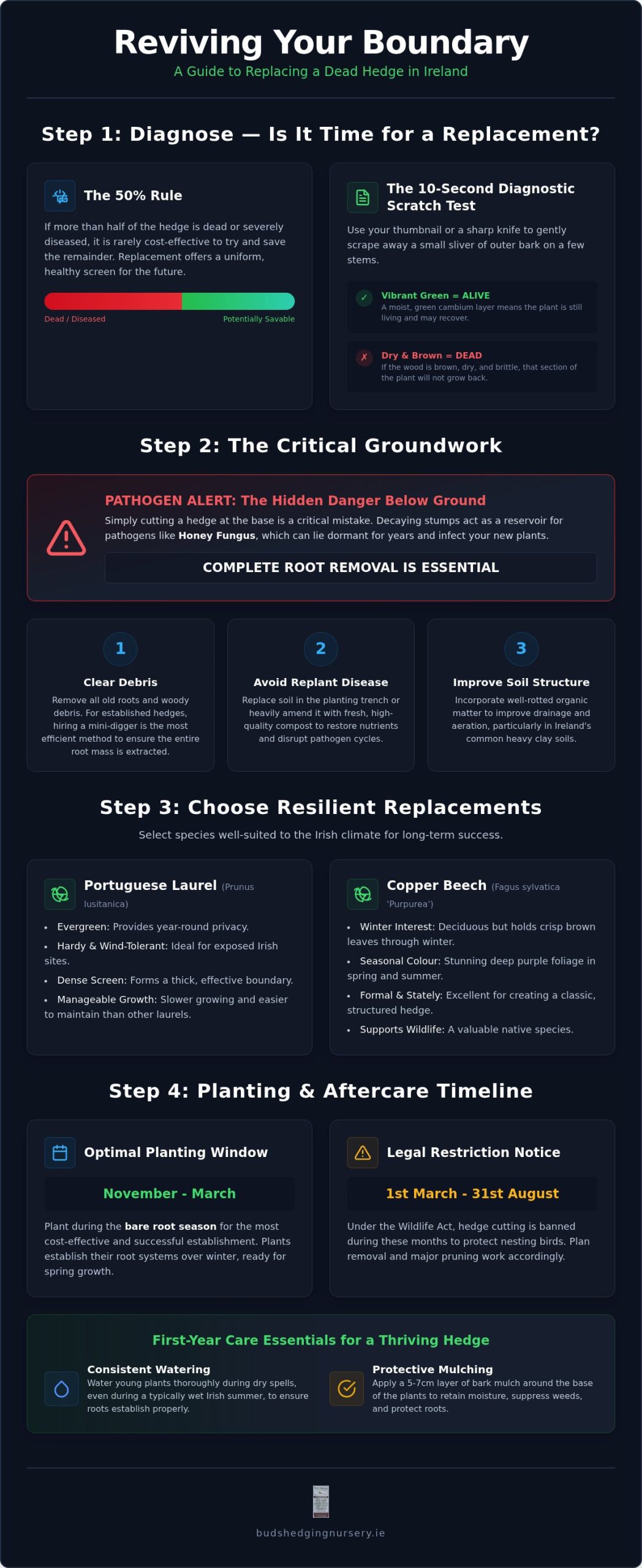
Before you commit to the labour of clearing a boundary, you must decide if the plants are truly dead or just struggling. A Hedge represents years of growth and privacy; a hasty removal can be a costly mistake. However, sentiment shouldn’t override logic. If you’re facing a line of brittle, brown stems, replacing a dead hedge Ireland becomes the most practical path forward. We generally suggest the “50% rule” as a starting point. If more than half of the hedge is dead or severely diseased, it’s rarely cost-effective to try and save the remainder. You’ll likely end up with a patchy, uneven screen that never recovers its former density.
Environmental stressors in Ireland often mimic disease. Waterlogging is a frequent culprit in heavy clay soils, literally drowning the root system. Conversely, coastal gardens often see foliage scorched by salt spray, while high-altitude or exposed sites suffer from wind desiccation. If the issue is purely environmental, you can often save the plants by improving drainage or adding a temporary windbreak. But if you find signs of Honey Fungus, such as white fungal growth under the bark at the soil line, or the characteristic black streaks of Box Blight, replacement is usually required to stop the spread.
The Scratch Test: A 10-Second Diagnostic
The most reliable way to check for life is the scratch test. Use your thumbnail or a sharp pocket knife to gently scrape away a small sliver of the outer bark on a few different stems. If you see a moist, vibrant green layer underneath, that’s the cambium. It means the plant is still alive. If the layer is brown, it’s dead; if the wood is brittle and snaps easily, the plant has been dead for some time. Don’t stop at one branch. Test multiple points along the hedge line to identify the “death zone” and see if the problem is localised or systemic. If the test reveals widespread brown wood, you’re likely looking at replacing a dead hedge Ireland to restore your garden’s security.
Common Signs of a Revivable Hedge
Not every yellow leaf signifies a terminal decline. Nutrient deficiencies often cause discolouration that looks alarming but is easily fixed with a high-quality fertiliser. Look closely at the stems for dormant buds. These tiny, often reddish bumps are a sign that the plant is waiting for the right conditions to push out new growth. Certain varieties, like Privet or even some types of Laurel, respond well to rejuvenation pruning. By cutting the plants back hard in early spring, you can often stimulate fresh, healthy growth from the base, provided the roots haven’t been compromised by rot or fungal pathogens.
How to Organise the Removal and Prepare the Ground
Success starts with a clean slate. Simply cutting the dead foliage at ground level is a mistake. When you are replacing a dead hedge Ireland, you must remove the entire root system. Decaying stumps act as a reservoir for pathogens, particularly Honey Fungus, which can lie dormant for years. If you leave these hosts in the ground, your new plants face an uphill battle from day one. Complete removal is the only way to ensure the site is safe for the next generation of hedging.
The cost of removal varies across the country. For a standard residential hedge, you might expect quotes starting around €200, though large, established Leylandii lines can reach significantly higher figures if stump grinding is required. Regardless of the cost, the goal is the same: clear the ground of all woody debris and old root mass to prevent the spread of fungal diseases to your new investment.
Mechanical vs Manual Removal
For small, young hedges, a sharp spade and a mattock might suffice for the job. However, for established boundaries, hiring a mini-digger is the most efficient choice. Mechanical removal ensures you pull up the entire root mass rather than just the main trunk. It also helps to loosen the surrounding soil, which is often compacted after decades of growth. Safe disposal is non-negotiable. If you suspect disease, don’t add the material to your home compost heap. Most Irish local authorities provide green waste facilities that process material at high temperatures to kill off pathogens.
Soil Remediation for Irish Gardens
“Replant disease” is a genuine risk where a new hedge is planted in the exact spot as the old one. The soil becomes depleted of specific nutrients and builds up a population of harmful soil-borne organisms. To remediate this, you should replace the soil in the immediate planting trench or heavily amend it with fresh compost and well-rotted manure. This restores the microbial life necessary for healthy root development. It’s also a good time to check your soil pH to ensure it matches your chosen replacement species.
Many Irish gardens sit on heavy clay. Over time, the area beneath an old hedge can develop a “plough pan” or a compacted layer that prevents water from draining. Use a garden fork to break up this subsoil. If the area is prone to waterlogging, incorporate grit to improve structure before you plant. If time allows, let the ground rest for a few weeks to stabilise. While the ground settles, you can browse hardy, Irish-grown plants to find the best fit for your garden’s specific conditions.
Selecting the Best Replacement Hedging for Irish Conditions
Selecting the right species is the most critical step in replacing a dead hedge Ireland. You want a plant that won’t just survive but will thrive in your specific garden conditions. For many, Portuguese laurel is the gold standard. It’s exceptionally hardy, handles pruning well, and offers a sophisticated look with its dark green leaves and red stems. If you need a faster result for immediate privacy, Cherry Laurel or Photinia Red Robin are reliable, vigorous growers. Cherry Laurel provides large, glossy leaves that block light effectively, while Photinia offers a striking flush of red new growth in the spring.
For those prioritising biodiversity or working within rural grants, native trees scheme plants like Whitethorn, Holly, and Hazel are excellent choices. These species support local wildlife and blend perfectly into the Irish countryside. If you prefer a formal, structured look, beech hedging plants Ireland remain a favourite. While deciduous, they hold their copper leaves through the winter. This provides year-round screening and a beautiful seasonal change in colour.
Best Hedging for Wet or Heavy Soil
Many Irish gardens struggle with drainage. If your soil is heavy clay or stays damp, Hornbeam is a superior choice to Beech. It looks similar but is far more tolerant of “wet feet” and produces attractive catkins in the spring. For truly boggy corners, consider Alder or Whitethorn. In exceptionally wet areas, we recommend planting on slightly raised mounds. This keeps the main root flare above the water level while the roots establish themselves in the improved soil below. It’s a simple technique that prevents root rot during our wet winters.
Coastal and Windy Site Specialists
Salt spray and Atlantic gales can shred the leaves of less hardy plants. Griselinia is often called the “king of the coast” for its incredible salt tolerance and leathery, lime-green leaves. It grows quickly and creates a thick, opaque screen. Escallonia is another tough contender, providing a dense windbreak whilst producing attractive flowers in summer. Regardless of the species, use windbreak netting during the first two winters. This protects young plants from desiccation until their root systems are strong enough to anchor them against the wind. It’s a small investment that ensures your new boundary doesn’t fail before it starts.
A Practical Step-by-Step Guide to Replanting Your New Hedge
Once the ground is cleared and remediated, timing is everything. The bare root tree season Ireland runs from November to March. This is the optimal window for replacing a dead hedge Ireland. Planting during the dormant phase allows the root system to settle and establish before the energy-intensive growth of spring begins. If you plant outside this window, you must use pot-grown stock, which requires more intensive care during the warmer months.
Spacing is the next critical factor. For a dense, private screen using species like Laurel or Beech, we recommend three to four plants per metre. If you are planting a native mix of smaller whips, a double staggered row with five to seven plants per metre creates a much thicker, stockier boundary. We suggest the “Trench Method” over individual pits. Digging a continuous trench ensures the soil is consistently loose across the entire line, preventing roots from becoming pot-bound in a single hole. To give your plants the best start, sprinkle mycorrhizal fungi directly onto the roots. These beneficial fungi form a symbiotic relationship that significantly improves water and nutrient uptake.
Bare Root vs Pot Grown: Which to Choose?
Bare root whips are the most cost-effective choice for long garden runs. They are lightweight, easy to handle, and establish very quickly in cold soil. However, they are sensitive. You must prevent “root desiccation” by keeping the roots covered in their delivery bags until the exact moment they hit the ground. Even ten minutes of exposure to a drying wind can kill the fine feeder roots. Pot-grown plants are more expensive but offer an “instant” look and can be planted at any time of the year, provided the ground isn’t frozen or waterlogged.
The Planting Process
Dig your trench twice as wide as the root mass and just as deep. Use a garden fork to loosen the sides and bottom of the trench; this is vital in heavy Irish clay to allow roots to penetrate. When placing your plants, look for the soil mark on the stem. This indicates the depth at which the plant grew in the nursery. Planting too deep leads to stem rot, whilst planting too shallow causes the roots to dry out. Fill the trench with a mix of native soil and well-rotted organic matter. Firm the soil down with your heel as you go to eliminate air pockets. A simple “heel test” should show the plant is secure; if it wobbles or pulls out easily, it needs more firming.
If you are ready to start your garden revival, order your hardy hedging plants directly from our 60-acre nursery for national delivery across Ireland.
Post-Planting Care: Ensuring Your Replacement Hedge Thrives
The work doesn’t end once the last spadeful of soil is firmed down. Successfully replacing a dead hedge Ireland requires a commitment to maintenance for at least the first two growing seasons. This period is when the root system is most vulnerable to environmental stress. Even if you have selected hardy species from our 60-acre site, they still need a helping hand to anchor themselves and build the resilience required for the Irish climate. Neglecting post-planting care is the most common reason new boundaries fail to reach their full potential. If you find that the ongoing maintenance of a living screen is too demanding, you can explore Fence Panels from Romford Fencing Ltd, who offer a wide range of durable, low-maintenance timber solutions through their online store.
Watering is the single most important task. Many Irish homeowners assume that our frequent rainfall provides enough moisture. This is a mistake. Whilst the surface may look damp, a light shower often fails to reach the root ball of a newly planted whip or pot-grown shrub. During dry spells in late spring and summer, you must provide a deep soak twice a week. To help retain this moisture, apply a 50mm to 75mm layer of organic mulch, such as bark or well-rotted compost, around the base of the plants. This also suppresses weeds that would otherwise compete for vital nutrients.
The First Two Years: Critical Maintenance
Ireland’s winter storms pose a specific threat known as “wind rock.” Strong gales can catch the top of a young plant, swaying it until a hollow develops around the stem at the soil line. This gap allows frost to reach the roots and can lead to the plant’s death. After any significant storm, walk the length of your hedge and re-firm any loosened plants with your heel. In early March, apply a balanced general-purpose fertiliser to give the plants a boost as they break dormancy. If your garden is prone to browsing animals like rabbits or hares, ensure you have installed spiral guards or mesh fencing immediately after planting.
Pruning for Density
It feels counter-intuitive to cut back a plant you have just put in the ground. However, formative pruning is essential for a thick, private screen. For deciduous species like Beech or Hornbeam, a “hard prune” after planting encourages the plant to branch out from the base rather than putting all its energy into a single tall stem. For evergreens like Laurel or Photinia, light trimming of the side shoots promotes a bushier habit. Always remember the legal hedge-cutting ban between March 1st and August 31st; whilst light maintenance on young garden hedges is generally permitted for health reasons, major work should be kept to the winter months. For more specific guidance, you can visit Buds Nursery Cavan for expert advice on your specific site conditions.
Restoring Your Garden Boundaries for the Future
Successful garden restoration starts with a clear plan. You’ve learned how to identify terminal disease, the necessity of clearing old root mass, and why selecting species like Portuguese Laurel or native mixes ensures long-term privacy. Successfully replacing a dead hedge Ireland is a significant project, but it’s the only way to guarantee a healthy, dense boundary that stands up to our local weather. Proper soil remediation and correct planting during the bare root season provide the foundation your garden needs to flourish.
At Buds Nursery Cavan, we bring over 30 years of Irish growing expertise to your project. Our 60-acre nursery produces hardy, reliable stock suited to every soil type across the country. We provide national delivery and offer specialist guidance on the Native Trees Scheme to help you choose the right varieties for biodiversity and shelter. Whether you need a formal evergreen screen or a traditional native boundary, we have the practical experience to help you succeed.
Browse our extensive range of Irish-grown hedging at Buds Nursery Cavan
Your garden’s privacy is an investment worth protecting. With the right preparation and quality plants, your new hedge will thrive for decades to come.
Frequently Asked Questions
How do I know if my hedge is dead or just dormant?
You can determine this using a simple scratch test. Scrape a small sliver of bark from a stem; a green layer underneath indicates life. If the wood is brown, dry, or snaps easily, that section is dead. Check multiple areas, as some parts may survive whilst others fail. If the test reveals widespread death, you should begin the process of replacing a dead hedge Ireland to restore your garden’s privacy.
Can I plant a new hedge in exactly the same spot where the old one died?
You can, provided you remediate the soil first. Planting in the exact same spot carries the risk of “replant disease” and lingering soil-borne pathogens. It is essential to remove all old root mass and replace the soil in the trench with fresh compost and well-rotted manure. This process restores the nutrients and microbial life needed for your new plants to thrive. Proper preparation is the key to successfully replacing a dead hedge Ireland.
What is the fastest-growing hedge for privacy in Ireland?
Cherry Laurel and Green Leylandii are among the fastest-growing options for immediate privacy. These species can put on significant growth each year once their root systems are established. Photinia Red Robin is another vigorous choice that adds a splash of colour with its red spring foliage. For the best results, ensure the ground is well-prepared and the plants are watered regularly during their first two growing seasons to maintain their growth rate.
When is the best time of year to replace a hedge in Ireland?
The optimal time is during the bare root season, which runs from November to March. During these months, plants are dormant and experience less transplant shock when moved. This window is also the most cost-effective time to purchase hedging in large quantities. Whilst pot-grown plants can be installed year-round, they require much more intensive watering if planted during the summer months. Winter planting allows roots to settle before the spring growth flush.
Why did my previous hedge die suddenly?
Sudden death is often caused by root pathogens like Honey Fungus or Phytophthora. These thrive in the heavy clay soils common across Ireland, especially during waterlogged winters. Environmental factors like extreme wind desiccation or salt spray in coastal areas can also cause rapid decline. If your hedge died quickly, it is vital to check the roots for fungal growth or signs of rot before you introduce any new plants to the same area.
How much does it cost to replace a 20-metre hedge?
Total costs depend on the removal method and the species you select for the new boundary. Industry quotes for professional hedge removal often start around €200, though large, established lines may cost significantly more. For the new plants, bare root whips are the most economical choice for 20-metre runs. Pot-grown specimens offer a more immediate screen but represent a higher initial investment. We recommend choosing hardy, Irish-grown stock for the best long-term value.
Do I need to hire a professional to remove my old hedge?
For small or young hedges, manual removal with a spade and mattock is often sufficient. However, for mature hedges, hiring a professional with a mini-digger is highly recommended. A machine ensures that the entire root mass is extracted from the ground. Leaving old stumps behind creates a breeding ground for fungal diseases, which can quickly spread to your new hedge. Professional removal saves time and provides a much cleaner site for replanting.
What are the best native Irish hedging plants for biodiversity?
Whitethorn, Holly, and Hazel are premier choices for supporting Irish biodiversity. These species provide vital nesting sites for birds and early-season nectar for pollinators. They are also central to the Native Trees Scheme, which encourages the use of indigenous plants in the landscape. A mixed native hedge creates a resilient, wildlife-friendly boundary that changes beautifully with the seasons. These plants are exceptionally well-adapted to our local climate and soil conditions.