


The cheapest boundary today often becomes your most expensive mistake within five years. In the damp Irish climate, a standard timber fence starts its journey toward rot the moment it’s installed; meanwhile, a well-chosen hedge is just beginning to gain value. You likely want a secure perimeter that provides privacy without becoming a permanent drain on your time and bank account. When weighing up the hedge vs fence cost Ireland, you must look past the first invoice to see the total cost of ownership over a decade.
This guide provides a practical comparison for 2026, stripping away the fluff to show you exactly how initial investments stack up against long-term maintenance. We’ll explore why bare root seasons offer a significant financial advantage and how certain species like Portuguese Laurel or Copper Beech outlast man-made alternatives. You’ll learn the true price of materials, the reality of upkeep in our weather, and how to choose a boundary that actually appreciates as it grows. By the end, you’ll have the clarity needed to make a choice that suits both your property and your pocket.
Key Takeaways
- Understand why timber fences often require full replacement every 10 to 15 years in the Irish climate, while a living hedge becomes more durable with age.
- Compare the initial hedge vs fence cost Ireland to see how bare root plants can significantly reduce your upfront investment for large boundaries.
- Learn why planting a hedge is a manageable DIY task for most homeowners, avoiding the high labour costs associated with professional fence installation.
- Identify which boundary types thrive in high-wind or boggy conditions, ensuring your investment doesn’t rot or blow over.
- Discover the specific seasonal windows that allow you to source plants direct from the grower for the best possible value.
Upfront Investment: Initial Purchase Costs of Hedges vs Fences
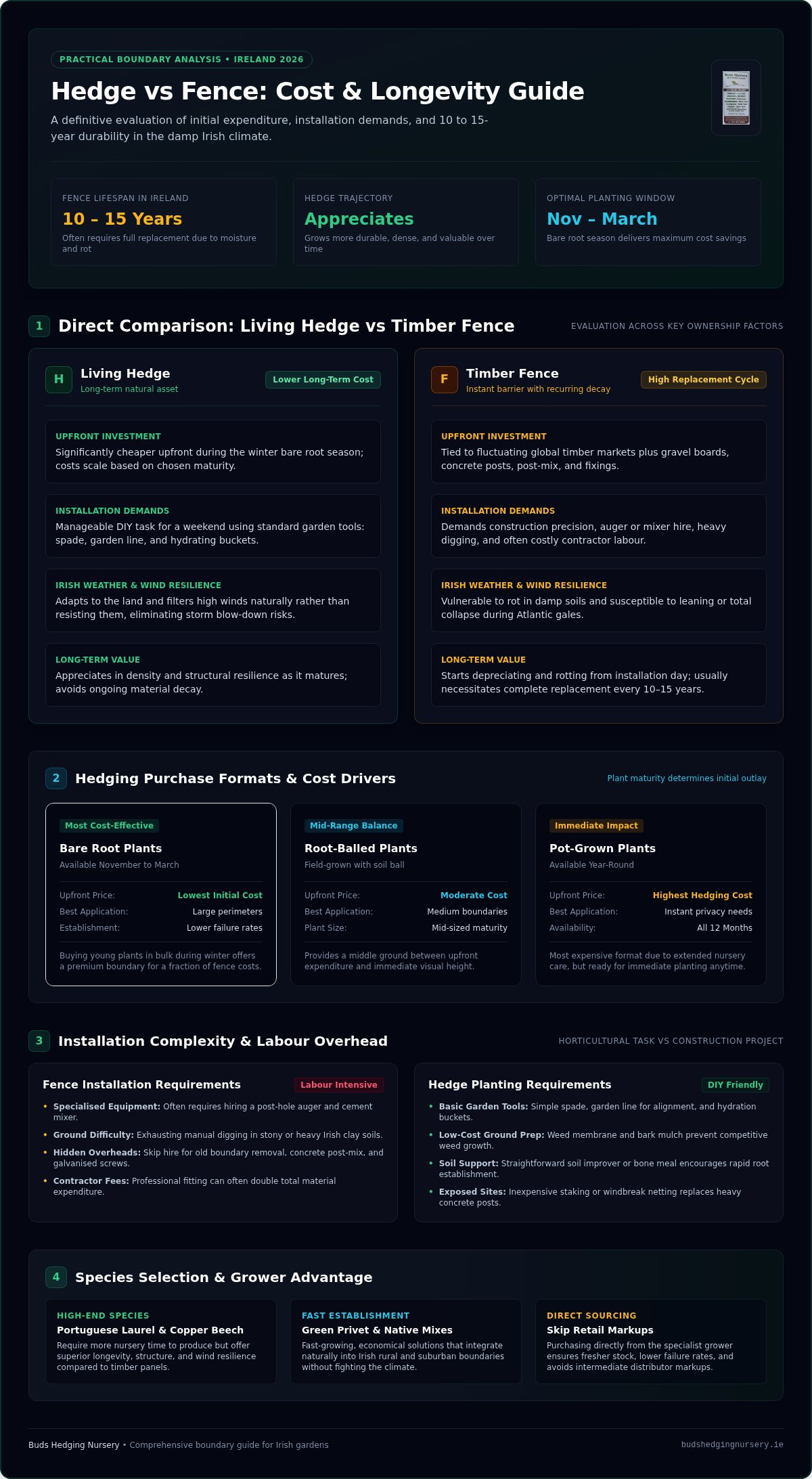
Initial costs are usually the first thing homeowners consider when securing a property boundary. While a fence offers an instant barrier, the hedge vs fence cost Ireland varies significantly based on the method of establishment. For a 10-metre stretch, a fence requires a fixed set of materials including panels, posts, and gravel boards. A hedge, however, allows for flexible spending depending on the maturity of the plants and the time of year you choose to plant.
The Cost of Fencing Materials in Ireland
Fencing costs are tied closely to the global timber market. Prices can fluctuate monthly; this makes it difficult to budget for large projects in advance. Beyond the visible panels, you must account for the infrastructure. Concrete posts and gravel boards are often preferred in damp Irish soil to prevent timber rot, but these add significant weight and cost to the initial purchase. Don’t forget the hidden extras like bags of post-mix concrete, galvanised screws, and wood preservative. If you aren’t doing the work yourself, professional labour for digging and levelling can often double the total material cost.
Hedging Price Factors: Species and Maturity
When selecting plants, maturity is the biggest price driver. You can choose from three main growth formats:
- Bare Root: Available from November to March, these are the most cost-effective option for large boundaries.
- Root-balled: Field-grown plants with a soil ball, offering a middle ground in terms of price and size.
- Pot-grown: The most expensive format but available year-round for immediate impact.
Higher-end species like Portuguese laurel require more nursery time to produce than faster-growing options like Green Privet. However, sourcing direct from the grower allows you to skip retail markups. Historically, hedges as boundary features have been the standard in rural Ireland because they adapt to the land rather than fighting against it. Choosing smaller plants often results in better establishment and lower failure rates amongst your stock.
If you compare 10 metres of high-quality timber fencing against a 10-metre native hedge mix, the initial hedge vs fence cost Ireland shows the hedge as the cheaper upfront investment during the bare root season. While the fence is “finished” on day one, the hedge requires a few seasons to fill out. For those on a budget, the “Bare Root Advantage” is the clear winner. Buying young plants in bulk during the winter months allows you to secure a premium boundary for a fraction of the cost of a manufactured fence whilst ensuring the plants establish well in our local soil.
Installation and Labour: DIY vs Professional Fitting
Choosing between a living boundary and a timber one often comes down to who is doing the work. While the material price is one part of the hedge vs fence cost Ireland, labour and equipment hire often determine the final bill. Fencing is essentially a construction project. It requires precision, heavy lifting, and often, specialised machinery. Planting a hedge is a more forgiving horticultural task that most homeowners can manage over a weekend with a basic set of tools.
Fencing Installation Complexity
To install a fence that survives an Irish winter, you can’t just push posts into the ground. You’ll likely need to hire a post-hole auger and a cement mixer. Digging into stony or heavy clay soil by hand is exhausting work. If the posts aren’t perfectly level or the concrete isn’t mixed correctly, the first Atlantic gale could leave your new boundary leaning or collapsed. There’s also the matter of what you’re replacing. If you have an old boundary to clear, the cost of a skip for waste removal adds another layer to your budget. These logistical hurdles often force homeowners to hire professional contractors, significantly increasing the total spend.
The Ease of Planting Hedging
Hedging requires far less in the way of heavy machinery. A sharp spade, a garden line for straight rows, and a few buckets for hydrating roots are usually enough. The main effort goes into ground preparation. Using a weed membrane and bark mulch helps the plants establish without competition, which is a small upfront cost that saves hours of weeding later. Adding a simple soil improver or bone meal ensures the roots take hold quickly in our damp climate. In more exposed sites, simple staking or windbreak netting might be needed, but these are inexpensive and easy to install compared to concrete fence supports.
While a fence offers instant privacy, it’s a static product that begins to degrade from day one. A hedge is an investment in growth. If you’re looking at a large area, the selection of bare root plants available during the winter months makes the project even more accessible. For those participating in the Native Trees Scheme, the labour of planting is offset by the long-term environmental and financial benefits. You don’t need a professional crew to plant a hundred Whitethorn or Beech saplings; a few willing helpers and a clear day are all it takes to get the job done. This DIY potential makes hedging the more flexible option for those looking to manage their project costs tightly.
Total Cost of Ownership: Maintenance and Lifespan Over 20 Years
Looking at a twenty-year horizon changes the perspective on your boundary choice. While a fence is a finished product at installation, it’s also a degrading one. A living hedge is the opposite; it grows stronger and more valuable as the years pass. Understanding the hedge vs fence cost Ireland over two decades requires a cold look at the labour and money spent on upkeep vs the eventual need for total replacement.
The “Hidden” Cost of Fencing Upkeep
Timber panels in the Irish climate have a finite lifespan, usually between 10 and 15 years. Even pressure-treated wood eventually succumbs to the constant cycle of damp and wind. To push a fence toward that 15-year mark, you’ll need to commit to regular power washing and staining. If you have a double-sided fence, you’re buying twice the volume of wood treatment. A single 5-litre tub of quality stain might cover only a few panels, and a full garden boundary requires several. Then there’s the risk of Atlantic storms. A single gale can snap posts or shatter panels, leading to emergency repairs. When the wood finally rots beyond saving, you face the cost of a skip for disposal before paying for a full replacement. Over 20 years, you’re likely to pay for your fence twice.
Hedging Maintenance: Effort vs Reward
Hedges do require work, but it’s predictable and low-cost. Most species, such as Cherry Laurel, only need pruning once or twice a year to maintain their shape. Your primary investment here is a decent pair of shears or a petrol hedge trimmer. Beyond that, annual feeding with a bit of fertiliser and a fresh layer of mulch keeps the soil healthy. Unlike timber, a hedge doesn’t rot. It can live for decades or even centuries if managed well. This biological durability means you never face a total replacement bill.
For many Irish buyers, a mature, well-kept hedge is a sign of an established property. It adds kerb appeal and a sense of permanent privacy that a weathered timber fence cannot match. While the fence starts losing value the day it’s installed, the hedge appreciates. When you calculate the hedge vs fence cost Ireland over twenty years, the living boundary becomes the clear financial winner through longevity and minimal material costs.
The physical environment of your property should dictate your choice as much as your bank balance. In exposed coastal areas or high-wind corridors, a solid timber fence acts like a sail; it catches every gust and puts immense pressure on the posts. On boggy or poorly drained ground, even concrete-set timber posts can shift or rot prematurely. When assessing the hedge vs fence cost Ireland, a living boundary is often the only logical choice for difficult sites. Hedges filter the wind rather than blocking it, which reduces turbulence and protects the rest of your garden.
With a garden that is better protected from the wind and more private, you can focus on creating a comfortable outdoor lounge area. To make the most of your sheltered space, explore Rattan Sofa Sets that offer both comfort and resilience.
Privacy requirements often create a conflict between speed and quality. A fence provides a screen by tea-time, but it remains a thin, vulnerable barrier. A hedge like Photinia Red Robin or Laurel takes a few seasons to knit together, but it eventually forms a thick, sound-dampening wall that a fence cannot match. For those with larger plots, the Native Trees Scheme offers a way to establish hundreds of metres of boundary at a significantly reduced cost, provided you meet the 2026 requirements for species diversity.
The Hybrid Solution: Post-and-Wire with Hedging
You don’t always have to choose one or the other. A highly effective way to manage the hedge vs fence cost Ireland is to install a simple post-and-wire fence first. This provides immediate security for pets and children at a fraction of the cost of timber panels. You then plant young hedging through or alongside the wire. As the plants mature, they grow through the mesh, eventually hiding the wire entirely. This creates a reinforced, stock-proof boundary that is virtually indestructible. For this method, mixed native species like Whitethorn and Beech work exceptionally well. Once your perimeter is established, you can focus on making the most of your garden for events; to explore high-quality structures and party tents, visit Garden Chic.
Site-Specific Recommendations
Your choice of species should reflect your lifestyle. For homeowners who want a tidy look with minimal effort, Portuguese Laurel or Green Privet offer dense, evergreen cover that only needs an annual trim. If your site is particularly exposed to salt spray or heavy winds, tougher choices like Escallonia or Griselinia are better investments than any wooden structure. These plants are built for the Irish climate and won’t require the constant repairs that a storm-damaged fence demands. If you are unsure which variety suits your soil type, you can view our full range of hardy hedging plants to find a match that lasts.
Why Source Your Boundary Solutions from Buds Nursery
Selecting the right supplier is the final step in managing your hedge vs fence cost Ireland. When you buy from a retail garden centre, you’re often paying for multiple layers of transport and markups. Buds Nursery Cavan operates as a traditional grower with over 30 years of experience. We produce our stock across 60 acres, which means you’re buying direct from the source. Our plants are hardened to the Irish climate long before they reach your gate, which significantly reduces the risk of failure compared to imported stock. By skipping the middleman, you can allocate more of your budget to higher-quality species like Copper Beech or Hornbeam.
The Specialist Nursery Advantage
The timing of your purchase is critical for your project budget. While we provide pot-grown plants year-round, the bare root tree season is the most cost-effective window for establishing large boundaries. During these winter months, we supply dormant plants that are easy to transport and quick to establish. For homeowners who need an immediate screen, we also maintain a large stock of mature hedging such as Portuguese Laurel and Photinia Red Robin. Our team provides practical advice on plant spacing and soil preparation to ensure your investment thrives. We don’t just sell plants; we help you plan a boundary that works for your specific site conditions and drainage needs.
Ordering and Logistics
Large boundary projects require reliable logistics. We offer a national delivery service across Ireland, ensuring your plants arrive in prime condition directly to your property. You can contact us for a specific quote based on the volume of stock and your location. If you prefer to see the quality of our 60 acres of production firsthand, you can arrange to visit our growing facilities. We are open Tuesday to Saturday, though we recommend checking seasonal availability before making your journey. Our focus is on providing healthy, vigorous plants that offer a better long-term return than any timber alternative. If you’re ready to secure your property with a living boundary, enquire about our hedging stock today to get started on your 2026 project.
Securing Your Property for the Long Term
Choosing between a living boundary and a manufactured one is a decision between a depreciating asset and one that grows in value. Fences offer immediate privacy but carry the burden of rot and replacement every decade. By contrast, a hedge becomes more resilient and attractive with age. When you calculate the total hedge vs fence cost Ireland, the savings found in bare root planting and minimal material upkeep over twenty years are undeniable.
With over 30 years of experience in Irish horticulture, we provide the expert guidance needed to select species that thrive in your specific soil. Our 60 acres of production ensure you get healthy, Irish-grown stock with national delivery available across the country. Whether you’re looking for native mixes or specialists in Portuguese Laurel, we have the stock to suit your site. Browse our range of cost-effective hedging and trees to find your ideal solution. Start your planting project this season to create a boundary that truly lasts.
Frequently Asked Questions
Is it cheaper to plant a hedge or build a fence in Ireland?
Planting a hedge is typically more cost-effective than building a fence, particularly when using bare root stock. While a fence requires an immediate outlay for timber panels, concrete posts, and professional labour, a hedge allows for a lower initial investment. Over time, the gap in the hedge vs fence cost Ireland widens further because fences require replacement every 10 to 15 years, whereas a living boundary grows stronger and more valuable with age.
How long does a typical timber fence last in the Irish climate?
A standard timber fence in Ireland usually lasts between 10 and 15 years before rot or storm damage necessitates a full replacement. The high rainfall and damp soil conditions accelerate the decay of wooden posts and panels. Even with regular staining and maintenance, the structural integrity of timber eventually fails. In contrast, a well-maintained hedge can live for decades or even centuries, providing a permanent boundary that outlasts several generations of fencing.
What is the most cost-effective hedging plant for a long boundary?
Mixed native hedging, including species like Whitethorn, Green Beech, and Hornbeam, is the most economical choice for large boundaries. These are best purchased as bare root saplings during the winter months. Buying in bulk direct from a grower reduces the price per plant significantly. These species are incredibly hardy, adapt well to various Irish soil types, and require very little initial maintenance to establish a thick, stock-proof barrier.
Do I need planning permission for a hedge or a fence in Ireland?
Planning permission is generally not required for planting a hedge on your property. For fences, you can usually build up to 2 metres in height at the rear or side of a house without permission. However, front boundaries facing a public road are typically restricted to 1.2 metres. It’s always best to check with your local authority, especially if you live in a protected area or if the boundary affects road visibility.
How much does it cost to maintain a hedge per year vs a fence?
Maintaining a hedge involves the low cost of an annual trim and occasional organic fertiliser or mulch. If you own your own shears or trimmer, the ongoing expense is minimal. Fencing maintenance is often more expensive because it requires periodic power washing and multiple coats of wood preservative or stain. Over a twenty-year period, the cumulative cost of these chemicals and the eventual replacement of broken panels far exceeds the price of hedge upkeep.
Can I use the Native Trees Scheme to pay for my garden hedge?
The Native Trees Scheme is designed to support the planting of indigenous species across Ireland, and it can often be used for boundary hedging on larger plots. To qualify, you must select approved native species like Whitethorn, Holly, or Hazel and follow specific planting density guidelines. This scheme is an excellent way to offset the hedge vs fence cost Ireland while supporting local biodiversity. We recommend checking the current 2026 requirements for eligibility.
Which boundary type adds more value to an Irish property?
A mature, well-kept hedge generally adds more long-term value to a property than a fence. Living boundaries provide superior privacy, noise reduction, and a sense of established character that appeals to Irish homebuyers. While a fence is a static feature that begins to look weathered within a few years, a hedge is seen as a permanent, living asset. It enhances kerb appeal and suggests a property that has been cared for over many years.
What is the best time of year to plant a hedge to save money?
The winter months between November and March are the best time to plant to ensure the lowest costs. This is known as the bare root season, when plants are dormant and can be moved without soil around their roots. This method is significantly cheaper than buying pot-grown plants in the summer. Planting during this window also allows the hedge to establish its root system before the spring growth begins, leading to better survival rates.