

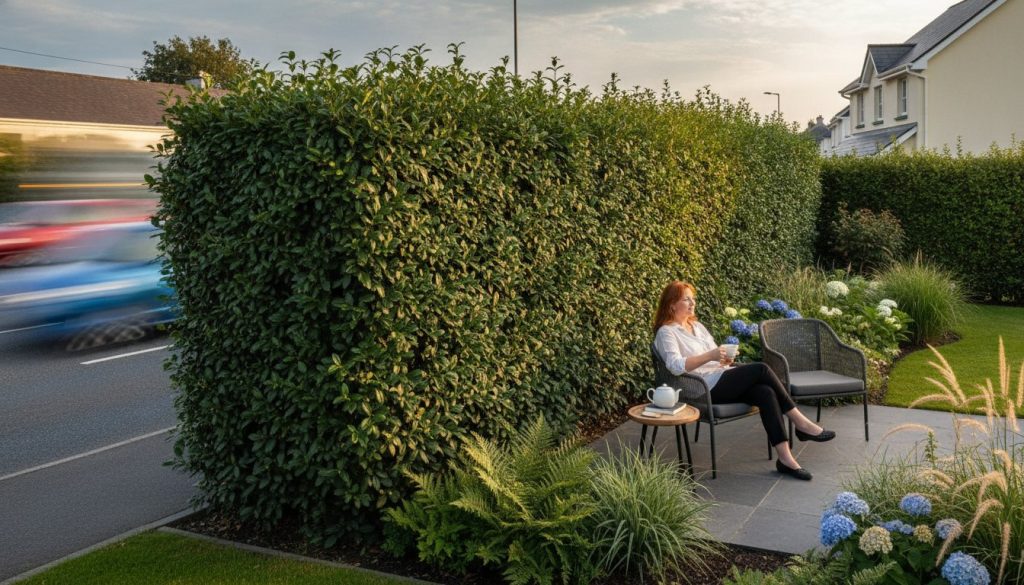
Most homeowners think that any fast-growing plant will block out the sound of a busy road, but height alone is rarely the solution to a noisy garden. It’s a common mistake to prioritise speed over substance. If you’re struggling with distracting traffic or feeling exposed to the house next door, you’ve likely realised that a thin line of trees doesn’t offer much relief. Choosing the right hedging for noise reduction Ireland requires a focus on “Acoustic Density,” which uses thick, multi-layered foliage to actually break up sound waves rather than just hiding the source.
We understand how frustrating it is when wind rattles your fencing or heavy clay soil causes your new plants to fail. This 2026 guide provides a practical blueprint for transforming your garden into a quiet, private sanctuary. You’ll discover the most effective evergreen species, such as Portuguese Laurel and Cherry Laurel, alongside professional planting techniques designed for the Irish climate. We will also outline the essential legal requirements for hedge maintenance and the best ways to ensure your screen remains healthy and dense for years to come.
Key Takeaways
- Understand how “Acoustic Density” works by using multi-layered foliage to absorb and reflect sound waves rather than just hiding the source.
- Identify the most effective evergreen species for Irish gardens, with a focus on why Portuguese Laurel and Photinia Red Robin excel at noise reduction.
- Learn how to choose the right hedging for noise reduction Ireland to suit challenging site conditions like heavy clay or coastal wind.
- Follow a professional planting blueprint that uses staggered rows and specific spacing to create a dense, functional barrier quickly.
- Recognise the importance of sourcing hardy, Irish-grown stock that is already acclimatised to local weather and soil conditions.
The Science of Acoustic Screening: How Hedging Reduces Noise
To understand how plants manage sound, you have to look at The Science of Acoustic Screening. An acoustic barrier hedge is a dense living wall that mitigates noise by absorbing sound energy within its foliage, reflecting waves back towards the source, and diffracting sound over the structure. Unlike a solid concrete wall, which can cause sound to bounce and create echoes, a living hedge breaks up the sound waves. This is why choosing the right hedging for noise reduction Ireland is about more than just aesthetics; it’s about building a functional piece of garden infrastructure.
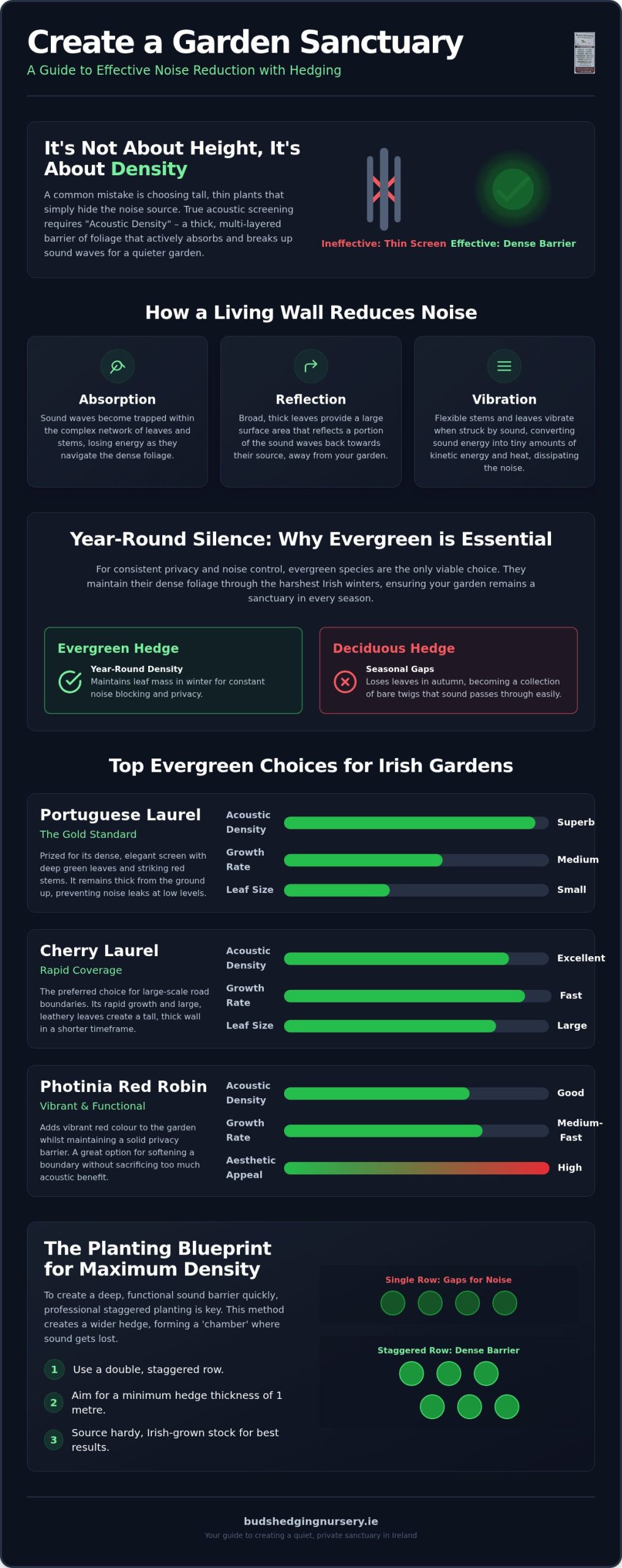
The effectiveness of a hedge depends on two main factors: leaf surface area and evergreen density. Broad, thick leaves provide a larger surface for sound waves to strike. When these waves hit the hedge, they don’t just stop. They enter a complex network of stems and leaves. This leads to the “Vibration Effect.” Because stems and leaves are flexible, they vibrate when struck by sound energy. This movement converts the sound into a tiny amount of kinetic energy and heat, effectively dissipating the noise before it reaches your ears.
A well-established hedge is often superior to a standard timber fence for managing road noise. Solid fences can actually create wind turbulence and “whistling” as air is forced over the top or through small gaps. A hedge is semi-porous; it allows some air to pass through while filtering out the high-frequency sounds that humans find most irritating.
Absorption vs Reflection: Why Density Matters
Density is the most important metric for any noise-blocking project. Sound waves are trapped amongst the leaves in a process called absorption. For this to work, the hedge needs depth. A single thin line of plants won’t suffice. A wider hedge, often achieved through staggered planting, creates a deeper “chamber” for sound to get lost in. We generally recommend a minimum thickness of one metre to see a noticeable reduction in decibels. The thicker the leaf mass, the more opportunities the sound has to be reflected back toward the road or absorbed by the plant tissue.
Evergreen vs Deciduous for Year-Round Silence
Consistency is key for privacy and noise control. Deciduous species like Beech or Hornbeam are excellent for boundaries, but they lose their primary acoustic tool once the leaves drop in autumn. In winter, a deciduous hedge is little more than a collection of bare twigs that sound passes through easily. For year-round silence, evergreen species are the only viable choice. They maintain their leaf mass through the harshest Irish winters, ensuring your garden remains a sanctuary in every season. Species like Portuguese Laurel are particularly effective because they retain their lower branches as they mature, preventing “noise leaks” at ground level where traffic sound is often loudest.
Top Evergreen Contenders for Noise Reduction in Ireland
Selecting the right species is the first step in creating a functional sound barrier. Choosing the right hedging for noise reduction Ireland involves analysing the specific growth habits of evergreen plants that thrive in our local conditions. Three specific evergreens dominate the market due to their hardiness and foliage density: Portuguese Laurel, Cherry Laurel, and Photinia Red Robin. Each offers a different balance of growth speed and acoustic performance. For those seeking a premium finish, Portuguese Laurel is widely considered the gold standard. It provides a dense, elegant screen with deep green leaves and striking red stems that remain thick from the ground up.
While Portuguese Laurel is prized for its refinement, Cherry Laurel is the preferred choice for large-scale road boundaries. Its rapid growth rate allows it to establish a tall, thick wall in a shorter timeframe. Photinia Red Robin serves a different purpose; it introduces vibrant red colour to the garden whilst maintaining a solid privacy barrier. It isn’t quite as dense as the laurels, but it’s an excellent option for homeowners who want to soften the look of a security boundary without sacrificing too much acoustic benefit.
The Laurel Comparison: Portuguese vs Cherry
The choice between these two laurels usually comes down to leaf size and available space. Portuguese Laurel (Prunus lusitanica) has smaller, tighter leaves, whereas Cherry Laurel (Prunus rotundifolia) features large, leathery leaves. These broad surfaces are highly effective at reflecting sound waves away from the property. According to scientific studies on noise reduction, species with similar leaf structures to Prunus laurocerasus show significant promise in urban noise mitigation. Consider these factors when choosing:
- Portuguese Laurel: Best for narrow gardens and formal, compact screening.
- Cherry Laurel: Ideal for wide perimeters and blocking high-decibel road noise.
Resilient Alternatives: Privet and Griselinia
Beyond the laurels, other species provide excellent results for hedging for noise reduction Ireland. Green and Golden Privet are reliable choices for those who prefer a tight, formal acoustic wall. They respond well to frequent trimming, which encourages the dense branch structure needed to trap sound. For coastal areas, Griselinia is the undisputed champion. It is exceptionally salt-tolerant and won’t brown in sea spray, making it the primary choice for seaside noise and wind screening. Some growers now recommend mixing these species to create a “tapestry hedge.” This approach provides varied leaf textures for better sound diffraction and supports local biodiversity. If you’re unsure which species suits your soil, you can view our full range of hardy Irish-grown hedging to find the best fit for your site.
Matching Acoustic Hedging to Your Site Conditions
Finding the right hedging for noise reduction Ireland depends heavily on your local soil profile and weather exposure. A plant that provides excellent sound absorption in a sheltered urban garden might struggle on an exposed, windswept hillside or a damp site in an inland region. You must match the species to the land to ensure the hedge grows thick enough to function as a barrier. If the plants are stressed by waterlogged soil or salt spray, they will thin out, allowing noise to leak through the gaps.
Urban gardens face their own specific set of challenges. Pollution from heavy traffic can clog the pores of certain sensitive species, leading to stunted growth. For city-centre boundaries, we recommend resilient evergreens like Privet or Laurel, which tolerate poor air quality whilst maintaining the dense foliage required for acoustic screening. For more detailed species selection based on environmental factors, you can consult RHS advice on hedging, which highlights how different plants interact with their environment.
Thriving in Heavy Clay and Damp Ground
Heavy clay is a common obstacle across many areas of Ireland. When soil holds too much water, the roots of many evergreens can rot. Hornbeam is often the best choice for noise reduction in these conditions. Whilst it is technically deciduous, it retains its copper-coloured leaves throughout the winter if pruned correctly, providing a year-round sound buffer. It is far more tolerant of “wet feet” than Beech or most conifers.
If you prefer an evergreen like Portuguese Laurel in heavy soil, preparation is essential. We recommend the following techniques to improve survival rates:
- Incorporate plenty of horticultural grit into the planting trench to facilitate drainage.
- Add well-rotted organic matter to break up the clay structure.
- Plant on a slightly raised mound if the area is prone to standing water during the winter months.
Coastal and High-Altitude Resilience
Coastal gardens require plants that can withstand salt-laden winds without browning. Escallonia is a superb flowering evergreen that thrives in these conditions. Its small, glossy leaves create a tight mesh that is excellent at breaking up wind-borne noise. Similarly, Griselinia littoralis remains a versatile choice for coastal regions. It grows rapidly and produces thick, leathery leaves that reflect sound waves effectively.
For very exposed, windy sites, a single row of plants might not be enough. In these cases, we suggest using a “sacrificial” windbreak of native species like Whitethorn on the outer edge. This protects your primary acoustic hedge, allowing it to grow tall and dense without being scorched by the wind. This multi-layered approach is the most reliable way to secure long-term privacy and silence in a challenging Irish landscape.
The Planting Blueprint: Spacing and Timing for Maximum Density
Success with hedging for noise reduction Ireland isn’t just about what you plant, but how you arrange it. We call this the “Density Dividend.” If you prioritise height too early, the plant focuses its energy on upward growth, leaving the base thin and sparse. Noise behaves like water; it will find any gap, especially at ground level where tyres meet the road. To prevent a “leggy” hedge, you must focus on building thickness from the bottom up starting on the day of planting.
The professional planting sequence begins with thorough trench preparation. Don’t simply dig individual holes. A continuous trench twice as wide as the root mass allows roots to spread laterally, leading to a more stable and uniform barrier. Once planted, the secret to a dense wall is initial pruning. Cutting back the leading shoots of many species stimulates lower buds to break. This forces the plant to bush out at the base, ensuring no sound-leaking gaps remain near the soil line.
Staggered Planting for Acoustic Buffering
Staggered planting is the gold standard for privacy and creating a functional acoustic barrier. Instead of a single straight line, you should arrange your plants in a double-row “W” pattern. This layout maximises the depth of the foliage in a relatively small footprint. For a solid wall, we recommend spacing Portuguese or Cherry Laurel at 60cm intervals. If you’re using smaller-leaved plants like Privet, reduce the spacing to 33cm. This ensures the branches interlock quickly, creating the multi-layered structure needed to trap and dissipate sound waves.
Bare Root Season vs Year-Round Containers
Timing your project correctly can save you a significant amount of money, particularly if you plant during the bare root tree season Ireland. This dormant period typically runs from November to March. Bare root plants are easier to transport and establish well in our damp winter soil. If you need to plant during the summer, pot-grown containers are the better option. They provide an immediate visual screen and suffer less transplant shock in warmer weather. Root-ball hedging serves as a middle ground, offering larger, semi-mature plants for projects where privacy is an urgent requirement. You can check our latest availability for hardy Irish-grown hedging to see which format fits your 2026 planting schedule.
Sourcing Resilient, Irish-Grown Hedging for Long-Term Privacy
The success of your project depends on the origin of your plants. When selecting hedging for noise reduction Ireland, many homeowners make the mistake of buying imported stock that has been raised in much milder European climates. These plants often suffer from “garden centre shock” when exposed to the damp, windy conditions of an Irish winter. At Buds Nursery Cavan, our 60-acre production site allows us to grow hardy, acclimatised stock that is ready for the local environment. Because our plants are raised in the open ground in Cavan, they develop the resilience needed to establish quickly and provide a functional sound barrier from the first season.
Buying direct from a specialist grower offers tangible benefits that go beyond simple cost savings. Stock from a traditional nursery is fresher because it hasn’t spent weeks in a distribution centre or on a retail shelf. Buds Nursery Cavan brings 30 years of horticultural expertise to every plant we sell, ensuring that the specimens you receive are at the peak of health. This experience is particularly important for large-scale privacy projects where the failure of even a few plants can create a permanent gap in your acoustic screen.
The Quality Difference: Root Health and Branching
A dense hedge requires a robust root system. We use a horticultural technique called “undercutting” during the growing process. This involves severing the taproot while the plant is still in the ground, which encourages the development of a thick, fibrous root mass. A plant with a superior root system can take up nutrients more efficiently, leading to faster growth and thicker foliage. For noise reduction, we prioritise multi-stemmed plants. These specimens have been pruned in the nursery to branch out from the base, providing the immediate density required to block road noise and wind. This is a significant advantage over leggy, single-stemmed plants often found in general retail outlets.
National Delivery and Expert Support
Organising the logistics for a large-scale planting project shouldn’t be a hurdle. Buds Nursery Cavan provides a national delivery service across Ireland, ensuring that your hedging arrives in prime condition, regardless of the size of the order. Whether you are planting a small urban boundary or a long perimeter along a national primary road, we can manage the delivery logistics to suit your schedule. If you are unsure about the number of plants required or the best species for your specific soil type, consulting with a specialist plant nursery Ireland is a vital step. Our team can provide bespoke advice based on three decades of experience in the Irish trade.
View our full range of noise-reducing hedging and request a quote to start your garden transformation today.
Secure Your Garden Sanctuary for 2026
Creating a quiet outdoor space starts with selecting the right plants and following a disciplined planting blueprint. You now understand how “Acoustic Density” and staggered rows outperform simple timber fences when blocking road noise or buffering coastal winds. Sourcing hardy, acclimatised stock is the final piece of the puzzle to ensure your investment survives the Irish climate.
With over 30 years of growing experience on our 60-acre specialist production site, we’ve refined the process of raising resilient plants. Selecting the correct hedging for noise reduction Ireland ensures you receive stock that’s already hardened to local conditions. Buying direct from the grower guarantees fresher plants with superior root systems, giving your new screen the best possible start. This professional approach prevents the “leggy” growth that often leads to noise leaks at ground level.
Browse our 2026 Privacy and Noise Reduction Hedging and request a quote for your project. You don’t have to tolerate a noisy or exposed garden. With the right species and professional spacing, you can build a living wall that provides peace and privacy for decades to come.
Frequently Asked Questions
Which hedging is best for blocking road noise in Ireland?
Portuguese Laurel and Cherry Laurel are the most effective due to their dense, evergreen foliage and large leaf surface area. These species create a thick living wall that absorbs and reflects sound waves. For coastal road noise, Griselinia is often the superior choice because it tolerates salt spray. Choosing the right hedging for noise reduction Ireland involves selecting plants that maintain their leaves year-round to ensure consistent acoustic screening during the winter months.
What is the fastest-growing hedge for privacy in Ireland?
Cherry Laurel and Green Leylandii are amongst the fastest-growing species, often putting on 60cm to 90cm of height per year under the right conditions. While speed is helpful for immediate privacy, it’s important to trim them regularly to maintain density at the base. Photinia Red Robin also grows quickly and offers a vibrant colour change. For those prioritising a balance of speed and manageable maintenance, Cherry Laurel remains the most popular choice for Irish perimeters.
How many hedging plants do I need per metre for a dense noise screen?
For a standard single-row hedge, you typically need 3 plants per metre. However, for effective noise reduction, we recommend a double-row staggered pattern using 5 or 6 plants per linear metre. This “W” shaped layout creates a deeper foliage barrier that traps more sound energy. Spacing usually ranges from 33cm for smaller species like Privet to 60cm for larger evergreens like Portuguese Laurel. This density ensures branches interlock quickly to block sound leaks.
Can I plant a privacy hedge in heavy clay soil?
You can plant a privacy hedge in clay, but you must select tolerant species like Hornbeam or certain Laurel varieties. Hornbeam is particularly resilient in damp, heavy ground where other evergreens might suffer from root rot. Preparation is key; you should incorporate grit and organic matter into a continuous planting trench to improve drainage. If the site is prone to standing water, planting on a slightly raised mound can prevent the roots from becoming waterlogged.
Is Portuguese Laurel better than Cherry Laurel for noise reduction?
Both are excellent, but Portuguese Laurel is often considered superior for formal gardens due to its tighter, denser leaf structure. Its smaller leaves and red stems create a very thick mesh that is highly effective at absorbing high-frequency noise. Cherry Laurel has larger, leathery leaves which are better at reflecting sound waves away from your property. Your choice for hedging for noise reduction Ireland should depend on your aesthetic preference and whether you have the space for a wider spread.
When is the best time of year to plant a hedge in Ireland?
The best time to plant is during the dormant season, which runs from October to March. This is when bare root plants are available, offering a cost-effective way to plant long boundaries. Pot-grown plants can be planted year-round, provided they are watered well during dry summer spells. Planting in the autumn or early spring allows the root system to establish in the damp Irish soil before the main growing season begins in May.
How do I make my hedge grow thicker at the bottom?
To ensure a thick base, you must prune the leading shoots immediately after planting. This stimulates the dormant buds lower down the stem to break and produce new branches. If you let a hedge grow tall too quickly without trimming the sides and top, it will become “leggy” and thin at the bottom. Regular maintenance pruning in a slightly tapered shape, where the bottom is wider than the top, allows sunlight to reach the lower foliage.
Do I need planning permission for a tall hedge in Ireland?
There is no specific legislation in the Republic of Ireland that sets a maximum height for hedges or requires planning permission for them. However, you should consider the impact on your neighbours’ light and access. Disputes over high hedges can be subject to common law rights and nuisance claims through the courts. It is always best to discuss your plans with neighbours if you intend to grow a screen significantly higher than two metres.