

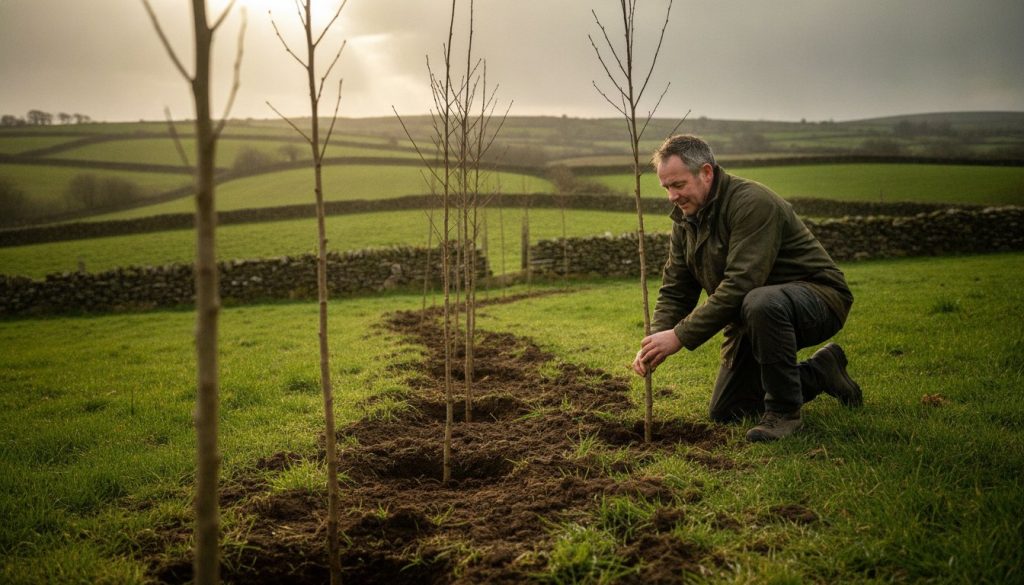
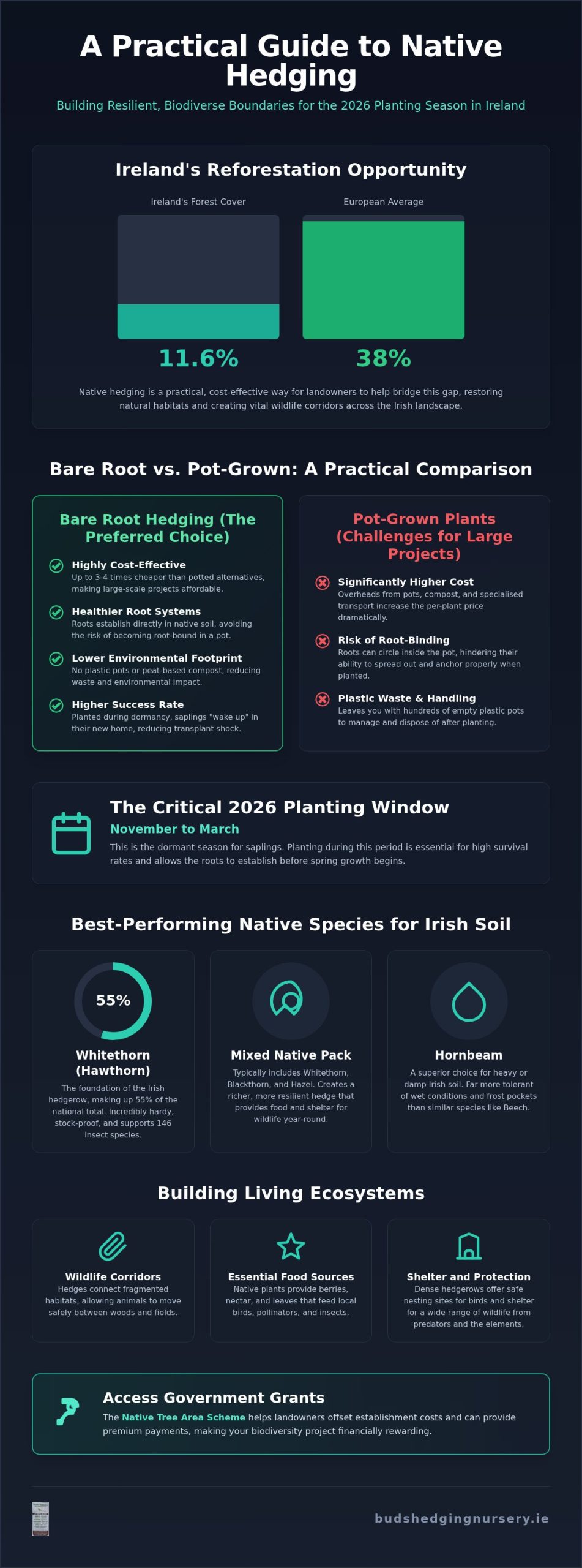
Did you know that Ireland’s forest cover sits at just 11.6 per cent, significantly lower than the European average of 38 per cent? It is a gap that many local landowners are now working to bridge. If you’re planning a project for the 2026 season, sourcing quality bare root native hedging Cavan is the most practical way to build a resilient, biodiverse boundary without the steep costs of container-grown plants. Whether you’re a farmer participating in the Native Tree Area Scheme or a homeowner wanting a traditional whitethorn screen, getting the right advice from the start makes all the difference.
It’s frustrating to invest time and money into planting only to see saplings fail because they weren’t suited to the heavy soils often found in this region. We know that navigating grant requirements and species selection can feel like a chore. This guide simplifies that process. You’ll learn how to select the best species for the Irish climate, master the 2026 planting timeline, and maximise your value through government schemes. We will cover everything from site preparation to national delivery, ensuring your new hedge thrives for decades to come.
Key Takeaways
- Learn why bare root native hedging Cavan is the most cost-effective solution for establishing long-lasting, biodiverse field boundaries and garden screens.
- Identify the best-performing species for Irish soil, including traditional Whitethorn and year-round Beech varieties.
- Understand the critical 2026 planting window from November to March to ensure high survival rates and strong root development.
- Discover how to access the Native Tree Area Scheme to offset establishment costs and secure premium payments for your land.
- Get practical maintenance tips on pruning and soil preparation to guarantee your new hedge grows thick and healthy from the base up.
Understanding Bare Root Native Hedging for Irish Landscapes
Bare root plants are nursery-grown saplings lifted directly from the field during their dormant phase. This typically happens between November and March. When you order bare root native hedging Cavan, you receive plants that have been moved without soil or pots. It’s a method that works with the seasons rather than against them. This traditional approach is the preferred choice for large-scale boundary projects across the Irish countryside because it mirrors how plants naturally establish in the wild.
Choosing bare root isn’t just about tradition; it’s a matter of practical efficiency. Since these plants don’t require heavy pots or peat-based compost, the environmental footprint is significantly lower. You won’t find yourself dealing with hundreds of empty plastic pots once the job is done. Instead, the focus remains on the plant’s health and its ability to integrate with your local soil conditions immediately upon planting. For a 60-acre specialist nursery, this method allows for the production of high-quality stock that is ready for the rigours of the Irish climate.
Bare Root vs Pot-Grown: A Practical Comparison
The economic advantage of bare root hedging becomes obvious when you calculate the requirements for a 100-metre boundary. Potted alternatives often cost three to four times more per plant due to the overheads of container production and specialised transport. For large projects, these costs add up quickly. Bare root bundles are light and easy to handle. You can transport enough hedging for a massive site in a single trip, and national delivery is straightforward because the plants aren’t weighed down by heavy soil.
There’s also the issue of transplant shock. Potted plants can become root-bound, where roots circle the inside of the plastic rather than spreading outwards. When you plant bare root native species whilst they’re asleep, they wake up in their permanent home. This allows the roots to move directly into the surrounding earth as soon as the ground warms in spring. It results in a much higher success rate for large Irish landscapes where soil can be heavy or challenging.
Why Native Species Matter for Biodiversity
Native hedging consists of species indigenous to Ireland since the last ice age. These plants are the backbone of our rural landscape. To truly understand What is a Hedgerow, you must see it as a living ecosystem. Native hedges provide essential food sources, such as berries and nectar, for local birds and pollinators that have evolved alongside them for thousands of years.
These boundaries act as vital wildlife corridors. They connect fragmented habitats, allowing animals to move safely between woods and fields. By choosing native species for your project, you’re helping to restore these natural highways. A well-planned native hedge supports hundreds of insect species, which in turn feeds the wider food chain, ensuring the long-term health of our local environment.
Selecting the Best Native Species for Your Boundary
Choosing the right plants for your site is the first step towards a successful project. Whitethorn, also known as Hawthorn, is the foundation of the traditional Irish hedgerow. It makes up roughly 55 per cent of all hedgerows across the country. It’s incredibly hardy and supports 146 different insect species. If you’re looking for bare root native hedging Cavan, Whitethorn provides a stock-proof barrier that thrives in our local conditions.
Blackthorn is often planted alongside it. It offers early spring blossom and deep purple sloes in autumn. For those needing year-round colour and security, Holly is an excellent addition. It’s one of the few native evergreens that can handle the Irish winter whilst providing shelter for nesting birds. If your ground is particularly heavy or prone to dampness, Hornbeam is a superior choice. It looks very similar to Beech but is far more tolerant of wet feet and frost pockets.
The Mixed Native Hedge Pack: A Biodiversity Powerhouse
A mixed native pack usually includes a blend of Whitethorn, Blackthorn, and Hazel. This variety isn’t just for looks. A multi-species hedge is far more resilient to pests and diseases than a single-species line. It creates a richer environment for wildlife, providing food and shelter at different times of the year. For landowners looking to meet specific environmental criteria, you can find more details in A Practical Guide to Native Trees Scheme Plants in Ireland.
Specialist Hedging for Privacy and Shelter
If your goal is privacy or a formal boundary, Beech is the standard. Green and Copper varieties both retain their brown leaves through winter, providing a solid screen even when dormant. Beech needs well-drained soil to thrive. On exposed sites, these species act as effective windbreaks that protect smaller garden plants. For a deeper look at spacing and varieties, see Beech Hedging Plants Ireland: The Complete 2026 Buying Guide. You can speak with our team for advice on your specific site.
The Bare Root Planting Season: 2026 Timing and Preparation
The 2026 bare root season typically runs from mid-November through to late February or mid-March. This window is dictated by the plant’s natural cycle. Lifting and planting must happen whilst the saplings are dormant. When you order bare root native hedging Cavan, you’re receiving plants that have paused their growth for the winter. This dormancy is critical. It allows the root system to settle into the soil without the immediate demand of supporting new leaves or flowers. By the time spring arrives, the roots are already established and ready to push out new growth.
Preparation should begin well before your delivery date. Clearing a strip of grass at least 60cm wide is the first task. Grass is a fierce competitor for moisture and nutrients, and removing it gives your hedge the best start. If your plants arrive during a period of heavy frost or snow, you’ll need to store them correctly. Keep the bundles in a cool, frost-free shed. Ensure the roots stay damp by covering them with wet sacking or straw. If planting is delayed for more than a few days, it’s best to “heel them in” by digging a shallow temporary trench and covering the roots with loose soil.
Step-by-Step Soil Preparation for Native Hedges
Testing your soil drainage is a vital step before the lifting season begins. Dig a small hole and fill it with water; if it hasn’t drained within 24 hours, you may need to improve the structure or plant on a slightly raised drill. For large-scale projects, the trench method is far more efficient than digging individual pits. Digging a continuous trench ensures that the soil is loosened evenly along the entire line, which encourages lateral root spread. For a comprehensive look at the 2026 calendar, consult our Bare Root Tree Season Ireland: The Complete 2026 Planting Guide.
Logistics of National Delivery in 2026
Sourcing from a specialist 60-acre nursery means your plants are lifted fresh from the field rather than sitting in a distribution centre. We bundle saplings in protective, breathable bags to prevent the roots from drying out during transport. This is particularly important for species that are sensitive to wind-burn. Demand for popular varieties like Copper Beech is always high, so we recommend organising your order early in the season. National delivery is handled with care to ensure the plants arrive in peak condition, ready to go straight into your prepared ground.
Maximising Growth: Maintenance and the Native Trees Scheme
The success of your bare root native hedging Cavan depends heavily on the first six months after planting. Once the saplings are in the ground, you must firm the soil around the roots with your heel. Frost often causes the ground to heave, which can lift young plants and expose their roots to the air. Checking your hedge after a hard frost is a simple but essential task. Whilst Ireland is known for its rain, a dry spell in April or May can be fatal for new hedges. Regular watering during the first growing season ensures the root system can support the new foliage as it emerges.
Pruning is another area where many landowners hesitate. To get a thick, stock-proof boundary, you need to encourage growth from the bottom. For species like Whitethorn, cutting the saplings back to about 15cm at the time of planting stimulates multiple new shoots from the base. Without this initial cut, you often end up with a ‘leggy’ hedge that is thin at the bottom and offers little privacy or security. This practice is standard for traditional Irish field boundaries.
Grant Support and Environmental Schemes
The Native Trees Scheme is a DAFM-supported initiative for woodland expansion that provides significant financial support for planting. Under the Native Tree Area Scheme (NTAS), a farmer planting one hectare can receive premium payments of over €22,000 over a 10-year period. Participation requires specific species and sourcing standards to ensure the new woodland integrates with the local environment. As a specialist nursery managing 60 acres of production, we ensure our stock meets all the necessary criteria for these government grants. We provide the documentation and the correct provenance of plants required for successful scheme participation.
Long-term Maintenance for a Healthy Boundary
Annual maintenance keeps your boundary functional and resilient. For formal native hedges like Beech, trimming once a year in late summer helps maintain a neat shape whilst allowing the plant to retain its winter foliage. For traditional farm hedges, an organic approach to weed control is best. Applying a thick layer of bark mulch or using biodegradable mats prevents competition from grass and weeds without the need for chemicals. This is particularly important during the first three years of establishment.
Common mistakes often include planting the saplings too deep. The soil level should match the nursery line on the stem. Planting too deep can cause the bark to rot, whilst planting too shallow leaves the roots vulnerable to drying out. If you’re planning a project for the 2026 season and need bare root native hedging Cavan that complies with national standards, you can contact our expert team to discuss species selection and grant requirements.
Sourcing Quality Native Plants from Buds Nursery Cavan
Sourcing your bare root native hedging Cavan from a specialist production site ensures you get plants that are fresh, vigorous, and ready to thrive. With 60 acres under management at Buds Nursery Cavan, we maintain the stock levels required for both small garden boundaries and large agricultural projects. Buying direct from the grower removes the middleman. This means your plants are lifted just before they are bundled for delivery, which significantly reduces the time roots spend out of the ground. It is a level of quality control that general garden centres simply cannot match.
We take the health of our stock seriously. Every plant grown at Buds Nursery Cavan is monitored throughout its growth cycle to ensure it develops a robust root system. This focus on root health is what allows our native hedging to establish so quickly once it reaches its permanent home. Whether you are planting a single row of Beech or a multi-species farm boundary, starting with healthy, nursery-grown saplings is the best way to guarantee long-term success.
Why Experience Matters in Horticulture
Buds Nursery Cavan has been a fixture in the Irish landscape since 1994. Over 30 years of hands-on experience goes into every bundle we produce. Sourcing from a local nursery is vital because our plants are already hardened to the Irish climate. They have grown in the same rain, frost, and wind they will face on your land. This local provenance is a key factor in the high survival rates our customers experience. For a deeper look at our production methods, see our guide on Specialist Plant Nursery Ireland: A Guide to Sourcing Quality Trees and Hedging.
Planning Your Visit or Delivery
We provide expert guidance on-site at Glassdrummon from Tuesday to Saturday. Please note that Buds Nursery Cavan is closed on Sundays and Mondays. If you are planning a large project for the 2026 season, a visit allows you to see the quality of our bare root native hedging Cavan and discuss your specific requirements with our team. Whilst we don’t offer landscaping installation services, we provide all the practical advice you need to manage the planting process yourself.
For farmers and large landowners, Buds Nursery Cavan provides tailored quotes for bulk orders. This is particularly helpful for those aligning their projects with national grant schemes. We organise national delivery to ensure your plants arrive in peak condition, regardless of your location in Ireland. Contact Buds Nursery Cavan today to organise your 2026 bare root hedging and secure your stock for the upcoming planting window.
Preparing Your Land for a Sustainable Future
Establishing a native boundary is an investment in the long-term health of your land. By choosing bare root native hedging Cavan, you’re opting for a cost-effective and ecologically sound method that respects the natural rhythm of the Irish seasons. The success of your project depends on selecting the right species and planting whilst they remain dormant. This approach ensures high survival rates and a resilient, healthy boundary that will thrive in our local soil.
Since 1994, our 60-acre specialist production site has focused on traditional growing methods that suit the Irish climate. As specialists in the Native Trees Scheme, we provide the 30 plus years of experience needed to help you transform your landscape. We understand the practicalities of large-scale planting and the requirements for national grant schemes.
Visit Buds Nursery Cavan to source your 2026 bare root hedging and begin your project with confidence. Your new hedge will provide shelter, security, and beauty for decades to come.
Frequently Asked Questions
When does the bare root native hedging season start in 2026?
The 2026 lifting season begins in mid-November once the saplings enter their winter dormancy. This period usually runs until late February or mid-March, though some species like Beech can be planted slightly later if the ground remains cool. It’s essential to finish planting before the spring buds begin to open. Sourcing your bare root native hedging Cavan during this specific window ensures that the roots have time to settle before the summer growing season.
What is the best native hedge mix for a farm boundary?
A standard farm boundary usually consists of a high percentage of Whitethorn, often between 55 and 75 per cent of the total mix. We recommend adding Blackthorn, Hazel, and Holly to increase biodiversity and provide year-round interest. At Buds Nursery Cavan, we grow these species on our 60-acre site to ensure they are hardy enough for the heavy soils and weather conditions found across the Irish midlands and beyond.
How many bare root plants do I need per metre for a thick hedge?
To achieve a thick and stock-proof boundary, you should plant six bare root saplings per metre. These are best arranged in a double staggered row with roughly 33cm between each plant. This layout prevents gaps from forming at the base of the hedge as it grows. Using this density with bare root native hedging Cavan ensures you create a solid barrier that offers both privacy and an effective windbreak for your property.
Can I plant bare root native hedging in a small garden?
Native species are perfectly suited for smaller gardens, provided they are managed correctly. Beech and Hornbeam are the most popular choices for garden boundaries because they respond well to formal pruning and retain their winter leaves for privacy. Whilst a rural hedge might be allowed to grow quite wide, a garden hedge can be kept at a depth of about 60cm. This allows you to support local wildlife even in a limited space.
How long can bare root trees be kept before planting?
Bare root plants are best put into their permanent positions within two or three days of arrival. If you face a delay, keep the bundles in a cool, frost-free area and ensure the roots stay damp. For longer delays, you must ‘heel them in’ by digging a temporary trench and covering the roots with loose soil. This protects the delicate root hairs from drying out, which is the primary cause of plant failure.
Does Buds Nursery Cavan deliver bare root hedging nationwide in Ireland?
Buds Nursery Cavan provides national delivery for all orders, ensuring your plants arrive in peak condition regardless of your location. We use specialised packaging to keep the roots moist and protected from wind-burn during the journey. This service is designed for both small garden orders and large-scale agricultural projects. You can also choose to collect your order directly from our nursery site in Cavan from Tuesday through to Saturday.
Are the plants at Buds Nursery Cavan suitable for the Native Trees Scheme?
Every plant grown at Buds Nursery Cavan is produced to meet the strict standards required for the Native Trees Scheme and other DAFM grants. We have over 30 years of experience in providing the correct species and provenance for these environmental initiatives. We provide all the necessary documentation for your grant application, ensuring your project meets the 2026 criteria for woodland expansion and biodiversity improvement across the Irish landscape.
What is the difference between Whitethorn and Blackthorn for hedging?
Whitethorn is the backbone of the Irish hedge, known for its white May blossom and red autumn berries. Blackthorn is easily identified by its darker bark and white flowers that appear much earlier, often in March before any leaves emerge. Whilst Whitethorn is easier to maintain as a neat hedge, Blackthorn is excellent for thickening wilder boundaries. Both species provide vital food and security for birds and pollinators throughout the year.