

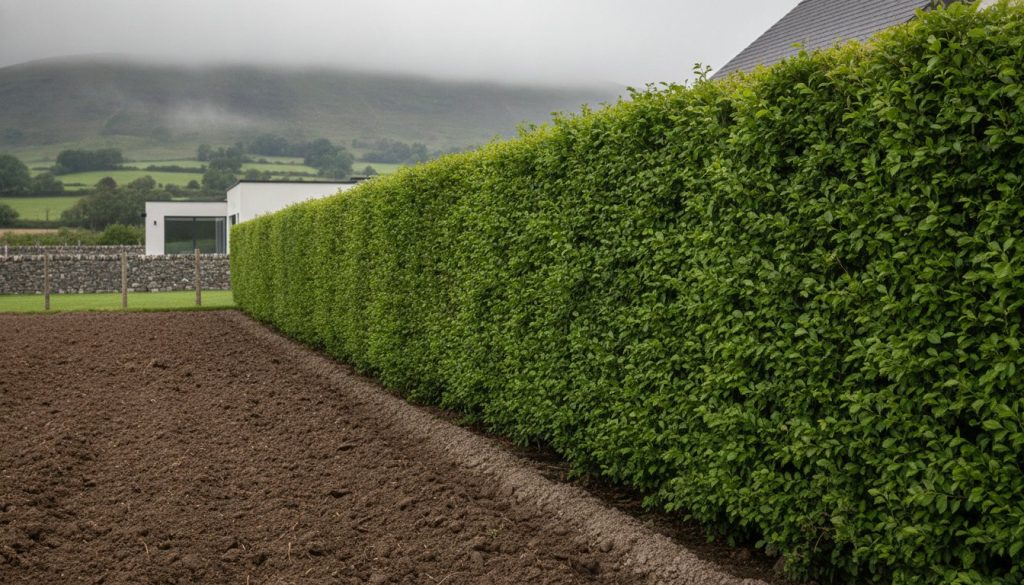
Most gardeners treat heavy clay like a life sentence for their plants, but it’s actually one of the most nutrient-rich foundations you can have for a boundary. If you’ve spent years watching expensive shrubs fail to establish, it’s easy to feel defeated by the ground beneath your feet. We understand the frustration of dealing with waterlogging in the winter and soil that turns rock-hard in the summer. It’s a common struggle, yet the right choice of hedging for clay soil can turn these challenges into a lush, thick privacy screen that lasts for decades.
This guide provides a practical look at the species that genuinely thrive in heavy ground, from the resilient Hornbeam to the reliable Cherry Laurel. You’ll learn how to prepare your soil to prevent the dreaded “sump effect” and ensure your new plants get the best possible start. Drawing on over 30 years of experience at our 60-acre nursery, we’ll share the exact methods we use to grow hardy, low-maintenance hedges. Whether you’re planting a small garden or meeting the March 2026 ACRES scheme deadline, these expert insights will help you build a hedge that stands the test of time.
Key Takeaways
- Identify why Hornbeam is the superior choice over Beech for heavy ground and which evergreens, like Portuguese Laurel, can handle damp conditions.
- Learn how to turn nutrient-rich but compact ground into an advantage by selecting the most resilient species of hedging for clay soil.
- Master the essential preparation techniques to avoid the “sump effect” and ensure roots have the oxygen they need to thrive.
- Explore cost-effective bare root options and native species that meet 2026 environmental scheme requirements.
- Understand why sourcing plants from a specialist grower with 30 years of experience ensures better survival rates in tough local conditions.
Why Clay Soil is a Challenge (and an Opportunity) for Hedges
Clay soil is a dense, heavy medium. It’s often misunderstood by those trying to establish a boundary. While it feels like a barrier to gardening, it’s actually a powerhouse of nutrients. The trick is managing the physical structure. Clay particles are flat and tiny; they stack like sheets of paper. This leaves very little pore space for air. When you’re selecting hedging for clay soil, you must choose species that can tolerate lower oxygen levels around their roots. A well-placed Hedge can eventually help improve soil structure, but the initial planting requires a specific approach.
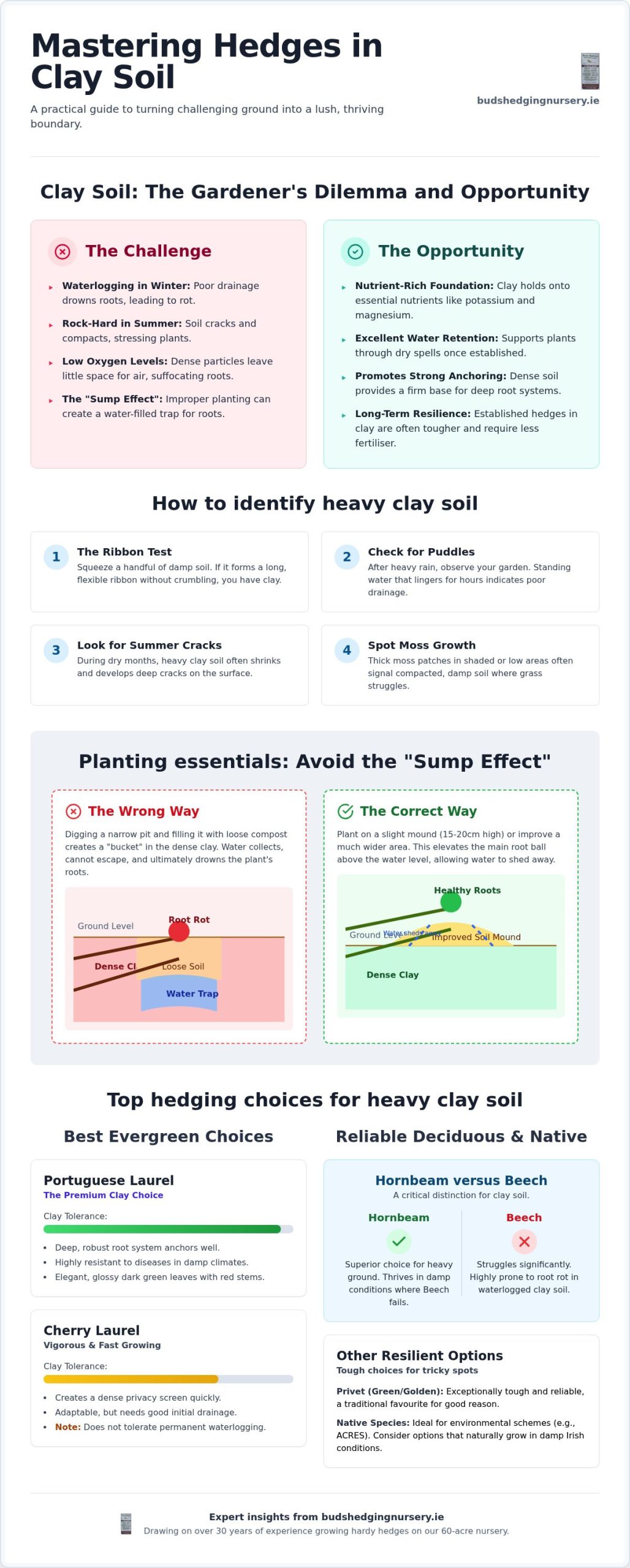
The “sump effect” is a common trap. Gardeners often dig a pit in the clay and fill it with loose, high-quality topsoil. During a wet winter, that pit acts like a bucket. Water cannot drain through the heavy clay walls, so it collects around the roots. The plant sits in a stagnant pool, leading to root rot. We’ve seen many previous plants fail because they were essentially drowned in their own planting holes. Understanding this behaviour is the first step toward a healthy, long-term screen.
Identifying Heavy Clay in Your Garden
Check your soil texture before making any purchases. You don’t need expensive kits; a simple hand test is often more reliable. Look for these indicators amongst your garden beds:
- The Ribbon Test: Take a small handful of damp soil and roll it between your palms. If it forms a long, flexible ribbon that doesn’t crumble, you have heavy clay.
- Drainage Issues: Watch for standing water that lingers for hours after a downpour.
- Surface Cracking: Notice deep fissures in the soil during the dry months of July and August.
- Moss Growth: Look for thick moss patches in shaded or low-lying areas where grass struggles to compete.
The Nutrient Advantage of Heavy Ground
Clay soil has a high cation exchange capacity. This is a technical way of saying the soil particles are negatively charged, which allows them to hold onto essential nutrients like potassium and magnesium. Because these minerals aren’t easily leached away by rain, your hedge has a reliable food source. You’ll often notice that plants in clay have a much deeper leaf colour and thicker stems. Once established, these hedges are remarkably resilient. They often require far less supplemental fertiliser than those grown in sandy conditions. Successfully managing hedging for clay soil means you’re working with the most fertile ground nature provides, provided you get the drainage right from day one.
The Best Evergreen Hedging for Clay Soil
Evergreen hedges are the first choice for homeowners seeking total privacy throughout the year. However, evergreens are generally more sensitive to “wet feet” than their deciduous counterparts. In heavy ground, the lack of oxygen can lead to yellowing leaves or stunted growth. Choosing the right hedging for clay soil is about balancing your need for privacy with the plant’s need for oxygen. Selecting the correct species ensures your boundary stays green and healthy even through a damp winter.
Cherry Laurel (Prunus laurocerasus) is a vigorous option that many gardeners turn to for quick results. It grows rapidly and creates a dense screen. Whilst it’s adaptable, it doesn’t tolerate permanent waterlogging. If your site is particularly heavy, we recommend planting on a slight mound. Photinia Red Robin is another popular alternative for those wanting a splash of colour. Its bright red new growth is striking. It remains surprisingly resilient amongst heavier soil textures, provided it isn’t sitting in a winter sump. These species provide the thick, low-maintenance cover most homeowners desire.
Portuguese Laurel: The Premium Clay Choice
Portuguese Laurel (Prunus lusitanica) stands out as the most reliable evergreen for heavy sites. It possesses a deep, robust root system that anchors firmly into the clay. Unlike the common Cherry Laurel, the Portuguese variety is notably more resistant to diseases like shot-hole. This is a significant advantage in the damp Irish climate. Its dark green, glossy leaves and elegant red stems provide a sophisticated finish to any boundary. For a deeper dive into this species, see our Portuguese Laurel: The Complete Guide for Irish Gardens 2026. It’s a favourite for a reason; it simply handles the pressure of heavy ground better than most.
Other Resilient Evergreens: Privet and Viburnum
Privet remains a staple of the traditional garden for good reason. Both Green and Golden Privet are exceptionally tough. They are technically semi-evergreen, meaning they might drop some leaves in a very harsh winter, but they recover quickly. They provide a neat, formal look that’s easy to maintain. Viburnum Tinus is another excellent candidate. It offers winter flowers and dark berries, thriving even in soils that would stress more delicate shrubs. Escallonia is a fast-growing evergreen that produces beautiful summer flowers. It handles clay well but needs a spot that avoids the worst of the winter floods. If you’re unsure which species suits your garden, you can view our full range of evergreens to see what we have in stock at the nursery.
Reliable Deciduous and Native Hedges for Heavy Ground
Deciduous hedges are the workhorses of the Irish landscape. While evergreens offer year-round cover, deciduous species are often far more forgiving of the seasonal shifts found in heavy ground. These plants enter dormancy during the winter months. This is exactly when clay soil is at its most saturated. Because the plants aren’t actively growing or transpiring during the wettest weeks, they’re much less likely to suffer from root stress compared to sensitive evergreens. For many rural or large-scale projects, choosing deciduous hedging for clay soil is the most practical path to a successful, long-term boundary.
Whitethorn, also known as Hawthorn, is perhaps the most resilient option available. It’s virtually indestructible once established. Its deep, aggressive root system can penetrate even the most compacted clay layers, helping to break up the soil structure over time. It provides a dense, stock-proof barrier that’s as functional as it is hardy. We’ve seen Whitethorn thrive in conditions where almost every other species has failed. It’s a staple of our 60-acre nursery for good reason.
Hornbeam: The Superior Alternative to Beech
Many gardeners admire the neat, formal look of a Beech hedge. However, Green Beech is notorious for failing in wet clay. It simply cannot tolerate “wet feet” and will often die back during a particularly sodden winter. Hornbeam (Carpinus betulus) is the essential alternative. It looks remarkably similar to Beech, with comparable leaf shapes and a similar growth habit. The key difference is its resilience. Hornbeam thrives in heavy, damp ground where Beech would struggle. It even retains its copper-brown leaves throughout the winter, providing privacy whilst dormant. If you’re set on the look of Beech but have heavy soil, read our Beech Hedging Plants Ireland: The Complete 2026 Buying Guide to understand the differences before you plant.
Native Hedging and the Native Trees Scheme
A native hedge mix is naturally adapted to the Irish climate and various soil types. By combining species like Whitethorn, Blackthorn, and Hazel, you create a boundary that supports local biodiversity whilst remaining incredibly hardy. These mixes are particularly suited to the hedging for clay soil found across many Irish farms and gardens. They handle the transition from a waterlogged winter to a baked, dry summer with ease. If you’re planning a large-scale planting project, you may be eligible for support. You can find more details in our article, A Practical Guide to Native Trees Scheme Plants in Ireland. These schemes often require specific species counts, so choosing the right mix is vital for both compliance and plant survival.
How to Prepare and Plant a Hedge in Clay Soil
Preparation is the single most important factor in determining whether your new boundary thrives or remains stagnant. Successful hedging for clay soil relies on the physical structure of the ground at the moment of planting. You should never work the soil when it’s “plastic” or overly saturated. If you squeeze a handful of soil and it forms a slick, shiny ball that won’t crumble, it’s too wet. Walking on or digging in these conditions causes severe compaction. This squashes the tiny air pockets roots need to breathe, leading to a hedge that survives but never grows.
The goal of preparation is to “open up” the clay. You aren’t trying to replace the soil entirely, but rather improve its aeration. This is a long-term investment. Once the hedge is established, its roots will do the hard work of maintaining soil structure. Until then, you must provide a hospitable environment. Correct planting depth is also vital. In heavy ground, it’s safer to plant slightly shallow rather than too deep. If the stem base is buried in heavy, wet clay, it will likely rot before the first spring growth begins.
Improving Drainage Before You Plant
Mounding is a traditional technique that works wonders in damp Irish gardens. By creating a slight ridge or mound about 15 to 20 centimetres high, you lift the root ball out of the most saturated zone. This prevents the roots from sitting in standing water during a wet winter. To break up heavy clods, incorporate plenty of well-rotted manure or horticultural grit. Avoid adding pure building sand. When sand is mixed with clay, it often creates a texture similar to concrete, which is even harder for roots to penetrate than the original clay.
The Professional Planting Method for Clay
Digging a continuous trench is far superior to individual holes. A trench allows water to move more freely along the line rather than pooling in a single spot. It effectively prevents the “bucket effect” we mentioned earlier. Use a spade to scuff or “rough up” the sides and bottom of the trench. If the walls are left smooth and glazed, they act like a ceramic pot, trapping the roots inside. Once the plants are in place, backfill with a 50/50 mix of the native soil and a quality soil conditioner. This ensures the roots can gradually transition into the surrounding ground. If you’re ready to start your project, you can order your bare root trees or container plants directly from our nursery for delivery across Ireland.
Sourcing Quality Hedging from a Specialist Irish Nursery
Choosing the right plants is only half the battle. Where you source them matters just as much. Plants grown in a specialist nursery environment are far better prepared for the transition to your garden than those kept in small pots at a general retail centre. At Buds Nursery, we manage over 60 acres of specialist growing ground. Our stock is raised to withstand the realities of the Irish climate and the specific challenges of hedging for clay soil. From the sophisticated Portuguese Laurel to the rugged, native Whitethorn, our variety ensures you find a species that fits your soil profile and privacy needs.
Buying directly from a grower provides a level of certainty that’s hard to find elsewhere. We’ve spent over 30 years observing how different species behave in heavy ground. This long-standing experience allows us to offer expert on-site guidance. We help you avoid expensive mistakes, such as choosing a species that will struggle in a winter sump. Sourcing locally also means your plants haven’t spent days in a dark lorry. They arrive fresh, healthy, and ready to put down roots in your local soil.
Why Bare Root Season is Essential for Clay
The bare root season is the most economical and effective time to plant a new hedge. Planting whilst the species are dormant allows the root systems to settle into the clay before the active growing season begins. This is particularly important for heavy ground. It gives the hedge a head start before the clay dries out and “bakes” during the summer months. For a detailed look at the current window, see our Bare Root Tree Season Ireland: The Complete 2026 Planting Guide.
There are times when the weather doesn’t cooperate. If your clay is frozen solid or completely waterlogged when your order arrives, you must store the plants correctly. You can “heel them in” by digging a temporary shallow trench in a more workable area and covering the roots with loose soil or compost. Alternatively, keep them in a cool, frost-free shed with the roots covered in damp straw or sacking. This prevents the delicate root hairs from drying out whilst you wait for the ground to become workable.
Visit Buds Nursery for Practical Guidance
We believe in a straightforward, no-nonsense approach to the trade. Our nursery is open Tuesday to Saturday for on-site selection. You can walk the rows and see the quality of our stock first-hand. We provide expert plant matching to ensure your choice of hedging for clay soil is the right one for your specific site. For those with larger projects, we offer delivery services across the country. To learn more about our process and how we grow, read our Specialist Plant Nursery Ireland: A Guide to Sourcing Quality Trees and Hedging. We are here to help you build a boundary that lasts.
Establishing a Resilient Boundary in Heavy Ground
Selecting the right hedging for clay soil is the first step toward a thick, healthy screen. By choosing water-tolerant species like Hornbeam or Portuguese Laurel and using professional planting techniques such as mounding, you can turn heavy ground into a nutrient-rich asset. Proper drainage and aeration during the bare root season provide the foundation for long-term growth. These methods prevent the common failures often associated with waterlogging and soil compaction.
We’ve spent over 30 years growing and testing species on our 60-acre specialist nursery site. This hands-on experience ensures we only provide plants that are hardy enough for the Irish climate and soil conditions. Whether you are planting a few metres or a large-scale farm boundary, we offer expert guidance and national delivery across the country. We are committed to helping you find the most durable species for your specific site.
Browse our full range of clay-tolerant hedging at Buds Nursery. Your clay soil doesn’t have to be a barrier to a beautiful garden; with the right species and a bit of preparation, you’ll have a flourishing hedge that stands for decades.
Frequently Asked Questions
Can I plant a Beech hedge in heavy clay soil?
Green Beech is generally unsuitable for heavy clay as it cannot tolerate waterlogged roots. If your soil stays damp in winter, the Beech will likely die or fail to establish. We always recommend Hornbeam as the superior alternative for these conditions. It offers the same formal look and leaf retention but possesses the resilience needed to thrive in tough, damp ground where Beech would struggle.
How do I improve drainage for a hedge in clay soil?
Improving drainage for hedging for clay soil is best achieved by planting on a raised mound or ridge. This lifts the root ball out of the most saturated zone. You should also dig a continuous trench rather than individual holes to prevent the bucket effect. Scuffing the sides of your trench with a spade is essential; it breaks the glazed surface and allows roots to penetrate the surrounding ground.
What is the fastest-growing hedge for clay soil in Ireland?
Cherry Laurel and Green Privet are amongst the fastest-growing options for heavy ground in Ireland. These species are vigorous and can put on 30 to 60 centimetres of growth per year once established. Whilst they grow quickly, they still require proper ground preparation to ensure they don’t sit in stagnant water during the winter. Regular pruning will help maintain a thick, dense screen as they mature.
Is Portuguese Laurel better than Cherry Laurel for wet ground?
Portuguese Laurel is significantly better than Cherry Laurel for sites that are prone to dampness. It has a more robust root system and better resistance to diseases that thrive in humid, wet conditions. While Cherry Laurel is tough, it is more likely to show signs of stress, such as yellowing leaves, if the ground remains saturated for long periods during a typical Irish winter.
When is the best time of year to plant hedging in clay?
The best time to plant hedging for clay soil is during the bare root season, which typically runs from November to March. Planting whilst the shrubs are dormant allows the roots to settle before the ground bakes hard in the summer. It’s important to avoid planting when the soil is frozen or completely waterlogged, as working the ground in these states leads to severe compaction.
Should I add sand to my clay soil before planting a hedge?
You should never add pure sand to clay soil as it can create a texture similar to concrete. The fine sand particles fill the small gaps between clay particles, making the ground even harder for roots to penetrate. Instead, use horticultural grit or large amounts of well-rotted organic matter. These materials help open up the soil structure and improve aeration without ruining the soil’s physical properties.
What happens if I plant my hedge too deep in clay soil?
Planting too deep in clay soil often leads to stem rot and oxygen starvation. The base of the plant needs access to air; burying it in heavy, wet clay prevents this and encourages fungal issues. We suggest planting so the root flare is just at or slightly above the soil surface. This is a safer approach in heavy ground, ensuring the hedge has the best chance of survival.