

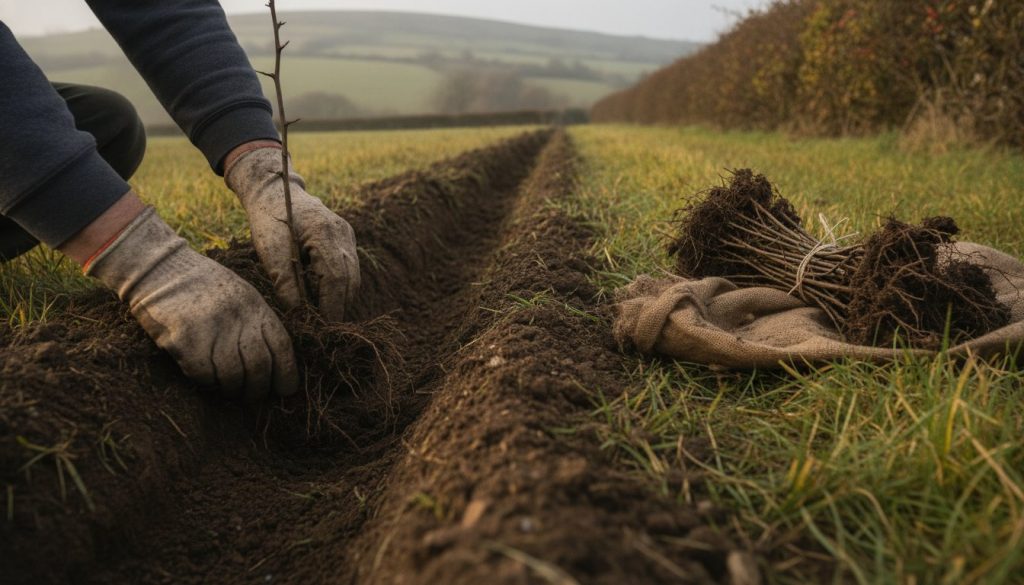
Did you know that a single native whitethorn can support 146 different insect species, making it the most vital component of the Irish countryside? You likely recognise that a well-planted hedge is more than just a line of bushes; it’s a functional, stock-proof tool and a necessity for farm management. It’s frustrating to see saplings fail because they were poorly stored or handled before they reached your gate. Sourcing the bare root whitethorn hedging Cavan farmers trust is the first step toward a successful planting season.
This guide will show you how to select, plant, and maintain your hedging to ensure a high survival rate and full compliance with Department of Agriculture schemes like ACRES. Drawing on 30 years of experience at our 60-acre nursery, we’ll cover everything from planting densities to the maintenance steps needed to establish a thick, stock-proof boundary by the 2026 deadlines.
Key Takeaways
- Understand the critical planting window between November and March to ensure your plants establish whilst dormant.
- Learn how to calculate planting densities to meet ACRES scheme requirements and create a truly stock-proof boundary.
- Discover why sourcing bare root whitethorn hedging Cavan directly from a 60-acre specialist nursery guarantees fresher, hardier plants.
- Master the “first year” pruning techniques that encourage thick, bushy growth from the base of the hedge upwards.
- Identify the essential maintenance steps, including weed suppression and watering, to protect your investment in the Irish landscape.
Bare Root Whitethorn: Essential for Irish Hedges
Whitethorn is the definitive backbone of the Irish rural landscape. For generations, it has served as the primary material for field boundaries across the country. When we talk about Common Hawthorn (Crataegus monogyna), we’re describing a species that is perfectly adapted to our soil and climate. Choosing bare root whitethorn hedging Cavan growers recommend means opting for plants that are lifted from the ground during their winter dormancy. This method ensures the roots remain undisturbed until they’re ready for their permanent home. It’s a traditional, no-nonsense approach that prioritises plant health and long-term survival.
The benefits of this species are practical. Its dense, thorny growth creates a secure, stock-proof barrier that keeps livestock in and intruders out. It’s incredibly hardy, capable of withstanding the damp, windy conditions common in the northern counties. Sourcing bare root whitethorn hedging Cavan from an experienced grower ensures you get plants that are acclimatised to the local environment. For anyone looking to plant several hundred metres of hedging, the bare root format is the only logical choice. It allows for large-scale planting at a fraction of the cost of containerised alternatives.
The Role of Hawthorn in the Ecosystem
Whitethorn is a vital asset for local biodiversity. Research indicates that it supports 146 different insect species in Ireland, providing a complex habitat for birds and small mammals. The seasonal cycle adds value too. In late spring, the “May bush” erupts in white blossoms, whilst the autumn brings a heavy crop of red berries, or haws. By using native Irish stock, you’re ensuring your hedge provides the right food and shelter at the right time for local wildlife. It’s a simple way to manage land whilst supporting the environment.
Bare Root vs Pot Grown: The Practical Choice
For large boundaries, the practical advantages of bare root plants are clear. They’re usually sold in manageable bundles of 50 or 100, making transport to the field much easier. You don’t have to worry about disposing of hundreds of plastic pots or moving heavy soil. Whilst pot-grown plants might look more established at the point of sale, bare root whitethorn often catches up within two growing seasons. They develop stronger, more natural root systems once they’re in the ground. It’s the standard choice for farmers and professional growers who value efficiency and results.
Sourcing Quality Bare Root Whitethorn Hedging in Cavan
Where you buy your plants is just as important as how you plant them. For a hedge to thrive in the specific conditions of the northern midlands, it needs to be hardy. Plants grown in County Cavan are already acclimatised to the local rainfall, soil types, and temperature shifts. Sourcing your bare root whitethorn hedging Cavan directly from a specialist 60-acre nursery ensures the plants haven’t been stressed by long-distance transport or improper storage in a retail distribution centre. Local stock is lifted from the field and prepared for you, maintaining the vital link between the soil and your site.
Buying from a dedicated grower offers a level of security you won’t find in private classified ads. Professional nurseries prioritise the health of the root system above all else. At Buds Nursery Cavan, we organise our stock to ensure roots remain moist and protected from the wind and frost from the moment they’re lifted. This professional handling is the difference between a hedge that takes off in spring and one that struggles to survive its first season. If you want to see the quality of our current stock, you can visit the nursery in Cavan from Tuesday to Saturday.
The Grower Advantage
When you buy direct, you’re getting expert advice alongside your plants. We can guide you on the best sizes for your project. For most farm boundaries, a 60-90cm plant is the standard choice. It’s large enough to be robust but small enough to establish quickly. You also have the option to pick up complementary species. Adding a small percentage of Holly or Copper Beech can break up the line and provide additional year-round interest and shelter for wildlife.
Inspecting Your Plants
A healthy bare root plant should have a well-developed, fibrous root system. When you receive your bundles, the stems should be pliable, not brittle. You can perform a simple “scratch test” to check for life. Use a fingernail to lightly scratch the bark on a stem; if it’s bright green underneath, the plant is healthy and dormant. Professional nurseries will always provide plants in tidy, labelled bundles. This makes it easier to organise your planting rows and ensures you’re putting the right species in the right place. Avoid any stock where the roots feel dry to the touch or look shrivelled, as these plants have likely suffered from desiccation during storage.
Planting Bare Root Whitethorn: Timing, Densities, and ACRES Guidelines
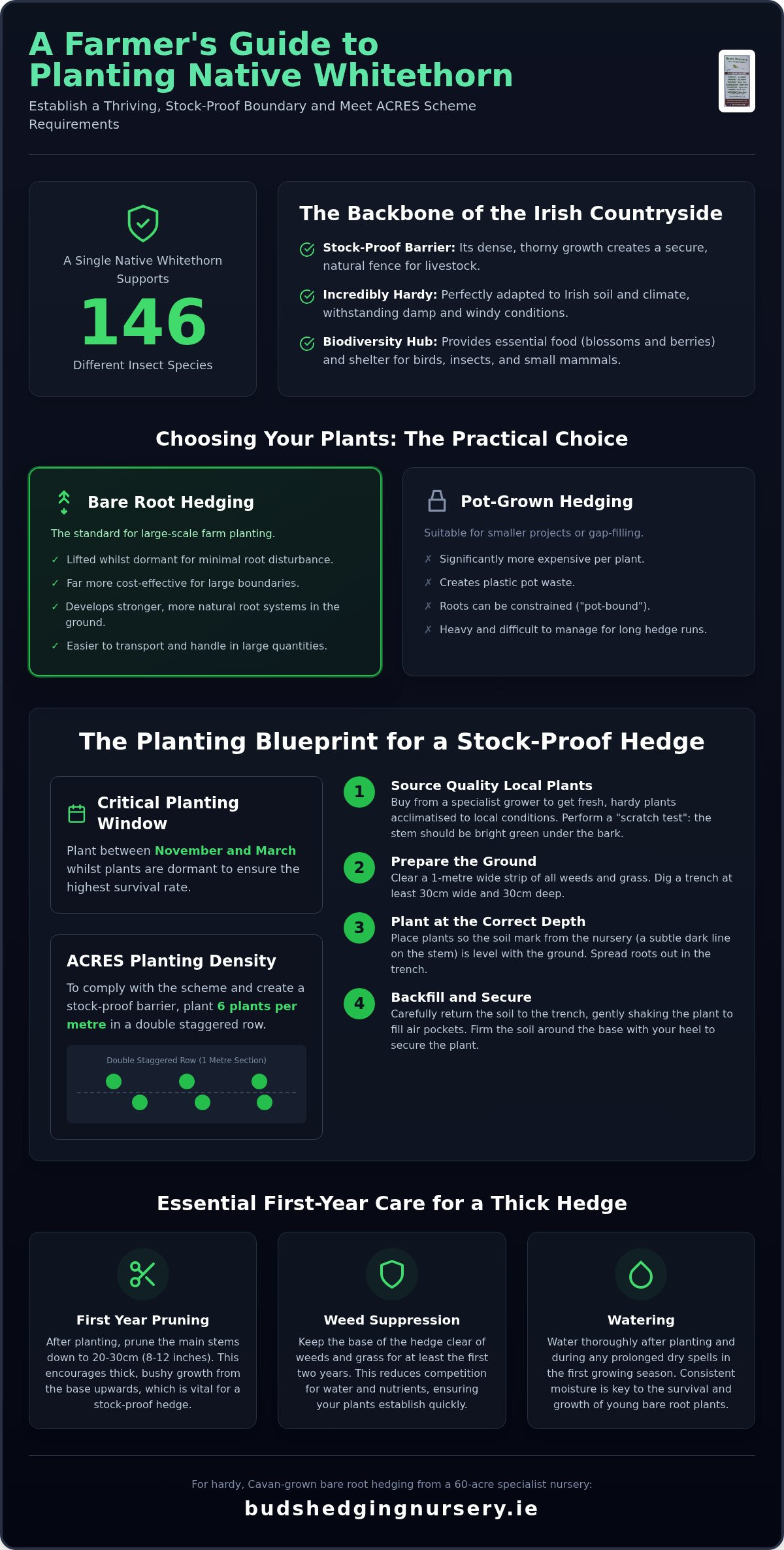
The window for successful planting is narrow but critical. You must get your bare root whitethorn hedging Cavan in the ground whilst the plants are dormant, which usually runs from November through to March. Planting during this time allows the root system to settle before the energy-intensive growth of spring begins. If the ground is frozen solid or completely waterlogged, wait for a break in the weather. For those participating in environmental schemes, remember that the deadline for completing hedge planting for ACRES tranche 1 is March 31, 2026.
Effective site preparation is non-negotiable. You should clear a strip at least one metre wide of all competing vegetation. Grass and weeds are aggressive competitors for moisture and nitrogen; removing them gives your young saplings a fighting chance. For large-scale farm boundaries, a mechanical mini-digger can make light work of trenching, but for smaller garden projects, a sharp spade is sufficient. When planting, ensure the roots are spread out naturally and the soil is firmed in well with your heel to remove any air pockets.
Meeting ACRES Scheme Requirements
If you are planting under the ACRES scheme, specific densities are mandatory to qualify for payments. The Department of Agriculture requires five plants per linear metre. To achieve this, you must use a double-staggered row. This involves planting two parallel lines roughly 30cm apart, with the plants spaced at 33cm intervals in a zigzag pattern. This layout ensures the hedge grows thick from the base, providing a superior stock-proof barrier. Your mix must include at least three species, ensuring no single species makes up more than 85% of the total. Most farmers use whitethorn as the skeletal majority for its hardiness and thorn structure.
Handling and Storage Before Planting
The biggest risk to bare root stock is the wind. Roots can dry out in minutes if left exposed on a trailer or the side of a field. Keep your bundles in their bags until the very moment you are ready to put them in the soil. If you cannot plant your entire order immediately due to poor weather, you must protect the stock. Heeling in is the temporary burial of roots in a shallow trench to prevent desiccation. Simply dig a quick trench in a sheltered spot, lay the plants in at an angle, and cover the roots with loose soil or sand. This keeps them moist and protected from frost whilst you wait for better planting conditions.
Essential Care: Establishing a Thick and Secure Boundary
Once your bare root whitethorn hedging Cavan is in the ground, the focus shifts to establishment. The first twelve months are the most demanding. Weed suppression is your primary task. Weeds compete for nutrients and water, often choking out young saplings before they can take hold. Applying a thick layer of bark mulch or compost around the base of the plants is a practical way to retain moisture and keep competition at bay. Whilst Ireland is rarely short of rain, young hedges can suffer during dry spring spells. Keep a close eye on soil moisture levels during the first growing season.
Protection is the next priority. In rural areas, rabbits and hares can decimate a new hedge in a single night. Using spiral guards is a simple, cost-effective solution. If you’re planting along a field boundary with livestock, ensure your fencing is set back far enough to prevent cattle from grazing the young shoots. A distance of at least 1.5 metres is usually sufficient to protect the new growth from curious livestock. This physical barrier ensures the plants have the peace they need to root deeply.
Pruning and Facing Techniques
Density starts with the first cut. Many people are hesitant to prune new plants, but cutting your whitethorn back to about 15-20cm from the ground at planting encourages multiple shoots to break from the base. This ensures the hedge is thick from the bottom up. As the hedge matures, aim for an “A-shape” profile. By keeping the top narrower than the base, you ensure that sunlight reaches the lower branches. This prevents the hedge from becoming “leggy” or thin at the bottom, which is a common mistake that compromises the stock-proof nature of the boundary.
Long-term Wildlife Management
A well-managed hedge is a living corridor. To maximise biodiversity, avoid cutting the entire length of your hedge every year. Instead, prune on a two or three-year cycle. This allows the whitethorn to produce the white blossom and red berries that are so vital for birds and insects. If space allows, leave a “wildlife margin” alongside the hedge where grass is left long. This creates a safe zone for ground-nesting birds and small mammals to move amongst your fields. To ensure you have the right plants for a secure and thriving boundary, you can browse our full range of whitethorn and native hedging at our Cavan site.
Why Choose Buds Nursery Cavan for Your Bare Root Hedging in 2026?
Since 1994, Buds Nursery Cavan has operated as a specialist centre for native Irish hedging. Our 60-acre production site provides the space needed to grow hardy, reliable stock at scale. Choosing bare root whitethorn hedging Cavan from an established grower means you get plants that are already adapted to our specific weather patterns and soil types. We don’t rely on retail distribution centres; our plants go from the field to your site with minimal stress. This direct approach ensures a higher survival rate for your new boundary, whether you are planting a few metres or several kilometres.
We carry a deep understanding of the Native Trees Scheme and the practicalities of rural land management. Our experience allows us to provide stock that meets the strict requirements of Department of Agriculture schemes, ensuring your project is compliant and eligible for support. We prioritise the health of the root system and the structural integrity of every plant we lift. This commitment to quality has made us a trusted partner for farmers and landowners across the region for over 30 years.
Expert Advice and On-site Selection
Our nursery is open Tuesday to Saturday for on-site selection. Seeing the plants in the ground gives you a clear idea of the quality and maturity of the stock before it is lifted. We encourage visitors to consult with our seasoned professionals to ensure they’re choosing the right sizes and species for their specific site conditions. You can learn more about our role as a specialist plant nursery Ireland by reading our dedicated guide to sourcing quality trees.
Ordering Your Bare Root Whitethorn
Large-scale farm and garden projects require careful logistics and timing. We offer a reliable delivery service across the country, with plants carefully bundled and labelled to protect the roots during transit. To avoid missing out, it’s best to organise your orders early in the bare root tree season Ireland. Whether you need pure whitethorn or mixed native packs for environmental schemes like ACRES, we can provide the quantities required. Contact us directly to discuss your project requirements, bundle sizes, and national delivery schedules.
Establishing Your Rural Boundary for 2026
A successful hedge starts with the right stock and correct timing. By sourcing bare root whitethorn hedging Cavan farmers can trust, you’re investing in a boundary that’s built to last. Remember to plant whilst dormant between November and March. This ensures the roots establish well before the spring growth begins. Following the ACRES guidelines for double-staggered rows will help you achieve the density required for a truly stock-proof and wildlife-friendly result.
At Buds Nursery Cavan, we bring 30 years of experience and 60 acres of dedicated production to every bundle we lift. As active participants in the Native Trees Scheme, we’re here to help you navigate the specific requirements for your farm or garden project. Don’t leave your boundary to chance. Visit our nursery Tuesday to Saturday to see our stock firsthand. Our team is ready to provide the practical guidance you need to ensure your planting project thrives.
Enquire about Bare Root Whitethorn at Buds Nursery Cavan to secure your stock for the coming season. Building a hardy, functional hedge is a long-term investment in your land; we’re ready to help you get it right from the start.
Frequently Asked Questions
How many whitethorn plants do I need per metre for a stock-proof hedge?
You need five plants per linear metre to create a truly stock-proof barrier. This is best achieved by planting in a double-staggered row, with approximately 33cm between each plant in a zigzag pattern. This density is the standard requirement for Department of Agriculture schemes like ACRES. Planting fewer than this often results in gaps at the base, which allows livestock to push through as the hedge matures.
When is the best time to plant bare root whitethorn hedging in Ireland?
The ideal planting window is between November and March whilst the plants are in their dormant state. You must get your bare root whitethorn hedging Cavan in the ground before the buds begin to burst in early spring. Avoid planting when the ground is frozen solid or completely waterlogged. Planting during the winter months allows the root system to settle into the soil before the growing season starts.
Do I need to prune my bare root whitethorn immediately after planting?
Yes, we recommend cutting your new plants back to about 15 or 20cm from the ground immediately after planting. Whilst it feels counterintuitive to remove growth, this action stimulates the dormant buds at the base of the stem. This results in a much thicker, bushier hedge from the bottom up. If you skip this step, you’ll likely end up with a “leggy” hedge that is thin at the base.
How long does it take for a whitethorn hedge to become fully established?
A whitethorn hedge typically takes between three and five years to become a functional, stock-proof boundary. During the first two years, the plant focuses on establishing a deep root system and side-branching. By the fourth year, with proper pruning and weed control, the hedge should be dense enough to deter livestock. Reaching its full height and maturity generally takes seven to ten years depending on soil quality and maintenance.
Can I mix other species with my bare root whitethorn hedging?
You can certainly mix other native species into your hedge to improve biodiversity and visual interest. Common choices include Holly, Copper Beech, or Hazel. For a traditional Irish field hedge, a mix of 75% whitethorn and 25% other species is standard. This maintains the structural strength of the whitethorn whilst providing different food sources for local birds and insects throughout the changing seasons.
What is the difference between whitethorn and blackthorn for hedging?
Whitethorn is generally preferred for managed field boundaries because it is easier to maintain and doesn’t “sucker” as aggressively as blackthorn. Blackthorn produces white flowers earlier in the spring and has darker bark, but its tendency to spread into fields via underground roots can be a nuisance for farmers. Whitethorn provides a more controlled, dense structure that is simpler to trim into a neat A-shape profile over the long term.
How should I store my bare root plants if I cannot plant them immediately?
If weather prevents immediate planting, you should “heel in” your plants to protect the roots. Dig a shallow trench in a sheltered spot, place the bundles at an angle, and cover the roots completely with loose soil or sand. It’s vital to keep the roots moist and shielded from drying winds and hard frost. Don’t leave bare root bundles in an open shed or on a trailer where the roots can desiccate.
Is whitethorn hedging suitable for coastal or windy sites?
Whitethorn is exceptionally hardy and performs well on windy, upland sites across County Cavan. Whilst it can tolerate some salt spray in coastal areas, it thrives best in slightly sheltered inland positions. For extremely exposed coastal sites, you might consider mixing it with more salt-tolerant species like Escallonia or Griselinia. However, for the vast majority of Irish rural boundaries, whitethorn remains the most reliable and robust choice available.