


In the Irish climate, a plant being “hardy” isn’t just about surviving a light frost. It’s about whether it can withstand six months of relentless Atlantic wind and soil that stays damp from October through March. Many gardeners have seen expensive imports from warmer climates lose their leaves or rot at the roots during a standard winter. It is a common frustration to find your garden looking bare and battered exactly when you want it to provide shelter and privacy.
We understand the challenge of selecting hardy evergreen shrubs Ireland that actually perform as promised. You want a garden that stays vibrant in January and provides a natural screen from the neighbours without requiring constant attention. Drawing on over 30 years of growing experience on our 60-acre site, we have identified the most resilient varieties that suit our local conditions. This article highlights seven dependable shrubs, including Portuguese Laurel and Viburnum Tinus, that offer year-round structure and colour. You will discover which plants thrive in coastal gales and which ones are best for smaller, shaded borders.
Key Takeaways
- Learn why true hardiness in the Irish climate requires tolerance for both salt-laden winds and waterlogged winter soil.
- Identify the top hardy evergreen shrubs Ireland gardeners rely on for year-round structure, including versatile laurels and vibrant Photinia.
- Compare growth rates and leaf textures to select the ideal variety for fast privacy or decorative garden borders.
- Discover the “golden windows” for planting and how to choose between bare root, rootballed, and pot-grown evergreens.
- Understand the benefits of sourcing farm-grown plants that are better prepared for local conditions than imported garden centre stock.
Understanding Hardiness: What Makes an Evergreen Shrub Thrive in Ireland?
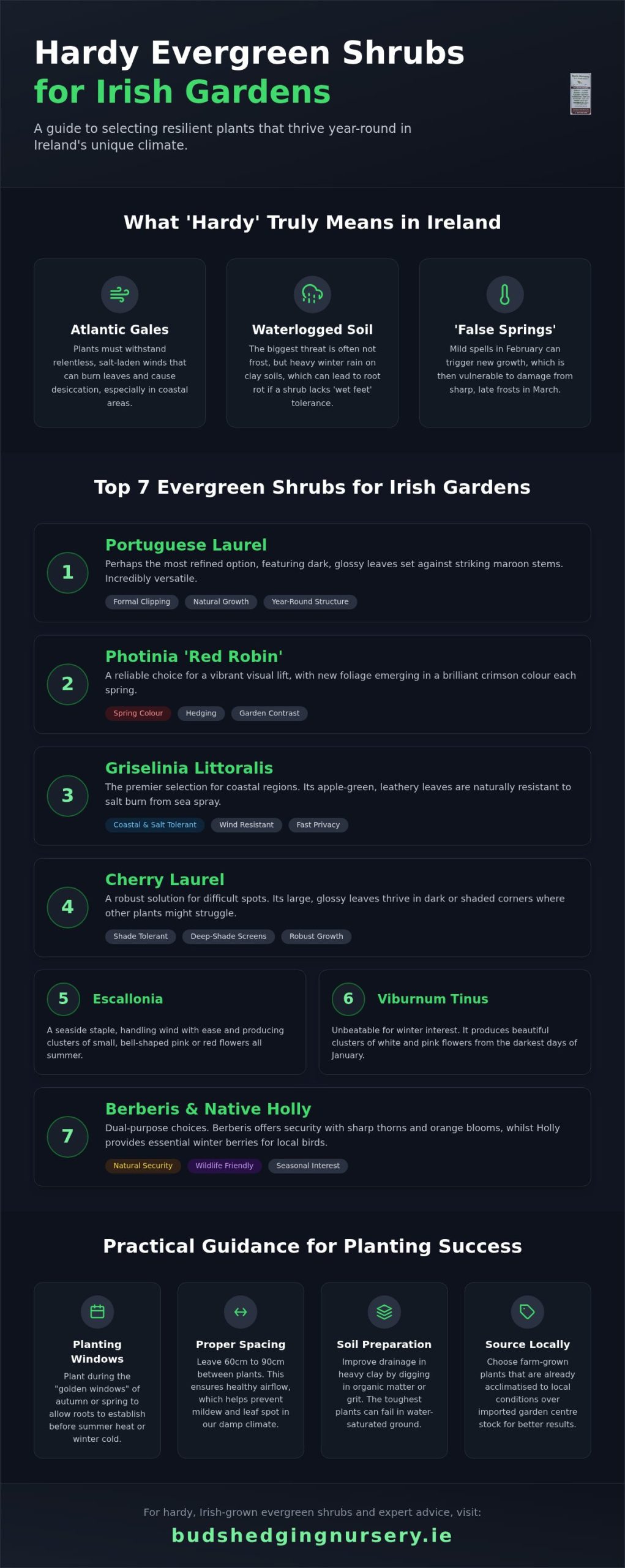
In the Irish context, hardiness is a complex term. It encompasses more than a plant’s ability to survive a cold night. For hardy evergreen shrubs Ireland requires species that can handle the specific combination of high rainfall, Atlantic gales, and fluctuating temperatures. A hardy evergreen is a plant capable of maintaining foliage through RHS H4 or H5 conditions whilst resisting desiccation from wind.
What is an evergreen shrub? Botanically, these plants retain their leaves throughout the year, which makes them vital for local biodiversity. During our damp winters, birds and insects rely on these dense canopies for shelter from the elements. However, the biggest killer of shrubs in Ireland isn’t usually frost; it’s waterlogged soil. Many Irish gardens sit on heavy clay that holds moisture for months. If a shrub’s roots sit in standing water all winter, they will rot, regardless of how cold-tolerant the plant is. Choosing varieties with “wet feet” tolerance is essential for long-term success.
The Impact of the Irish Atlantic Climate
The Atlantic Ocean dictates our gardening success. In coastal areas, salt spray can burn the leaves of less resilient plants, making salt-tolerant evergreens like Griselinia a necessity. Inland, the challenge shifts to “false springs.” This occurs when a mild February triggers new growth, only for a sharp March frost to kill the tender shoots. Structural evergreens are essential here; they break up the relentless grey of a mid-winter landscape and provide the backbone for the rest of your garden’s design.
Soil Considerations: From Limestone to Peat
Soil pH directly affects how your shrubs look. In limestone-heavy areas, some plants may struggle to take up iron, leading to yellowing leaves. Conversely, peaty soils suit acid-loving varieties but often lack structure. Drainage remains the most critical factor. Even the toughest plants can fail if they are forced to sit in anaerobic, water-saturated ground. Before planting, it’s worth digging in organic matter or grit to improve the soil structure. This ensures your new shrubs have the best possible start in our demanding environment.
The Top 7 Hardy Evergreen Shrubs for Irish Gardens
Selecting hardy evergreen shrubs Ireland requires a focus on plants that offer more than just aesthetic appeal. They must be practical workhorses capable of providing shelter and structure throughout the year. Portuguese Laurel is perhaps the most refined option for Irish gardens. It features dark, glossy green leaves set against striking maroon stems. It’s incredibly versatile, handling both formal clipping and more relaxed, natural growth with ease.
For those seeking a contrast to deep greens, Photinia Red Robin is a reliable choice. Its new foliage emerges in a brilliant crimson colour during the spring, providing a much-needed visual lift. In coastal regions, Griselinia Littoralis remains the premier selection. Its apple-green, leathery leaves are naturally resistant to salt burn. The domestic production of these resilient species is a vital part of the industry, as mentioned in the Teagasc overview of Irish nursery stock, which emphasises the quality of locally grown plants. If you have a particularly dark or shaded corner, Cherry Laurel is the robust solution. Its large, glossy leaves thrive where other plants might struggle, making it ideal for creating deep-shade privacy screens.
Escallonia and Viburnum Tinus: Flowers and Foliage
Escallonia is a staple in Irish gardens, particularly near the sea. It handles wind with minimal fuss and produces small, bell-shaped flowers in shades of pink or red throughout the summer months. For winter interest, Viburnum Tinus is hard to beat. It produces clusters of white and pink flowers in January, a time when very little else is in bloom. When planting these varieties, spacing is critical. We recommend leaving 60cm to 90cm between plants to ensure healthy airflow. This simple step helps prevent common issues like mildew or leaf spot in our damp climate.
Berberis and Holly: Security and Wildlife
Berberis Darwinii serves a dual purpose. Its sharp thorns make it an excellent choice for natural home security, whilst its vibrant orange blooms and blue berries provide seasonal interest. For a truly traditional Irish garden, Native Holly is the ultimate choice. It’s perfectly adapted to our weather and provides essential winter berries for local birds. At Buds Nursery, we grow these varieties on our 60-acre site to ensure they are fully acclimatised to local conditions before they reach your garden. You can browse our full range of evergreen shrubs to find the right combination for a naturalistic, varied border that supports local wildlife whilst providing year-round privacy.
Selecting the Right Shrub for Your Specific Site
Matching a plant to its environment is the most effective way to ensure long-term health. When choosing hardy evergreen shrubs Ireland offers a variety of microclimates, from sheltered town gardens to exposed rural hillsides. If your priority is fast privacy, growth rates are the deciding factor. Cherry Laurel is a vigorous grower, often adding 60cm of height in a single season. In contrast, Portuguese Laurel grows at a more moderate pace, making it easier to manage in smaller spaces. Texture also plays a role in the garden’s feel. Fine-leaved Griselinia creates a soft, uniform backdrop, while the glossy, broad leaves of Cherry Laurel reflect light and provide a bold, structural presence.
A common concern for many gardeners is whether a shrub will eventually dominate the entire space. This is easily managed through a simple maintenance framework. Most evergreens only require pruning once a year, typically in late summer, to maintain their shape. More vigorous species like Green Privet might require a second trim in early spring to keep them tight and formal. By choosing the right variety for your garden’s scale, you avoid the need for heavy, restorative pruning later on.
Best Shrubs for Windy and Exposed Sites
Small-leaved evergreens are the best performers in windy conditions. Plants like Privet and Griselinia have smaller surface areas, which allows them to withstand high-velocity gusts without the leaves tearing or desiccating. The goal in an exposed site is to filter the wind rather than trying to block it with a solid wall. A filtering hedge reduces the wind’s speed without creating the damaging turbulence often found behind solid fences. For more detailed screening ideas, you can view our guide on the best hedging for privacy Ireland.
Evergreens for Deep Shade and North-Facing Walls
North-facing borders and areas under large trees present a light challenge. Cherry Laurel and Portuguese Laurel are exceptionally adaptable to low-light conditions. They maintain their deep green colour even when sunlight is limited. Be cautious with variegated evergreens in these spots. Without enough light, plants like Golden Privet may lose their bright yellow margins and revert to plain green to maximise their photosynthesis. To create a finished look, consider underplanting these larger shrubs with ground cover plants. This creates a tiered, professional finish that suppresses weeds and keeps the soil cool.
Practical Guidance: Planting and Establishing Evergreens
Successful establishment of hardy evergreen shrubs Ireland depends on selecting the right root type for your project. Pot-grown shrubs offer the most flexibility. You can plant them at any time of the year. Rootballed and bare root options are seasonal. They are typically available from November to March. These traditional methods are often more cost-effective for long runs of hedging. Timing is a critical factor. The golden windows in Ireland are autumn and early spring. During these periods, the soil retains enough warmth to encourage root growth whilst the cooler air reduces stress on the foliage. To give your plants the best start, dig a hole twice the width of the root ball. Mix well-rotted organic matter amongst the existing soil. This improves the structure and provides essential nutrients for rapid establishment. You must plant the shrub so the soil level matches the original nursery line, as burying the stem too deep often leads to stem rot.
The Bare Root Advantage
Bare root plants are lifted directly from the field during their dormant phase. This makes them significantly cheaper than pot-grown alternatives. It’s the ideal choice for large-scale garden projects or long boundary hedges. You can check the specific dates for our next lifting period in our guide to the bare root tree season Ireland. Handling these plants requires care. If you cannot plant them immediately, “heel them in” by placing the roots in a temporary trench and covering them with loose soil. Never leave the bare roots exposed to the air. Even a few minutes of cold wind can damage the delicate root hairs.
Aftercare: Watering and Mulching
New evergreens require consistent moisture. They continue to lose water through their leaves even in winter. Cold, drying winds can be just as dehydrating as a summer drought. Check your plants regularly during their first eighteen months. If the soil feels dry a few inches down, give them a thorough soak. Applying a 5cm to 7cm layer of bark mulch is a practical way to manage this. It suppresses competing weeds and locks moisture into the soil. Keep an eye out for vine weevil. These pests are common in Irish gardens. You’ll notice distinctive U-shaped notches on the leaf edges. Early identification prevents the larvae from damaging the root system.
Ready to start your project? You can order your hardy shrubs directly from our nursery for national delivery.
Sourcing Quality Evergreens from a Specialist Nursery
Buying plants from a local grower is a practical decision that affects the long-term success of your garden. Many garden centres rely on imports from continental Europe. These plants are often raised in milder, controlled environments and can suffer a significant shock when exposed to a damp Irish winter. In contrast, the hardy evergreen shrubs Ireland growers produce are already acclimatised to our specific weather patterns. At Buds Nursery, we grow our stock on a 60-acre site in Cavan. This exposure ensures that every plant is tough enough to thrive from the moment it is planted in your soil.
The Buds Nursery Difference
Our nursery carries over 30 years of growing experience. This heritage allows us to select and propagate varieties that we know will perform well in local conditions. We focus on the fundamentals of plant health and root development rather than just top-growth aesthetics. You can learn more about our processes in our guide to choosing a specialist plant nursery Ireland. Because we operate on such a large scale, we can provide the quantities needed for extensive boundary hedges or commercial projects without compromising on the quality of individual plants.
Organising a large-scale delivery is a straightforward process. We regularly coordinate national transport for garden projects across the country. Whether you need a few specimen shrubs or hundreds of metres of hedging, we ensure the plants are handled correctly and delivered in prime condition for planting. Dealing directly with the grower also means you receive expert advice on which sizes and root types suit your specific budget and timeline.
Planning Your Visit or Delivery
We welcome visitors to our Cavan site from Tuesday to Saturday. Walking through the nursery allows you to see the scale of our production and the maturity of the plants firsthand. It’s a chance to compare leaf textures and growth habits before making a final decision. Our team is available to provide bespoke advice on native species, traditional hedging, and ornamental shrubs. If you’re planning a project for the upcoming season, it’s best to contact us early. This ensures we can secure the specific stock you need, particularly for seasonal items like bare root Portuguese Laurel or native Holly. You can reach us during opening hours to discuss your requirements and finalise your planting plans.
Building Your Year-Round Garden Structure
Selecting the right hardy evergreen shrubs Ireland offers is the first step toward a low-maintenance, vibrant garden. By matching resilient varieties like Portuguese Laurel or Griselinia to your specific site conditions, you ensure your garden remains a functional and private space throughout the winter months. Successful establishment depends on planting during the golden windows of autumn and spring and improving your soil structure to prevent waterlogging.
At Buds Nursery, we provide farm-grown plants with the strength to thrive in the Irish climate. Our 60-acre production site and over 30 years of Irish growing experience mean our stock is fully acclimatised and ready for your landscape. Our seasoned horticulturalists are always available to provide practical, expert advice on native species and large-scale planting projects. We focus on providing the vigour and quality that imported garden centre stock often lacks.
View our full range of hardy evergreen shrubs and hedging at Buds Nursery to secure your stock for the upcoming season. With the right selection and a bit of preparation, you can enjoy a garden that looks just as well in January as it does in June.
Frequently Asked Questions
What is the fastest-growing hardy evergreen shrub in Ireland?
Cherry Laurel is widely considered the fastest-growing option for Irish gardens. It can add up to 60cm of height in a single season once it is established. Green Leylandii is another extremely rapid grower often used for tall boundaries. Whilst these species provide quick privacy, they require more frequent pruning to maintain a tidy shape. This prevents the plants from outgrowing their intended space and becoming unmanageable over time.
Can I plant evergreen shrubs in the middle of winter?
Yes, you can plant evergreen shrubs in the middle of winter, provided the ground is not frozen or waterlogged. Winter is actually the ideal time for planting bare root and rootballed varieties because they are in their dormant phase. This significantly reduces transplant shock. For pot-grown hardy evergreen shrubs Ireland gardeners can plant year-round, but winter planting allows the root system to settle before the spring growth spurt begins.
Which evergreen shrubs are best for very small gardens?
Portuguese Laurel and Box are excellent choices for smaller gardens because they respond well to tight, formal clipping. Portuguese Laurel grows more slowly than Cherry Laurel, which makes it much easier to keep in a compact form. For lower-level structure, Lavandula Angustifolia or smaller Berberis varieties provide colour and texture without dominating the space. These plants offer the year-round greenery of larger shrubs but on a scale that respects limited garden dimensions.
How do I stop my evergreen hedge from getting too thin at the bottom?
To prevent a hedge from thinning at the base, you must prune it into a slight “taper” or “wedge” shape. This means the bottom of the hedge should be wider than the top. This specific shape allows sunlight to reach the lower branches, which encourages dense foliage growth near the ground. If the top is wider than the base, it shades the bottom. This causes the lower leaves to drop and creates unsightly gaps.
Are there any evergreen shrubs that are completely resistant to sea salt?
Griselinia and Escallonia are the most salt-resistant evergreens for Irish coastal conditions. Griselinia has leathery, apple-green leaves that naturally repel salt spray, whilst Escallonia provides the added benefit of vibrant summer flowers. These species have evolved to handle high-velocity, salt-laden winds that would burn the foliage of more sensitive plants. They are the standard choice for boundary screens in gardens within sight of the Atlantic or Irish Sea.
Do I need to fertilise my evergreen shrubs every year?
Most established evergreen shrubs don’t require annual fertiliser if they are growing in healthy, well-structured soil. However, a top-dressing of well-rotted organic matter or a balanced slow-release fertiliser in early spring can benefit younger plants. Over-fertilising can lead to excessive, weak growth that is more susceptible to frost damage and pests. Focus on maintaining good soil structure with bark mulch rather than relying solely on chemical feeds to sustain plant health.
What happens if I prune my evergreens at the wrong time of year?
Pruning evergreens in late autumn can trigger new growth that won’t have time to “harden off” before the first frosts arrive. This tender growth is easily killed by cold temperatures, which can lead to dieback and disease. For most hardy evergreen shrubs Ireland has, the best time to prune is late spring after the risk of frost has passed or in late summer once the main growth period has naturally finished.
Can I grow hardy evergreens in large pots or containers?
Many hardy evergreens, including Viburnum Tinus and Photinia Red Robin, thrive in large containers. The key is ensuring the pot has excellent drainage and is large enough to accommodate the expanding root system. Container-grown plants dry out much faster than those in the ground, so they require more frequent watering and occasional feeding. Using a high-quality compost mixed with some grit will help maintain the right balance of moisture and aeration.