

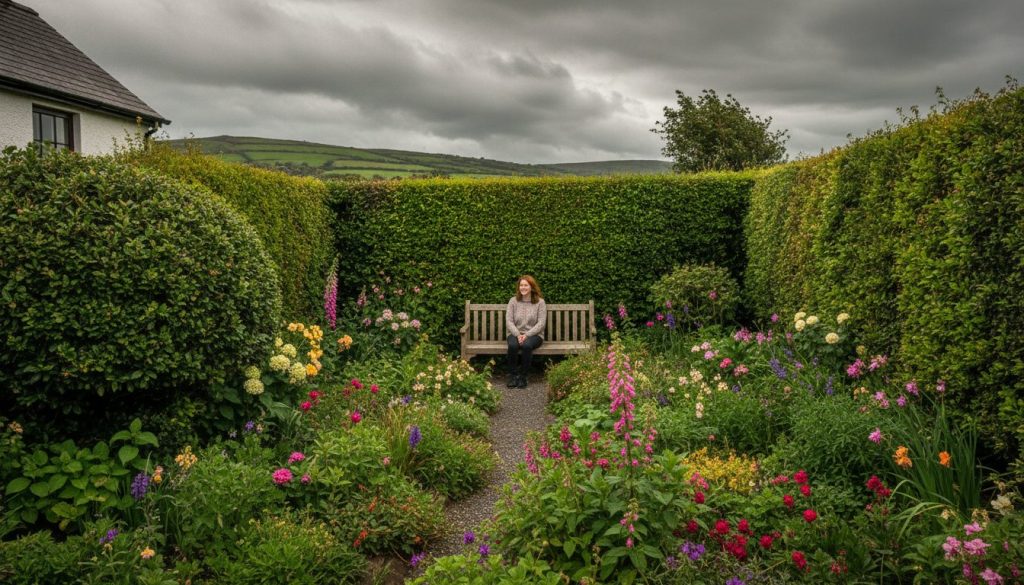
A solid wall is often the worst defence against a gale. While a stone boundary causes turbulence that can flatten nearby shrubs, a living windbreak acts as a permeable filter, slowing the air and creating a genuine microclimate. We understand the frustration of watching a new hedge succumb to wind-burn or finding your garden unusable because of a biting wind-chill. It’s a common struggle for those managing exposed Irish gardens, but the right selection of hedging plants for windy sites can transform a battered plot into a sheltered sanctuary.
We’ve spent over 30 years at Buds Nursery Cavan growing stock that stands up to the elements. In this guide, you’ll discover which species actually thrive in high-exposure areas and the professional planting techniques that ensure they take root. We’ll cover everything from salt-tolerant Griselinia and Escallonia for coastal stretches to the structural reliability of Hornbeam and Portuguese Laurel for inland sites. You’ll also learn how to time your planting with the bare root season to build a cost-effective, biodiverse boundary that provides privacy and protection for years to come.
Key Takeaways
- Learn why a permeable living barrier is more effective at filtering wind than a solid wall, which often causes damaging turbulence.
- Identify the most resilient hedging plants for windy sites, distinguishing between salt-tolerant coastal species and hardy inland varieties.
- Discover professional establishment techniques, including the use of windbreak netting and the advantages of planting during the bare root season.
- Understand how to source hardy, Irish-grown stock and utilise native schemes to create a cost-effective and biodiverse shelterbelt.
Understanding Windbreaks: How Hedging Protects Exposed Gardens
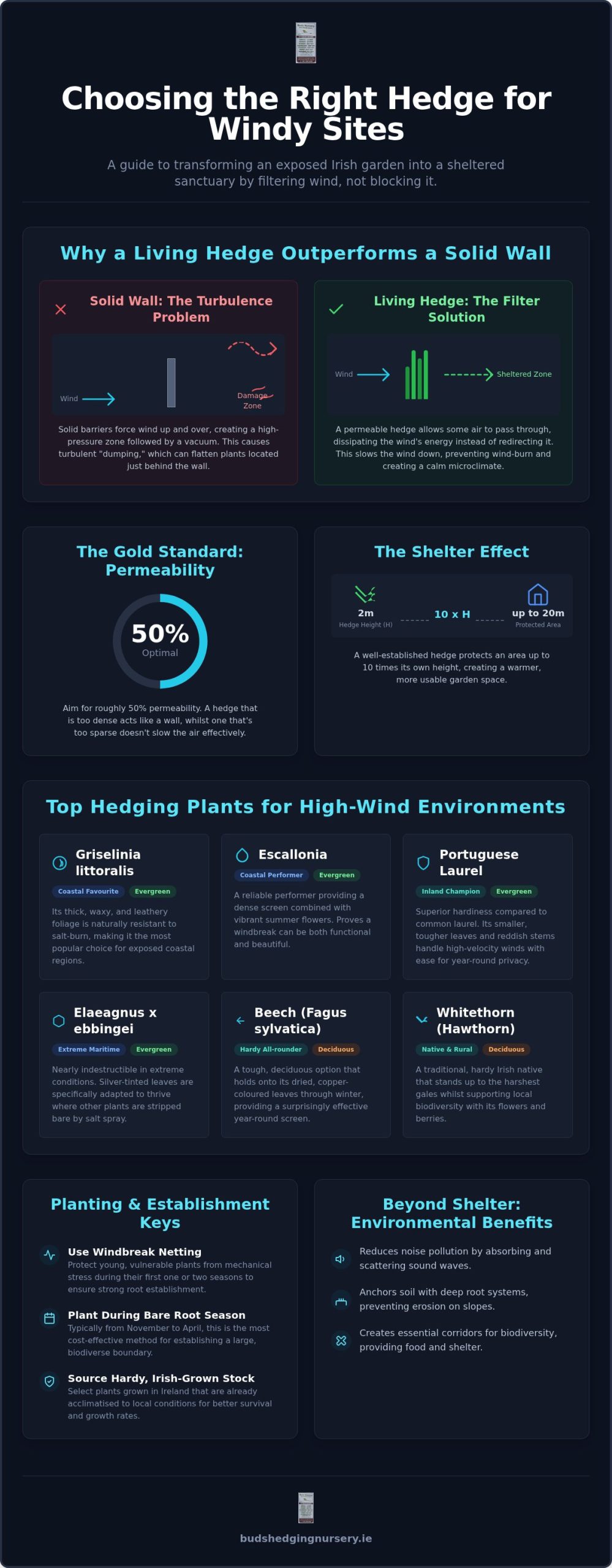
Many gardeners assume a stone wall or solid fence is the best defence against a storm. In reality, these structures often cause more harm than good. When wind hits a solid barrier, it’s forced upward and over, creating a high-pressure zone and a subsequent vacuum on the leeward side. This leads to turbulent “dumping” where the wind crashes down with renewed force just a few metres away. It’s a common reason why plants positioned directly behind a wall still suffer from severe damage.
A living boundary works differently. It acts as a permeable filter. By allowing some air to pass through the branches and foliage, the wind’s energy is dissipated rather than redirected. This is why choosing the correct hedging plants for windy sites is vital for long-term garden health. Instead of fighting the wind, a hedge breaks it down into harmless eddies. This process prevents wind-burn, a condition where leaves lose moisture faster than the roots can replace it, which often leaves plants looking scorched and stunted.
A well-established hedge provides a “shelter effect” that extends far beyond its footprint. Generally, a functional windbreak protects an area up to 10 times its own height. If your hedge is two metres tall, you’ll feel the benefit up to 20 metres into your garden. Understanding How Hedging Protects Exposed Gardens is the first step in reclaiming a wind-swept site and creating a space where you can actually spend time comfortably.
Filtering vs. Blocking: The Science of Permeability
Aim for roughly 50% permeability for the best results. This is the gold standard for wind reduction. A hedge that’s too dense acts like a wall, while one that’s too sparse doesn’t slow the air enough. When air passes through the intricate network of twigs and leaves, it loses velocity without creating a vacuum. This creates a stable microclimate. Within this sheltered zone, the air temperature can feel several degrees warmer. This allows you to grow a much wider variety of ornamental plants that would otherwise perish in an exposed Irish winter.
The Environmental Benefits of Living Boundaries
Hedges offer tangible environmental perks beyond simple shelter. They are excellent at reducing noise pollution; the irregular surfaces of the leaves absorb and scatter sound waves. This is particularly useful for gardens near busy roads or exposed coastal paths. On sloped or hilly sites, the deep root systems of hedging plants for windy sites anchor the soil, preventing erosion during heavy rainfall. In the rural Irish landscape, these boundaries are also essential corridors for biodiversity, providing nesting sites and food for birds and pollinators alike.
Top Hedging Species for High-Wind Environments
Selecting the right variety is the difference between a thriving boundary and a line of dying sticks. In the Irish climate, we look for species with specific physical traits, such as leathery leaves or flexible stems, that can bend without snapping. These hedging plants for windy sites must establish quickly to protect the rest of your garden from the mechanical stress of constant gales.
Griselinia littoralis is perhaps the most popular choice for coastal regions. Its thick, waxy foliage is naturally resistant to salt-burn. If you need a mix of protection and aesthetics, Escallonia is a reliable performer. It provides a dense evergreen screen and produces vibrant flowers in the summer, proving that a windbreak doesn’t have to be purely functional. For those in rural settings, Whitethorn (Crataegus monogyna) offers a traditional, hardy solution that supports local wildlife whilst standing up to the harshest Atlantic gales.
Reliable Evergreens for Year-Round Shelter
Evergreen species provide a permanent filter against the wind. When choosing Top Hedging Species, Portuguese Laurel (Prunus lusitanica) stands out for its superior hardiness compared to the more common Cherry Laurel. Its smaller, tougher leaves and reddish stems handle high-velocity winds with ease. It’s an excellent option for those seeking year-round privacy on an exposed site. For extreme maritime conditions, Elaeagnus x ebbingei is nearly indestructible. Its silver-tinted leaves are specifically adapted to thrive where other plants would be stripped bare by salt spray.
Tough Deciduous Options for Seasonal Interest
Deciduous hedges are often overlooked for windbreaks, yet they are incredibly effective. Green and Copper Beech (Fagus sylvatica) are favourites because they hold onto their dried, copper-coloured leaves throughout the winter. This provides a dense screen that filters wind even when the plant is dormant. It’s a practical way to maintain privacy whilst enjoying the changing colours of the seasons.
If your site has heavy, clay-based soil that tends to stay damp, Hornbeam (Carpinus betulus) is a better choice than Beech. It looks almost identical but tolerates “wet feet” and biting upland winds much better. For large-scale projects, the structural strength of Whitethorn is hard to beat. It forms a deep, tangled network of branches that slows wind down to a breeze. You can find many of these varieties amongst our range of bare root trees, which are ideal for establishing large boundaries during the winter months.
Selecting the Right Hedge: Coastal vs. Inland Exposure
Not all wind is created equal. A gale on the West Cork coast brings different problems than a biting breeze on a Cavan hillside. To pick the best hedging plants for windy sites, you must first identify whether your primary enemy is salt spray or pure mechanical force. Matching the species to your specific location ensures your investment doesn’t end up as expensive kindling after the first winter storm.
Soil conditions often dictate your choices as much as the wind itself. Coastal gardens frequently deal with sandy, fast-draining soil that lacks nutrients. In contrast, inland upland sites often sit on heavy clay. This soil holds moisture but can become waterlogged or frozen during harsh winters. We’ve found that sourcing plants already acclimatised to the Irish climate is critical. Stock grown in local conditions, such as our 60-acre nursery, is already “hardened off” and ready for the reality of an Irish winter.
Maritime Resilience: Dealing with Salt Spray
Coastal wind is a chemical challenge. Salt-laden air settles on leaves and draws out moisture through osmosis, leading to brown, scorched edges. This is why “waxy” or leathery foliage is a vital survival trait. Species like Olearia (Daisy Bush) and Hippophae (Sea Buckthorn) are specialists in this environment. Their leaves are designed to repel salt and retain water whilst standing up to the Atlantic gales.
Practical care makes a difference during the first two years. After a severe storm, it’s worth taking a hose to your young hedge. Rinsing the salt crust off the foliage prevents desiccation and gives the plants a better chance to recover. This simple step can save a hedge that’s struggling with salt-burn.
Upland and Inland Wind: Managing Mechanical Force
Away from the coast, the wind is a physical hammer. The goal here is flexibility. You want species with stems that “give” with the gale rather than snapping. Mixed Native Hedging is a superb solution for inland boundaries. You might consider using Native Trees Scheme plants to create a diverse structure that breaks up wind currents more effectively than a single-species row.
For those seeking aesthetic appeal, Copper Beech is a standout performer in exposed rural gardens. It provides a rich, sophisticated colour whilst maintaining the structural integrity needed to withstand high-altitude gusts. Unlike softer ornamental shrubs, these hardy varieties are built to endure the mechanical stress of an inland winter without losing their shape or health.
Planting and Establishing Hedges in Windy Conditions
Selecting the right species is only half the battle. Even the toughest hedging plants for windy sites require careful establishment to survive their first two winters. Wind is a physical force that can physically rock a plant in its hole, snapping delicate new root hairs as they try to anchor into the soil. Without proper planting techniques, even a hardy Portuguese Laurel can fail before it has a chance to thrive.
We recommend planting during the bare root tree season Ireland, which typically runs from mid-November to March. During this dormant period, the plant isn’t trying to maintain foliage, allowing it to focus all its energy on root development. Smaller, younger plants, often called transplants or whips, are far more successful in exposed areas than mature specimens. They have less “sail” area for the wind to catch, which reduces the risk of the roots being disturbed during winter gales. If you need an established screen from day one, however, you can buy hedging direct from grower Ireland to source robust, already-acclimated mature plants that skip the years of waiting for a young whip to fill in.
When preparing the ground, trench planting is generally superior to digging individual pits. A continuous trench allows for more uniform soil aeration and better drainage, which is vital on heavy inland clays. Once the hedge is in the ground, apply a thick layer of bark mulch or well-rotted manure. This isn’t just for nutrients; it prevents wind-driven soil desiccation, ensuring the roots stay moist whilst the plant is establishing. You can browse our full range of hardy hedging stock to find varieties grown specifically for these conditions.
The Critical First Year: Protection Techniques
Temporary protection is often necessary for the first 24 months. Installing windbreak netting, also known as parawebbing, can reduce wind speed by up to 50% whilst your hedge takes hold. This netting should be secured to sturdy posts roughly 50cm away from the hedge on the windward side. It’s also essential to check your plants after every major storm or heavy frost. Look for “root rock,” where a gap has opened around the stem at the soil line. If left, water will settle in this hole and freeze, potentially killing the plant. Simply firm the soil back down with your heel to close the gap.
Staking and Anchoring for Taller Specimens
If you choose to plant larger, pot-grown specimens for immediate privacy, proper anchoring is non-negotiable. Avoid using tall, rigid stakes that reach high up the stem. Instead, use low-staking techniques where the stake is driven in at a 45-degree angle, securing the trunk just 30cm to 60cm above the ground. This allows the top of the plant to move slightly, which actually stimulates the trunk to grow thicker and stronger. For very large trees, underground root anchors are a better option as they provide stability without the need for visible ties. Always check ties regularly to ensure they aren’t girdling the growing stem as it expands.
Sourcing Quality Hedging for Challenging Sites in Ireland
Sourcing your stock from a specialist plant nursery Ireland is the most effective way to ensure your new boundary survives its first winter. General retailers often stock plants grown in milder European climates or polytunnels, which can lead to a shock when they’re moved to an exposed Irish hillside. At Buds Nursery Cavan, our 60 acres of on-site production means our plants are already hardened off and accustomed to the local rainfall and temperature shifts. This environmental resilience is exactly what you need when establishing hedging plants for windy sites.
When you visit a specialist grower, you can inspect the physical health and root structure of the stock. For large-scale windbreak projects, particularly on farms or rural estates, the Native Trees Scheme plants offer an excellent solution. These species, such as Whitethorn and Alder, are genetically adapted to thrive in our landscape. Expert on-site guidance allows you to discuss specific microclimates, such as a particular “wind tunnel” between buildings or a salt-heavy corner of the garden, ensuring you don’t waste money on unsuitable varieties.
The Value of Farm-Scale Hedging Solutions
For large boundaries, mixed native hedge packs are often the most practical choice. These packs create a thick, impenetrable barrier that filters wind whilst providing a massive boost to local biodiversity. If you need to combine wind protection with property protection, you can integrate security hedging plants with thorns like Berberis Darwinii or Holly into your plan. These additions strengthen the boundary’s structure whilst deterring intruders. We also provide logistical support and delivery for large-scale rural orders, making it easier to coordinate planting during the busy bare root season.
Low Maintenance Underplanting for Windbreaks
The base of a new hedge is often vulnerable to weed competition and soil drying. Using ground cover plants Ireland helps to suppress weeds naturally and creates a living mulch that retains moisture in wind-swept soil. This integrated approach ensures that your hedging plants for windy sites have the best possible start without requiring constant maintenance. Once the ground cover is established, it protects the soil surface from the scouring effect of the wind, keeping nutrients where the hedge roots can reach them.
If you’re ready to transform an exposed site into a sheltered, productive garden, come and talk to us. You can visit Buds Nursery Cavan to see our stock first-hand and organise your planting for the coming season. We’re here to help you select the hardiest species for your specific location.
Reclaiming Your Exposed Garden
Transforming a wind-swept site into a sheltered haven is a matter of physics and patience. It’s about working with nature rather than fighting it. By choosing permeable barriers over solid walls, you allow your garden to breathe whilst reducing the destructive energy of the wind. We’ve seen how the right hedging plants for windy sites, such as hardy Portuguese Laurel or salt-tolerant Griselinia, create a microclimate where more delicate plants can finally thrive. Success depends on sourcing stock that’s already acclimatised to our climate and ensuring it’s firmly established during the dormant bare root season.
With 60 acres of home-grown plants and over 30 years of experience, we understand the specific challenges of the Irish landscape. Whether you’re participating in the Native Trees Scheme or looking for a decorative evergreen screen, we provide the practical expertise to help your garden succeed. View our full range of hardy hedging and trees at Buds Nursery and start planning your new boundary today. Your garden doesn’t have to be at the mercy of the elements.
Frequently Asked Questions
Which hedge is best for a very windy garden?
The best species depends on your specific location, but Griselinia littoralis is the standard for coastal areas, whilst Portuguese Laurel is superior for inland sites. These varieties are chosen for their leathery leaves and structural resilience. For traditional rural boundaries, Whitethorn is an excellent choice as it forms a dense, tangled barrier that effectively filters heavy gales.
How do you protect a new hedge from the wind?
Protecting a new hedge involves reducing the mechanical force of the wind during the first 24 months of establishment. Installing temporary windbreak netting on the windward side can reduce wind speed by up to 50%. It is also vital to check the plants after storms to firm in any that have been loosened by “root rock,” which prevents the delicate new roots from snapping.
Is Laurel good for windy sites?
Portuguese Laurel (Prunus lusitanica) is specifically recommended as one of the best hedging plants for windy sites because its small, leathery leaves resist wind-burn. In contrast, the larger, softer leaves of Cherry Laurel can become tattered and brown in high-exposure areas. Portuguese Laurel maintains its tidy appearance and dense structure even when subjected to constant breezes.
Will Beech hedging grow in an exposed area?
Beech (Fagus sylvatica) is very successful in exposed areas because it retains its dried, copper-coloured leaves throughout the winter. This characteristic allows it to act as a permanent wind filter even when dormant. If your exposed site has heavy or wet clay soil, we recommend planting Hornbeam instead, as it looks similar but is much more tolerant of damp conditions.
What is the fastest-growing hedge for a windbreak in Ireland?
Griselinia littoralis is one of the fastest-growing options for coastal windbreaks, often putting on 30cm to 45cm of growth annually once established. For large inland sites where you need height quickly, Green Leylandii is a traditional favourite. Both species provide a dense, evergreen screen that can be maintained at your desired height with regular clipping once the windbreak is formed.
Can I plant a hedge in the winter in a windy location?
Winter is the ideal time to plant in a windy location, provided the ground isn’t frozen or waterlogged. This period coincides with the bare root season, allowing you to plant dormant specimens that can focus on root development before the spring growth begins. Planting in winter ensures the hedge is better anchored before the drying winds of late spring arrive.
How far apart should I space hedging plants for a windbreak?
For an effective windbreak, you should generally space plants at intervals of 33cm to 40cm, which equates to 3 per metre. If you require a thicker, more immediate screen, a double staggered row is often the best approach. This involves planting two parallel rows roughly 40cm apart, which creates a deeper permeable filter to catch more wind energy.
Does windbreak netting really help new hedges?
Windbreak netting is a highly effective temporary measure that reduces wind velocity by roughly 50% whilst still allowing some air to pass through. This prevents the “vacuum effect” caused by solid barriers and protects young plants from desiccation and physical damage. It is a small investment that significantly increases the survival rate of hedging plants for windy sites during their critical first two years.