

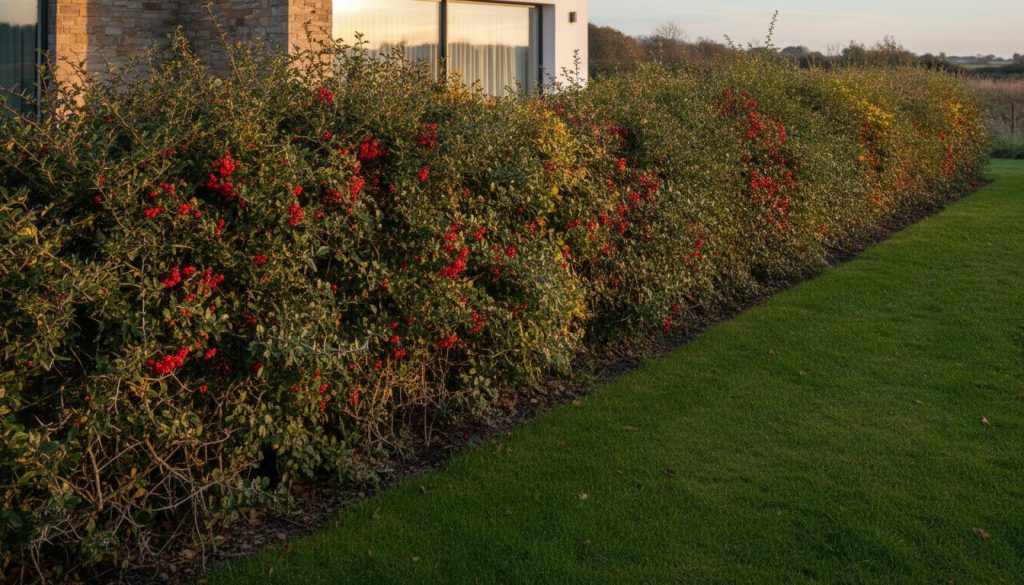
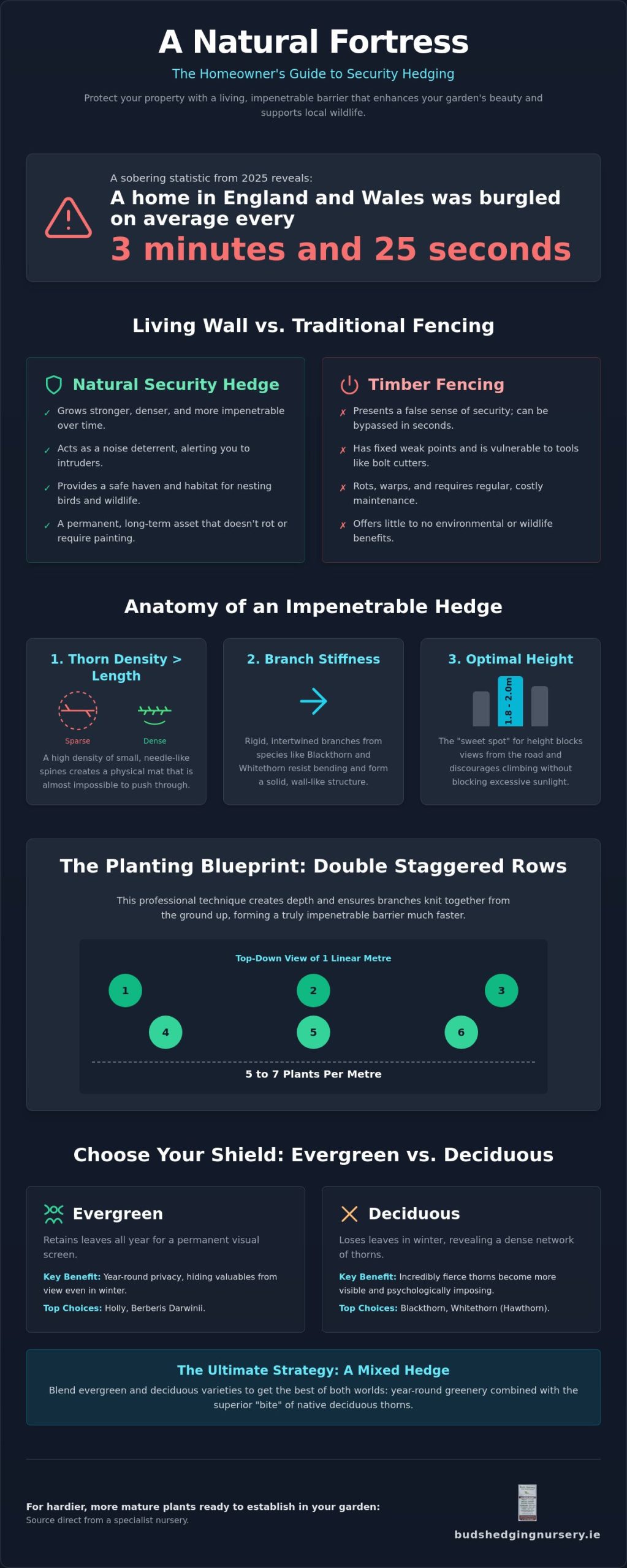
Did you know that in 2025, a home in England and Wales was burgled every 3 minutes and 25 seconds on average? It’s a sobering statistic that explains why so many homeowners are now prioritising security hedging plants with thorns to protect their boundaries. You likely want to keep trespassers out, yet the idea of installing harsh metal fencing or barbed wire feels entirely wrong for a domestic garden. It’s a common dilemma; you shouldn’t have to sacrifice the beauty of your outdoor space just to feel safe.
This guide will show you how to select and plant the most effective species to create a natural, impenetrable barrier. We believe that true security comes from a combination of density and thorn structure, often achieved through a clever mix of native species rather than a single ornamental plant. You’ll learn which varieties grow thick enough to stop an intruder, the official height regulations for front and rear boundaries, and a step-by-step checklist to get your hedge established quickly. By the end, you’ll have the practical knowledge to build a living defence that looks as good as it works.
Key Takeaways
- Understand why natural barriers offer a superior psychological and physical deterrent compared to traditional timber fencing.
- Learn why thorn density and branch stiffness are more critical for property protection than the actual length of the spines.
- Identify the most effective security hedging plants with thorns, including varieties like Berberis and Firethorns, for year-round protection.
- Discover the professional planting technique of using double staggered rows to create a thick, impenetrable barrier quickly.
- See how sourcing direct from a specialist nursery ensures you receive hardier, more mature stock that is ready to establish in your garden.
Why Choose Security Hedging Plants with Thorns?
Timber fencing often presents a false sense of security. A determined intruder with a pair of bolt cutters or a sturdy ladder can bypass a wooden panel in seconds. In contrast, security hedging plants with thorns create a living, evolving barrier that becomes more difficult to penetrate as it matures. A well-established Hedge acts as a biological wall. It doesn’t rot, it doesn’t need painting, and it won’t yield to a saw. Unlike timber, which has fixed weak points, a thorny hedge grows thicker and more resilient every year, making it a permanent fixture of your home’s defence.
Investing in security hedging plants with thorns offers more than just physical resistance. Whilst some species are deciduous, the stiff, sharp thorns remain present throughout the winter months. This ensures your boundary stays “armed” even when the garden is dormant. There’s an added benefit for local wildlife too. Thick, thorny foliage provides a safe haven for nesting birds, as the prickly branches keep cats and other predators at bay. You’re essentially creating a mini-ecosystem that doubles as a high-level security measure. It’s a sustainable choice that supports biodiversity whilst maintaining a hard, physical perimeter that traditional fencing simply cannot replicate over the long term.
The Psychology of the Prickly Barrier
Intruders look for the easiest entry point. A visual deterrent like the bright berries of a Firethorn or the needle-like spines of a Berberis sends a clear message. Entry here will be painful. There’s also the noise factor. You can’t push through a dense thicket without snapping twigs. This auditory warning alerts homeowners or neighbours to movement. It’s more attractive than razor wire but achieves the same psychological effect.
Privacy Meets Protection
Security is also about stopping eyes. Dense foliage acts as a natural screen, hiding your valuables from the road. For most properties, a height between 1.8 and 2 metres is the “sweet spot.” This blocks views and discourages climbing without blocking too much light. Security hedging is a dense, thorny biological barrier designed to prevent unauthorised access. It’s a practical, long-term investment for any property owner.
Essential Features of a High-Deterrent Security Hedge
A secure boundary requires more than just a few sharp points. When selecting security hedging plants with thorns, you must consider the density of the spines rather than just their length. A plant with long, sparse thorns can often be bypassed by carefully pushing branches aside. However, a variety with a high density of smaller, needle-like spines creates a physical mat that is almost impossible to penetrate. Berberis is an excellent example of this, providing a multi-stemmed growth habit that leaves no room for gaps.
Branch stiffness is the next critical factor. If the stems are too flexible, an intruder can simply trample them or use a board to flatten the hedge. You need varieties that resist bending. Plants like Whitethorn and Blackthorn are prized for their rigid structure. These species don’t just sit there; they fight back. When these branches intertwine, they form a mechanical bond that makes the hedge feel solid, much like a traditional wall but with the added deterrent of sharp barbs. You can browse our full range of hardy stock to find the right balance of stiffness and thorn density for your specific soil type.
Structure and Branch Intertwining
The way you plant your hedge determines its eventual strength. We always recommend a double staggered row. By planting 5 to 7 plants per linear metre in two parallel lines, you create depth. As the plants grow, their branches knit together. Regular pruning is essential during the first few years. Cutting back the leading shoots encourages the plant to bush out from the base. This “knitting” process ensures that even the bottom of the hedge is a thick, prickly mass that stops small intruders or pets from squeezing through.
Evergreen vs Deciduous Security
Deciding between evergreen and deciduous species depends on your specific security needs. Evergreen plants, such as Holly or Berberis Darwinii, provide a permanent visual screen. They keep their leaves all year, hiding your property from prying eyes even in the depths of January. Deciduous plants like Blackthorn often lose their leaves, but they compensate with incredibly fierce thorns that are easier to see once the foliage is gone. Many homeowners choose a mixed security hedge. By blending these types, you get the year-round greenery of an evergreen with the superior “bite” of native deciduous thorns.
The Best Thorny Hedging Varieties for Natural Protection
Not all security hedging plants with thorns are created equal. Some excel at providing a year-round visual screen, whilst others are designed purely for physical deterrence. In the Irish landscape, we often find that the most effective boundaries combine the ornamental density of garden species with the rugged resilience of native stock. Choosing the right security hedging plants with thorns often means looking at both native and ornamental options to find a balance that suits your soil type and security goals.
Ornamental Powerhouses: Berberis and Pyracantha
Berberis Darwinii is a standout choice for its compact, multi-stemmed habit. It features small, leathery leaves and needle-sharp spines that make it almost impossible to reach through. If you want a splash of colour, Berberis Rose Glow offers striking purple foliage without compromising on security. These plants are hardy and establish well, forming a dense mat of prickly branches near the base of the hedge.
Firethorns, or Pyracantha, are famous for their long, stiff thorns. These plants are incredibly versatile. You can grow them as a standalone hedge or train them against a wall to prevent scaling. The vibrant red or orange berries provide a vital food source for birds, but the branch structure remains a clear “no-go” zone for anyone attempting to cross your boundary. They are fast-growing and respond well to regular pruning, which only increases their density over time.
The Native Deterrents: Hawthorn and Blackthorn
For larger properties or agricultural boundaries, native species offer the best value. Whitethorn, also known as Hawthorn, is the most cost-effective solution for long perimeters. It’s incredibly hardy and thrives in most soil types across Cavan and beyond. Its stiff branches and sharp thorns create a dense thicket that only becomes stronger with age. It is a staple of the Irish countryside for a reason; it works.
Blackthorn is arguably the fiercest of the native deterrents. It produces long, sturdy “sloe thorns” that can pierce through thick clothing. Even in winter, its dense, dark branch structure remains a formidable obstacle. If you are looking for agricultural security or want to support local biodiversity, you might find A Practical Guide to Native Trees Scheme Plants in Ireland helpful for selecting the right mix of native species for your land.
Holly (Ilex aquifolium)
Holly is the classic evergreen choice for security. Its thick, leathery leaves are edged with sharp points, making it a painful climb for any intruder. Whilst it grows more slowly than Hawthorn, it creates a permanent, solid wall of green that requires very little maintenance once established. It provides excellent privacy throughout the year and is one of the few evergreen options that can tolerate significant shade whilst remaining thick and secure.
The Security Hedging Installation and Care Checklist
Success with security hedging plants with thorns depends entirely on the groundwork. Even the fiercest Firethorn won’t deter an intruder if it’s planted too thinly or struggles to establish in poor soil. To create a “biological wall” that lasts for decades, you must follow a disciplined approach to spacing and initial care. This process starts long before the first plant goes into the ground.
- Preparation: Clear a 1-metre wide strip of all weeds and grass. This removes competition for nutrients and moisture, which is vital for young plants.
- Soil Enrichment: Incorporate well-rotted manure or garden compost into the trench. This provides the organic matter needed for fast, healthy root development.
- Hydration: Soak the roots in a bucket of water for at least two hours before planting. This is especially critical for bare root stock to prevent transplant shock.
- Initial Pruning: For deciduous species like Whitethorn or Blackthorn, cut the stems back by about a third immediately after planting. This forces the plant to branch out from the base, preventing “leggy” growth with gaps at the bottom.
Step-by-Step Planting for Security
To achieve maximum density, avoid planting in a single straight line. Use a double staggered row instead. Mark out two parallel lines approximately 30cm to 40cm apart. Place your plants in a “zigzag” pattern, aiming for 5 to 7 plants per linear metre. This layout ensures there are no direct sightlines through the hedge once the foliage fills out. It’s vital to firm in each plant with your heel to avoid air pockets that can lead to root rot or unstable growth amongst your thorny barrier.
Long-Term Maintenance for Maximum Density
Pruning for security is different from pruning for aesthetics. You should adopt the “A-shape” technique, where the base of the hedge is kept wider than the top. This allows sunlight to reach the lower branches, ensuring they stay thick and prickly rather than dying back. During the first three years, apply a general-purpose fertiliser every spring to encourage rapid growth. This helps the hedge reach its deterrent height of 1.8 to 2 metres as quickly as possible. To further reduce maintenance in the surrounding garden beds, pairing your hedge with the right ground cover plants Ireland gardeners rely on can suppress weeds at the base of your boundary and protect soil from erosion.
Safety is paramount when maintaining security hedging plants with thorns. Always wear heavy-duty, thorn-proof gauntlets and use sharp bypass secateurs to ensure clean cuts that heal quickly. If you’re ready to secure your perimeter with professional-grade plants, you can order your security hedging stock directly from our 60-acre nursery for national delivery.
Sourcing Quality Hedging from a Specialist Nursery
Choosing the right security hedging plants with thorns is only half the battle. Where you source those plants determines whether your new barrier thrives or fails. Buying direct from a specialist nursery ensures you receive stock that has been grown in local conditions and is properly acclimatised. Garden centres often stock plants that have spent weeks in transit or sitting on concrete forecourts, which can lead to poor establishment. A specialist grower understands the specific needs of thorny species, ensuring they have the root vigour required to grow into a dense, impenetrable screen.
Scale is another major advantage when dealing with a 60-acre site. For large perimeter projects, you need consistency in plant size and health. Sourcing from a vast inventory allows for uniform growth across the entire length of your boundary. This prevents weak spots where an intruder might find a gap in the thorns. Whether you need a few individual Firethorns or hundreds of metres of mixed native hedging, a nursery with extensive stock provides the quantity and quality needed for a professional finish. We offer national delivery across Ireland, ensuring that high-grade security hedging plants with thorns are accessible regardless of your location.
Bare Root vs Pot Grown for Security
The choice between bare root and pot-grown stock often comes down to timing and budget. Bare root plants are the superior choice for long security boundaries. They are cost-effective, easy to transport in bulk, and establish deep root systems during the dormant winter months. If you are planning a large-scale project, you should read our Bare Root Tree Season Ireland: The Complete 2026 Planting Guide to understand the best planting windows. Pot-grown stock, whilst more expensive, is available year-round. It is ideal for filling immediate “spot” gaps in an existing hedge where security has been compromised.
The Buds Nursery Advantage
With over 30 years of experience in plant production, Buds Nursery Cavan takes a no-nonsense approach to quality. We don’t just sell plants; we provide the expertise needed to ensure they serve their purpose. Our 60-acre nursery is home to a wide range of specialist security species, from fierce Berberis to hardy native Whitethorn. For a deeper look at why sourcing matters, see our Specialist Plant Nursery Ireland: A Guide to Sourcing Quality Trees and Hedging. Buying direct from the grower means you get hardier plants and reliable advice from people who have deep roots in the industry.
Securing Your Boundary for the Long Term
Building an impenetrable barrier takes more than just digging a few holes. True success depends on selecting the right security hedging plants with thorns and ensuring they are planted in a double staggered row to achieve maximum density. By choosing stiff-stemmed varieties like Blackthorn or the needle-sharp spines of Berberis, you’re building a biological wall that only grows stronger and more resilient with age. It’s a practical, natural alternative to metal fencing that also supports local biodiversity whilst keeping your property private.
While a secure garden provides physical protection, ensuring that elderly or vulnerable family members feel safe and supported inside the home is just as vital. For those seeking holistic support in England, you can discover NeeryVille Care and their range of companionship services designed to provide peace of mind.
At Buds Nursery Cavan, we’ve spent over 30 years cultivating 60 acres of hardy, nursery-grown stock. We understand the specific requirements of the Irish climate and provide plants that are ready to establish quickly in your soil. Whether you need ornamental Firethorns for a garden boundary or cost-effective bare root native mixes for a larger perimeter, we provide national delivery across Ireland to support your project. View our full range of security hedging and request a quote today. With the right selection and the correct planting technique, your property will have a reliable, prickly defence that stays effective for decades.
Frequently Asked Questions
Is it legal to plant thorny hedging for security on my boundary?
It is perfectly legal to plant thorny hedging on your property boundary. You should follow the “Secured by Design” police guidelines, which as of July 2026, suggest front hedges stay at a 1-metre maximum height to maintain visibility from the street. Rear and side boundaries should be at least 1.8 metres high to deter intruders effectively. Always ensure your hedge doesn’t obstruct public footpaths or sightlines for road users.
How long does it take for a thorny hedge to become intruder-proof?
A hedge typically takes between three and five years to become fully impenetrable. This timeframe depends on the species chosen and the maintenance provided during the establishment phase. Using security hedging plants with thorns in a double staggered row with 5 to 7 plants per metre will create density much faster than a single line. Regular feeding and pruning in the first three seasons are essential for encouraging thick growth.
What is the most painful thorny plant for a security hedge?
Blackthorn is widely considered the most painful option due to its long, sturdy sloe thorns that can easily pierce heavy clothing. Berberis is another fierce contender, featuring dense clusters of needle-sharp spines that are painful to even brush against. These species provide a level of physical deterrent that makes them the most effective security hedging plants with thorns for high-risk boundaries where a hard barrier is required.
Are security hedges safe if I have pets or children?
Thorny hedges are generally safe for households with pets or children, as the prickly nature of the plants acts as a natural deterrent. Animals and children tend to learn quickly to keep a respectful distance from the boundary. If you have very young children, you might consider planting a soft buffer strip of lavender or grass in front of the prickly barrier to prevent accidental contact during play.
Which thorny hedging is the best for coastal or windy sites?
Whitethorn and Blackthorn are the most resilient choices for exposed, windy, or coastal sites in Ireland. These native species have evolved to withstand harsh weather and salt spray whilst maintaining their stiff, secure structure. Berberis Darwinii is another hardy evergreen that performs well in difficult conditions. These plants remain dense and effective as security barriers even when subjected to the persistent winds common in coastal regions. For a full breakdown of which species perform best in high-exposure gardens, our guide to hedging plants for windy sites covers salt-tolerant and wind-resistant varieties in detail.
Can I mix different thorny species in one hedge?
Mixing different species is highly recommended to create a more resilient and attractive security barrier. A combination of evergreen Holly and deciduous Hawthorn, for example, provides year-round privacy along with the fierce deterrent of native thorns. This approach also supports a wider range of local wildlife and ensures the hedge remains thick even if one particular species is affected by a seasonal pest or disease.
What is the best time of year to plant a security hedge in Ireland?
The best time to plant a security hedge in Ireland is during the bare root season, which runs from November to March or April. Planting while the specimens are dormant allows them to establish a strong root system before the spring growth spurt begins. Whilst pot-grown plants can be installed at any time of the year, the bare root window offers a more cost-effective way to secure long boundaries.
Do I need a permit to plant a tall security hedge?
You don’t usually need a permit to plant a hedge, but you must adhere to local height regulations. Most local authorities in Ireland allow boundary hedges up to 2 metres tall without requiring planning permission. If you plan to exceed this height significantly, it’s best to consult your local council first. Keeping your hedge at the recommended 1.8 to 2-metre range is typically enough to provide a high level of security.