


A September trim can be a better choice than a late-winter tidy-up, but the calendar alone doesn’t decide when to prune hedges in Ireland. Timing also depends on the species, how much it has grown and whether birds are nesting in it.
It’s easy to assume every hedge follows the same spring, summer or autumn schedule. In practice, pruning at the wrong time can remove flowers or berries, disturb wildlife or leave a hedge struggling to recover. Irish rules also set a general cutting window: hedge and ditch vegetation must not be cut from 1 March to 31 August, subject to limited exceptions. An active bird’s nest must not be destroyed at any time of year.
This guide explains general pruning windows for evergreen and deciduous hedges, then covers species that need different timing or only a light trim. You’ll also find practical advice on checking for nests, shaping a hedge to support healthy growth and adapting your approach to Irish conditions. The aim is to help you keep your hedge in good order without treating every plant as if it needs the same cut.
Key Takeaways
- To decide when to prune hedges in Ireland, identify the species and distinguish routine trimming from more substantial shaping.
- Evergreen, deciduous and flowering hedges can need different timing. Consider how a cut may affect flowers, berries and new growth.
- Plan routine hedge cutting around Ireland’s seasonal restrictions, and check carefully for active nests before starting work.
- Use clean, sharp tools and a considered cutting shape to help maintain healthy growth and light across the hedge.
- Choose hedging plants with their mature growth and upkeep in mind. The right choice can make future pruning more manageable.
When to prune hedges in Ireland: the seasonal overview
The short answer is that timing depends on the hedge species, how much it has grown and whether birds are nesting in it. A hedge or hedgerow can provide shelter and act as a boundary, so pruning is about more than keeping a neat outline. Identify the plant before choosing the cut, and treat routine trimming differently from a major reduction.
Which months are generally suitable for hedge pruning?
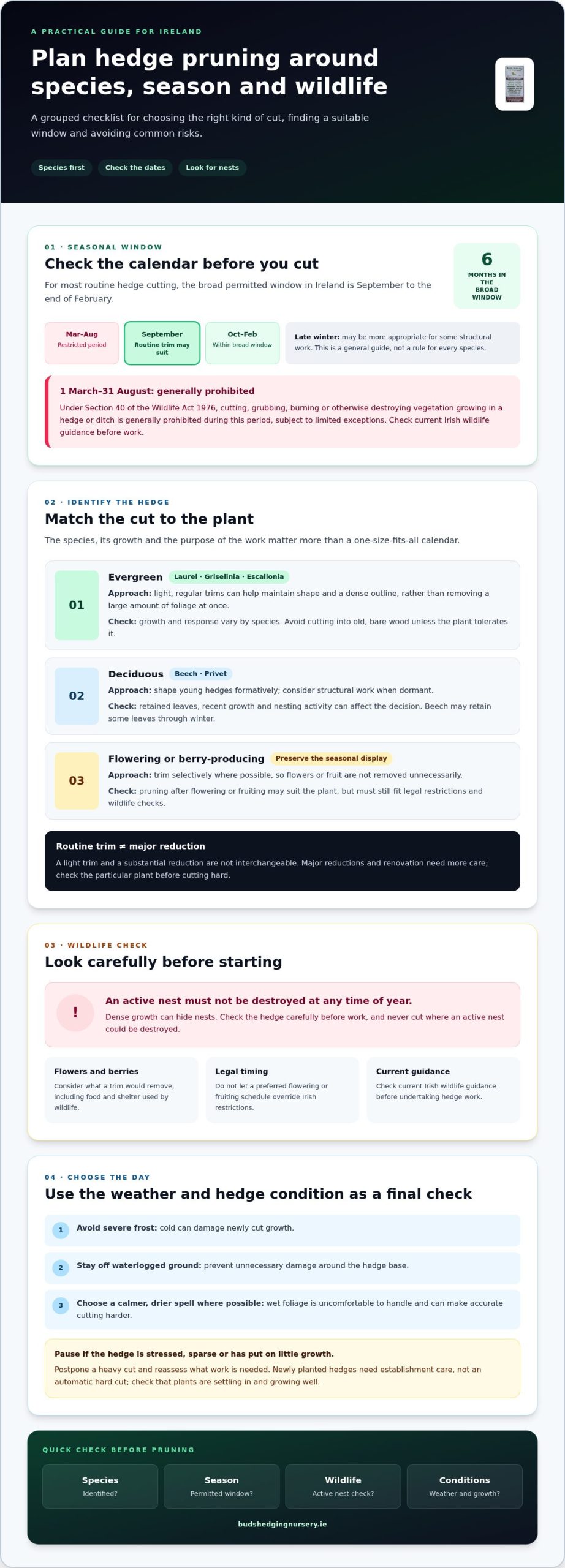
For most routine hedge cutting, the broad window in Ireland is September to the end of February. Under Section 40 of the Wildlife Act 1976, cutting, grubbing, burning or otherwise destroying vegetation growing in a hedge or ditch is generally prohibited from 1 March to 31 August, subject to limited exceptions. Check current Irish wildlife guidance before work, and never cut where an active nest could be destroyed.
Within the permitted window, September can suit a routine trim, while late winter may be more appropriate for some structural work. These are general guides, not rules for every species. A flowering hedge may need a lighter or differently timed cut to avoid removing flowers or berries. Major reductions and renovation need more care than clipping back fresh growth, so check the needs of the particular plant before cutting hard.
How Irish weather changes the best day to prune
The calendar gives you a window, but the day’s conditions matter too. Mild spells can encourage new growth, while frost, rain and strong winds can make pruning harder and place extra stress on plants.
- Avoid severe frost, when cold can damage newly cut growth.
- Stay off waterlogged ground to prevent unnecessary damage around the hedge base.
- Choose a calmer, drier spell where possible. Wet foliage is uncomfortable to handle and can make accurate cutting more difficult.
Before starting, assess the hedge’s condition and recent growth. If it is stressed, sparse or has put on little growth, postpone a heavy cut and reassess what work is needed. A light trim and a substantial reduction are not interchangeable tasks.
Newly planted hedges need establishment care, not an automatic hard cut simply because the season has arrived. First check that the plants are settling in and growing well. Any formative pruning should suit the species and the hedge’s condition. Avoid removing a large amount of growth without a clear reason. This measured approach helps young plants establish while keeping the timing appropriate to Irish weather and wildlife.
When to prune evergreen, deciduous and flowering hedges
Hedge type gives you a better starting point than a single calendar rule. Evergreen plants usually respond well to measured trimming that maintains their outline, while deciduous hedges may need formative or structural work at a different stage. Flowering and berry-producing species add another consideration: a cut can remove the display or food and shelter that wildlife uses. These are general patterns, so identify the plant and check for active nests before working.
| Hedge group | Typical pruning approach | Timing caveat |
|---|---|---|
| Evergreen, such as laurel, Griselinia and Escallonia | Light, regular trims to maintain shape | Timing varies by species and growth; avoid cutting into old, bare wood unless the plant tolerates it. |
| Deciduous, such as beech and privet | Formative shaping when young; structural work when dormant | Retained leaves, recent growth and nesting activity can affect the decision. |
| Flowering or berry-producing hedges | Trim selectively, preserving the seasonal display where possible | Pruning after flowering or fruiting may suit the plant, but must fit legal restrictions and wildlife checks. |
Evergreen hedges such as laurel, Griselinia and Escallonia
Many evergreen screens are easier to keep in shape with light, regular trims than with an occasional severe cut. This avoids removing a large amount of foliage at once and helps retain a dense outline. Laurel, Griselinia and Escallonia don’t all grow or respond in the same way, so let the plant’s growth and condition guide how much you remove. For more about one common garden hedge, see this Portuguese Laurel guide.
Deciduous and flowering hedges, including beech and native species
Structural shaping of deciduous hedges is often considered during dormancy, but species and conditions matter. Beech may retain some leaves through winter, so don’t assume a hedge is fully dormant just because the season has turned. For beech-specific context, read the guide to beech hedging in Ireland.
For flowering and berry-producing hedges, consider what a trim would remove. Cutting after the display may preserve flowers or fruit, but that timing can fall outside Ireland’s permitted hedge-cutting season. Don’t delay a necessary cut into a restricted period or disturb an active nest. Check current wildlife guidance and choose a lawful, wildlife-aware approach.
Matching a hedge to its intended use can also make future care more manageable. Explore hedging plants suited to your garden and consider mature size, growth habit and the level of trimming you’re prepared to do.
Nesting birds, Irish rules and common hedge-pruning mistakes
A suitable month doesn’t automatically make a hedge safe to cut. Dense growth can hide nests, and pruning may remove shelter, flowers or berries that wildlife depends on. Before choosing a date, consider the hedge’s condition and what may be living in it.
How to check for nesting birds before pruning
Before starting, look carefully through the hedge from a respectful distance. Watch and listen for birds repeatedly entering or leaving one spot, or carrying nesting material. Don’t push into the foliage or disturb a suspected nest to get a closer look. A quick glance isn’t conclusive, as thick evergreen growth can conceal nests. If you find an active nest, stop work and seek appropriate guidance from the National Parks and Wildlife Service (NPWS). An active nest must not be destroyed, even outside the usual nesting season.
Which hedge-cutting rules apply in Ireland?
Under Section 40 of the Wildlife Act 1976, the general prohibited period for cutting, grubbing, burning or otherwise destroying vegetation growing in a hedge or ditch is 1 March to 31 August. The permitted hedge-cutting period is generally 1 September to the end of February. Limited exceptions include work for road safety under the Roads Act 1993, the ordinary course of agriculture or forestry, and construction or site works. These are specific exceptions, not a general licence to cut.
Check current NPWS guidance before acting, as the rules and their application depend on the circumstances. A private garden may be treated differently under the land provisions, but that doesn’t make it lawful to destroy an active bird’s nest. Nest protection applies at any time of year.
Keep legal timing separate from horticultural timing. A hedge may be legally cut within the permitted period but still be better left until another point in that window to protect its shape, flowers or fruit. The answer to when to prune hedges in Ireland therefore involves two checks: is the work lawful, and is it suitable for this hedge now?
A common mistake is assuming every hedge needs one hard cut each year. Formal privet may benefit from a light trim to maintain its outline, while a native hedge may need less frequent cutting. Repeatedly cutting hard to the same dimensions can leave dense, woody growth and reduce the hedge’s value as habitat. Identify the species, decide whether it needs a light trim or more substantial work, then check for wildlife before picking up the shears.
How to prune a hedge safely and encourage healthy growth
A tidy result starts with a careful check, not the first cut. Identify the hedge, decide whether it needs a light trim or substantial renovation, and make sure the timing suits both the plant and local wildlife. A measured approach helps avoid bare patches and reduces the risk of removing more growth than the hedge can replace.
Prepare the hedge and choose the right tools
Before pruning, check the hedge for nests, loose branches and hazards around the work area. Choose a dry, reasonably calm day, make sure you have stable access, and use tools suited to the hedge’s height and thickness. Hand shears can give you control on small hedges; powered tools may suit larger growth, provided you can use them safely.
Clean, sharp blades make controlled cuts and are less likely to crush or tear stems. Remove dirt and plant residue before use, and check that your tools are in good working order.
Shape the hedge without leaving a thin or uneven finish
Where suitable for the species and setting, keep the sides slightly wider at the base than at the top. This lets more light reach lower growth and can help prevent the base becoming thin. It isn’t the right shape for every hedge, so consider the plant’s natural habit and the space available.
- Inspect the plant. Identify the species if possible, look for weak or damaged growth, and check how much it has grown since the last trim.
- Check for nests and hazards. Look carefully through the foliage before starting. If you suspect an active nest, stop and seek appropriate guidance.
- Set the line. Stand back and decide how much growth to remove. Use a guide line if helpful, but avoid forcing an irregular or informal hedge into a rigid shape.
- Trim in small stages. Start lightly and step back often to check the outline. Small cuts are easier to correct than a deep cut made all at once.
- Protect older growth. Don’t cut into old, bare wood unless reliable guidance for that species supports it. Some plants may not regrow well after hard pruning.
- Clear and care for the hedge. Remove clippings from the hedge and its base, then water during dry spells if the soil is dry. Monitor new growth and watch for signs of stress.
Good preparation makes hedge care more straightforward, particularly where different species grow alongside one another. Explore hedging plants and practical plant guidance to help match a hedge to your garden and the level of maintenance you can manage.
Choosing and caring for hedging plants with Buds Nursery
Good hedge care starts before the first trim. Identify the plant, check for wildlife and choose work that suits its growth habit. When deciding when to prune hedges in Ireland, the same approach applies whether you’re maintaining an established boundary or planning a new one. A hedge suited to its purpose and available space is generally easier to care for over time. For homeowners planning wider exterior renovations alongside their garden boundaries, established timber specialists like Arborfield Joinery supply high-quality doors and windows to enhance the overall property.
Match the hedge to the garden before planning maintenance
Think about what the hedge needs to do, how much room it has and how often you’re prepared to trim it. Evergreen choices such as Portuguese Laurel and Privet provide year-round foliage, while deciduous beech changes with the seasons and may retain its leaves through part of winter. Flowering or native hedging can offer seasonal interest, but pruning needs to take account of flowers, berries and wildlife.
Whitethorn is one native option to consider. If you’re weighing up native plants, the guide to the Native Trees Scheme provides further context. Whichever type you choose, allow for its mature size and growth habit. A hedge that outgrows its space can demand harder, more frequent cuts, while a suitable choice may be maintained with lighter work.
Get practical guidance on plants and ongoing care
Plant choice, establishment and pruning are connected. Young hedges need time and appropriate care to establish; later trimming should reflect the species and the role the hedge plays in the garden. Keep a note of how quickly it grows and when it flowers or carries berries. That record can help you plan future maintenance without relying on a single schedule for every plant.
Buds Nursery Cavan has more than 30 years of experience and 60 acres devoted to hedging, trees and shrubs. Its range includes evergreen, deciduous and native hedging plants, alongside options such as beech, Privet, Portuguese Laurel and Whitethorn. On-site guidance can help you compare plants and understand how hedge choice connects to ongoing care.
Start with the purpose of the hedge, then consider the available space, desired appearance and maintenance you can manage. For help exploring suitable options, explore hedging plants at Buds Nursery Cavan.
Plan your next hedge trim with confidence
The practical answer to when to prune hedges in Ireland starts with identifying the plant, then considering its growth, the weather and any wildlife activity. Evergreen, deciduous and flowering hedges can need different approaches, so avoid giving every hedge the same hard annual cut. Check for active nests before work, and follow current Irish guidance on permitted cutting periods.
Small, controlled trims and a shape suited to the species can help maintain healthy growth. If you’re choosing a new hedge, consider its purpose, mature size and ongoing care before planting. Buds Nursery has more than 30 years of experience, dates to circa 1994 and manages 60 acres devoted to hedging, trees and shrubs. Its range includes evergreen, deciduous and native hedging plants.
Explore hedging plants and get practical guidance from Buds Nursery. With the right plant and a considered approach to pruning, you can keep your hedge growing well for years to come.
Frequently Asked Questions
When is the best time to prune hedges in Ireland?
There isn’t one best month for every hedge. The answer to when to prune hedges in Ireland depends on whether the plant is evergreen, deciduous or flowering, and whether you’re maintaining its shape or doing more substantial work. Check for nesting birds and follow current official wildlife guidance before cutting. Choose a suitable spell of weather, too, rather than pruning simply because it’s a particular month.
Can I prune a hedge during the bird nesting season in Ireland?
Take particular care during the nesting season, and never disturb an active nest. Section 40 of the Wildlife Act 1976 generally prohibits cutting or destroying vegetation in a hedge or ditch from 1 March to 31 August, subject to limited exceptions. Nest protection applies at any time of year. Inspect the hedge carefully, as foliage can conceal nests, and check current National Parks and Wildlife Service guidance before work.
How often should I trim an established hedge?
Trim an established hedge according to its species, growth rate and the shape you want to maintain. A formal hedge may need light, regular attention to keep its outline, while a slower-growing or informal hedge may need less frequent work. Flowering and berry-producing plants need extra thought about timing. Check recent growth and look for wildlife before each cut; a fixed annual schedule won’t suit every hedge.
Should evergreen and deciduous hedges be pruned at the same time?
Not necessarily. Evergreen and deciduous plants have different growth patterns, and flowering or fruiting adds another timing consideration. Use seasonal advice as a starting point, then identify the plant and follow reliable guidance for that species. In Ireland, also check for active nests and current wildlife restrictions before trimming or undertaking structural work. Don’t assume a date suitable for one hedge automatically suits another.
Is autumn a good time to cut a hedge in Ireland?
Autumn can suit some hedge-maintenance work, but it isn’t right for every species or every year. Consider whether the plant has finished flowering or fruiting, whether it’s still putting on growth and whether wildlife is using the hedge. Choose a suitable day and check current Irish guidance before cutting. A light trim and a substantial reduction are different jobs, so assess what the hedge actually needs.
Can I cut a hedge back hard to make it grow thicker?
A hard cut won’t suit every hedge. Some plants may respond poorly to cuts into old wood, and severe pruning can leave them sparse or stressed. Identify the species and check reliable advice before removing a large amount of growth. Also consider whether the hedge provides nesting or other wildlife habitat. Check for nests and current rules before major work, rather than assuming a hard annual cut will make the hedge denser.
What should I do if I find a bird’s nest in my hedge?
Stop cutting near the nest and avoid disturbing it. Don’t move it or carry on to finish the job. If you’re unsure how to proceed, seek current guidance from an appropriate Irish wildlife authority, such as the National Parks and Wildlife Service. Resume hedge work only when it’s appropriate and lawful. A nest can be difficult to see in dense growth, so take care before restarting, even after time has passed.