


Choosing the fastest-growing hedge might be the biggest mistake you make for your garden’s long-term health. Most Irish homeowners looking for a quick privacy screen naturally gravitate towards the common Cherry Laurel. It’s a familiar sight across the country, but recent scientific assessments have changed the conversation. In August 2026, the National Biodiversity Data Centre officially classified Cherry Laurel as a high-risk invasive species in Ireland. This makes the debate of portuguese laurel vs cherry laurel more important than ever for anyone planning a new boundary.
You likely want a dense, evergreen screen that provides privacy without becoming an unmanageable burden. It is a common goal to find a plant that handles Irish wind and wet soil whilst staying within its bounds. This article explains the critical differences in growth, maintenance, and aesthetics to help you choose the perfect fit for your site. We will look at planting distances and soil tolerances, drawing on our 30 years of experience across our 60-acre specialist nursery to ensure your hedge thrives for decades.
Key Takeaways
- Learn how to distinguish between the glossy, lime-green leaves of Cherry Laurel and the deep emerald foliage and distinctive red stems of Portuguese Laurel.
- Compare growth rates and maintenance needs in the portuguese laurel vs cherry laurel debate to see which variety fits your long-term pruning schedule.
- Identify the best species for your specific site, including which laurel handles shallow, lime-rich soils and exposed Irish winds more effectively.
- Discover why Portuguese Laurel is the superior choice for formal, compact gardens whilst Cherry Laurel remains a vigorous option for rapid, large-scale screening.
Deciphering the Laurel Family: Prunus lusitanica vs Prunus laurocerasus
The choice between portuguese laurel vs cherry laurel is often the first major decision for an Irish gardener looking for year-round privacy. These two species stand as the heavyweights of evergreen hedging in Ireland. While they share a name, their roles in the landscape are quite different. Prunus laurocerasus, or Cherry Laurel, is the vigorous workhorse. It’s known for its large, leathery leaves and sheer speed of growth. On the other hand, Prunus lusitanica, the Portuguese Laurel, is the more refined relative. It offers a deeper emerald colour and a neater habit. Professional landscapers across Ireland value both for their resilience, but they rarely use them interchangeably.
The Botanical Breakdown
Both plants are members of the Prunus genus. This makes them relatives of cherries and plums rather than true laurels like the Bay tree. Cherry Laurel originates from the regions surrounding the Black Sea. It has adapted to grow quickly in various light conditions. Portuguese Laurel comes from the Iberian Peninsula and Macaronesia. It’s naturally more accustomed to slightly drier conditions but thrives in the Irish damp. Whilst they are both hardy, their botanical differences dictate how they respond to pruning and local weather patterns.
In our 30 years of growing experience, we’ve seen specific cultivars dominate the market:
- Rotundifolia: This is the standard Cherry Laurel. It features broad, light-green leaves and a rounded growth habit that fills gaps quickly.
- Angustifolia: The most popular Portuguese Laurel. It has narrower leaves and distinctive red stems that provide a sharp contrast against the dark foliage.
Understanding these distinctions helps you predict how the hedge will behave once it’s established in your soil. They belong to different sub-groups, meaning their root structures and leaf densities vary significantly.
Why Choice Matters for Your Garden
Choosing the wrong species often leads to long-term “hedge regret.” The debate of portuguese laurel vs cherry laurel often comes down to maintenance. This usually happens when a homeowner prioritises speed over scale. Planting a vigorous Cherry Laurel in a confined urban garden can result in a constant battle with pruning shears. The plant naturally wants to reach a significant width and height. Portuguese Laurel is far better for formal boundaries where space is at a premium.
It’s vital to match the plant to the scale of your property. A large rural site benefits from the broad, dense coverage of a Common Laurel. A smaller garden requires the sophisticated, upright structure of the Portuguese variety. Visiting a Specialist Plant Nursery Ireland allows you to see these differences in person. Getting expert advice on-site ensures you don’t end up with a hedge that outgrows its welcome amongst your other garden features.
Visual Contrast: Leaves, Stems, and Seasonal Interest
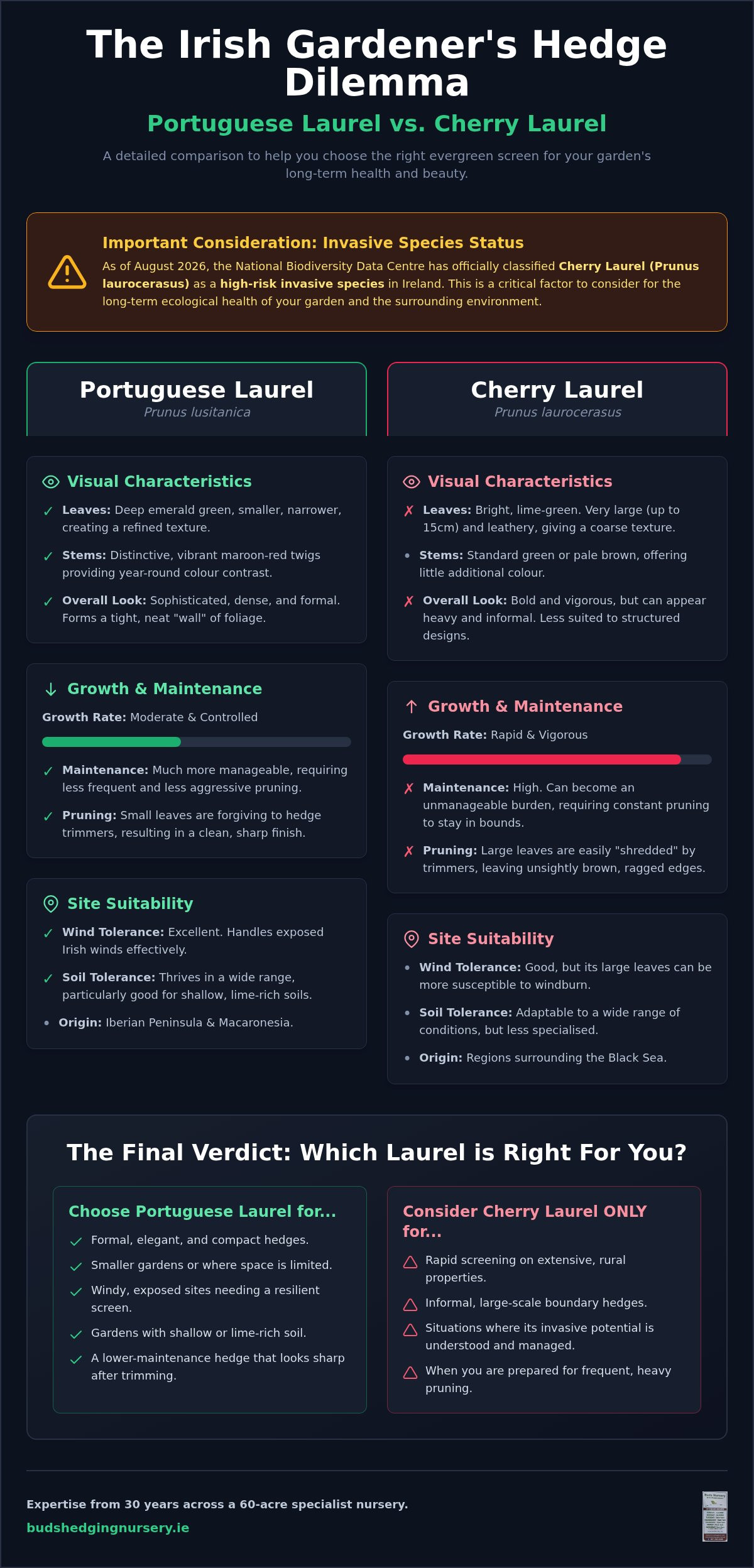
The visual difference between portuguese laurel vs cherry laurel is immediate once you see them side by side. Cherry Laurel features a bright, lime-green gloss. Its leaves are large and leathery, often reaching 15cm in length. This gives the hedge a bold, tropical appearance. In contrast, Portuguese Laurel offers a deep, sophisticated emerald hue. The most striking distinction is the “red stem” factor. Portuguese Laurel has vibrant maroon-red twigs that provide a sharp contrast against its dark foliage. Cherry Laurel stems are typically green or pale brown, blending into the leaves without adding much extra colour interest.
Leaf size also dictates how the hedge looks after a trim. Cherry Laurel’s large leaves are prone to looking “shredded” if you use a standard petrol hedge trimmer. The blades often slice through the middle of the broad leaves, leaving brown, ragged edges that take time to grow out. Portuguese Laurel has much smaller, narrower leaves. This makes it far more forgiving when using power tools. Both species produce upright white flower racemes in late spring. These are followed by small cherry-like fruits that transition from red to a deep purple-black by autumn, providing a food source for local birds.
The Aesthetic Impact of Leaf Scale
The smaller leaves of Portuguese Laurel create a tighter, more formal “wall” effect. This high density is ideal for structural garden designs or boundary hedges in smaller spaces. Cherry Laurel’s larger leaves create a coarser, heavier texture. They are better suited for informal, larger-scale screening where a softer, more relaxed outline is acceptable. The “Angustifolia” cultivar is specifically recognised for its pointed, bay-like leaf shape that adds a touch of Mediterranean elegance to the garden.
Seasonal Changes and Winter Interest
Winter is when the Portuguese variety truly comes into its own. The red stems often become more vibrant during the cold Irish months. This provides a warm, architectural detail when the rest of the garden is bare. Both plants are reliable evergreens that retain their colour whilst deciduous species go dormant. According to the North Carolina Extension Gardener Plant Toolbox, this species is highly valued for its dense, lustrous foliage that remains attractive throughout the year.
A Portuguese Laurel hedge also offers a dark, consistent backdrop that makes the colours of flowering shrubs or perennials pop. If you are struggling to decide between the two, you can visit our nursery to compare the foliage textures and stem colours in person before making your final choice.
Growth Rates and Maintenance: How Quickly Will They Screen?
The speed at which a hedge reaches maturity is often the deciding factor for many Irish gardeners. In the portuguese laurel vs cherry laurel debate, Cherry Laurel is the undisputed champion for rapid growth. It can put on 60cm or more in a single year once established. This makes it a go-to for those who need a tall privacy screen as quickly as possible. However, this vigour comes with a price. A faster-growing hedge requires more frequent attention to keep it from encroaching on garden paths or blocking light.
Portuguese Laurel grows at a steadier, more manageable pace of approximately 30-45cm per year. While it takes a little longer to reach its ultimate height, it’s far easier to maintain. You won’t find yourself battling with the shears every few months. As noted by the Tualatin Soil and Water Conservation District, understanding these growth habits is essential for selecting a plant that fits your available space and maintenance budget. Slower growth often results in a denser, more structural hedge that holds its shape better over time.
Establishing Your Hedge
The first two years are critical for both species. During this period, the plants focus on developing a strong root system. We’ve found that planting during the bare root tree season Ireland is the most cost-effective way to plant long boundaries. Bare root plants are easier to transport and often establish more quickly than pot-grown alternatives if planted between November and March. Regular watering during the first dry spell and a good layer of bark mulch will significantly speed up this establishment phase.
Long-Term Maintenance Commitments
If left unpruned, both varieties can eventually reach the proportions of a small tree. Cherry Laurel, with its broad habit, will quickly dominate a small garden if you don’t trim it twice a year. It’s also prone to the “pruning scar” issue. Because the leaves are so large, using a standard hedge trimmer often cuts them in half, leaving brown, unsightly edges. For a cleaner finish, many professionals prefer using secateurs, though this is only practical for smaller hedges.
Portuguese Laurel is the favourite for formal, clipped boundaries. Its smaller leaves mean that hedge trimmers don’t cause the same visual damage. Usually, a single trim in late summer is enough to keep it looking sharp for the rest of the year. This makes it a superior choice for homeowners who want a neat, wall-like effect without the constant workload associated with more vigorous species. Using sharp, clean tools is vital for both to prevent the spread of disease whilst maintaining plant health.
Resilience and Site Suitability: Soil, Wind, and Disease
The resilience of your hedge is tested by the specific conditions of your site. In the comparison of portuguese laurel vs cherry laurel, soil type and exposure are the primary deciders. Both are fully hardy across Ireland. However, they react differently to local environmental stresses. Cherry Laurel is a robust plant, but it struggles in very shallow, lime-rich soils. This often leads to yellowing leaves, a condition known as chlorosis. Portuguese Laurel is much more versatile. It thrives in alkaline conditions and handles thinner soils with ease.
Exposure to wind is another critical factor. Cherry Laurel has large, broad leaves that can act like sails in a gale. This often leads to physical damage or wind-burn on the foliage in coastal or hilltop gardens. Portuguese Laurel has smaller, more aerodynamic leaves and tougher stems. It’s the superior choice for breezy sites where a structural windbreak is required.
Tackling the Irish Climate
High rainfall is a staple of the Irish climate, and it impacts these species differently. Whilst both plants enjoy moisture, they won’t tolerate standing water. You can improve drainage in heavy clay by incorporating grit or well-rotted organic matter into the planting trench to prevent root rot before you put your plants in the ground. For coastal gardens, Portuguese Laurel offers better resistance to salt spray. It’s often cited as the best hedging for privacy in Ireland when dealing with exposed rural boundaries that face the brunt of Atlantic weather.
Pests and Disease Management
The most common complaint about Cherry Laurel in damp Irish conditions is “shot-hole” disease. This is caused by bacteria or fungi that thrive when the leaves stay wet for long periods. It doesn’t usually kill the plant, but it makes the hedge look tatty and thin. You can identify it using this checklist:
- Small, circular brown spots appearing on the new growth.
- The centre of these spots falling out, leaving small, clean holes.
- Tattered leaf edges that look like they’ve been hit by shotgun pellets.
Portuguese Laurel is generally considered more disease-resistant. Its tougher, waxier leaves are less susceptible to these pathogens. If your site is exceptionally wet and low-lying, consider Beech Hedging Plants Ireland as a deciduous alternative that handles damp soil better than most evergreens. Choosing the right plant for your specific ground conditions avoids years of struggle. You can view our full range and get expert advice on-site at Buds Nursery Cavan from Tuesday to Saturday to ensure your hedge thrives.
The Final Verdict: Choosing the Right Laurel for Your Garden
Deciding between portuguese laurel vs cherry laurel ultimately depends on the specific goals you have for your property and the footprint of your garden. Both plants offer excellent year-round privacy, but they serve different landscape functions. If you are designing a formal boundary or have limited room, Portuguese Laurel is the superior choice. Its compact nature means it won’t eat into your lawn or require aggressive hacking back to stay in bounds. For those managing a large rural boundary where budget and speed are the priorities, Cherry Laurel remains the standard for creating a thick green wall in a short timeframe.
Project costs also play a major role in the final decision. Bare root plants are the most economical option for large-scale projects, though they are only available during the dormant winter months. Pot-grown laurels offer an instant impact and can be planted at any time of year, but they carry a higher price point per plant. At Buds Nursery Cavan, we often suggest that homeowners consider the long-term maintenance costs alongside the initial purchase. A hedge that grows at a steadier pace may cost more upfront but saves significant time and professional pruning fees over its lifetime.
We also encourage customers to think about biodiversity when planning their boundaries. While a single-species laurel hedge is effective, mixing in other hardy evergreens like Holly or Photinia Red Robin can create a more resilient screen. This approach, which we frequently recommend at Buds Nursery Cavan, reduces the risk of a single pest or disease affecting your entire boundary at once.
Decision Matrix: Urban vs Rural
Your location often dictates the best choice. If you have a small urban garden with a narrow boundary, choose Portuguese Laurel. It maintains a tight, upright structure that looks polished with minimal effort. If you have a wide boundary on a farm or a large rural site, Cherry Laurel is the most cost-effective way to achieve total privacy. We recommend a visit to our 60-acre nursery where you can see mature examples of both to help you visualise the finished scale of your project.
Next Steps for Your Hedging Project
Before you order, take the time to measure your boundary accurately. For a dense screen, we typically recommend planting three specimens per metre for smaller sizes. Larger rootball plants may only require two per metre to achieve full coverage. Soil preparation is equally vital. Ensure you clear the area of weeds and incorporate organic matter during the dormant season to give your new plants the best start.
If you are ready to start your 2026 planting project, contact the team at Buds Nursery Cavan. We provide expert on-site guidance from Tuesday to Saturday to help you select the right stock for your specific site conditions. Whether you need a few pots for a town garden or a national delivery for a large estate, we can supply high-quality plants directly from our production fields.
Securing Your Garden Boundary for the Long Term
Choosing the right hedge is a long-term commitment that shapes your outdoor space for decades. The comparison of portuguese laurel vs cherry laurel highlights that while both are reliable evergreens, they serve very different garden roles. Portuguese Laurel is the professional choice for formal, manageable boundaries in exposed or lime-rich sites. Cherry Laurel remains the standard for those requiring a vigorous, large-scale privacy screen as quickly as possible. Matching the plant to your specific soil and scale avoids the common pitfall of a hedge that eventually becomes unmanageable.
With over 30 years of horticultural expertise and 60 acres of Irish-grown stock, we provide the practical guidance you need to make the right choice. We offer national delivery across Ireland to ensure your plants arrive in prime condition for the upcoming planting season. Browse our premium Laurel hedging and get expert advice at Buds Nursery Cavan. We look forward to helping you create a healthy, evergreen boundary that enhances your Irish garden for years to come.
Frequently Asked Questions
Which is better for a small garden, Portuguese or Cherry Laurel?
Portuguese Laurel is much better for small gardens. It has a more compact, upright growth habit and smaller leaves. This prevents the hedge from becoming too bulky and encroaching on your lawn or patio space. Cherry Laurel grows much wider and its large leaves can make a small area feel cramped. Choosing the Portuguese variety ensures you maintain a neat, formal boundary without the need for constant, aggressive pruning.
Does Portuguese Laurel grow as fast as Cherry Laurel?
No, Portuguese Laurel does not grow as quickly as the Cherry variety. Once established, Portuguese Laurel typically grows between 30cm and 45cm per year. In contrast, Cherry Laurel is more vigorous and can put on 60cm or more annually. This makes the portuguese laurel vs cherry laurel choice a trade-off between how quickly you need privacy and how much maintenance you’re willing to do. Slower growth generally leads to a denser, more structural hedge.
Is Cherry Laurel poisonous to dogs and livestock?
Yes, all parts of the Cherry Laurel are toxic if ingested by animals. The leaves and seeds contain cyanogenic glycosides, which release cyanide when chewed. This is a significant concern for livestock like horses or cattle, and it can also be dangerous for dogs that tend to chew on garden debris. While most animals naturally avoid it, you should be cautious if planting it near grazing areas or in gardens with curious pets.
Why are the leaves on my Cherry Laurel turning yellow or getting holes?
Yellowing leaves usually indicate a nutrient deficiency or poor soil drainage, whilst holes are typically caused by shot-hole disease. In the damp Irish climate, this fungal or bacterial issue creates small brown spots that eventually drop out, leaving tattered edges. Improving soil drainage and airflow around the plants can help. If your soil is shallow or lime-rich, you may find that Portuguese Laurel is a more resilient alternative that avoids these common issues.
Can I plant Portuguese Laurel in heavy clay soil?
Yes, you can plant Portuguese Laurel in clay soil, provided it isn’t waterlogged. This species is quite adaptable but requires decent drainage to thrive. We recommend incorporating grit and well-rotted organic matter into the planting trench to improve the soil structure. If the ground stays saturated for long periods, consider mounding the soil or installing drainage. Proper site preparation during the planting phase is essential for long-term health in heavy ground.
What is the best time of year to plant laurel hedging in Ireland?
The best time to plant is during the dormant season, typically between November and March. This is especially true if you are using bare root trees, which are cost-effective for long boundaries. Planting during these months allows the root system to establish before the spring growth spurt begins. Pot-grown plants can be put in the ground year-round, but they will require much more frequent watering if planted during the warmer summer months.
How far apart should I space Portuguese Laurel plants?
For a standard boundary, space Portuguese Laurel plants 2 to 3 per metre. The exact distance depends on the size of the plants at the time of purchase and how quickly you want the hedge to fill in. Planting at 50cm intervals is a common choice for a dense, formal screen. In the portuguese laurel vs cherry laurel comparison, the Portuguese variety’s upright habit means it fills gaps reliably without becoming overly wide.
Can I keep a Cherry Laurel hedge at 4 feet tall?
You can keep it at that height, but it requires significant effort. Cherry Laurel is naturally a large, vigorous shrub that wants to grow much taller. Keeping it at 4 feet means pruning at least twice a year. Because of its large leaves, a low hedge can often look untidy if trimmed with power tools. If you need a permanent 4-foot boundary, Portuguese Laurel or Box might be a more manageable choice for your garden.