

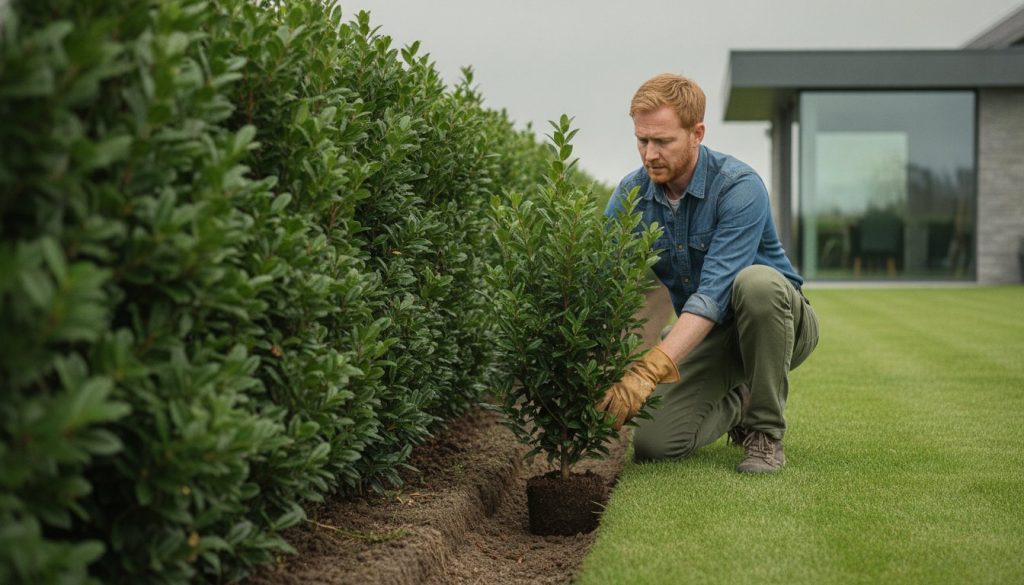
Most gardeners choose a hedge based on how fast it grows, but the real secret to a lasting evergreen screen in Ireland is prioritising plant hardiness and soil drainage over sheer speed. You likely want a thick, deep green boundary that provides year-round privacy without the invasive growth habits of other laurel varieties. When searching for a Portuguese laurel nursery Ireland offers several options, yet the choice often brings up more questions than answers. You might feel stuck choosing between pot-grown plants and seasonal rootballs, or perhaps you’re worried about your new investment failing in heavy, wet soil.
This guide will give you the confidence to select, prepare, and plant Portuguese Laurel using professional methods tailored for the Irish climate. We’ll clarify the differences in stock types, explain how to space your plants for a dense finish, and provide a clear roadmap for long-term maintenance. By the end, you’ll know exactly how to transform your garden boundary into a premium, resilient feature that stands the test of time. We’ll move through the selection process first, ensuring you start with the highest quality specimens for your specific site.
Key Takeaways
- Learn why sourcing stock from a specialist Portuguese laurel nursery Ireland ensures you receive plants acclimatised to the local climate alongside expert guidance on variety selection.
- Understand the practical differences between pot-grown and rootballed specimens to choose the best option for your specific planting season and budget.
- Discover how to properly prepare your site by prioritising soil drainage and clearing a dedicated planting strip to encourage fast root establishment.
- Master professional planting techniques, such as digging a continuous trench and handling rootballs correctly to ensure a thick, uniform hedge.
- Establish a reliable maintenance routine using the deep-soak watering method and organic mulching to keep foliage healthy and vibrant year-round.
Why Portuguese Laurel is the Favourite Choice for Irish Screening
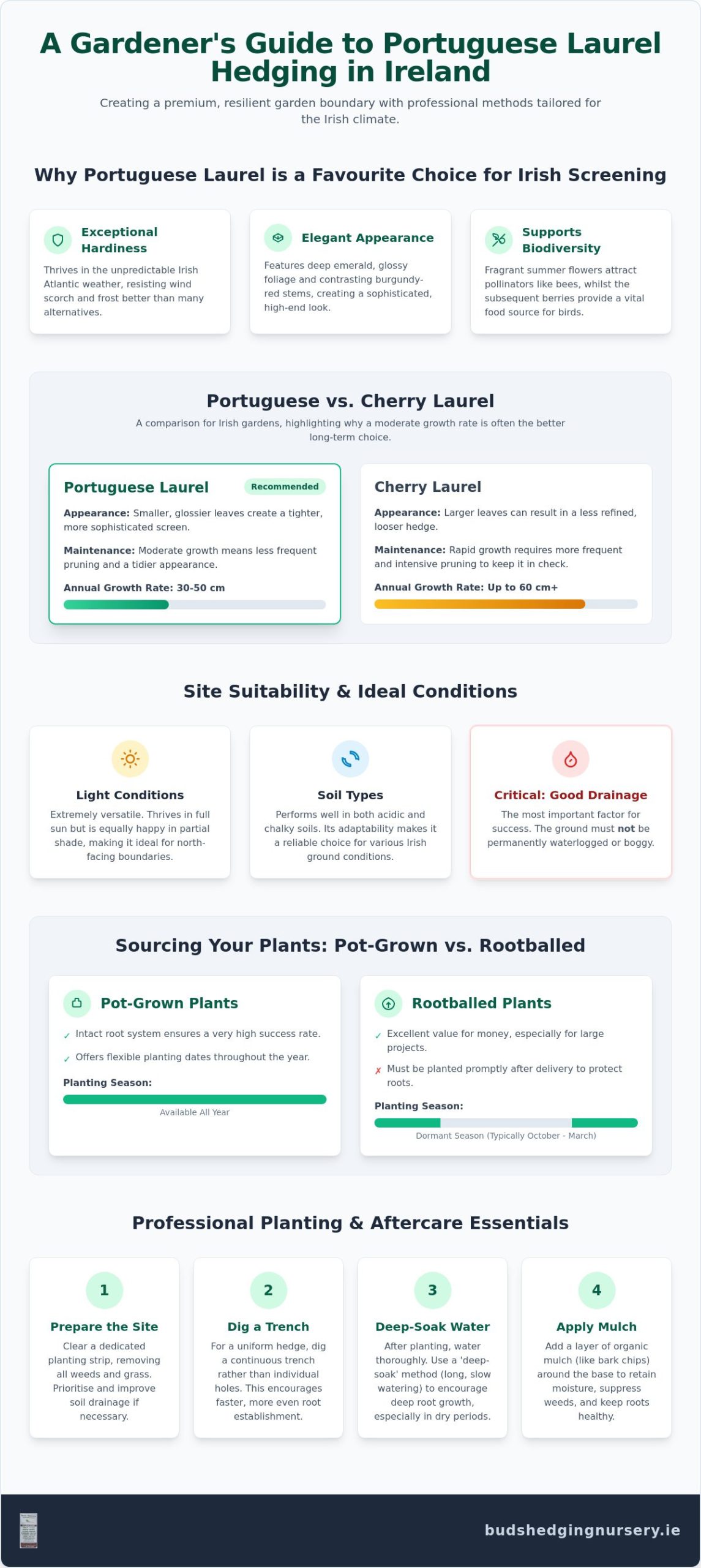
Portuguese Laurel remains a staple for Irish gardeners seeking a reliable, high-quality boundary. It’s often the first recommendation at any specialist Portuguese laurel nursery Ireland gardeners visit. The plant is prized for its deep emerald foliage, which stays vibrant throughout the winter months. One of its most distinctive features is the burgundy-red stems that provide a sharp contrast against the dark green leaves. This aesthetic combination gives the hedge a sophisticated look that fits both contemporary and traditional garden designs.
Botanically known as Prunus lusitanica, this species is exceptionally hardy. It handles the unpredictable Irish Atlantic weather with ease, resisting wind scorch better than many other evergreen options. Beyond its looks, it offers genuine value to local biodiversity. In early summer, it produces racemes of fragrant white flowers that are a major draw for local Irish pollinators; these are followed by small fruits that provide a food source for birds. This makes it a practical choice for those looking to support local wildlife whilst maintaining a secure perimeter.
Its versatility is another reason for its popularity amongst professional landscapers. Whilst most commonly used for dense boundary hedging, it also works well as a standard tree or clipped into formal topiary shapes. Because it responds so well to pruning, you can maintain it as a narrow screen in smaller urban spaces or let it grow into a large, imposing barrier on rural sites. It provides a dense, opaque screen that offers excellent privacy and noise reduction year-round.
Portuguese vs. Cherry Laurel: Making the Right Choice
Choosing between these two can be confusing. Cherry Laurel is known for rapid growth, but Portuguese Laurel offers a more refined, manageable pace. It typically grows about 30 to 50 cm per year. This moderate speed means you spend less time pruning and the hedge maintains a tidier appearance. The leaves are smaller and glossier than Cherry Laurel, creating a tighter, more sophisticated screen. For a deeper dive into these differences, see our guide on laurel hedge ireland.
Suitability for Different Irish Soil Types
Portuguese Laurel is remarkably adaptable to various Irish soil types. It performs well in both acidic and chalky conditions, provided the ground isn’t waterlogged. It’s often a safer bet than Griselinia for inland gardens or exposed sites where frost can be an issue. It thrives in full sun but is equally happy in partial shade, making it useful for north-facing boundaries. When you visit a Portuguese laurel nursery Ireland homeowners often find that this resilience makes it the most cost-effective long-term option for difficult sites.
Sourcing from a Specialist Portuguese Laurel Nursery in Ireland
Visiting a specialist plant nursery Ireland provides the best foundation for a successful hedge. Standing among the rows allows you to assess the uniform quality of the stock, which is impossible through a screen. A reliable Portuguese laurel nursery Ireland operates will offer ‘nursery-hardened’ plants. These specimens have been grown in conditions that mirror our local climate, ensuring they don’t suffer from shock once moved to your garden. Plants grown in milder, sheltered climates elsewhere often struggle when faced with a damp Irish winter or a salt-laden coastal breeze.
You must decide between pot-grown and rootballed stock based on your timeline and project scale. Pot-grown Portuguese Laurel is available throughout the year. These plants have a fully intact root system, allowing for flexible planting dates and high success rates. Rootballed stock is lifted directly from nursery fields during the dormant season, typically from October to late March. These are often preferred for large-scale projects because they offer excellent value for money when buying in bulk, though they must be planted promptly after delivery to prevent the roots from drying out.
Nursery Selection Checklist
Don’t just look at the height of the plant. A tall, thin plant is rarely better than a shorter, bushier one. Use this checklist when evaluating stock on-site:
- Foliage density: Ensure the plant is well-clothed in leaves from the very top down to the soil line. Leaf loss at the base is hard to fix later.
- Stem health: Look for the characteristic deep burgundy-red stems. Dull or brown stems can indicate the plant is under stress or lacks essential nutrients.
- Root structure: For potted plants, gently lift one from its container. The roots should be firm and visible but not tightly coiled or ‘choking’ the plant in a pot-bound mess.
Choosing the Right Size for Your Project
Budget often dictates the initial size, but consider the long-term outcome. Smaller starter plants, around 40-60cm, are highly affordable and tend to establish very quickly. They often ‘catch up’ to larger plants within a few seasons because they experience less transplant shock. Conversely, if you have a direct line of sight from a neighbour’s window, 150cm+ mature specimens provide an immediate solution. These larger rootballed plants offer an instant screen, though they require more diligent watering in their first year. If you’re unsure which size fits your goals, browse our current stock levels and talk to a grower about your specific site requirements.
Preparing Your Site for Planting Prunus Lusitanica
Ground preparation is the most influential factor in how quickly your hedge establishes. Whilst Portuguese Laurel is a hardy species, it is sensitive to waterlogged conditions. In the heavy soils often found across Ireland, poor drainage can lead to root rot during the damp winter months. Before you collect your plants from a Portuguese laurel nursery Ireland gardeners trust, you must ensure the planting site is ready to receive them. Proper groundwork prevents the ‘wet feet’ that often causes young laurels to fail in their first season.
Start by clearing a one-metre wide strip along the intended hedge line. It is vital to remove all grass, weeds, and old roots. This strip ensures that young plants don’t have to compete for nutrients and moisture during the critical establishment phase. Once the area is clear, incorporate well-rotted organic matter into the soil. Focus on improving the soil structure rather than over-fertilising. Heavy-handed feeding can lead to soft, sappy growth that is more susceptible to frost damage and pests.
Accurate planning prevents costly mistakes during the planting process. Use a hedging plant spacing guide to determine exactly how many specimens you need for your specific boundary length. Ordering the correct quantity ensures a uniform look without unnecessary gaps or overcrowding. It also allows you to calculate the volume of soil conditioner or grit you’ll need to have on hand before the plants arrive.
Managing Heavy Clay and Compaction
Many Irish gardens sit on heavy clay that compacts easily, forming a ‘pan’ layer that roots cannot penetrate. Use a garden fork to break up the bottom and sides of your planting trench. If your site is prone to standing water, consider planting on a raised berm or mound about 15-20cm high. This keeps the main root mass above the water table. For localised drainage issues, mixing horticultural grit or sharp sand into the backfill soil can help water move away from the stems more efficiently.
Setting the Line and Spacing
A straight hedge starts with a string line. Stretch a line between two stakes to keep your trench perfectly aligned. For standard 2-litre or 3-litre pots, we recommend three plants per metre. This density creates a thick, private screen relatively quickly. If you’ve sourced larger rootballed plants from a Portuguese laurel nursery Ireland specialist, you may need to increase the spacing slightly to 60cm or 70cm between centres. This allows the wider root systems enough room to settle without competing for space.
Step-by-Step Guide to Planting Your Portuguese Laurel Hedge
For a uniform hedge, a continuous trench is far superior to digging individual holes. A trench provides a consistent volume of loosened soil, allowing roots to spread laterally without meeting the resistance of compacted pit walls. Dig your trench at least twice the width of the root system and slightly deeper than the root mass itself. This ensures the surrounding ground is friable enough for new growth to penetrate quickly. If you have collected your stock from a Portuguese laurel nursery Ireland specialist, you will notice the plants are often quite dense; a trench makes it much easier to maintain the straight line required for a professional finish.
Depth control is the most critical part of the process. The plant must be set at the same level it was growing at the nursery. You can usually see a faint soil mark on the main stem that indicates this line. Planting too deep can cause the bark to rot, whilst planting too shallow leaves the top of the root system exposed to drying winds. Use a straight edge, such as a shovel handle, laid across the trench to verify the height before you begin backfilling. Once positioned, return the soil in layers, firming it down gently with your boot to eliminate air pockets. This prevents frost heave during the winter and ensures the roots stay in direct contact with the soil.
Finish the job by ‘puddling in’ the plants. This involves a very heavy initial watering that turns the soil into a temporary slurry around the roots. It is the most effective way to settle the earth and provide the moisture needed for immediate recovery from transplant shock. For large-scale projects, talk to us about delivery options to ensure your plants arrive fresh and ready for immediate planting.
Handling Pot-Grown vs. Rootballed Specimens
For pot-grown laurels, gently tease out any roots that have started to circle the base of the pot. This encourages them to grow outwards rather than continuing to spiral. When handling rootballed plants, keep the hessian wrap intact while positioning. It protects the delicate feeder roots and will rot away naturally over time. Applying mycorrhizal fungi directly to the root zone or the planting hole can significantly speed up establishment in new garden soil by creating a secondary root network.
Staking and Support for Taller Plants
In exposed Irish sites, wind rock can prevent roots from ever taking hold. If your Portuguese Laurel is over 1.2 metres tall, it may need temporary support. For standard trees, use a stake driven in at a 45-degree angle to avoid the rootball. Secure the stem with soft tree ties that won’t damage the sensitive burgundy bark. For hedging, a low-level windbreak mesh on the windward side can provide enough shelter to allow the plants to settle without the need for individual stakes.
Post-Planting Care: Ensuring Your Hedge Thrives
The first two growing seasons are the most critical for a new hedge. Whilst Portuguese Laurel is remarkably resilient once established, its initial success depends on a consistent care routine. Most failures occur because of insufficient watering or competition from weeds. When you source your stock from a Portuguese laurel nursery Ireland specialist, you are starting with healthy plants, but the transition to garden soil requires active management. Proper aftercare ensures the burgundy stems and deep green leaves remain vibrant throughout the year.
Watering is the single most important task. We recommend the ‘deep soak’ method rather than frequent, light sprinkling. A deep soak ensures water reaches the bottom of the root ball, encouraging roots to grow downwards into the cooler, moister layers of soil. During dry spells in the first two summers, you should water your hedge twice a week. Apply enough water so it penetrates at least 20cm deep. This is especially important for larger rootballed specimens that have a higher foliage-to-root ratio and lose moisture quickly through their leaves.
Mulching provides a protective layer that suppresses weeds and retains moisture. Apply a 5-7cm layer of bark mulch or well-rotted organic matter in a strip along the base of the hedge. Keep the mulch a few centimetres away from the main stems to prevent bark rot. To support the moderate growth rate of 30-50cm per year, apply a slow-release balanced fertiliser in early spring. This provides a steady supply of nutrients without forcing the soft, sappy growth that can be damaged by late frosts.
Seasonal Maintenance Calendar
- Spring: Apply a balanced feed and check for any wind rock after winter gales. Trim back any damaged tips to encourage fresh growth.
- Summer: Monitor moisture levels closely. Even in the Irish climate, a week of dry, windy weather can dehydrate a young hedge.
- Autumn/Winter: Check that mulch levels are maintained. Ensure any ties on taller plants are still secure but not tight enough to strangle the growing stems.
Troubleshooting Common Issues
In damp Irish conditions, you might notice small, circular holes in the leaves, a condition known as ‘Shot Hole’ fungus. This is usually a sign of environmental stress rather than a terminal disease. Improving airflow around the plants and ensuring they are well-fed typically resolves the issue. If leaves begin to turn yellow, it is often a sign of poor drainage or a nitrogen deficiency. Check the soil moisture levels first; if the ground is sodden, you may need to revisit the drainage solutions discussed in earlier sections. For a deeper look at long-term health, refer to the Portuguese Laurel: The Complete Guide for Irish Gardens 2026. Visiting a Portuguese laurel nursery Ireland gardeners recommend can also provide on-site expert guidance for specific local soil problems.
Establishing Your Permanent Garden Boundary
A successful Portuguese Laurel hedge is a practical investment in your property’s privacy and year-round aesthetic. By selecting nursery-hardened stock and prioritising soil drainage, you’ll avoid the common pitfalls that lead to plant failure in our damp climate. The long-term success of your evergreen screen depends on the groundwork you perform now and the consistent deep-soak watering you provide during the first two growing seasons. This methodical approach ensures your hedge remains vibrant and dense for decades.
When you consult a specialist Portuguese laurel nursery Ireland gardeners trust, you gain access to plants already acclimatised to local weather patterns. At Buds Nursery Cavan, we draw on 30 years of experience across our 60-acre production site to provide premium specimens. We offer expert on-site guidance to help you calculate spacing and provide nationwide delivery for large orders. With the right selection and careful planting, your garden will soon feature a professional-grade boundary that stands the test of time.
Visit Buds Nursery Cavan to select your Portuguese Laurel hedging and start your project with confidence.
Frequently Asked Questions
Is Portuguese Laurel faster growing than Cherry Laurel?
Portuguese Laurel grows at a moderate rate of 30 to 50 cm per year, which is slower than the rapid pace of Cherry Laurel. Whilst it takes longer to reach its full height, it requires less frequent pruning and maintains a much tidier, more formal shape. This controlled growth makes it easier to manage in smaller urban gardens where space is limited.
When is the best time of year to plant Portuguese Laurel in Ireland?
You can plant pot-grown specimens at any time of the year provided the ground isn’t frozen or waterlogged. However, rootballed plants from a Portuguese laurel nursery Ireland specialist are only available from October to March. Planting during the dormant autumn and winter months allows the root system to settle before the spring growth spurt begins.
How many Portuguese Laurel plants do I need per metre for a privacy hedge?
We recommend planting three specimens per metre for a standard privacy hedge. This spacing, roughly 33 cm apart, ensures the plants knit together quickly to form a thick, opaque screen. If you’re using very large, mature rootballs, you might increase this to two plants per metre to allow for their existing width and prevent immediate overcrowding.
Can Portuguese Laurel grow in heavy clay soil?
Portuguese Laurel can tolerate heavy clay, but it will fail if the soil remains waterlogged. You must improve the site by breaking up the clay ‘pan’ and incorporating horticultural grit or organic matter. In particularly wet gardens, planting on a slightly raised mound or berm is the best way to keep roots above the winter water table.
Does Portuguese Laurel retain its leaves in the winter?
Yes, Portuguese Laurel is a fully evergreen shrub that retains its deep green leaves throughout the winter. Unlike deciduous hedging, it provides consistent privacy and wind protection all year round. The dark foliage is especially striking in the winter months when contrasted with the plant’s characteristic burgundy-red stems and dark berries.
How tall will a Portuguese Laurel hedge grow if left unpruned?
If left entirely unpruned, a Portuguese Laurel can eventually reach a height of 4 to 8 metres. It naturally forms a large shrub or small decorative tree. In most Irish gardens, it is easily maintained as a formal hedge at a height of 2 to 3 metres with a single annual trim in late summer or early autumn.
Is Portuguese Laurel poisonous to pets or livestock?
The leaves and berries of Portuguese Laurel are mildly toxic if ingested in large quantities by pets or livestock. Like most members of the Prunus family, they contain compounds that can cause illness. It’s sensible to keep the hedge trimmed to prevent heavy fruiting if you have inquisitive animals or young children in the garden.
Why are the leaves on my Portuguese Laurel turning yellow?
Yellowing leaves are usually a sign of environmental stress, most commonly caused by poor drainage or a nutrient deficiency. When sourcing plants from a Portuguese laurel nursery Ireland growers operate, ensure your soil isn’t waterlogged. If the drainage is clear, a balanced slow-release fertiliser in early spring will usually restore the healthy deep green colour.