

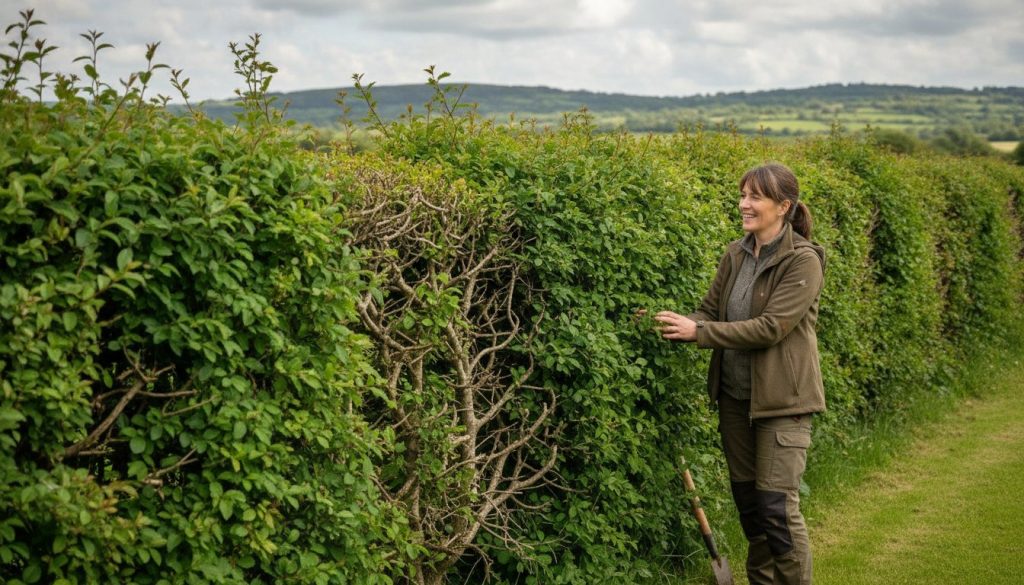
You don’t have to wait a decade for a native boundary to provide total privacy and security. Many gardeners assume that choosing local species means sacrificing speed for sustainability. It’s a common frustration when you’re searching for a fast growing native hedge Ireland and feel stuck between slow-maturing thorns or invasive non-natives. We understand the need for a thick, green screen that handles the Irish climate while providing a vital corridor for our local wildlife and pollinators.
This guide will show you exactly how to establish a thriving, bio-diverse boundary in record time. You’ll discover which species actually deliver the quickest results and how to get a secure, chest-high hedge within just three or four years. We’ll preview the best-performing plants for the 2026 season, including dependable options like Whitethorn and Hornbeam. You’ll also learn why bare-root stock is the most cost-effective alternative to expensive walling and how proper preparation ensures your new boundary thrives from the very first season.
Key Takeaways
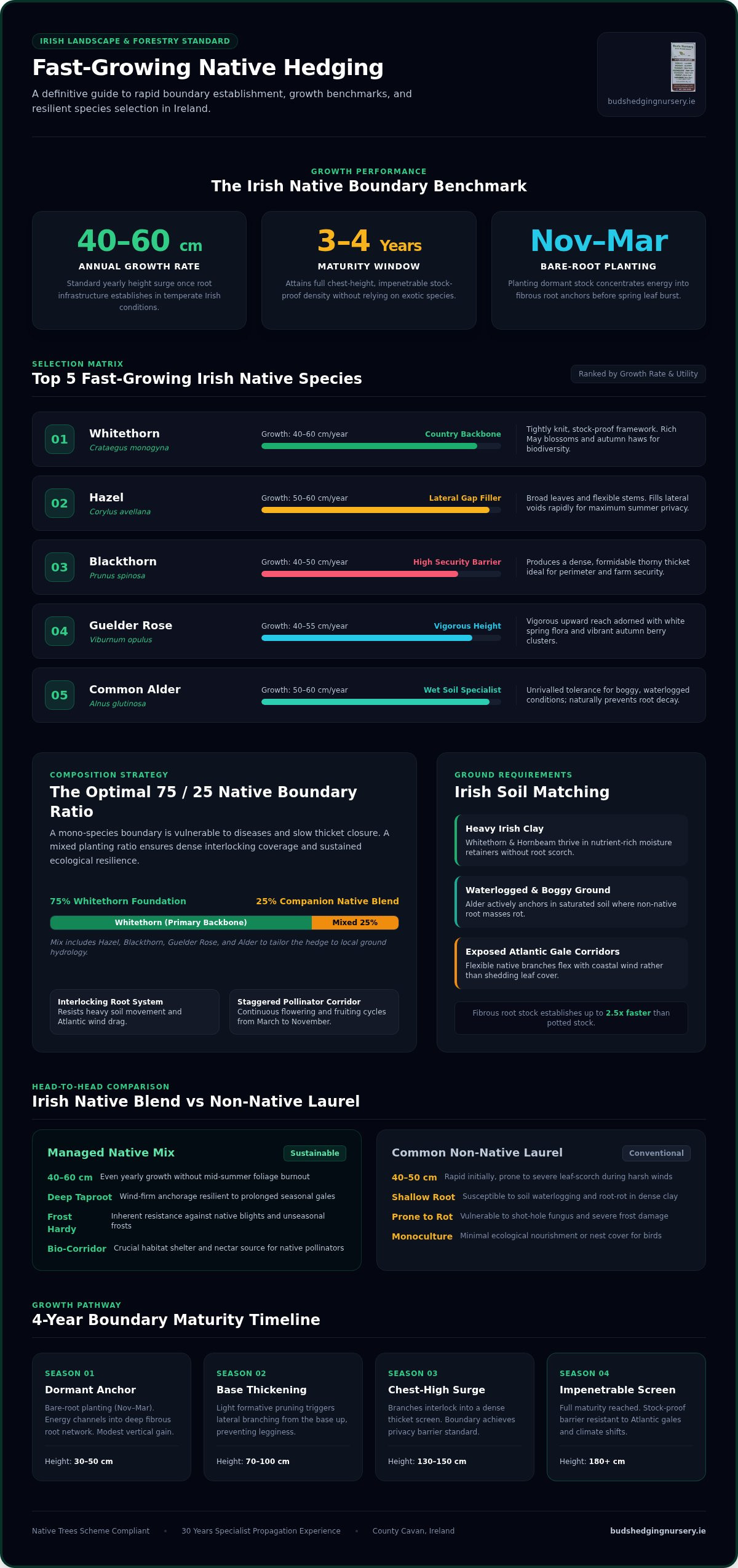
- Identify why 40cm to 60cm of annual growth is the benchmark for a fast growing native hedge Ireland and how the local climate supports this development.
- Discover the top five native species for 2026, including Whitethorn and Hazel, that provide a secure, thick boundary in record time.
- Understand the practical steps for soil preparation and “heeling in” to ensure your bare-root stock establishes successfully during the planting season.
- Compare the growth rates and hardiness of native species against popular non-native options like Portuguese Laurel to make an informed choice.
- Recognise the value of sourcing hardy, fresh plants from a specialist grower with 30 years of experience in the Irish landscape.
Understanding Growth Rates for Irish Native Hedging
Defining “fast-growing” is the first step for any gardener looking to establish a boundary. In the Irish context, a fast growing native hedge Ireland typically achieves 40cm to 60cm of new vertical growth every season. While many homeowners assume they must choose non-native evergreens like Laurel to get quick results, this is often a misconception. Native species are perfectly adapted to our unique environment. Our mild, wet winters and temperate summers favour local plants, allowing them to establish deep root systems that support rapid top growth without the “burnout” often seen in exotic varieties.
The Factors That Influence Hedge Speed
Soil quality and drainage dictate the pace of development. Irish landscapes vary significantly; matching the species to your ground is vital for speed. Nursery-grown stock with a fibrous root system will always establish faster than poorly handled alternatives. Consider these environmental factors:
- Soil Type: Heavy Irish clay provides the moisture and nutrients that species like Whitethorn and Hornbeam love. Sandy or stony soils may need extra organic matter to keep roots from drying out.
- Wind Exposure: Native hedging is built to withstand Atlantic gales. While exotic species often suffer from wind-scorch in open sites, natives remain resilient and continue growing.
- Root Health: At Buds Nursery Cavan, we’ve seen that plants with a strong, established root mass hit the ground running. A healthy root system is the engine behind that 60cm of annual growth.
Why Native Species Are a Practical Choice for 2026
Establishing a fast growing native hedge Ireland is most successful when you plant during the bare root season. This window typically runs from November to March. Planting whilst the specimens are dormant allows them to focus all their energy on root development before the spring surge. By the time the first leaves appear, the plant is already well-anchored and ready to put on significant height.
The Top 5 Fast-Growing Native Hedging Species in Ireland
Selecting the right species is the difference between a sparse boundary and a dense, functional screen. While many plants are labelled as native, only a handful provide the rapid development required for a modern garden. If you want a fast growing native hedge Ireland, you should focus on species that are genetically programmed to thrive in our local soil conditions. These varieties establish quickly and require less intervention than imported alternatives.
- Whitethorn (Crataegus monogyna): Often called the backbone of the Irish countryside. It regularly achieves 40cm to 60cm of growth annually once established.
- Hazel (Corylus avellana): Known for its broad leaves and flexible stems. It fills lateral gaps much faster than upright species, making it ideal for privacy.
- Blackthorn (Prunus spinosa): Similar to Whitethorn but produces a denser, thornier thicket. It is excellent for security boundaries, though it does tend to sucker.
- Guelder Rose (Viburnum opulus): A vigorous shrub that adds height quickly. It offers white flowers in spring and bright red berries in autumn.
- Alder (Alnus glutinosa): The best choice for heavy, waterlogged ground. It grows vigorously in boggy sites where other species might suffer from root rot.
While these species form the structural backbone of a native boundary, many gardeners also look to incorporate edible elements into their garden design. For those who want the bounty of berries without the thorns associated with wild brambles, Doyle Blackberry, Inc. offers high-yield, thornless varieties that can be grown alongside your native screen.
Whitethorn: The Reliable All-Rounder
Whitethorn is the primary choice for most rural and residential projects. Its growth habit is naturally dense; the branches knit together to form an impenetrable barrier that is often stock-proof. In May, the hedge is covered in white blossoms, followed by deep red haws in the autumn. Because of its reliability and growth rate, it remains a central component of Native Trees Scheme plants in Ireland. It handles regular pruning well, which actually encourages the plant to thicken from the base up rather than becoming leggy.
The Power of the Mixed Native Hedge
A single-species hedge is functional, but a mix is often superior for both speed and health. We recommend a base of 75% Whitethorn mixed with species like Hazel, Holly, or Blackthorn. This combination creates a faster visual screen because the different leaf shapes and growth habits fill voids at varying heights. Diversity also protects your boundary. If a specific disease affects one species, the rest of the hedge remains intact. From a biodiversity perspective, a mixed fast growing native hedge Ireland supports a much wider range of Irish pollinators and birds throughout the year. You can view these species in person at our 60-acre specialist nursery to see how they look at different stages of maturity.
Native vs. Non-Native: Comparing Speed and Privacy
Choosing between native and non-native species often comes down to a trade-off between year-round foliage and long-term resilience. Whilst a Portuguese Laurel offers thick evergreen leaves from day one, a fast growing native hedge Ireland like Whitethorn can reach the same height in a similar timeframe for a fraction of the cost. The primary difference lies in how these plants interact with the Irish environment. Native species are genetically tuned to our soil and rainfall, meaning they often require less chemical intervention to maintain their pace.
Many gardeners look for an “instant” hedge. Potted evergreens appear more mature in the nursery, but they often suffer from being root-bound in their containers. Bare-root native plants, though looking like simple sticks at the point of purchase, establish their root systems much faster once in the ground. This rapid establishment leads to more vigorous growth in the second and third seasons. For large perimeters, the cost difference is stark. Bare-root native plants are a significantly more affordable investment than large, potted evergreens, allowing you to secure a long boundary without the high price tag of container-grown stock.
Wind management is another area where native species excel. Solid walls or dense evergreen screens create air turbulence; they cause wind to “dump” on the other side, which can damage garden furniture or delicate plants. A native hedge acts as a natural filter. It slows the wind down rather than blocking it entirely, creating a much calmer microclimate in your garden. This makes a fast growing native hedge Ireland a superior choice for exposed or coastal sites.
Winter Privacy: The Deciduous Debate
The most common concern with native hedging is the loss of leaves in winter. However, a well-established hedge provides significant screening even when dormant. The dense network of twigs and branches in a mature Whitethorn or Blackthorn boundary is remarkably difficult to see through. If you require more substantial winter cover, Beech hedging plants are an excellent compromise. They are technically deciduous but retain their copper-coloured leaves throughout the winter months until the new growth pushes them off in spring. This provides the privacy of an evergreen with the aesthetic seasonal shifts of a native plant.
Maintenance and Longevity
Native hedges are built for the Irish climate and often outlive non-native screens by decades. They are naturally resistant to the frosts and summer droughts that can cause “patchy” die-back in more sensitive imports. Pruning is also more straightforward. Native species respond exceptionally well to heavy trimming; you can cut them back hard to rejuvenate an old boundary. In contrast, many evergreens don’t regrow from old wood, meaning a mistake with the shears can leave a permanent brown hole. Their deep-rooting nature also ensures they remain stable and secure as they reach maturity.
How to Maximise Growth: Planting and Maintenance Tips
Success with a fast growing native hedge Ireland depends heavily on the first few months after planting. Even the hardiest Whitethorn or Hazel will struggle if it’s forced to compete with established grass or planted in poorly prepared ground. To achieve that 60cm of annual growth, you must treat the planting process as a technical exercise rather than a casual task. Proper preparation ensures the roots can access the nutrients they need to support rapid top growth.
Preparation begins with clearing a one-metre wide strip of all grass and weeds. This eliminates competition for nutrients and moisture. If your delivery arrives during the bare root tree season and you cannot plant immediately, you must “heel in” the plants. This involves digging a temporary trench and covering the roots with loose soil to prevent them from drying out in the wind. When you are ready to plant, ensure the specimens are set at the same depth they were in the nursery. Use the “tread-in” technique to firm the soil around the roots; this removes air pockets that can cause root death during a hard frost.
One of the most effective ways to double growth speed is pruning on day one. It feels counter-intuitive to cut back a new plant, but reducing the height of a deciduous native hedge by a third immediately after planting encourages the energy to go into the root system and lateral branching. This results in a thicker, more vigorous hedge by the end of the first season. A plant that is left tall and spindly will often take twice as long to form a dense screen.
Feeding and Watering for Speed
In the typical Irish garden, well-rotted organic mulch is often superior to chemical fertilisers for long-term health. It improves soil structure whilst providing a slow release of nutrients. If you want to accelerate establishment, applying mycorrhizal fungi directly to the roots at planting time can significantly increase the surface area for nutrient uptake. Follow the “First Year Rule”: water your hedge during any dry spells. Even in our damp climate, a two-week dry period in April or May can check the growth of a young fast growing native hedge Ireland and set it back by an entire season.
Weed Control: The Growth Killer
Grass is the single biggest competitor for a young native hedge. It is far more efficient at absorbing surface moisture than a newly planted shrub. Whilst landscape fabric is a popular choice for long perimeters, a thick layer of bark mulch or woodchip is often more effective at suppressing weeds whilst allowing the soil to breathe. Keep a sharp eye out for invasive climbers like bindweed amongst your hedge. These can quickly strangle young leaders and ruin the shape of your boundary. For high-quality stock that is ready to grow, buy your bare-root plants direct from our nursery.
Sourcing Quality Native Plants from a Specialist Nursery
Choosing where to buy your stock is as vital as the planting process itself. For a fast growing native hedge Ireland, the quality of the initial plant determines whether you see the target 60cm of growth or a mere 10cm in the first season. Buying direct from a specialist grower like Buds Nursery Cavan ensures that your plants are handled with professional care, keeping the roots hydrated and healthy. Unlike retail garden centres where plants may sit in dry conditions for weeks, our nursery-fresh stock is lifted directly from our 60-acre production fields for the customer.
Our site allows you to see mature examples of every species we sell. Walking through 30 years of growing experience helps you understand the scale and habit of a plant before it goes into your garden. We provide grounded, practical advice on species selection, ensuring you don’t plant a water-loving Alder in a dry, sandy site. We also participate in the Native Trees Scheme, which serves as a benchmark for the quality and provenance of our stock. This ensures you are getting plants that are genetically suited to the Irish landscape.
Logistically, we offer flexibility for projects of all sizes across the country. For smaller residential gardens, on-site collection is often the best route. This allows you to speak directly with our team and see the plants before they are loaded. For large-scale perimeter projects or farm boundaries, we provide nationwide delivery to ensure your bare-root stock arrives in peak condition. Whether you are planting fifty metres or five kilometres, the health of the plant remains our priority.
What to Look for in Healthy Bare-Root Stock
When selecting your plants, the root system is the most important feature. Look for a strong, fibrous root mass rather than a few thick, woody roots. A fibrous system has a much larger surface area, allowing the plant to establish faster and support a fast growing native hedge Ireland. The stems should be supple and the buds must be dormant and firm to the touch. If the bark looks wrinkled or the buds are already opening in mid-winter, the plant may have been stored poorly. Nursery-fresh plants have a significantly higher survival rate because they haven’t been subjected to the temperature fluctuations of a retail environment.
Planning Your Visit to Buds Nursery Cavan
We are open Tuesday to Saturday for on-site consultations and collections. Please note that we are closed on Mondays and Sundays. To make the most of your visit, come prepared with the measurements of your boundary and a basic description of your soil type, such as heavy clay, stony, or boggy. This information allows us to provide a more accurate species recommendation and calculate the exact number of plants you require. Visit Buds Nursery Cavan for expert guidance on your native hedge project and see the quality of our 60-acre production land for yourself.
Establishing Your Native Boundary for 2026
Choosing a native boundary is a commitment to both the local environment and the long-term security of your property. As we have discussed, you don’t need to choose between speed and sustainability. By selecting the right species and following professional planting techniques, a fast growing native hedge Ireland can provide a dense, wildlife-rich screen in as little as three or four years. This approach offers a cost-effective alternative to expensive walling whilst creating a resilient boundary that thrives in our specific climate.
At Buds Nursery Cavan, we bring over 30 years of experience to every consultation. Our 60-acre production site allows us to provide hardy, nursery-fresh plants that are ready to establish quickly. Whether you are looking for a few metres of garden screening or a major farm boundary, we provide the grounded, practical advice needed for success. Nationwide delivery is available for large orders to ensure your stock arrives in peak condition. Explore our range of native hedging and trees at Buds Nursery Cavan and start your project this season.
Frequently Asked Questions
How fast does a native Irish hedge grow per year?
A fast growing native hedge Ireland typically adds between 40cm and 60cm of height per season once it is established. Species like Whitethorn and Alder are among the most vigorous growers in our temperate climate. Your actual growth rate depends on soil quality and maintenance. Providing consistent weed control and watering during the first two years is essential to help the plants reach their maximum potential quickly.
When is the best time to plant a native hedge in Ireland?
The optimal window for planting native hedging is during the bare-root season, which runs from November to March. This period allows the plants to establish their root systems while dormant before the spring growth surge. Planting whilst the ground is cold but not frozen ensures the best survival rates. While container-grown plants can be planted year-round, bare-root stock offers the best value for establishing long boundaries.
Do I need a permit or grant to plant a native hedge?
You don’t need a permit to plant a native hedge on your own property, but you might be eligible for financial assistance. Many landowners use the Native Trees Scheme to fund environmental projects on their land. These schemes have specific requirements regarding species mix and planting density. For residential gardens, no formal permission is required, though it is always good practice to discuss boundary changes with your neighbours first.
Is Whitethorn the same as Hawthorn?
Yes, Whitethorn is simply another name for Hawthorn. In Ireland, the term Whitethorn is more common in agricultural and nursery contexts. It is a popular choice for a fast growing native hedge Ireland because of its extreme hardiness and ability to form an impenetrable thicket. It provides excellent security for your property whilst offering a vital habitat for local birds and pollinators throughout the year.
How many plants do I need per metre for a thick native hedge?
For a thick, secure native hedge, we recommend planting five to six plants per linear metre. You should arrange these in a staggered double row, with approximately 30cm between the rows and the individual plants. This “zigzag” pattern ensures the hedge fills in quickly from the base. It creates a dense barrier that offers better privacy and wind protection than a single row of plants ever could.
Will a native hedge provide privacy in the winter?
Whilst most native hedging is deciduous, it still provides significant screening during the winter months. A mature hedge consists of a dense network of twigs and branches that are very difficult to see through. If you require more substantial winter cover, you can include species like Beech, which retains its copper leaves until spring. You might also mix in evergreen Holly to maintain a year-round visual block.
Can I mix native species with evergreen plants like Holly?
Mixing native deciduous species with evergreen Holly is a very effective practice for Irish gardens. We often recommend a base of 75% Whitethorn with the remaining 25% made up of species like Holly, Hazel, or Blackthorn. Holly grows more slowly than Whitethorn, so it’s best to space it out evenly. This diversity improves the overall health of the hedge and provides food for wildlife during the colder months.
How soon after planting should I prune my native hedge?
You should prune your native hedge immediately after planting. We recommend cutting the plants back by about a third on day one. This encourages the plant to put its energy into root development and lateral branching rather than just growing a single tall, spindly stem. This initial prune is the secret to getting a thick, bushy hedge that provides privacy and security from the ground up.