

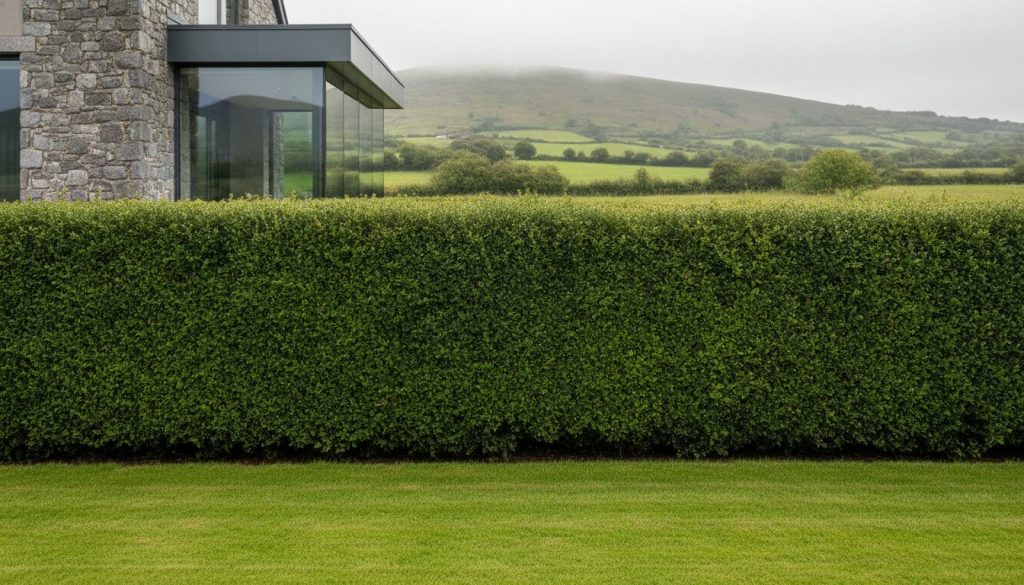
A Yew hedge planted today could easily outlive your house, providing a lush, deep green backdrop for generations to come. While many gardeners opt for faster growing alternatives, nothing matches the timeless prestige and density of Taxus baccata. You might worry that our notoriously damp winters will lead to the dreaded “wet feet” and kill off your investment, or perhaps you’re simply unsure if you have the patience for its steady growth rate. These are valid concerns for anyone looking into yew hedging Ireland, but with the right preparation, they’re easily managed.
We understand the importance of getting it right from the first spadeful of soil. This guide provides the practical expertise you need to establish a thriving, impenetrable screen that stands the test of time. You’ll learn how to secure perfect drainage in heavy ground, the vital differences between Common and Irish Yew, and the specific pruning schedules required for the Irish climate. By the end, you’ll have the confidence to plant a legacy that remains vibrant and healthy for decades, regardless of what the Atlantic weather throws at it.
Key Takeaways
- Discover why Taxus baccata is the premier choice for creating a dense, impenetrable privacy screen that thrives in both sun and deep shade.
- Learn how to avoid the common pitfall of “wet feet” with specific drainage and soil preparation techniques essential for yew hedging Ireland.
- Understand the “old wood” pruning secret that allows Yew to be rejuvenated and reshaped far more effectively than other evergreen varieties.
- Identify the optimal planting windows during the bare root season and the benefits of sourcing acclimatised plants from a specialist nursery.
- Master the spacing and maintenance requirements needed to grow a healthy legacy hedge that will last for generations in the Irish climate.
What is Yew Hedging (Taxus Baccata)?
Taxus baccata is a native evergreen conifer that has defined the Irish landscape for centuries. It’s easily identified by its soft, dark green needle-like foliage and the distinctive red arils, or berries, that appear in autumn. Unlike many other conifers that can look spindly if left unmanaged, Yew develops a naturally dense and bushy habit. This characteristic makes it the premier choice for anyone planting yew hedging Ireland to create a thick, permanent boundary.
Gardeners often refer to it as the “King of Hedges” for its remarkable longevity. A well-maintained Yew hedge is a multi-generational investment; it’s not uncommon to find specimens that have stood for hundreds of years. While its growth rate is slower than species like Laurel, the resulting screen is much tighter and requires less frequent clipping once it reaches the desired height. It provides a level of structural permanence and winter interest that few other plants can match.
Common Yew vs. Irish Yew: Clearing the Confusion
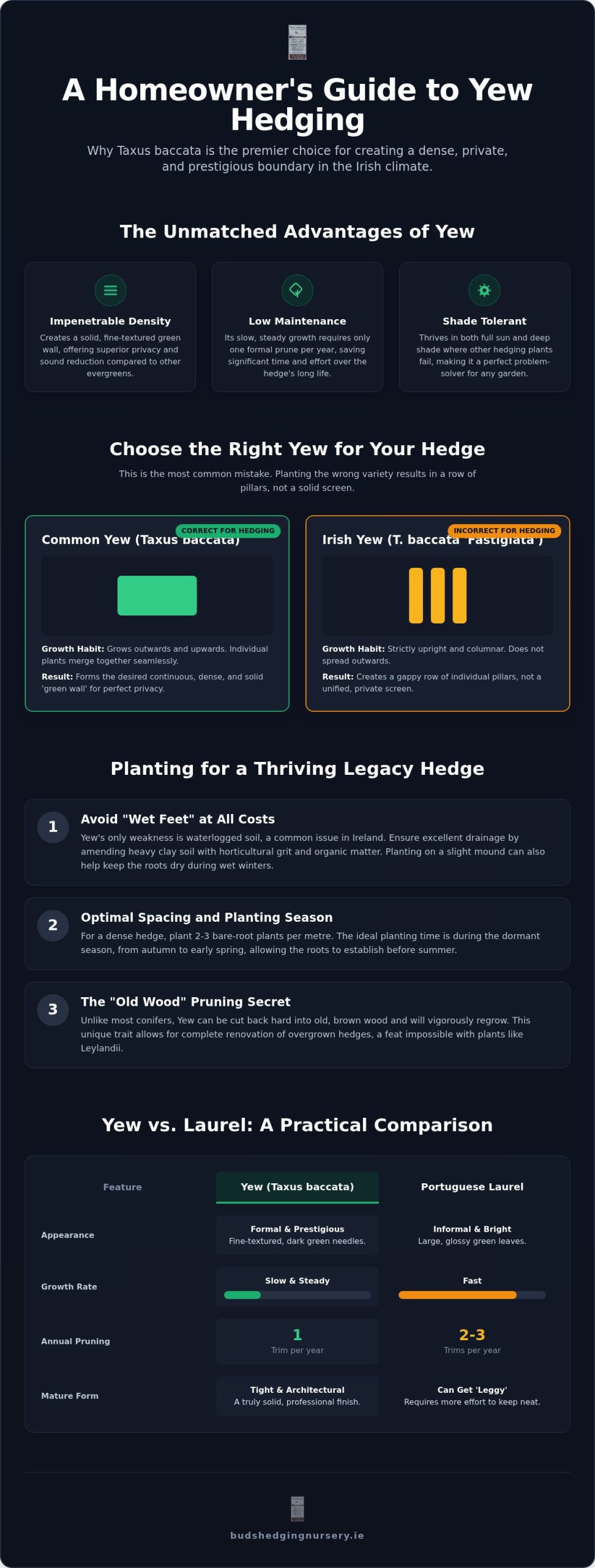
It’s vital to distinguish between the two main varieties found in nurseries to avoid a costly mistake. Common Yew (Taxus baccata) is the plant you need for a standard boundary hedge. It grows outwards as well as upwards, allowing individual plants to knit together into a solid green wall. In contrast, Irish Yew (Taxus baccata ‘Fastigiata’) has a strictly upright, columnar growth habit. If you mistakenly plant the ‘Fastigiata’ variety for a privacy screen, you’ll end up with a row of individual pillars rather than a continuous hedge. Choosing the correct variety at the start is essential for a successful boundary plan.
Native Heritage and Biodiversity
As a native species, Yew plays a significant role in our local ecosystem. It is a key component of the Native Trees Scheme, offering several benefits to Irish wildlife:
- Shelter: The dense, evergreen foliage provides essential nesting sites and winter cover for birds like thrushes and goldcrests.
- Food source: While the seeds are toxic, the fleshy red arils are a vital food source for various bird species in late autumn.
- Pollination: Yew produces significant amounts of pollen in early spring, which can be a resource for early-emerging pollinators.
Its historical significance in Ireland is profound, with ancient trees often found in monastic sites and old estates. Choosing yew hedging Ireland isn’t just a practical decision for privacy; it’s a way to continue a long-standing horticultural tradition that is perfectly suited to our climate and native biodiversity.
The Benefits of Choosing Yew over Other Hedging Varieties
Yew provides a level of privacy that few other species can match. Its fine needles grow so closely together that a mature hedge becomes a solid, impenetrable wall. This density makes it an excellent sound barrier and a secure boundary for any property. While many evergreen hedges struggle in the shadows of buildings or large trees, yew is remarkably shade-tolerant. It maintains its deep green colour and thickness even in spots where sunlight is scarce, making it a versatile problem-solver for awkward garden corners.
The slow growth rate of yew hedging Ireland is often misunderstood as a disadvantage. In reality, it’s a major benefit for the long-term owner. A faster-growing hedge might need three clips a year to look tidy. Yew generally only requires one formal pruning in late summer. This reduces the time and effort spent on maintenance significantly over the life of the hedge. It stays in its “lane” much better than more aggressive species, allowing you to maintain crisp, architectural lines with minimal fuss.
Yew vs. Laurel: A Practical Comparison
Choosing between Yew and Portuguese Laurel often comes down to the desired aesthetic. Laurel has larger, glossy leaves that reflect light, creating a brighter and more informal feel. Yew offers a much finer texture and a darker, more prestigious appearance. This deep green backdrop is the traditional choice for formal gardens because it makes the colours of flowering perennials pop. While Laurel is faster to establish, it needs more frequent attention to prevent it from becoming leggy. Yew provides a tighter, more professional finish that ages with far more grace.
Hardiness and Resilience
Yew is one of the toughest plants available for our climate. According to the RHS guide to growing yew, it carries an H7 hardiness rating. This is the highest level of frost resistance, meaning it can withstand temperatures below -20°C. It’s safe from even the most severe Irish winters. It also handles urban pollution and coastal salt spray well, which are common challenges in many parts of the country.
Unlike some conifers that have a finite lifespan of 20 or 30 years before they start to thin out, Yew only gets better with age. It outlasts almost all other hedging species, often surviving for centuries. If you’re looking for a permanent solution that won’t need replacing in your lifetime, you can speak with our team at the nursery to see how our acclimatised stock can suit your specific site conditions.
Planting Yew Hedges: Soil, Spacing, and Drainage Requirements
Success with yew hedging Ireland depends almost entirely on what happens below the surface. While yew is incredibly hardy, it has one fatal weakness: “wet feet.” In areas with heavy clay soils, water can sit around the roots for weeks during the winter. This lack of oxygen causes root rot, which often doesn’t show up until the following spring when the foliage turns an uncharacteristic rusty brown. If you’re planting into heavy ground, you must address drainage from day one.
To avoid establishment issues, planting should ideally occur during the bare root tree season, typically from November to March. During this dormant period, the plants are easier to handle and establish their root systems more effectively. When preparing your trench, don’t just dig a hole and drop the plant in. Incorporate plenty of horticultural grit and well-rotted organic matter. This breaks up the clay and ensures that even during heavy rainfall, water can move away from the root ball rather than pooling around it.
Recommended Spacing for a Thick Hedge
For a standard boundary, we recommend 3 plants per metre in a single row. This allows enough space for each plant to develop without competing too early for nutrients. If you need an “impenetrable” screen more quickly, a staggered double row is more effective. Plant 5 specimens per metre across two parallel lines, spacing them roughly 40cm apart. This creates a zig-zag pattern that closes the gaps much faster. You can use the RHS Find a Plant tool to check the eventual spread of specific cultivars to ensure your spacing is accurate for the long-term size of the hedge.
Solving Drainage Issues in Gardens
If your garden is prone to standing water, you must take extra precautions before investing in your plants. A simple test is to dig a hole 30cm deep, fill it with water, and see how long it takes to drain. If the water is still there after two hours, your drainage is poor. On these sites, plant your hedge on a slightly raised mound or “berm” about 15cm to 20cm above the surrounding ground level. This keeps the primary root mass out of the water table. For severely boggy areas, installing a simple land drain filled with gravel parallel to the hedge line is often the only way to ensure the hedge survives its first three winters.
Care and Maintenance: Pruning for Longevity and Shape
Maintaining yew hedging Ireland is a straightforward task that requires less effort than most other evergreen varieties. Because of its steady growth rate, you generally only need to clip the hedge once a year. The ideal window for a formal trim is late summer or early autumn, typically during August or September. This timing allows the hedge to look crisp throughout the winter without the risk of new growth being damaged by early frosts. If you’re managing a very formal or fast-growing specimen, a light touch-up in late spring can be done, provided you’ve checked for nesting birds first.
Safety is a practical priority when handling Taxus baccata. Every part of the plant, including the foliage and the seeds inside the red berries, is highly toxic to humans, pets, and livestock. If your garden borders a field with horses or cattle, yew is not the appropriate choice. For residential gardens, simply wear gloves whilst pruning and ensure all clippings are collected and disposed of immediately. Don’t leave piles of wilting branches where a curious dog or child might reach them.
How to Prune for a Neat Formal Finish
To achieve that classic, sharp-edged look, you can use either manual hand shears or quality electric trimmers. For the best health of the hedge, always prune with a slight taper, making the bottom of the hedge wider than the top. This “A-shape” ensures that sunlight reaches the lower branches, preventing the base from becoming thin or leggy over time. If you’re trying to encourage more height, keep the sides tight but leave the leading vertical shoots alone until the hedge reaches your target level.
Rejuvenating an Overgrown Yew Hedge
The “Old Wood” secret is what truly sets Yew apart from other conifers. Most evergreens, such as Leylandii, will never grow back if you cut into the brown, needle-less wood. Yew is the rare exception. It possesses dormant buds deep within the old timber that can spring into life even after a radical pruning. If you’ve inherited a hedge that’s grown too wide or tall, you can cut it back hard, right to the main trunk if necessary.
We recommend a three-year plan for radical restoration. Cut one side back hard in the first year, the other side in the second, and the top in the third. This phased approach reduces stress on the plant and ensures it has enough foliage to stay healthy whilst it regenerates. Following such heavy work, a generous spring feed and a thick layer of mulch will support vigorous regrowth. For more advice on managing long-term boundaries, you can contact our specialist team at the nursery for guidance on your specific project.
Sourcing High-Quality Yew Hedging in Ireland
Buying yew hedging Ireland is a long-term investment in your property’s structure and privacy. It isn’t a purchase you want to get wrong by picking up stressed plants from a general retailer. Sourcing from a specialist plant nursery ensures your stock has been raised by professionals who understand the specific needs of Taxus baccata. Plants grown in Irish soil are already acclimatised to our damp, temperate conditions. This reduces the risk of transplant shock compared to imported alternatives that often spend days in transit from different climates.
You’ll need to decide on the best format for your specific project. Bare root plants are the most economical choice and are available during the dormant winter months. Rootballed Yew offers larger, more established specimens that provide a more immediate impact, though these are also seasonal. If you’re planting outside the winter window, pot-grown Yew is available year-round. For large boundary projects, we organise national delivery to ensure your plants arrive in prime condition, ready for the soil.
The Buds Nursery Standard
We’ve been growing at our 60-acre site for over 30 years, having established the nursery circa 1994. This scale of production allows us to maintain a vast selection of both young and mature stock, ensuring we can supply projects of any size. When you visit us, you won’t get a high-pressure sales pitch. Instead, you’ll find practical, “no-nonsense” advice from experts who spend their days working the land. We’re open Tuesday to Saturday for on-site guidance, helping you select the exact specimens that will thrive in your garden’s specific conditions.
Planning Your Hedging Project
A pure Yew boundary is a classic choice, but you might also consider combining it with beech hedging plants Ireland for striking seasonal contrast. The copper tones of winter beech against the deep evergreen of Yew create a sophisticated look that changes with the seasons. If you’re planning for the current 2026 planting season, it’s best to get your order in early to secure the best bare root or rootballed stock. We always encourage customers to visit the nursery in person to see the quality of our plants and discuss the logistics of their project.
Establishing Your Timeless Green Boundary
Choosing a hedge is a long-term commitment to your garden’s structure. By prioritising proper soil preparation and addressing drainage early, you avoid the most common failures associated with Taxus baccata. Remember that whilst Yew grows steadily, its unique ability to rejuvenate from old wood ensures you’ll never have to replace it due to neglect. It remains the most resilient choice for a dense, formal screen in our climate.
As a specialist nursery with over 30 years of experience, we produce premium stock across our 60-acre site, specifically grown for the Irish weather. Whether you’re starting a new project or restoring an old boundary, we provide the expert on-site guidance needed to make your yew hedging Ireland project a success. We’re here Tuesday to Saturday to help you select the right plants for your land and can organise national delivery for larger projects.
View our range of Yew hedging and native trees to get started. With the right foundation, your new hedge will provide privacy and beauty for generations.
Frequently Asked Questions
Is Yew hedging fully hardy in the Irish climate?
Yew is exceptionally hardy and perfectly suited to our local environment. It carries an RHS H7 rating, which is the highest level of cold tolerance available. This means it can withstand temperatures well below -20°C, ensuring it survives even the harshest Irish winters without damage. Unlike some imported evergreens that struggle with Atlantic gales and frost pockets, native Taxus baccata remains robust and healthy year after year.
How fast does a Yew hedge grow per year in Ireland?
You can expect a growth rate of approximately 15cm to 30cm per year once the hedge is established. Whilst this is slower than species like Cherry Laurel, the resulting screen is much denser and requires less maintenance in the long run. In the fertile conditions often found with yew hedging Ireland, consistent feeding and mulching in early spring can help push the growth toward the higher end of that range.
Is Yew hedging poisonous to dogs and horses?
Yes, all parts of the Yew plant, including the foliage and seeds, are highly toxic to dogs, horses, and other livestock. The plants contain taxine alkaloids which can be fatal if ingested. If your garden is accessible to horses or cattle, we strongly advise choosing a non-toxic alternative like Beech or Griselinia. For dog owners, it’s essential to clear away all clippings immediately after pruning to prevent any accidental ingestion.
Can Yew hedging grow in wet or boggy soil?
Yew cannot survive in waterlogged or boggy soil. Prolonged exposure to “wet feet” leads to root rot, which is the most common cause of failure for this species in Ireland. If your site has heavy clay or poor drainage, you must plant on a raised mound or install land drains as discussed in the planting section. Testing your soil’s drainage before planting is a vital step to protect your investment.
When is the best time of year to prune a Yew hedge?
The best time to prune is late summer or early autumn, specifically during August and September. Clipping at this time allows the hedge to look tidy throughout the winter months whilst giving the plant enough time to recover before the first hard frosts arrive. Avoid heavy pruning in late spring to protect nesting birds, as mandated by the Wildlife Act, which restricts hedge cutting between March 1st and August 31st.
How many Yew plants do I need per metre for a privacy screen?
For a standard privacy screen, we recommend planting 3 specimens per metre in a single row. If you require a thicker, more immediate barrier, a staggered double row using 5 plants per metre is the better option. This zig-zag arrangement closes the gaps between plants much faster than a single line. Correct spacing ensures each plant has enough light and nutrients to develop the dense foliage required for total privacy.
Can I cut a Yew hedge back to the bare wood?
Unlike almost all other conifers, Yew can be cut back to the bare wood and will regrow vigorously. This unique characteristic allows you to rejuvenate old, overgrown hedges that have become too wide or tall for their space. By cutting back into the old timber, you stimulate dormant buds to produce new green growth. This makes yew hedging Ireland a very forgiving choice for gardeners who might have inherited a neglected boundary.
Does Yew hedging grow well in full shade?
Yew is one of the few evergreen hedging plants that thrives in full shade. It maintains its deep green colour and dense habit even in the shadows of tall buildings or under the canopy of large deciduous trees. This versatility makes it an excellent choice for north-facing boundaries or narrow side passages where sunlight is limited. It’s far more successful in these dark spots than more light-hungry species like Escallonia or Photinia.