

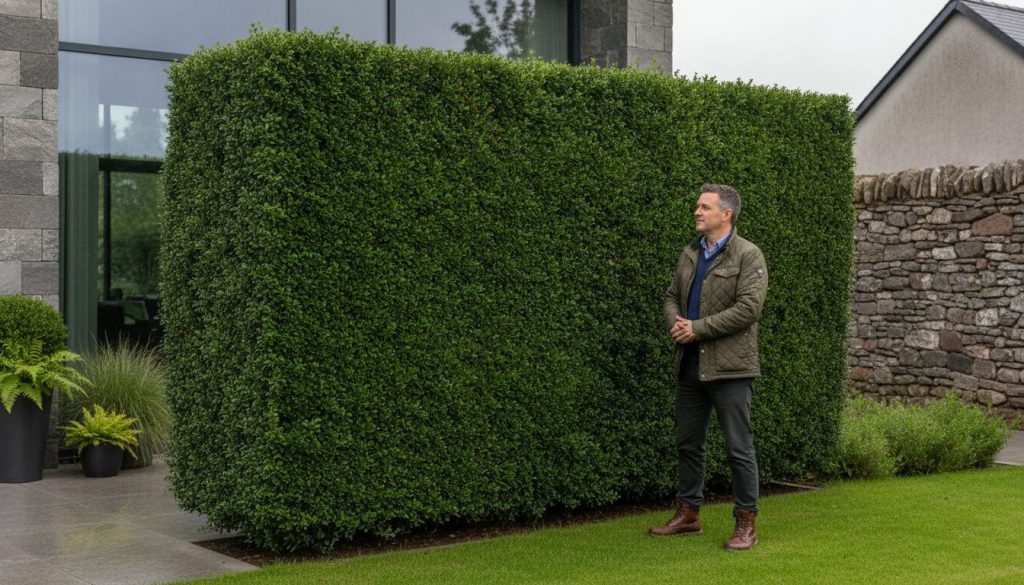
Most gardeners shy away from yew because they believe they will be waiting decades for a decent screen, but that is a fundamental misunderstanding of how this native powerhouse performs in Irish soil. When you search for yew hedging for sale Ireland options, you aren’t just buying a shrub; you are investing in a permanent, living structure that outlasts almost every other garden feature. It is the ultimate choice for a formal, dense boundary that stands up to our unpredictable weather.
You likely want a thick, evergreen wall for total privacy, yet the conflicting advice on planting distances and slow growth rates often leads to unnecessary hesitation. This guide cuts through the confusion to show you why Taxus baccata remains the gold standard for Irish gardens. We provide clear instructions on how many plants you need per metre and explain the best times of year to buy rootballed or container-grown stock. You will also learn the practical maintenance steps needed to establish a lush, private screen that serves your home for generations. From spacing your plants correctly to managing growth, we have the straightforward answers you need.
Key Takeaways
- Understand why Taxus baccata is a premier, generational investment for creating permanent evergreen boundaries in the Irish climate.
- Compare the practical benefits and cost-effectiveness of bare root versus rootballed formats when searching for yew hedging for sale Ireland.
- Learn how to achieve growth rates of up to 30cm per year by prioritising well-drained soil and proper site preparation.
- Get clear instructions on plant spacing and trench preparation to ensure your new hedge develops into a dense, gap-free privacy screen.
- Discover the long-term advantages of sourcing weather-acclimatised plants directly from a specialist grower with decades of experience.
Why Taxus baccata is the Ultimate Choice for Irish Gardens
English Yew, or Taxus baccata, is one of the few evergreen conifers native to Ireland. It’s built for our local climate. It handles wind, rain, and cold without dropping its needles. If you’re searching for yew hedging for sale Ireland, you’re looking at a plant that can live for centuries. It’s often called a generational hedge. Most species need replacing after a few decades, but yew stays. It actually gets better with age. Its density is unmatched. The fine, needle-like foliage grows so tightly that it creates a solid wall. This is perfect for blocking out noisy neighbours or traffic. It’s also highly adaptable. Whether your garden is baked in sun or stuck in deep shade under old trees, yew will thrive.
The Aesthetic and Practical Benefits of Yew
Yew is the king of formal gardens. It takes a trim better than almost any other species. You can achieve those crisp, razor-sharp lines that make a garden look professionally maintained. In winter, its deep dark green colour provides a strong structure when the rest of the garden looks bare. It isn’t just for looks, though. The thick growth is a sanctuary for wildlife. Native birds like thrushes and blackbirds often use it for nesting because it offers such good protection from predators and the Irish weather. It’s a functional addition to any eco-conscious garden.
Yew vs. Other Evergreen Hedges
Many people compare yew to Portuguese laurel. While laurel is excellent and offers a softer, glossier leaf, yew provides a more architectural finish. When comparing yew hedging for sale Ireland options against other evergreens, consider the long-term maintenance. It’s a better choice than fast-growing species like Leylandii, which can quickly become invasive and difficult to manage. Yew is slower, but it’s patient. It won’t outgrow its welcome. One practical point involves safety. Yew is poisonous to livestock and pets if eaten. We advise clients to keep it away from boundaries where horses or cattle might graze. In a standard domestic garden, this is rarely an issue, but it’s a detail worth knowing before you plant.
Comparing Yew Hedging Formats: Bare Root, Rootballed, and Pot-Grown
Selecting the right format is just as important as choosing the species itself. When you browse yew hedging for sale Ireland options, you’ll generally find three distinct types: bare root, rootballed, and pot-grown. Each format has a specific purpose based on the time of year, your budget, and how quickly you need a finished look. Understanding these differences prevents costly mistakes and ensures your plants thrive from the moment they’re in the ground.
When to Choose Bare Root Yew
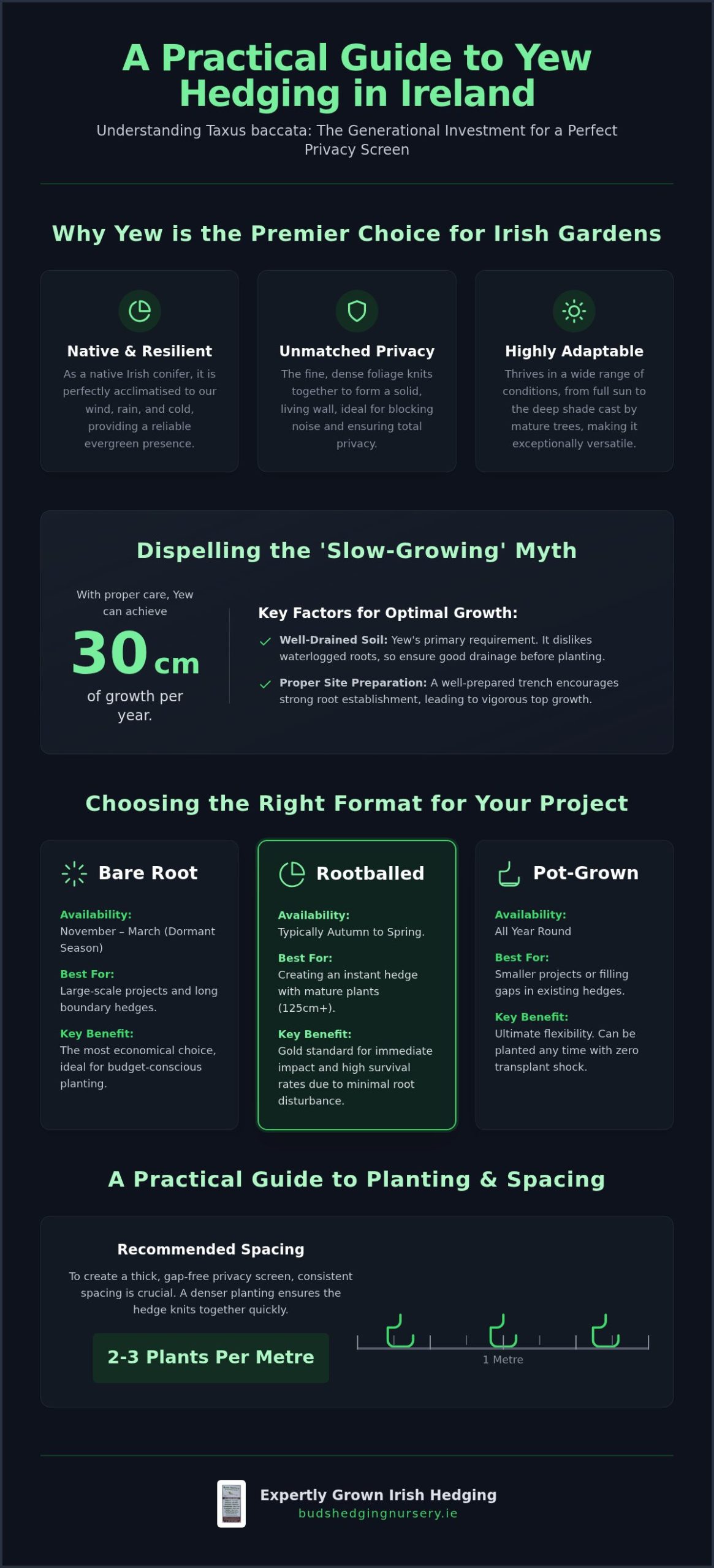
The bare root tree season in Ireland typically runs from November to March. This is the only window when these plants are available. They’re lifted directly from the nursery fields without any soil around the roots. This makes them the most economical choice for long boundary runs where you need hundreds of plants. You must plant them whilst they’re dormant to allow the root system to settle before the spring growth spurt begins. Bare root yew is the preferred choice for budget-conscious landowners who are happy to wait a few seasons for the hedge to knit together.
The Advantage of Rootballed Hedging
Rootballed yew is the gold standard for creating an immediate impact. These plants are grown in our fields for several years and then lifted with a large, heavy ball of earth protecting the roots. This soil ball is wrapped in biodegradable hessian to keep everything intact during transit. The primary benefit is minimal root disturbance, which leads to excellent survival rates for more mature specimens. If you want an “instant” hedge effect with heights of 125cm or taller, rootballed stock is the best investment. It provides the height and density needed for privacy from day one. You can find more details on Maintenance and Growth requirements to ensure these larger plants establish successfully in your specific soil type.
Pot-grown yew offers the ultimate flexibility for smaller garden projects. Unlike the other formats, these can be planted at any time of the year, even in the middle of summer. Because the roots have developed entirely within the container, there’s zero “transplant shock” when they’re moved to the garden. They’re slightly more expensive per unit but are ideal for filling gaps or planting in smaller batches. If you’re planning a large project and want to ensure you get the best value, you can speak with our nursery team to discuss which format suits your site and planting schedule.
Maintenance and Growth: Dispelling the “Slow-Growing” Myth
Many gardeners hesitate to plant yew because they believe it takes a lifetime to reach a decent height. This is a common misconception. Once your plants settle into their new environment, you can expect a growth rate of 20 to 30cm per year. This puts it on par with many other popular evergreen choices. When you buy yew hedging for sale Ireland, you’re choosing a plant that prioritises root development in its first two seasons. After that, it picks up speed. The secret to accelerating this process lies in the soil. Taxus baccata is exceptionally hardy, but it will not tolerate sitting in water.
Watering and Drainage Essentials
In our damp Irish climate, “wet feet” is the primary cause of hedge failure. If your garden has heavy clay soil that stays sodden after a downpour, you must take action before planting. We recommend digging in plenty of grit or well-rotted organic matter to open up the soil structure. In extreme cases, planting your hedge on a slightly raised mound can keep the roots above the water table. Yew hates “wet feet”. During the first summer, your new hedge needs consistent moisture to establish. Aim for a deep soak once a week rather than a light sprinkle every day. This encourages the roots to grow downwards, making the hedge more resilient to future droughts.
Pruning for a Perfect Finish
Regular clipping is the best way to encourage a thick, impenetrable screen. Trimming the tips of the branches stimulates dormant buds to grow, filling in any gaps. The best time for a major trim is late summer or early autumn, typically around August or September. When you prune, try to keep the top of the hedge slightly narrower than the base. This “tapered” shape ensures that sunlight reaches the bottom branches, preventing them from becoming thin or bare over time. It keeps the hedge healthy from top to bottom.
One of the most remarkable features of this species is its ability to regenerate from old wood. Most conifers won’t grow back if you cut into the brown, needle-less branches, but yew is different. You can cut a neglected, overgrown yew hedge right back to the main trunk, and it will flush with new green growth. This makes it an incredibly forgiving plant for those new to hedging. For those interested in the history of these plants, Sourcing Quality Yew Hedging often involves looking into native cultivars that have thrived in our landscape for centuries. Applying a simple mulch of bark or compost each spring will help retain moisture and provide the nutrients needed to maintain that deep green colour.
A Practical Guide to Planting and Spacing Yew Hedges
Success with yew depends on what happens the day the plants arrive. Proper spacing and soil preparation are more important than the size of the plants you start with. If you crowd them, they compete for nutrients; if you space them too far apart, you’ll be waiting years for a solid screen. When you look at yew hedging for sale Ireland options, always plan your layout before the first spade hits the ground. A well-planned planting ensures your hedge develops into the dense, architectural wall that makes this species so desirable.
Calculating Your Spacing Requirements
The number of plants you need per metre depends on the format and height of the stock. For small bare root plants (typically 30-60cm), we recommend planting 3 to 4 per linear metre. This creates a thick base from the start. For larger rootballed plants that are already 125cm or taller, 2 plants per metre is usually sufficient. If you require maximum security or an extra-thick boundary, consider a double-staggered row. This involves planting two parallel lines 40cm apart, with the plants arranged in a “W” pattern. This method requires 5 to 7 plants per metre but results in a hedge that is nearly impossible to see through once established.
If you are unsure about the exact quantities required for your boundary, you can contact our nursery team for a specific calculation based on your site measurements.
Step-by-Step Planting Instructions
We always advise digging a continuous trench rather than individual holes. Individual holes in heavy Irish clay can act like sumps, trapping water and drowning the roots. A trench ensures consistent drainage and makes it much easier to keep your hedge in a perfectly straight line. Dig your trench twice as wide as the root mass and about one and a half times as deep. Break up the soil at the bottom of the trench to help the roots penetrate deeper into the ground.
- Soil Enrichment: Mix a generous amount of well-rotted compost or a dedicated root stimulant into the backfill soil. This provides the immediate nutrients needed for establishment.
- Positioning: Place each plant in the trench, ensuring it sits at the same depth it was growing at the nursery. Look for the soil mark on the stem; planting too deep can cause the bark to rot.
- Backfilling: Fill the trench with your soil and compost mix. Firm the soil down gently with your heel to remove air pockets without compacting it so much that water cannot drain.
Post-planting care is vital on exposed Irish sites. High winds can rock new plants, creating a “hollow” in the soil around the stem that collects water and freezes in winter. For larger rootballed plants, use short stakes and ties to keep them steady for the first two seasons. Once the roots have anchored themselves firmly into the native soil, these supports can be removed. Keep the area around the base of the hedge free from grass and weeds for at least three years to reduce competition for moisture.
Sourcing Quality Yew Hedging from a Specialist Irish Nursery
Buying plants is an investment in your property’s future. When you look for yew hedging for sale Ireland, the source of your stock determines the success of your project. Choosing a specialist plant nursery in Ireland ensures you receive plants that have been raised in our specific climate. At Buds Nursery Cavan, we manage 60 acres of production. This scale allows us to grow hardier, weather-acclimatised plants that don’t suffer the shock often associated with imported stock. Our 30 years of experience means we understand the practicalities of Irish soil and wind conditions.
Quality Control and Plant Health
Expert on-site guidance is something an online checkout cannot provide. We encourage customers to visit the nursery to see the quality of our Taxus baccata in person. Seeing the root development and foliage density firsthand gives you confidence in what you are planting. We maintain strict quality control to ensure every plant is healthy and true to type. Sourcing Irish-grown or locally acclimatised stock is the best way to guarantee high survival rates in your garden. You can visit us between Tuesday and Saturday to walk the site and discuss your requirements with a grower who actually works with the land. We don’t open on Sundays or Mondays; this time is dedicated to nursery maintenance and stock management.
Ordering Your Yew Hedge
Large landscaping projects require careful logistics. We offer national delivery for bulk hedging orders and mature trees across Ireland. If you are planning a long boundary, we can organise a specific quote that includes transport to your site. Many of our clients choose to mix their boundaries, perhaps combining the formal evergreen look of yew with our beech hedging plants Ireland range for a bit of seasonal colour change. This approach can be both cost-effective and visually striking. Whether you need a few pot-grown specimens to fill a gap or hundreds of rootballed plants for a new estate, we have the capacity to supply and deliver. Visit us at Buds Nursery Cavan to see our yew stock in the fields or contact us directly to arrange a national delivery quote for your project.
Investing in a Permanent Garden Structure
Choosing Taxus baccata is a decision that benefits your garden for a lifetime. By selecting the correct format, whether economical bare root plants for long boundaries or mature rootballed stock for instant privacy, you set the foundation for a dense, evergreen screen. Success depends on practical site preparation. Remember that well-drained soil is non-negotiable and correct spacing ensures your hedge knits together without unnecessary competition. When you search for yew hedging for sale Ireland, sourcing directly from a grower provides the best chance for healthy, acclimatised plants.
At Buds Nursery, we draw on over 30 years of expert growing experience across our 60-acre specialist production nursery. We understand the specific needs of Irish landscapes and offer national delivery for bulk orders to ensure your project stays on track. We invite you to browse our yew hedging and contact us for a quote to get your planting project started. A well-planted yew hedge is more than just a boundary; it’s a living legacy for your home.
Frequently Asked Questions
Is yew hedging slow-growing?
Yew is moderate-growing once established, typically adding 20 to 30cm of height annually. While it spends its first two seasons focusing on root development, its growth rate is comparable to many other evergreens thereafter. Providing well-drained soil and a spring mulch helps maintain this steady pace. It isn’t the “slow” plant many people fear, provided the site is prepared correctly.
How many yew plants do I need per metre?
You need 3 to 4 plants per metre for small bare root stock or 2 per metre for larger rootballed specimens. If you are looking for yew hedging for sale Ireland to create a secure, thick boundary, a double-staggered row is best. This requires 5 to 7 plants per metre arranged in a zigzag pattern to ensure no gaps remain as the hedge matures.
What is the best time of year to plant yew hedging in Ireland?
The best time to plant bare root or rootballed yew is during the dormant season from November to March. This allows the roots to settle in the soil before the spring growth begins. Pot-grown yew can be planted at any time of year provided you water it consistently during dry spells. Avoid planting during periods of heavy frost or when the ground is waterlogged.
Can yew hedging grow in the shade?
Yes, yew is exceptionally shade-tolerant and thrives in areas where other hedging plants struggle. It is one of the few evergreens that can maintain a dense habit in deep shade under large trees or on north-facing boundaries. It also grows perfectly well in full sun, making it one of the most versatile choices for gardens with varying light levels.
Is yew hedging poisonous to dogs and horses?
Yes, all parts of the yew plant are highly poisonous to dogs, horses, and livestock. The foliage and seeds contain taxine alkaloids which are toxic if ingested. We strongly advise against planting yew in areas where animals graze or have access to the foliage. In domestic gardens, it is generally safe if pets don’t have a habit of chewing on garden plants, but caution is necessary.
How often should I trim my yew hedge?
You should trim your yew hedge once a year in late summer or early autumn. August or September is the ideal window as it allows the new growth to harden off before the first frosts. If you want a particularly crisp finish for a formal garden, a light tidy-up in early spring is also possible. Yew responds better to regular clipping than almost any other conifer.
Why are the leaves on my yew hedge turning yellow?
Yellowing leaves are almost always a sign of poor drainage or “wet feet”. Yew roots will rot if they sit in waterlogged soil for extended periods. If your soil is heavy clay, you must improve the drainage before planting. Occasionally, yellowing can also be caused by extreme windburn on exposed sites or a lack of nutrients in the soil, which a spring mulch can resolve.
How much does yew hedging cost compared to laurel?
Yew generally costs more than laurel because it takes longer to reach a saleable size in the nursery. While the initial investment for yew hedging for sale Ireland is higher, it is a more permanent solution. Unlike some laurel varieties that can become invasive or woody, yew is easily maintained at any height and can last for centuries, making it better value over time.