

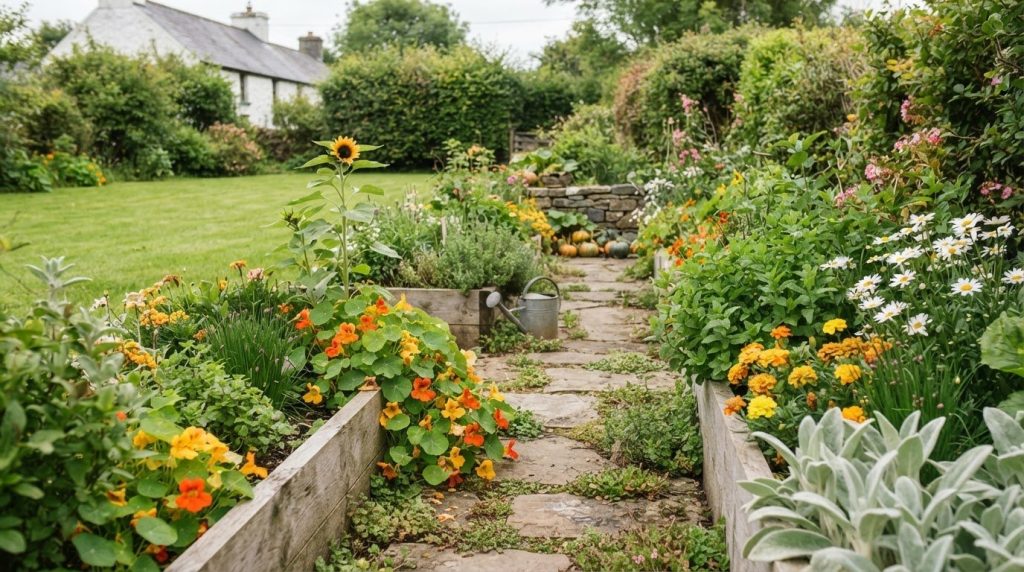
A child-friendly garden can offer colour, things to grow and a little picking. Choose child safe garden plants carefully, rather than assuming they are safe to eat freely. Nasturtiums and mint provide edible leaves or flowers, while daisies, marigolds and sunflowers add seasonal interest. Lamb’s ears and chives bring perennial planting.
It’s understandable to want children to explore the garden while keeping everyday risks in mind. Even plants described as low in toxicity can cause symptoms if a child eats too much, so supervision and simple garden rules matter.
This guide covers plants for seasonal colour, edible picking and perennial beds, with practical ways for children to enjoy them. It also explains straightforward safety habits: remind children not to put plant parts in their mouths and to wash their hands after handling plants.
Key Takeaways
- Plan for colour across the seasons by combining plants with different flowering times and growth habits.
- Make picking part of garden play by choosing edible plants and teaching children to handle them carefully.
- Use perennial plants to create lasting interest, including soft-textured leaves and flowers that attract pollinators.
- For a lasting garden structure, consider hedging and fruit trees suited to your planting plans.
1. Seasonal interest in a child-friendly garden
Plan colour through the year with spring daisies, summer marigolds and cosmos, then pumpkins for autumn picking. Cosmos can create a long-lasting haze of colour after 12 weeks. Marigolds prefer well-drained soil and can flower through summer and into autumn. A mix of child safe garden plants can make the garden interesting across several seasons.
Cool-season plants such as lettuce and spinach grow best in daytime temperatures of 60° to 70° F. Warm-season plants, including beans and corn, grow best in the mid-70’s through the 90’s. In Ireland, use seasonal conditions and drainage to guide planting. Dahlias can go outdoors in May or early June, after the risk of frost has passed. The varieties described here typically grow 2 to 4 feet tall.
Which child-safe plants suit Irish weather and soil? Daisies, marigolds and cosmos offer seasonal interest, while marigolds prefer well-drained soil. Match your planting to the season and the conditions in your garden.
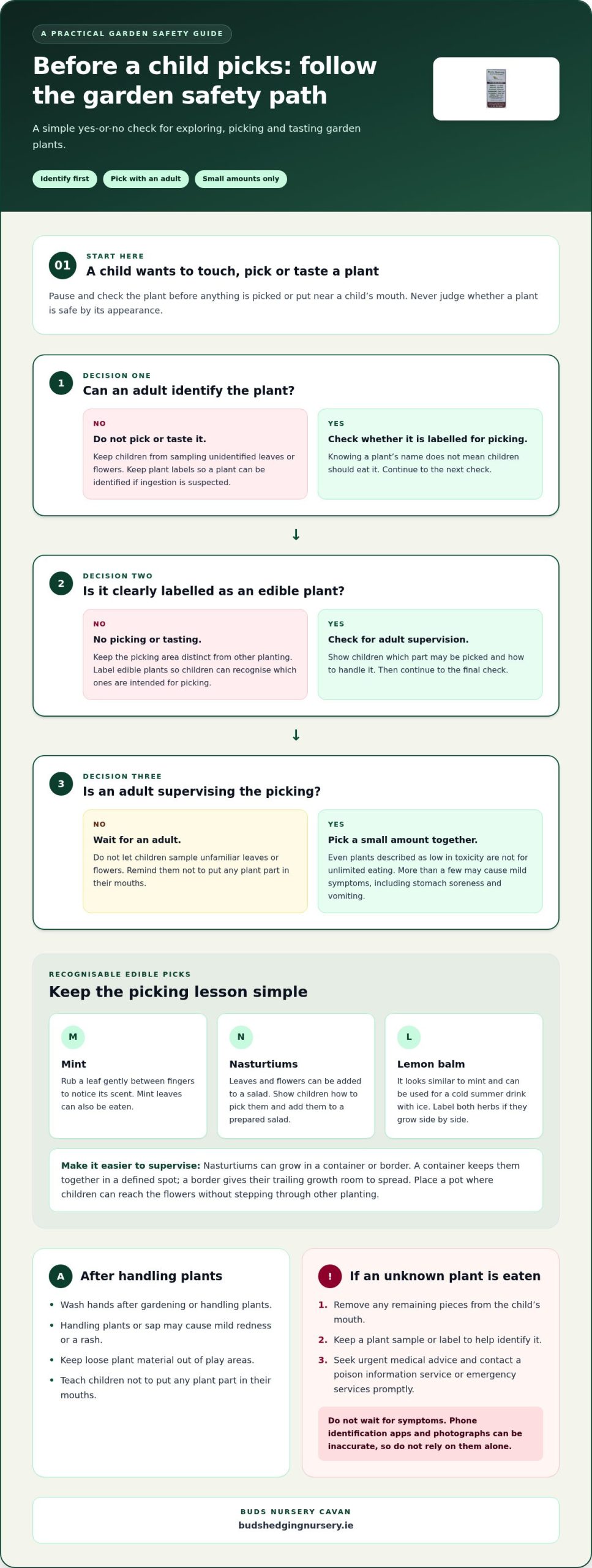
Which common or especially toxic plants should you avoid around children? Don’t let children pick or taste unidentified plants, and don’t judge safety by appearance. Keep plant labels so you can identify a plant if ingestion is suspected.
Design a play area with clear space for children, separate from plants they might touch or taste. Daisies flower in spring and can attract bees; picking them encourages more flowers. Pumpkins can swell and ripen in time for Halloween. Choose child safe garden plants for distinct growing areas, making play and planting easier to supervise.
If a child eats an unknown plant, remove any remaining pieces from their mouth, keep a sample or label, and seek urgent medical advice. Contact a poison information service or emergency services promptly; don’t wait for symptoms. Plant labels can help with identification. Phone identification apps and photographs can be inaccurate, so don’t rely on them alone.
Handling plants or their sap may cause mild redness or a rash. Wash hands after gardening, keep loose plant material out of play areas, and teach children not to put any plant part in their mouths.
2. Edible mint and nasturtiums
Mint and nasturtiums offer two ways for children to explore edible planting. Mint leaves release their scent when gently rubbed, while nasturtium leaves and flowers can be added to a salad. Clearly label each plant so children know which leaves and flowers are intended for picking.
Nasturtiums grow in containers or borders and prefer a sunny position with well-drained soil. A container keeps them together in a defined spot, while a border gives their trailing growth room to spread. Place the pot where children can reach the flowers without stepping through other planting.
Make picking a simple activity. Show children how to pick a nasturtium flower or leaf and add it to a prepared salad. Let them examine the plant’s different parts before harvesting. Focusing on identified nasturtiums helps distinguish edible flowers from other garden plants.
Invite children to rub a mint leaf between their fingers and notice its scent. The leaves can also be eaten. Lemon balm looks similar to mint and can be used to make a cold summer drink with ice. Label both herbs, especially if they grow side by side, so children can tell them apart.
Edible doesn’t mean unlimited. In Ireland, eating more than a few plants described as low in toxicity may cause mild symptoms, including stomach soreness and vomiting. Supervise picking, serve small amounts, and don’t let children sample unfamiliar leaves or flowers. Never treat an unidentified plant as edible.
If your edible patch sits beside a planted border, ground cover plants can mark a separate area. Keep the picking space distinct, with mint and nasturtiums easy to recognise and reach.
If the edible patch also includes sweet corn, plan its place alongside the herbs without making the planting area confusing. Sweet corn should be planted in blocks of at least 3 by 3 feet or in hills of at least 3 stalks to produce edible ears. Keep its growing space distinct from the smaller picking area, and show children which crop is intended for tasting. That way, gathering mint or nasturtiums remains supervised, while the corn has a clearly marked place of its own.
3. Perennial plants for children
Perennials return year after year, giving children familiar plants to observe as they grow. Lamb’s ears have soft leaves close to ground level, making them easy to touch. Place them beside a path or play space, where children can feel the leaf texture without walking through a planted bed. This is a practical way to include child safe garden plants in an area children use.
Chives add another useful feature to a perennial herb area. Their purple, globe-shaped flowers attract bees, giving children a chance to watch pollinators from a little distance. Keep a clear route around the planting, and explain that bees should be observed rather than handled. Chives can also grow in a herb garden, adding a recognisable plant among other herbs.
For edible fruit, thornless blackberry canes grow to heights of five to 10 feet. Give the canes support and keep their growth within a defined section, so children can approach the fruit without pushing through the planting. Thornless does not mean every part is harmless: supervise picking and make sure children take only fruit you have identified.
Lemon balm grows to 2 feet tall and is perennial in zones 4 to 9. Use its position to give children a clear example of a named herb, rather than letting them taste unidentified leaves elsewhere. Keep labels beside perennial herbs, particularly where several types grow together. Clear labels help children learn which plants they can touch or pick with an adult.
A selection described as low in toxicity is not an invitation to eat freely. Young children can play among plants on that list unless they ingest a large number. Supervise according to the child, and remove fallen leaves or berries from busy play areas. If established plants take up much of the garden, set aside a small area specifically for play. Lamb’s ears, chives and a labelled herb section can help make it inviting. Child safe garden plants work best alongside thoughtful placement, clear labels and supervised access.
4. Plants children can pick and eat
Choose clearly identified edible plants for picking, and show children which parts are intended for eating. Nasturtium flowers and leaves can go into salads, while marigolds suit flower beds and vegetable gardens. Edible does not mean unlimited: eating more than a few low-toxicity plants may cause mild symptoms, including stomach soreness and vomiting.
Which garden plants are non-toxic and safe for children? Don’t treat any plant as safe to eat simply because it grows in a family garden. Nasturtiums, marigolds and daisies are associated with edible flowers or picking, but children should only taste plants and parts an adult has identified.
Some garden berries are edible, but others should not be sampled. Chinese dogwood berries are safe to eat, although their skin can taste bitter. Stevia leaves are notably sweet, tasting 10 to 15 times sweeter than an equal amount of sugar. These examples don’t make unidentified berries, seeds or bulbs safe to try.
Are berries, seeds or bulbs from common garden plants dangerous to children? They can pose a risk if a child eats an unidentified plant part, so don’t allow tasting based on colour or appearance. Keep children away from unknown berries and seeds, and explain that bulbs and other plant parts aren’t automatically edible.
Make picking a supervised routine. First, name the plant and the part that may be picked. Then gather it in a bowl, rather than letting children eat directly from the border. Lawn daisies, buttercups and clover can be explored or used for daisy chains, but keep them separate from edible harvests. Wash hands after handling plants, and discourage pretend tea or perfume-making with garden flowers.
For a clearer boundary between edible beds and other planting, use ground cover plants to define garden areas. Keep the picking space identifiable, and make adult supervision part of each harvest.
When lawn daisies, buttercups and clover are allowed to bloom, children have flowers to explore and use for daisy chains. Keep the activity focused on exploring and making chains, not tasting: only plants and parts an adult has identified are intended for eating.
Buds Nursery Cavan: Portuguese Laurel
Buds Nursery Cavan offers Portuguese Laurel for those planning a defined hedge or evergreen structure around family garden areas. Choose plants for children’s play spaces carefully, and keep edible planting separate from ornamental plants.
For a hedge, consider its position in relation to paths, play areas and edible beds. Cherry Laurel and Golden Privet are other hedge options, while Fruit Trees can suit a separate picking area. Clearly identify any plant children might touch or taste, and supervise them around unfamiliar planting.
Turn to Buds Nursery Cavan when choosing plants to give your garden structure or planning a fruit-growing area alongside child-friendly planting. Contact Buds Nursery Cavan or visit budshedgingnursery.ie to explore the plants.
Make room for a garden children can grow into
A child-friendly garden can change as children become more confident outdoors. Start with clear boundaries between play, planting and picking areas, then adjust those spaces as interests and needs change. Keep plant names visible and make supervision part of garden routines, especially when children are exploring unfamiliar growth.
For the planting framework, think about what each part of the garden needs to do. A hedge can define an edge, while a separate growing area can support seasonal projects. Buds Nursery Cavan offers Portuguese Laurel, Cherry Laurel and Golden Privet for hedging choices. If you’re planning a new planting scheme, contact Buds Nursery Cavan for planting advice.
Choosing child safe garden plants is an ongoing part of making outdoor space useful and enjoyable. Work on one area at a time, keep the layout practical, and involve children in age-appropriate garden tasks. With clear planting zones and simple habits, the garden can grow alongside your family.