


Most homeowners see a steep incline as a landscaping headache, but the right hedging for a sloped garden is actually a living piece of engineering. It’s a common struggle to watch your best topsoil wash away during a heavy Irish downpour or to deal with the biting wind that hits the highest points of your property. You’re likely tired of the difficult access and the poor drainage that often settles at the base of your garden’s gradient.
We understand that a sloped site requires more than just a decorative border; it needs a functional solution that holds the earth together. This guide will show you how to transform those awkward inclines into stable, green boundaries that offer year-round privacy. We’ll cover the most resilient species for the Irish climate, including hardy Portuguese Laurel and deep-rooting native mixes, alongside the practical planting techniques needed to prevent erosion. You’ll learn why planting during the dormant season between October and March is vital for successful establishment and how to make your garden’s natural slope work for you instead of against you.
Key Takeaways
- Learn how specific root systems act as “nature’s rebar” to stabilise soil and prevent erosion on steep inclines.
- Identify the most resilient species of hedging for a sloped garden, focusing on wind-resistant and hardy varieties like Portuguese Laurel and Hornbeam.
- Master the staggered row planting technique to ensure a dense boundary that follows the natural gradient of your land.
- Understand the benefits of using Irish-grown stock to ensure your plants are fully acclimatised to local weather patterns and high-exposure sites.
- Compare the long-term cost and maintenance advantages of living boundaries over expensive hard-landscaped retaining walls.
The Challenges of Landscaping Slopes: Why Hedging is the Ideal Solution
Managing a garden on an incline presents a unique set of hurdles. Gravity pulls at your topsoil constantly. It makes every maintenance task a physical chore. Across the Irish landscape, where heavy rain is frequent, these issues are magnified. Unprotected slopes often suffer from nutrient washout, leaving the ground depleted and difficult to plant. Using hedging for a sloped garden offers a practical, long-term fix that addresses these structural problems whilst creating a natural boundary.
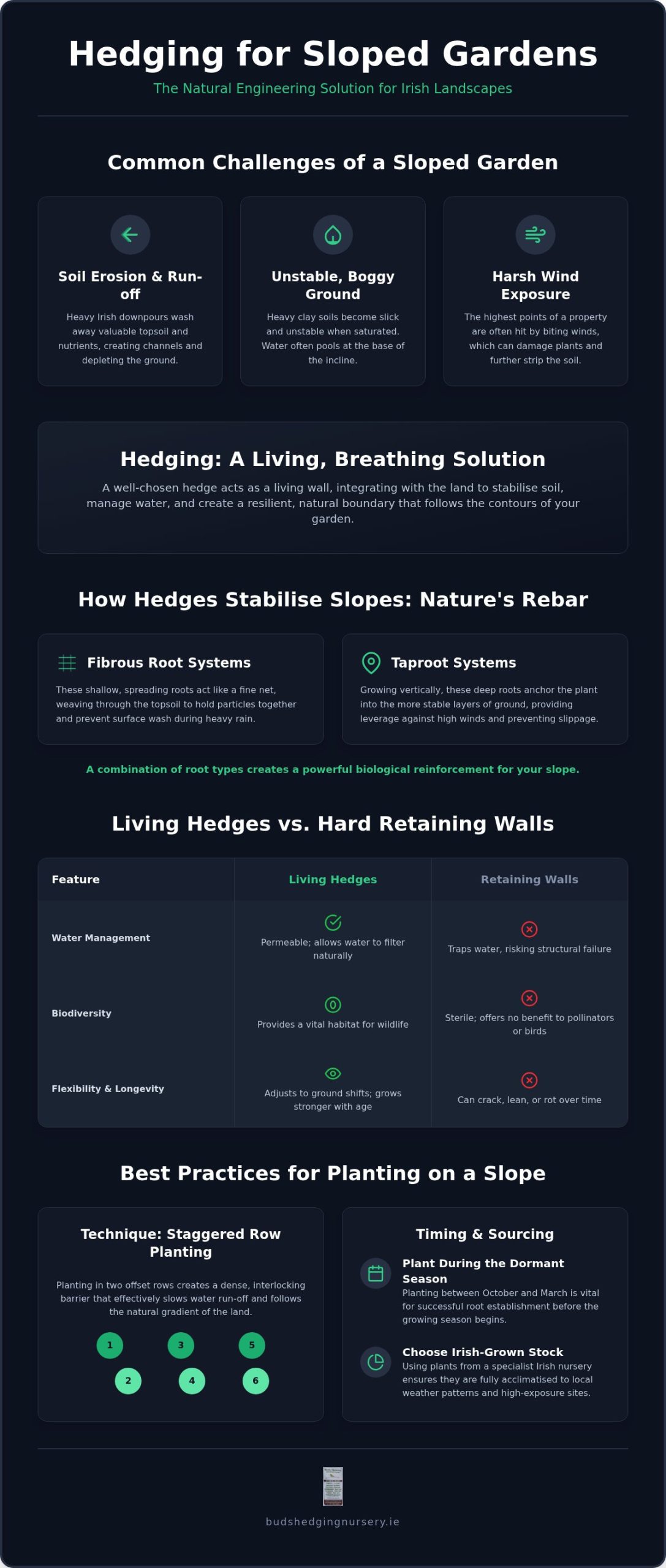
Irish gardens often deal with heavy clay soils. On a steep slope, this clay becomes slick and unstable when saturated. Unlike hard landscaping which just sits on top of the earth, a hedge integrates with the land. It acts as a living wall. The roots anchor the soil in place, which is especially important for exposed sites where wind and rain combine to strip the surface of its health. A well-chosen hedge adapts to the gradient, providing privacy that follows the natural flow of your property.
Managing Soil Erosion and Run-off
When rain hits a bare slope, it gains momentum. This creates channels or “gullies” that carry away valuable silt and organic matter. A thick hedge breaks this momentum. The dense leaf canopy of species like Portuguese Laurel or Hornbeam intercepts the rainfall. It slows the water’s descent so it can soak into the earth rather than rushing over it. Strategic placement of these plants creates a series of horizontal barriers. These barriers catch debris and keep your garden’s nutrients where they belong.
Hedging vs. Retaining Walls
Many homeowners assume that stone or timber retaining walls are the only way to manage a gradient. These structures are often expensive and require significant groundworks. They also tend to trap water behind them. This can lead to structural failure if the drainage isn’t perfect. Hedges offer several advantages over masonry:
- Permeability: Hedges allow water to filter through naturally. This reduces the risk of boggy patches at the bottom of the incline.
- Biodiversity: A living boundary provides a habitat for nesting birds and pollinators. A stone wall cannot do this.
- Flexibility: As the ground shifts over time, a hedge adjusts. It won’t crack or lean like stone or concrete.
- Longevity: Timber rot is a common issue in our damp climate. A well-maintained hedge can last for decades, growing stronger and more effective with each passing season.
Choosing hedging for a sloped garden is a decision that respects the natural topography. It provides a softer, more resilient boundary that improves with age rather than deteriorating.
Understanding Root Systems: How Hedges Stabilise Sloped Ground
Roots provide more than just nutrients. When you’re managing a gradient, they serve as a structural foundation. Think of them as nature’s rebar. Just as steel rods reinforce concrete, a network of roots weaves through the earth to lock soil particles together. This biological reinforcement is the primary reason why hedging for a sloped garden is often more effective than traditional fencing or walls.
A hedge doesn’t just sit on the surface. It integrates with the subsoil. This creates a biological anchor that prevents loose or sandy earth from shifting under its own weight. It’s also vital to consider the moisture gradient. The top of a slope is often dry and exposed, whilst the bottom can become waterlogged. Choosing species that can tolerate these varying moisture levels ensures the entire boundary remains stable. If you’re unsure which species suit your specific gradient, you can browse our full range of hedging to see which varieties offer the best structural support.
Fibrous vs. Taproots for Incline Security
To get the best results, you need a combination of root types. Fibrous roots are shallow and spread out like a fine netting. They’re excellent at catching topsoil and preventing surface wash during heavy Irish rain. Taproots, on the other hand, grow vertically. They reach deep into the more stable layers of the ground to provide leverage against high winds. Many of our customers opt for Portuguese Laurel because it develops a particularly robust and adaptable root system that thrives in these challenging conditions.
The Role of Ground Cover Plants
A single line of hedging can sometimes leave bare patches of earth between the stems. These gaps are prime spots for weeds and minor erosion. Integrating ground cover plants creates a multi-layered defence. These low-growing species act as a living mulch, suppressing weeds on steep banks where maintenance is difficult and dangerous. By filling these spaces, you ensure that every square inch of the slope is held in place by a root system. This multi-tiered approach creates a stable, green carpet that requires very little intervention once established.
Best Hedging Species for Sloped Gardens in Ireland
Choosing the right hedging for a sloped garden isn’t just about what looks good from the kitchen window. You have to consider the distinct micro-climates that exist on a single incline. The top of a bank is often a harsh environment; it’s dry, exposed, and catches the full force of the wind. Conversely, the bottom of the gradient tends to collect run-off, resulting in heavier, wetter soil that can drown less hardy plants. You need species with high root vigour and the ability to adapt to these shifting conditions.
We’ve spent over 30 years growing plants in the Cavan climate, so we know which species can handle the pressure. A successful sloped boundary often uses a mix of evergreens for year-round shelter and deciduous plants for their deep-rooting capabilities. Matching the plant to the specific part of the slope is the best way to ensure your hedge doesn’t just survive, but thrives.
Evergreen Reliability: Laurel and Griselinia
For many Irish homeowners, Portuguese Laurel is the gold standard. It is remarkably resilient against wind-burn and thrives in the well-drained soil often found at the top of a slope. It grows into a thick, dark green wall that provides immediate privacy. If your property is near the coast or particularly windswept, Griselinia is a better alternative. Its thick, leathery leaves are built to withstand salt spray and constant gales without turning brown. To add a bit of visual interest, Photinia Red Robin is another strong performer. It offers bright red new growth in the spring and maintains a dense, protective screen that helps break the wind’s force before it hits your garden.
Native and Deciduous Options for Exposed Slopes
Deciduous hedges shouldn’t be overlooked, especially for their structural benefits. Beech hedging plants are a favourite because they retain their dried, copper-coloured leaves through the winter. This provides a privacy screen even during the dormant season. For those looking to support local biodiversity or participating in the Native Trees Scheme, Whitethorn is a robust choice. It establishes deep, tenacious roots that are perfect for stabilising the heavier, damp ground at the foot of a slope. If you want flowers without sacrificing hardiness, Escallonia is a tough evergreen that produces beautiful pink or red blooms whilst standing up to the harshest Irish weather. Each of these options provides the root vigour needed to keep your garden’s boundary secure and stable.
Practical Planting Techniques for Steep Inclines
Success with hedging for a sloped garden depends on precision during the initial stages. It’s not enough to simply dig a hole and hope for the best. On a gradient, you must account for the angle of the ground to ensure the plants grow straight and the soil remains stable. If you plant perpendicular to the slope, the hedge will lean outwards, creating a weak boundary that is susceptible to wind damage. Always use a plumb line or a simple vertical stake to ensure every stem is perfectly upright, regardless of the bank’s incline.
Preparation is the most labour-intensive part of the process. You must clear the bank of all aggressive weeds and grass before you start. Marking your line with a string level helps maintain a consistent height across the gradient. Once the ground is clear, you can focus on the structural layout of the plants to ensure they provide the necessary erosion control discussed in previous sections.
Staggered Planting and Trenching
Digging a trench on a slope requires care to prevent a minor landslide. Work horizontally across the face of the bank rather than vertically. Dig your trench slightly wider than the root ball, but be careful not to undercut the uphill side too deeply, as this can cause the soil above to slump during the first heavy rain. For most sloped projects, we recommend spacing plants at a density of five to seven per metre to ensure quick closure of the canopy.
The zig-zag method involves planting two parallel rows in an offset, alternating pattern to ensure the root systems interlock and provide maximum stability across the face of the bank. This double-row approach creates a thicker, more resilient barrier that catches more surface run-off than a single line of plants.
Watering and Mulching on a Gradient
Watering on a slope is notoriously difficult because the liquid tends to run off before it reaches the roots. We suggest using the “saucer” method. This involves creating a small, flat micro-terrace around the base of each plant. This indentation acts as a basin that catches and holds water, allowing it to soak directly down into the root zone. It is a simple but effective way to ensure your new hedge doesn’t suffer from drought stress on the well-drained top sections of the hill.
Choosing the right mulch is equally important. Avoid light bark nuggets, as they act like marbles and will simply wash to the bottom of the hill during a storm. Instead, use a heavier, shredded wood mulch or well-rotted manure that binds together and grips the soil surface. When applying fertilisers, tuck them into the soil within the “saucer” basin. This ensures the nutrients are absorbed by the plant rather than being carried away by surface water. If you need large quantities of plants for a long boundary, you can order hardy, nursery-grown hedging that is ready for immediate planting on challenging sites.
Sourcing Quality Plants from a Specialist Irish Nursery
The success of your landscaping depends heavily on the health of your stock. When selecting hedging for a sloped garden, the origin of the plants is just as important as the species. Many retail outlets sell imported stock that hasn’t been hardened off to our specific Irish weather. A plant grown in a milder European climate often struggles when faced with the biting winds and heavy rainfall of an exposed Irish hillside. Our nursery-grown plants are raised to be resilient, ensuring they establish quickly and begin the vital work of anchoring your soil.
Sourcing directly from a 60-acre specialist nursery provides a level of selection that local garden centres cannot match. For large-scale projects on steep gradients, you need consistency in plant size and maturity to ensure the boundary develops evenly. We manage the logistics for these substantial orders, arranging delivery so that your plants arrive fresh and ready for immediate planting. This is particularly important for long boundaries where hundreds of individual stems may be required to secure the entire length of a slope.
Bare Root Season vs. Year-Round Pot Options
Timing your project can significantly impact your budget. If you are planning a large-scale installation, bare root hedging is the most economical choice. These plants are only available during the dormant season, which runs from October to March. They are easy to handle on difficult terrain and establish deep roots quickly once the growing season begins. For projects that cannot wait for the winter months, pot-grown plants are available year-round. These provide an immediate impact and are often preferred for bare banks where you need a root system to start stabilising the ground without delay.
Expert Guidance from Buds Nursery
With over 30 years of experience in the industry, we understand the practicalities of the Irish landscape. We can help you choose between a formal Portuguese Laurel screen or a diverse native mix that qualifies for the Native Trees Scheme. Our team provides straightforward advice on which species will thrive at the dry top of your incline versus the wetter foot of the gradient. We invite you to visit our 60-acre site in Cavan from Tuesday to Saturday to see the quality of our stock in person. Seeing the plants at various stages of maturity helps you visualise the final result for your hedging for a sloped garden. Please note that we are closed on Sundays and Mondays to manage our nursery operations.
Securing Your Garden Boundary for the Long Term
Establishing the right hedging for a sloped garden is a practical investment in your property’s stability and privacy. By selecting species like Portuguese Laurel or native mixes that suit the specific moisture levels of your incline, you create a living barrier that outlasts timber or stone. Success depends on vertical planting and using staggered rows to lock the soil in place. These techniques, combined with hardy plants, turn a difficult gradient into a manageable, green asset.
We’ve spent over three decades growing stock specifically for the Irish climate on our 60-acre nursery in Cavan. Our experience helps us provide the specialist advice needed for even the most challenging sloped sites. Whether you need bare root options for a large boundary or pot-grown plants for immediate impact, we have the variety to suit your project. You can explore our full range of Irish-grown hedging plants at Buds Nursery to find the best fit for your land. With the right preparation and quality stock, you’ll have a secure, thriving boundary that stands up to the elements for years to come.
Frequently Asked Questions
What is the best hedge for a very steep bank?
Portuguese Laurel and native Whitethorn are the most reliable choices for steep banks. These species develop the robust root systems required to anchor shifting soil. They also tolerate the high wind exposure common on elevated sites. We’ve found that a mix of these creates a dense, interlocking barrier that manages erosion effectively while providing year-round privacy on difficult gradients.
How do I stop soil from washing away while the hedge is growing?
Planting ground cover plants between your hedge stems is the most effective way to prevent soil wash. These low-growing plants act as a living mulch that grips the topsoil while the main hedge establishes its deeper roots. You can also use heavy, shredded wood mulch. Avoid light bark nuggets as they’ll simply wash to the bottom of the hill during the first heavy rain.
Can I plant a hedge on a slope in the winter?
Yes, the dormant season between October and March is actually the best time to plant. Planting during these months allows the roots to settle in the damp Irish soil without the stress of summer heat. It’s also the period when bare root trees are available, which is often the most cost-effective way to install hedging for a sloped garden on a large scale.
Do I need to terrace my garden before planting a hedge?
You don’t need to terrace the entire bank, as hedges are designed to follow the natural gradient. Instead, focus on creating small “saucer” basins around each individual plant. This micro-terrace catches water and nutrients, preventing them from running off. It’s a much cheaper and more flexible solution than building expensive stone or timber retaining walls that might trap water and eventually fail.
Which hedging plants have the deepest roots for slope stability?
Hornbeam and Beech are known for their deep-reaching taproots that provide excellent stability. These roots penetrate the tougher subsoil layers, acting as a biological anchor for the entire bank. While their surface roots prevent topsoil erosion, these deeper anchors ensure the hedge remains upright during winter gales. Using these species provides a dual-layer defence that is essential for long-term slope management.
How do I water a hedge on a slope without the water just running off?
Create a shallow, bowl-shaped depression in the soil at the base of each plant. This saucer-like basin holds the water in place, allowing it to soak directly down to the roots rather than rushing down the hill. It’s a simple, manual technique that ensures your new hedging for a sloped garden receives enough moisture during its first two growing seasons, especially on dry, exposed upper slopes.
Is Portuguese Laurel suitable for a windy, sloped garden?
Portuguese Laurel is exceptionally well-suited to windy, sloped sites because of its hardy, leathery leaves. Unlike other evergreens that might suffer from wind-burn or salt spray, it maintains its dark green colour even on exposed Irish hillsides. It’s a resilient grower that doesn’t mind the well-drained conditions often found at the top of a gradient, making it a dependable choice for a permanent boundary.
How far apart should I space plants on a gradient?
We recommend spacing five to seven plants per linear metre for a dense, stable boundary. Planting in a staggered, double-row pattern is essential on a slope. This zig-zag layout ensures that as the plants mature, their root systems interlock more tightly. This creates a stronger structural netting that is far more effective at holding the earth together than a single row of plants.