

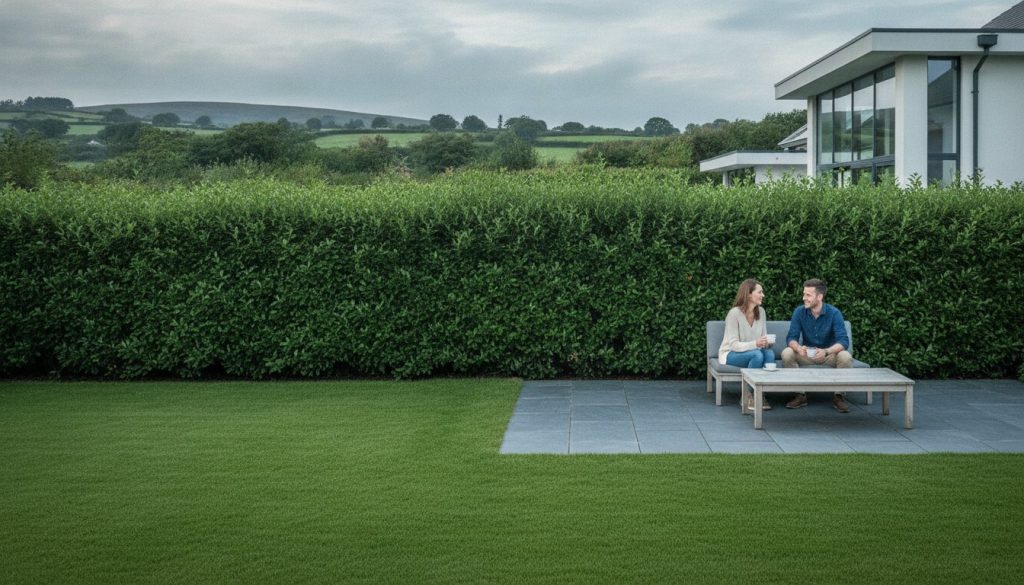
Buying the tallest plants available for an instant screen is often the most expensive way to ensure your new hedge fails during its first winter. Most Irish homeowners simply want a thick, green boundary that stands up to Atlantic gales and heavy rain without needing a trim every fortnight. It’s frustrating when a new screen fails because the soil is too wet or the species isn’t suited to the local exposure. Selecting the right evergreen hedging Ireland requires a bit of local knowledge to match the plant to the ground.
This practical 2026 guide helps you choose a permanent, low-maintenance privacy screen that actually thrives in our climate. We draw on 30 years of growing experience to help you avoid common pitfalls like poor drainage and wind-burnt foliage. You’ll learn which species work best for your specific site, from the hardy Portuguese Laurel to salt-tolerant Griselinia. We also provide a clear roadmap for the season, covering everything from the benefits of planting bare root stock between November and March to the specific maintenance routines that keep your garden sheltered and private all year round.
Key Takeaways
- Learn why living hedges are more effective than walls for reducing wind speeds and creating a permanent, year-round shelterbelt.
- Identify the best species of evergreen hedging Ireland for your specific garden goals, from security-focused thorns to the elegant Portuguese Laurel.
- Compare growth rates and maintenance requirements to find a balance between an instant privacy screen and a manageable pruning schedule.
- Master the essentials of soil preparation and early-stage care to protect your investment during the critical first 18 months of growth.
- Discover the benefits of choosing hardy, Irish-grown plants from a specialist nursery to ensure your hedge is already acclimatised to local weather.
Understanding Evergreen Hedging for the Irish Climate
Evergreen hedging refers to species that retain their foliage throughout every season. Unlike deciduous boundaries that lose their leaves in autumn, these plants offer a permanent visual barrier. For many Irish gardens, this year-round density is the primary requirement for privacy. When you choose a living screen, you aren’t just planting a boundary; you’re building a long-term asset for your property.
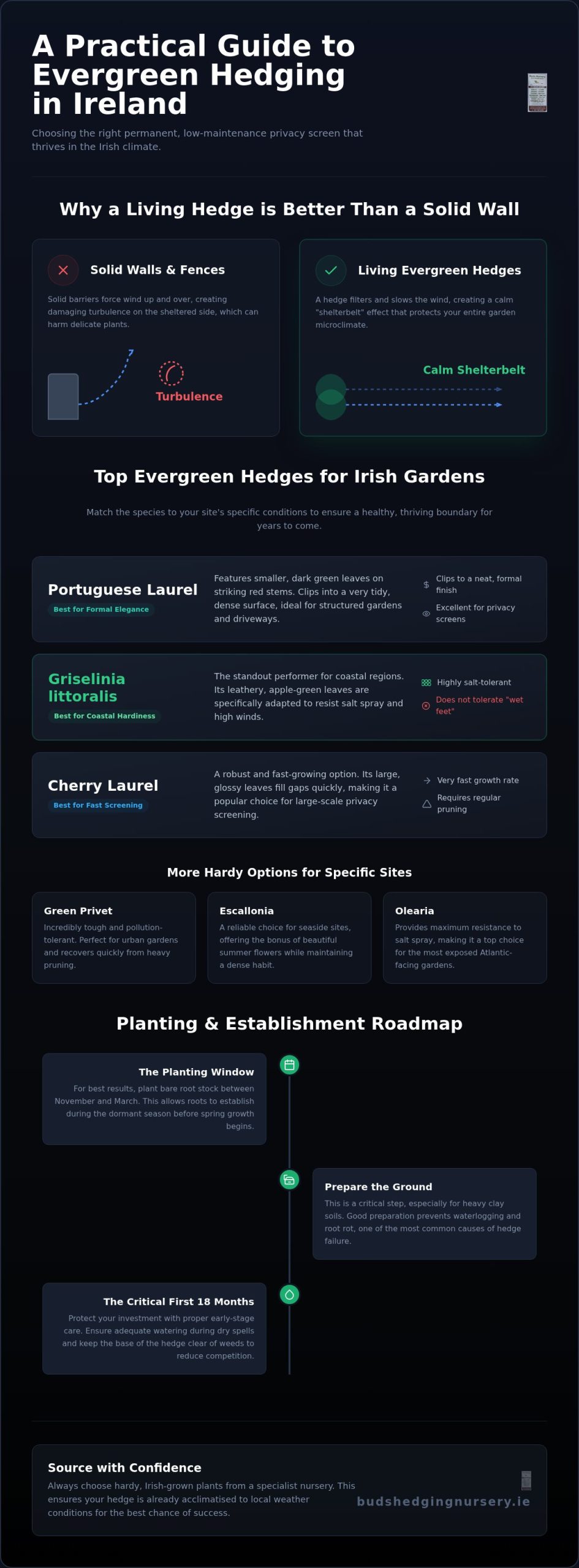
One of the most significant advantages of using evergreen hedging Ireland is the “shelterbelt” effect. Whilst a solid stone wall or timber fence forces wind upwards and creates turbulent air on the other side, a living hedge acts as a filter. It allows a small amount of air through, which breaks the wind’s force and reduces its speed far more effectively. This creates a calmer microclimate for the rest of your garden. It protects delicate flowers and makes the space more comfortable for sitting outside.
In the Irish context, hardiness is about more than just surviving a frost. It involves a plant’s ability to withstand prolonged dampness and fluctuating temperatures. Choosing plants that are already acclimatised to these conditions is essential for long-term success. A plant that thrives in a dry, continental climate may struggle with our heavy winter rains and high humidity.
Why Choose Evergreen Over Deciduous?
Privacy remains the biggest driver for most homeowners. Urban gardens often face overlooking windows, and a thick screen of Laurel or Privet provides a consistent shield. When selecting evergreen hedging Ireland, homeowners often prioritise this year-round noise and visual barrier. Beyond the visual, these dense layers of foliage help dampen road noise and local traffic sounds.
Structure is another benefit. Evergreens provide a solid framework that prevents the garden from looking empty during the winter months. They also offer vital sanctuary for local biodiversity. Irish garden birds, such as wrens and robins, rely on the dense interior of evergreen hedges for shelter against freezing winter rain and predators.
Common Challenges in Irish Soils
Irish gardeners frequently deal with heavy clay or ground that becomes waterlogged during the winter months. This is a critical factor when choosing your species. For instance, Griselinia is an excellent choice for many sites but it won’t tolerate “wet feet” or standing water, which can lead to root rot. If your soil is particularly heavy, you’ll need to focus on preparation or choose more resilient species.
Coastal exposure presents another hurdle. Salt-laden winds can scorch the leaves of less hardy plants. Species like Escallonia or Griselinia have evolved waxy leaf coatings to handle these conditions, making them ideal for gardens along the Atlantic or Irish Sea coasts. Understanding your specific soil drainage and wind exposure before you plant will prevent costly mistakes later.
Choosing the Best Species for Your Site Conditions
Selecting the right plant begins with defining its primary function. Are you looking for a dense wall for privacy, a thorny barrier for security, or a decorative border? In the varied Irish landscape, a species that thrives in a sheltered inland garden might fail on a clifftop. Matching the plant to the specific microclimate of your garden is the most reliable way to ensure a healthy boundary. This selection process is the foundation of successful evergreen hedging Ireland.
For many homeowners, Portuguese Laurel is the premier choice for a formal boundary. It features smaller, darker leaves compared to its cousin, the Cherry Laurel, and striking red stems. It clips into a very tidy, tight surface. This makes it ideal for elegant driveways or structured garden rooms. If you need a faster solution for large-scale screening, Cherry Laurel is a robust alternative. Its large, glossy leaves fill gaps quickly and provide a deep green backdrop throughout the year.
Best Hedging for Exposed and Coastal Gardens
Griselinia littoralis is the standout performer for coastal regions. Its leathery, apple-green leaves are specifically adapted to resist salt spray and high winds. Escallonia is another reliable option for seaside sites. It offers the added benefit of summer flowers whilst maintaining its dense evergreen habit. For urban gardens prone to wind tunnels between buildings, Green Privet remains a staple. It is incredibly tough, tolerates pollution, and recovers quickly from heavy pruning. In extremely harsh conditions, Olearia provides maximum resistance to salt spray. These species are often the only choice for gardens directly facing the Atlantic. If you are unsure which variety suits your local exposure, you can consult our specialist growers for advice based on three decades of experience.
Formal vs. Informal Evergreen Styles
The texture of your hedge depends largely on leaf size. Portuguese Laurel offers a fine, sophisticated texture. In contrast, Cherry Laurel provides a coarser, more vigorous look. If you require low borders or traditional topiary, Box and Yew remain the standard. Yew is particularly long-lived. It can be cut back to the old wood if it ever grows too large, a trait many evergreens lack. This makes it a permanent, forgiving solution for long-term garden planning.
Photinia Red Robin is popular for its vibrant red new growth. However, it can become sparse at the base if left to its own devices. To maintain a dense screen, it requires regular “tipping” to encourage bushier growth. This makes it an excellent choice for an informal, colourful screen rather than a strictly clipped formal hedge. Choosing the right evergreen hedging Ireland means balancing these aesthetic goals with the practical realities of your garden’s maintenance needs.
Comparing Popular Evergreen Options: Speed, Colour, and Cost
Choosing the right variety involves a direct trade-off between how quickly you want your privacy and how much time you’re willing to spend with a hedge trimmer. For many homeowners, the priority is a “fast-track” solution that fills a gap in a single season. Others prefer a “steady-growth” approach that requires less intervention over the years. When evaluating evergreen hedging Ireland, understanding these growth habits helps you budget both your time and money effectively.
Aesthetics also play a significant role in the long-term satisfaction with your boundary. Photinia Red Robin provides a distinct seasonal shift with its bright red spring foliage, whilst species like Viburnum Tinus offer white winter flowers. If you prefer a consistent, deep green backdrop, the small, dark leaves of Portuguese Laurel provide a more neutral canvas for your garden borders than the lighter, broader leaves of the Cherry Laurel. The choice between an instant hedge and a patient approach often comes down to the maturity of the stock you buy. Opting for larger, root-balled plants provides immediate impact, whereas planting bare root whips between November and March is the most cost-effective method for those who don’t mind waiting a few seasons.
Growth Rate Comparison
Cherry Laurel is widely considered the fastest route to a two-metre screen. In optimal conditions, it can put on 30cm to 60cm of growth annually. This makes it the most efficient way to achieve total privacy quickly on a budget. Portuguese Laurel moves at a more measured pace, typically adding 20cm to 30cm each year. Whilst it takes longer to reach its full height, its tighter growth habit results in a more refined finish that doesn’t “escape” as easily as faster species. Griselinia also falls into the rapid category, often matching the speed of Laurel, provided it isn’t stunted by severe frost or waterlogged soil.
Maintenance and Pruning Timelines
Maintenance requirements vary significantly across the evergreen spectrum. Green Leylandii and Castlewellen Gold are vigorous growers that demand twice-yearly pruning to keep them under control. If you miss a season, they can quickly become unmanageable and difficult to restore. In contrast, Portuguese Laurel and Holly are the low-maintenance stars of the Irish garden. A single trim in late spring or early summer is usually enough to maintain their shape and density.
Timing is critical for the health of the foliage. We recommend pruning most evergreens once the risk of hard frost has passed. Cutting back too early in the year can expose fresh growth to cold snaps, leading to the “brown tips” often seen in poorly timed hedges. For those with busy schedules, choosing a slower-growing species like Portuguese Laurel ensures the hedge stays tidy for longer without constant attention. This balance of speed and upkeep is a central consideration for anyone investing in evergreen hedging Ireland.
Planting and Establishing Your Evergreen Hedge
Success with evergreen hedging Ireland depends almost entirely on the work done before the first plant touches the soil. Proper preparation ensures that roots can establish quickly before the harsh winter weather arrives. Start by clearing a strip at least 60cm wide, removing all grass and perennial weeds that would otherwise compete for moisture. Digging in well-rotted organic matter or a high-quality soil improver provides the nutrients needed for that vital first year of growth, especially in heavy clay soils.
You have two main choices for stock: bareroot and pot-grown. Bareroot plants are lifted directly from the field and must be planted whilst dormant. This is the most economical way to plant large areas, but the window is strictly limited. You can find more detail on this in our Bare Root Tree Season Ireland guide. Pot-grown plants can be planted year-round. They have a fully developed root system, which often leads to a higher success rate for beginners or those planting outside the traditional winter window.
Spacing Guide: How Many Plants Do I Need?
Getting the density right is essential for a thick, gap-free screen. For standard 2-litre pots, we generally recommend planting 3 to 4 plants per linear metre. If you are using larger, more mature 10-litre plants for an instant impact, you might only need 2 per metre. For those seeking maximum privacy, a double-staggered row is the best approach. This involves planting two parallel lines in a “Z” pattern, which creates a much deeper, denser barrier. For specific measurements on popular species, refer to our Portuguese Laurel Spacing Guide.
Post-Planting Care in the Irish Climate
The first 18 months are the most precarious for any new boundary. In Ireland, “wind-rock” is a common issue where young plants are loosened in the soil by heavy gales. This creates a hollow at the base that collects water and can freeze, damaging the roots. Check your plants after any major storm and firm the soil back down with your heel if necessary. Protecting your investment involves maintaining evergreen hedging Ireland through these first few seasons with regular attention.
Mulching with bark mulch or similar material is also highly recommended. It suppresses the aggressive Irish grass that competes for nutrients and helps retain moisture during dry spells. Feeding should begin in the first spring after planting. A general-purpose slow-release fertiliser applied in March or April will fuel the new season’s growth. To ensure you get the best start, you can order your hardy, nursery-grown stock directly from our 60-acre site for national delivery.
Sourcing Quality Evergreen Hedging in Ireland
Sourcing your plants directly from a specialist grower ensures they haven’t spent weeks in transit or sitting in a dry warehouse environment. At our 60-acre site in Cavan, we cultivate stock specifically for the local climate. Buying evergreen hedging Ireland from a local producer means the plants are already resilient to our high rainfall and specific soil types. This significantly reduces the risk of failure that often comes with imported stock raised in controlled, continental nurseries.
When you’re evaluating stock, look for plants with a balanced structure rather than just height. A healthy specimen has dense foliage right to the base and a vigorous, fibrous root system. If you’re selecting potted plants, check that they aren’t pot-bound; circling roots can struggle to move into the surrounding soil after planting. Bareroot stock must be handled carefully to keep the roots moist until the moment they are planted. This attention to detail at the nursery stage is what ensures a successful, long-term privacy screen.
Why Visit a Specialist Nursery?
Visiting the nursery gives you the chance to speak with the people who actually grow the plants and understand their 30-year lifecycle. You can see mature examples of different species to gauge their final scale and texture, which is invaluable for planning a garden boundary. Seeing the plants in the ground helps you visualise how a formal Portuguese Laurel or a waxy-leaved Griselinia will look in your own space. For more detail on choosing a supplier, see our Specialist Plant Nursery Ireland guide.
Ordering and Delivery Logistics
We coordinate national delivery to ensure large orders arrive in prime condition for planting. Buds Nursery Cavan organises transport across all 32 counties, focusing on efficiency to keep the plants fresh. To make the process smoother, ensure your ground is cleared and your planting trench is ready before the delivery arrives. This prevents the roots from drying out whilst they wait for their permanent home. Once your site is ready, you can browse our full range of evergreen hedging plants here to find the best species for your project.
Planning Your Garden Boundary for 2026
Establishing successful evergreen hedging Ireland depends on matching the right species to your specific soil and exposure. Whether you require the salt-tolerance of Griselinia for a coastal site or the refined, dark foliage of Portuguese Laurel for a formal driveway, a living boundary offers a permanent shelterbelt that no timber fence can replicate. By focusing on thorough soil preparation and consistent early care, you ensure your hedge develops the density needed for genuine year-round privacy.
With over 30 years of growing experience since 1994, we understand the practicalities of the Irish landscape. Our 60-acre specialist nursery produces hardy, Irish-grown stock that is already acclimatised to local weather patterns, ensuring a much higher success rate in your garden. We provide expert guidance and national delivery across all 32 counties for both bareroot and potted stock. This ensures your plants arrive fresh and ready for immediate planting.
Explore our 60-acre range of evergreen hedging and trees to find the ideal species for your property and enjoy a sheltered, green garden for decades to come.
Frequently Asked Questions
What is the fastest-growing evergreen hedge in Ireland?
Cherry Laurel is the fastest-growing option for a dense screen, typically adding 30cm to 60cm of height per year in Irish conditions. Whilst Green Leylandii grows even quicker, it requires far more frequent maintenance to prevent it from becoming unmanageable. For most homeowners, Cherry Laurel provides the best balance of rapid height and easy upkeep.
When is the best time of year to plant evergreen hedging?
The best time to plant bare root evergreen hedging Ireland is during the dormant season, which runs from November to March. This is the most cost-effective way to establish a long boundary. If you are using pot-grown plants, you can plant them at any time of year, provided you can commit to regular watering during the drier summer months.
How many hedging plants do I need per metre for a thick screen?
You generally need 3 to 4 plants per linear metre when using standard 2-litre or 3-litre pots. For larger, more mature stock in 10-litre pots, 2 plants per metre is usually enough to create a solid line. If you want a deeper, more substantial barrier, we recommend planting a double-staggered row to increase the density of the foliage.
Which evergreen hedge is best for very windy or coastal sites?
Griselinia littoralis is the top performer for coastal gardens because its leathery leaves are naturally resistant to salt spray. Escallonia and Olearia are also excellent choices for exposed Atlantic sites. These species thrive where others might suffer from leaf scorch or wind-burn during winter gales.
Can I plant evergreen hedging in heavy clay soil?
Yes, you can plant evergreens in clay, but you must improve the soil structure to avoid waterlogging. Portuguese Laurel and Privet are more tolerant of heavier ground than species like Griselinia, which requires excellent drainage. Incorporating organic matter and grit into the planting trench helps prevent the roots from sitting in standing water during the winter.
Is Portuguese Laurel better than Cherry Laurel for an Irish garden?
Portuguese Laurel is often the better choice for formal, tidy gardens due to its smaller leaves and elegant red stems. It is also slightly hardier in cold, inland frost pockets. Cherry Laurel is more suitable if you have a large area to cover quickly and prefer the look of large, glossy foliage.
How often do I need to prune my evergreen hedge?
Most evergreen varieties only need pruning once a year, usually in late spring or early summer after the risk of frost has passed. This single trim is enough to maintain the shape of Portuguese Laurel or Holly. Fast-growing conifers like Leylandii are the main exception and often require a second cut in late August to stay neat.
Do evergreens provide enough shelter for Irish wildlife?
Evergreens provide vital sanctuary for garden birds like robins and wrens, especially during freezing winter rain. The dense, year-round foliage offers a protected space for nesting and a shield against predators. Choosing a variety that produces berries, such as Holly or Viburnum Tinus, adds extra value by providing a winter food source for local biodiversity.