

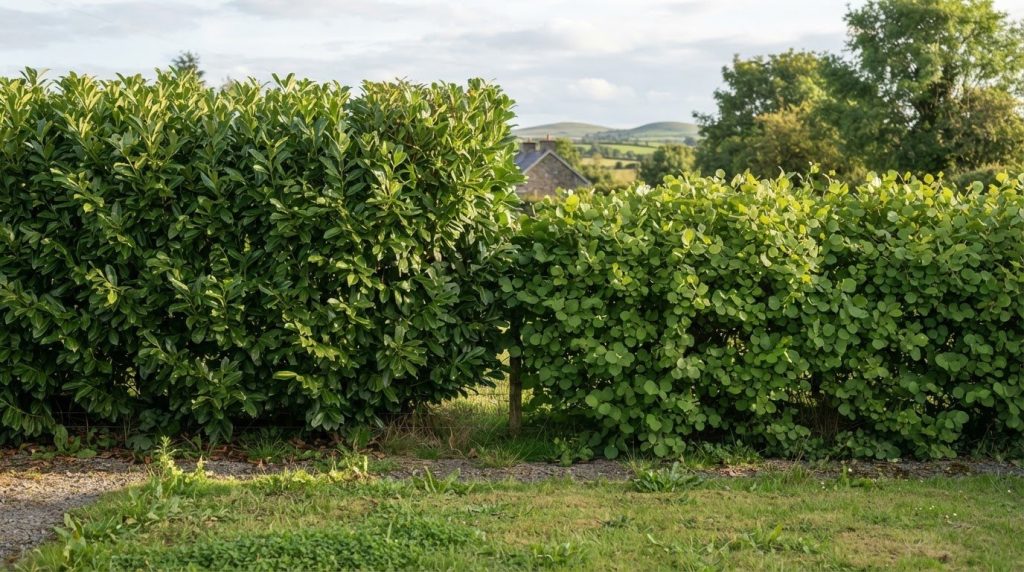
The taller hedge isn’t automatically the better privacy screen. Choosing laurel vs Griselinia for privacy comes down to how quickly you want coverage, the conditions in your garden and the look you prefer. Untrimmed Griselinia can reach 5 metres, while Cherry Laurel can grow 60 cm or more per year.
Both offer evergreen screening, but create different effects. Griselinia’s fresh apple-green foliage looks lighter than Cherry Laurel’s larger leaves, and suits milder coastal gardens. Laurel may suit a wider range of garden conditions, though its vigorous growth can call for more regular clipping.
This comparison explains how potential height, growth, coastal suitability and appearance affect privacy in an Irish garden. The right choice depends on what you need to screen and whether you prefer a lighter hedge or a denser-looking boundary.
Key Takeaways
- Compare the hedge’s potential height and growth with the level of screening you need and the amount of clipping you can manage.
- Griselinia can grow up to 60 cm per year in suitable conditions, but its coastal suitability makes location an important part of the decision.
- For a lighter-looking boundary, consider Griselinia’s apple-green foliage; Cherry Laurel has larger leaves and a more substantial appearance.
- Choose between Griselinia and laurel by weighing your garden’s exposure, soil and preferred hedge shape, not height alone.
1. Griselenia growth rate and coastal suitability
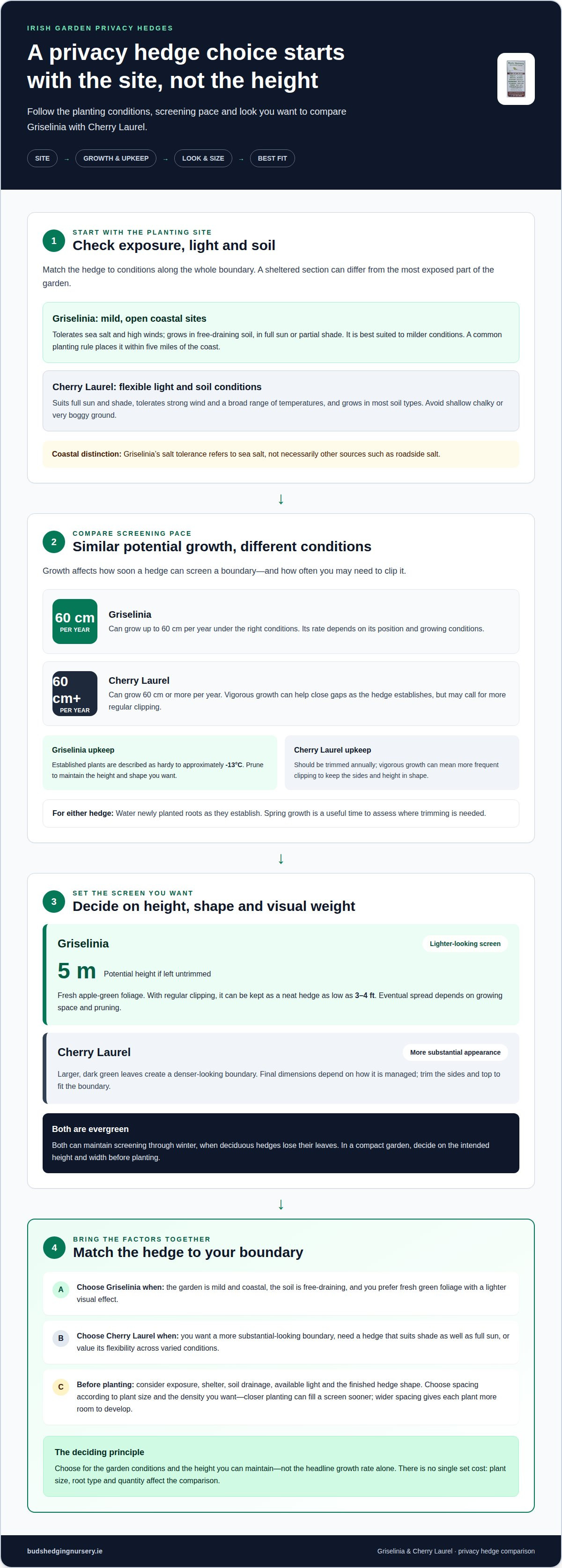
Growth speed affects how soon a hedge can screen a boundary and how often it needs clipping. Cherry Laurel can grow 60 cm or more per year, while Portuguese Laurel can grow up to 50 cm per year. Griselinia can also grow up to 60 cm per year under the right conditions, but its rate depends on its position and growing conditions.
For rapid privacy screening, Laurel’s vigorous growth can help close gaps as the hedge establishes. That speed also means more trimming to keep the height and sides in shape. Griselinia can form a dense evergreen screen too, but its coastal suitability matters: it is best suited to milder conditions, and a common planting rule places it within five miles of the coast. Established Griselinia is described as hardy to approximately -13°C.
There is no single spacing for a dense hedge. Choose according to plant size and the density you want: closer planting can fill a screen sooner, while wider spacing gives each plant more room to develop.
Soil and pruning needs also differ. Cherry Laurel grows in most soil types, but not shallow chalky or very boggy ground; it suits shade and full sun and should be trimmed annually. Griselinia grows in free-draining soil, in full sun or partial shade. For either hedge, water newly planted roots as they establish, then prune to maintain the height and shape you want. Spring growth is a useful time to assess where trimming is needed.
Griselinia is described as non-toxic. Keep children and pets from chewing hedge foliage or berries, and don’t treat either plant as food.
For an exposed Irish garden, compare the site’s coastal position, soil drainage and shelter before choosing. Inland conditions or harsh winters may matter more than a similar headline growth rate. The best screen suits the site and can be maintained at the height you need.
2. Why Choose an Alternative to Laurel?
Griselinia suits gardens where a tall evergreen screen is useful but Cherry Laurel’s large leaves feel too heavy. Left untrimmed, Griselinia can reach 5 metres; with regular clipping, it can be kept as a neat hedge as low as 3-4 ft. That gives you room to shape a boundary around a seating area or a neighbour-facing window.
For height and width, Griselinia’s untrimmed height can reach 5 metres, while the eventual spread depends on growing space and pruning. Laurel’s final dimensions also depend on how it’s managed, so trim the sides and top to fit the boundary rather than leaving the hedge to spread unchecked.
Both choices are evergreen, helping maintain screening through winter, when deciduous hedges lose their leaves. Griselinia has fresh apple-green foliage; Cherry Laurel has larger leaves and a more substantial look. Choose Griselinia for a lighter visual screen, or Laurel if you prefer a denser-looking boundary with dark green leaves.
Let your garden conditions guide the choice. Griselinia grows in free-draining soil, in full sun or partial shade. Cherry Laurel suits full sun and shady spots, but not shallow chalky or very boggy soil. In a compact garden, decide on the hedge’s intended height and width before planting, then prune to keep it within that space.
There isn’t one set cost for Laurel or Griselinia plants in Ireland. Plant size, root type and quantity affect the comparison, so use the same specifications when weighing options. If you’re planning a boundary screen, explore hedging plant choices and consider which foliage and finished shape best suit your garden.
Griselinia is described as a dense coastal evergreen hedge that provides privacy all year round. Consider growth speed, maintenance, leaf size and colour, potential height and soil type when choosing a hedge.
3. Griselinia in mild and coastal conditions
For an Irish coastal boundary, Griselinia has a practical advantage: it tolerates sea salt and high winds. Its evergreen leaves help maintain a green screen throughout the year, including winter. It can be a useful option where wind and salty air reach the planting line.
Laurel also tolerates strong wind and a broad range of temperatures. Cherry Laurel suits both shade and full sun, so it can work beside a wall or in an open garden. Griselinia suits milder coastal conditions, but its tolerance of sea spray doesn’t make it the automatic choice for every exposed site.
Position matters. Before planting Griselinia, consider whether the boundary faces the sea, receives salt-laden winds or sits in a sheltered part of the garden. An exposed coastal hedge has different demands from a screen behind a house or wall. Match the plant to the conditions rather than choosing on foliage colour alone.
For roadside planting, distinguish sea salt from other sources of salt. Griselinia’s coastal tolerance refers to salt from the sea, not necessarily every roadside condition. Laurel’s ability to grow in shade can make it more suitable where a boundary receives limited direct light, while Griselinia is a stronger fit for mild, open coastal gardens.
Both plants can form evergreen privacy screens, but their leaves create different effects. Griselinia’s fresh green foliage gives a lighter-looking boundary, while Cherry Laurel appears more substantial. If year-round screening is your priority, plan for the exposure and light levels along the whole boundary, not just its most sheltered section.
In short, Griselinia handles coastal salt and high winds, while Laurel offers flexibility in shade and varied weather. For an exposed Irish garden, the coastal position and available shelter help determine which hedge better suits the site.
4. Griselinia’s lighter appearance compared with cherry laurel
Griselinia changes the visual weight of a privacy screen. Its fresh apple-green leaves look lighter than Cherry Laurel’s large foliage, even when both form dense evergreen cover. This difference can suit a compact garden, where a dark hedge might dominate a seating area or narrow path. In a laurel vs griselinia for privacy comparison, appearance matters as much as screening.
Portuguese Laurel and Griselinia both provide evergreen cover, but the choice depends on the effect you want. Portuguese Laurel can grow up to 50 cm per year, so it suits a boundary where a substantial screen is the aim. Griselinia gives a lighter effect, which can work well in an open design or sheltered coastal garden.
When choosing laurel hedging, consider how mature foliage will sit against the house, paving and nearby planting. Cherry Laurel’s large leaves create a strong backdrop for pale walls or flowers. Griselinia’s brighter green can blend more gently with a lawn and lighter planting while still screening neighbours year round.
Both hedges respond to trimming, so their shape influences their appearance. A straight, clipped face creates a formal boundary with either species. A softer outline can make Griselinia feel less imposing beside an open lawn or contemporary garden. Before planting, view the hedge line from the main windows and seating areas. This helps you decide whether a green wall or lighter screen better suits the space.
For privacy, Portuguese Laurel offers an evergreen option with vigorous growth, while Griselinia combines dense cover with a fresher look. Griselinia can also be maintained at a lower height rather than left to reach its full potential. A laurel vs griselinia for privacy comparison should consider the garden’s conditions and the hedge’s intended shape, not foliage alone.
If Griselinia’s lighter foliage suits your boundary, explore Griselinia hedge plants as you plan the screen.
Buds Nursery Cavan: Griselinia
Buds Nursery Cavan offers Griselinia for gardeners choosing a lighter-looking evergreen privacy screen. It also offers Portuguese Laurel and Cherry Laurel, so you can compare foliage and growth habits with the conditions and appearance you want for your boundary. Golden Privet is another hedging option to consider when weighing different screening styles.
Consider these plant choices after assessing the site’s exposure, soil drainage and the height you want to maintain. Griselinia can suit a mild coastal position, while Laurel may fit better where shade tolerance or a more substantial-looking screen is important. The right plant matches both the setting and the hedge you can maintain.
For help choosing between these hedging plants, contact Buds Nursery Cavan.
Choose a hedge that fits your next step
Before deciding, picture the finished boundary from inside your garden. Consider what you want it to screen, how much room it can occupy and whether its foliage should blend in or stand out. This practical view can make choosing between laurel and Griselinia for privacy easier than focusing on growth rate alone.
If Griselinia doesn’t suit your site or preferred appearance, Portuguese Laurel, Cherry Laurel and Golden Privet are other hedging choices. Match the plant to your garden’s exposure and the shape you intend to maintain, then choose with the full boundary in mind.
For help taking the next step with your hedge choice, contact Buds Nursery Cavan. A well-matched hedge can give your garden the privacy and character you’re looking for.
Frequently Asked Questions
How high can your hedges for privacy be?
Griselinia can reach 5 metres if left untrimmed, or be clipped to a lower screen around 3-4 ft high. Laurel’s final height depends on how it’s grown and maintained, so plan around the boundary and the height you can regularly manage. For a narrow garden, a deliberately maintained hedge can screen windows without allowing foliage to dominate the space.
Why Choose an Alternative to Laurel?
Choose Griselinia over Laurel if you want a lighter-looking screen or are planting in a mild coastal garden. Its fresh green foliage can feel less visually dense beside a patio or smaller lawn. Laurel may suit a different preference, such as a more substantial-looking boundary. Compare the space, exposure and appearance you want before choosing either hedge.
How quickly do Portuguese laurel and Griselinia grow in Ireland?
Portuguese Laurel can grow up to 50 cm per year, while Griselinia can reach up to 60 cm per year under the right conditions. These are potential growth rates, not a timetable for a fully covered boundary. Plant establishment, soil drainage, light and exposure affect how quickly the hedge fills in. Allow for clipping as the screen develops.
Which hedge stays evergreen and provides better year-round privacy?
Both Laurel and Griselinia are evergreen options for screening through winter. Neither automatically provides better privacy: the result depends on how well the plants fill the boundary and whether the hedge is kept healthy and shaped. For example, choose Griselinia for brighter foliage or Laurel for a more substantial visual screen. Plan for consistent cover along the full hedge line.