

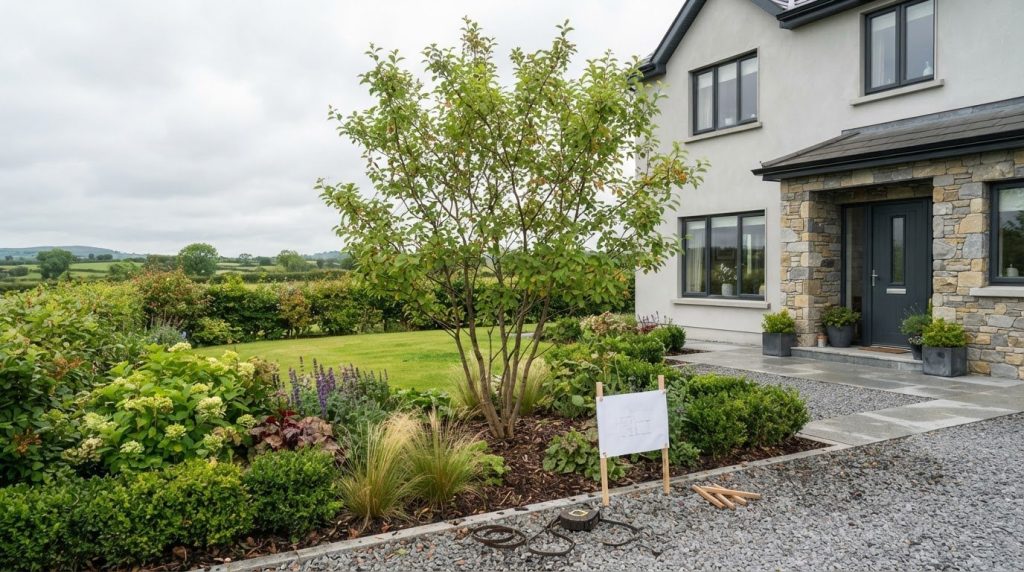
The biggest tree isn’t always the best focal point. A young tree can look modest at a nursery and grow to dominate a small front garden, obscure a window or narrow the view from the drive. Consider its mature size alongside the effect you want it to have. Choosing statement trees for front garden spaces starts with the space and sightlines, not just the tree’s appearance.
This guide explains how to assess your garden and compare trees by their shape, scale and ornamental qualities. You’ll learn what to record before choosing a position, how to think about a tree’s mature dimensions and what to consider when comparing buying formats. Buds Nursery Cavan offers ornamental trees, shrubs, hedging and fruit trees, with on-site plant guidance to help you consider options against your site. Rootballed and bare-root mature trees are available on request.
Key Takeaways
- Choose statement trees for front garden spaces for their role as a focal point, not simply because they’re the largest option.
- Assess available ground, overhead space, light and sightlines before deciding where a tree should go.
- Compare evergreen structure, seasonal foliage, flowers, fruit and bark to identify the ornamental qualities that suit your home.
- Record site measurements and observations, then compare them with a tree’s mature dimensions and suitable buying format.
- Explore Buds Nursery’s ornamental-tree range and use on-site plant guidance to help compare options.
What makes a statement tree work in a front garden?
A statement tree is a deliberate focal point. It isn’t simply the largest tree available or the one that grows fastest. Its position and form should draw the eye without getting in the way of everyday use. A well-placed tree can add height above lower planting, give an open area structure and bring seasonal interest through foliage, flowers, fruit or bark.
That role differs from a hedge or screen. Boundary planting is usually intended to create a continuous edge or degree of privacy; a focal tree stands apart and gives the garden a point of emphasis. You can review the botanical definition of a tree, then focus on how a particular tree’s shape and scale will work in your setting.
Suitability depends on a tree’s mature size and planting position. This matters at the front of a home, where a tree needs to sit comfortably beside the building, access routes and boundary planting.
What role should the tree play from the street?
Start by deciding what you want the tree to do. It might frame the entrance, draw attention to a view across the garden or anchor a planted area that otherwise feels flat. Look at the proposed position from the street and from inside the home. A tree that reads clearly from outside may block a window or interrupt a useful view indoors.
Consider the surroundings, too. Existing buildings and planting affect how a tree’s outline will appear. Leave enough visual space around it so the tree doesn’t disappear into nearby shrubs or compete with the house. If you are unsure about the position, mark the spot temporarily and view it from the different approaches to the entrance and from the rooms that face the garden.
Why does mature size matter more than the young tree?
At planting time, a young tree may appear small beside a path or front window. Its eventual height and spread can change that balance. The canopy may extend over a path, crowd an entrance or overlap with nearby planting as it grows. Judge the position using reliable information about the tree’s expected mature dimensions, not only the size of the plant you see today.
Check the space around paths, doors, windows and neighbouring plants. Think about the canopy as well as the trunk: it needs room to develop without making a narrow approach feel enclosed or obscuring a view you want to keep. Don’t assume all trees in a broad category reach the same dimensions. Mature size varies, so look for information about the specific tree before settling on a position.
To test the idea, mark the proposed planting spot and picture the tree’s eventual outline from the street and from indoors. Ask yourself:
- Will it make the entrance easier to identify, or draw attention away from it?
- Will its crown fit the space without crowding access or views?
- Will it stand out against the house and surrounding planting?
If the tree has a clear purpose and room to develop, it is more likely to feel like part of the garden’s design rather than an obstacle. This is the starting point for choosing statement trees for front garden spaces that are distinctive and practical. Buds Nursery grows trees and shrubs, including ornamental trees for garden planting.
How to assess front-garden space, light and sightlines
Before settling on a position, walk the front garden and make a simple site record. Separate what you can observe from what you’re assuming: a spot that looks bright during one visit may be shaded at another time. For statement trees for front garden spaces, use this four-point check:
- Available ground: Measure the planting area and note paths, entrances, boundaries and nearby structures.
- Overhead space: Look above the proposed position for rooflines, wires or other features that could affect the tree’s growth.
- Light: Observe where direct light falls at different times of day, including shade cast by buildings or existing planting.
- Sightlines: Check views from the street, approach, entrance and rooms facing the garden.
Record these details rather than relying on a quick impression. A tree’s eventual spread must fit the space around it, not just the planting hole.
How much room should you allow around a front-garden tree?
Measure the proposed planting area and note its distance from paths, walls, the house and boundary features. Then compare those measurements with reliable information for the selected tree’s mature height and spread. Required clearance varies with the tree and the site, so don’t use a general rule as a substitute for dimensions specific to the tree. Remember to consider the canopy as well as the trunk.
Paths and entrances need usable space, not just enough room for a young tree to be planted. A canopy that eventually extends over the route to the door may make the approach feel cramped. Consider whether branches could interrupt a view from a window or affect the outlook you want to preserve. Nearby shrubs and other planting need room, too. Mark the tree’s expected spread on the ground before deciding on its final position.
How do light and views influence the planting position?
Check the garden at different points through the day, and note where direct light falls and where buildings create shade. Pay attention to existing uses, such as a sunny seating spot or a planted bed that depends on brighter conditions. Check views from the entrance, windows and approach to the house; a tree can frame a view from one angle while obscuring it from another.
Use observations, not assumptions. A visit at one time won’t show how light changes across the frontage, and a view from the street may differ from the outlook indoors. HGTV’s front yard tree recommendations offer another perspective on front-garden planting, but your own measurements and sightlines should guide the final position.
Once you’ve noted the ground, overhead space, light and views, you’ll have a clearer basis for comparing options. Buds Nursery’s ornamental trees are a practical place to continue your search. On-site plant guidance can help you consider your planting plans alongside the options available at the nursery.
Compare statement-tree qualities before settling on a choice
Once you’ve assessed the site, compare what each tree could contribute to the front garden. Start with the effect you want to see from the house and the street, then weigh it against available space and the garden care you’re prepared to do. A photograph can show a feature, but it can’t tell you whether that tree’s mature form will suit your particular position.
Use the qualities below as a selection guide, rather than assuming every tree offers them. The effect depends on the tree and its characteristics, so look for reliable details about the variety you’re considering.
Quality
Possible visual effect
What to weigh up
Evergreen structure
A consistent leafy presence through the year.
Check the mature spread and whether the garden needs a lasting green outline.
Seasonal foliage
A change in colour or appearance as the seasons pass.
Consider how long the feature lasts and what the tree looks like outside that period.
Flowers
A seasonal display that can draw attention to the focal point.
Check the flowering period and whether it suits the effect you want.
Fruit
An added visual feature, depending on the tree.
Consider the position in relation to paths and the garden’s routine use.
Bark
Texture and colour that can be noticed when foliage is less prominent.
Look at the tree’s appearance across the year, not just in one photograph.
Which kind of ornamental interest matters most to you?
Decide whether year-round structure or a change in seasonal appearance matters more. Flowers, fruit, foliage and bark each create a different effect, and not every tree offers every feature. Choose one primary quality first. Then consider whether the tree’s shape, mature dimensions and other characteristics will work in the space, rather than selecting on the strength of a photograph alone.
How should shape and maintenance affect the decision?
Broad, upright and compact describe general forms, not guaranteed dimensions. Compare the chosen tree’s shape and mature spread with the room available. Also consider practical access for routine garden care: a tight position beside a path or planting bed may be harder to work around. Don’t assume any form needs no maintenance; match the likely upkeep to your preferences and site.
This comparison helps narrow the choice to a feature that fits both the frontage and your priorities. For statement trees for front garden spaces, focus on the ornamental quality you’ll value in your setting, alongside the tree’s size and form.
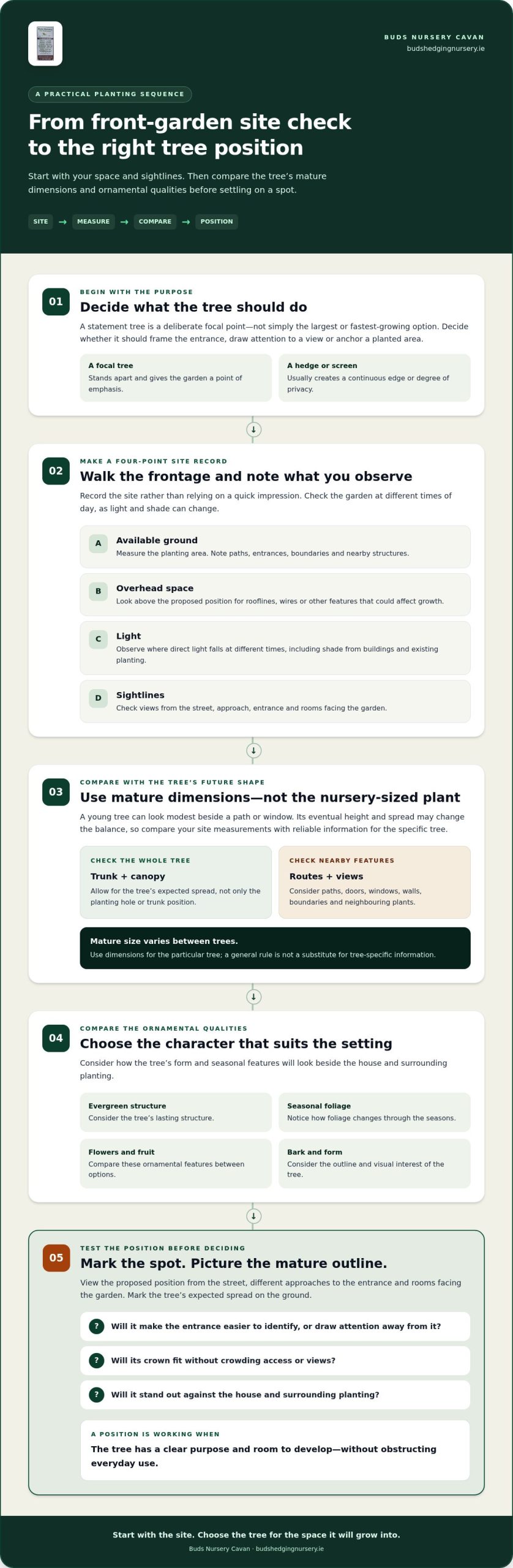
Use this checklist before choosing a front-garden tree
Turn your site notes into a shortlist before browsing tree categories. Work through these points in order, so the tree’s purpose and practical fit guide the choice, rather than appearance alone. Record measurements and observations as you go.
- Purpose: Decide whether the tree should frame the entrance, mark a view or anchor a planted area.
- Site: Note the planting area, overhead clearance, paths, structures, light conditions and views from the street and home.
- Mature dimensions: Compare the available space with reliable information on the selected tree’s eventual height and spread.
- Ornamental qualities: Choose the main feature you value, such as evergreen structure, seasonal foliage, flowers, fruit or bark.
- Buying format: Consider whether a younger tree suits your plans or whether a mature specimen is worth exploring.
What should you measure and record first?
Measure the planting area and note nearby paths, boundaries and structures. Record overhead clearance, where direct light falls through the day and which views you want the tree to frame. Then list your preferred ornamental qualities, putting the most important first. These notes give you a clear basis for comparing options and help prevent a striking feature from taking priority over the realities of the site.
Should you consider a mature tree?
A young tree takes time to establish and develop its presence; a mature specimen can make a more immediate visual impact. Its size also makes careful matching to the site essential. Buds Nursery’s rootballed and bare-root mature trees are available on request. For separate guidance on planting timing, see the bare-root tree season guide.
Buying format is part of the decision, not an afterthought. Think about the planting position, the tree’s dimensions and the effect you want from the outset. A mature tree may suit a plan where an established focal point is a priority, while a younger specimen may suit a plan that allows for growth over time. The right choice depends on the garden and your planting aims.
Use your notes to compare statement trees for front garden settings against the actual site, not just a photograph. Buds Nursery has been established for over 30 years, and visitors can select plants on site with expert plant guidance. Bring your planting area, overhead clearance, light observations and preferred qualities when comparing options. Explore Buds Nursery’s tree range as you narrow your shortlist.
Find statement trees through Buds Nursery’s ornamental-tree range
With your site measurements and priorities in hand, you can start comparing suitable tree options. Buds Nursery’s ornamental-tree category is a practical starting point if you’re looking for a focal tree for the front garden. Buds Nursery has been established for over 30 years, and visitors can select plants on site with expert guidance on plant selection.
What can you explore at the nursery?
The nursery’s categories include ornamental trees, shrubs, hedging and fruit trees. Each can play a different part in the garden: an ornamental tree may provide a focal feature, while shrubs and hedging can contribute structure or define a boundary. Fruit trees add a different purpose to the planting plan. Your measurements and preferred qualities can help narrow the options before you browse.
On-site plant guidance can help you consider how a tree fits the position you have in mind. Bring your recorded planting area, overhead clearance, light observations and views to discuss. These details are more useful than choosing from appearance alone, as they connect the tree’s form and expected dimensions with the space it needs. Buds Nursery offers ornamental trees, shrubs, hedging and fruit trees for customers to explore.
How can you take the next step?
Compare tree options against your notes: the role you want the tree to play, its mature dimensions, the available space and the ornamental feature that matters most. Also consider the buying format. A younger tree suits a plan that allows time for it to establish and grow; a mature tree may suit a plan for a more developed specimen from the outset. Its scale still needs to fit the site.
Buds Nursery’s rootballed and bare-root mature trees are available on request. This is an option to consider if you’re looking for a larger specimen. For planting and establishment, follow guidance appropriate to the selected tree and its format. Delivery service is available pending quantity and site location.
Choosing statement trees for front garden spaces is a matter of matching the focal effect to the real conditions at home. A clear record of the site makes it easier to discuss options and assess whether a tree’s form and buying format suit your plans. Buds Nursery’s on-site plant guidance can support that practical comparison.
Explore Buds Nursery’s tree range with your measurements and planting priorities in mind.
Turn your shortlist into a planting plan
Use your measurements to shortlist trees whose mature form suits the frontage. The right statement trees for front garden spaces should work from the street and from the views you use every day. Keep your choice flexible until you’ve considered how its shape and scale relate to the house and surrounding planting.
Buds Nursery has been established for over 30 years, and on-site plant guidance can help you compare options against your site notes. If a more developed focal point suits your plans, rootballed and bare-root mature trees are available on request. Keep your priorities to hand as you explore, so the tree you choose fits the garden you have rather than an idealised picture.
Explore the Buds Nursery tree range with your shortlist, measurements and planting priorities in mind. Use them to compare suitable options and choose a tree that fits your front garden.
Frequently Asked Questions
What is a statement tree for a front garden?
A statement tree is selected to give the garden a clear focal point. Its contribution might be height, structure or seasonal interest, depending on the tree and its surroundings. For example, you could use one to draw the eye towards a planted area or give an open frontage a stronger centre. Decide what role you want it to play first, then check whether its mature dimensions suit that position.
Can a statement tree work in a small front garden?
Yes, if its eventual form suits the available space. Measure the planting area and consider how the tree will relate to paths, boundaries and nearby buildings as it grows. A young tree can give little indication of its future scale, so use reliable information for the particular tree you’re considering. In a tight frontage, also consider whether the canopy could crowd a route or affect an important view. If ground space is particularly restricted, exploring container-grown or potted sculptural trees via resources like mori-bonsai.com can provide useful design inspiration for introducing dramatic living focal points on a more compact scale.
How do I choose the right size statement tree?
Choose by the space the tree will occupy as it matures, not by its size on planting day. Compare its expected height and spread with the garden’s dimensions, allowing for nearby structures, paths and the view you want to retain. The right size is one that can develop while still fitting the garden’s purpose. Check information for the specific tree, as broad categories alone don’t establish its eventual dimensions.
Where should I position a statement tree in a front garden?
Position it where it has a clear visual role without obstructing access or a view you value. Consider how it looks from the street, entrance and main windows, as these viewpoints can suggest different planting spots. Check the proposed area’s light at different times of day and note any shade from buildings. A useful test is to mark the position temporarily and view it from each approach before deciding.
When is the right time to plant a statement tree?
The suitable planting time depends on the tree’s form and the conditions at the site. Bare-root and potted trees can have different planting considerations, so follow guidance that matches the chosen tree and format rather than assuming one calendar window suits all. Buds Nursery’s bare-root tree season guide covers seasonal considerations for that format.
Are mature statement trees available from Buds Nursery?
Yes. If you’re considering a mature specimen, first note the approximate height and spread that could suit your site, along with the access route to the planting position. This gives you a practical starting point for comparing suitable options.
Does Buds Nursery deliver statement trees?
Delivery service is available pending quantity and site location. The tree’s size and buying format are useful details to consider when planning how it will reach the planting site. For instance, a mature tree may need different handling from a smaller specimen. Keep the access route and final planting position in mind as you compare options.