

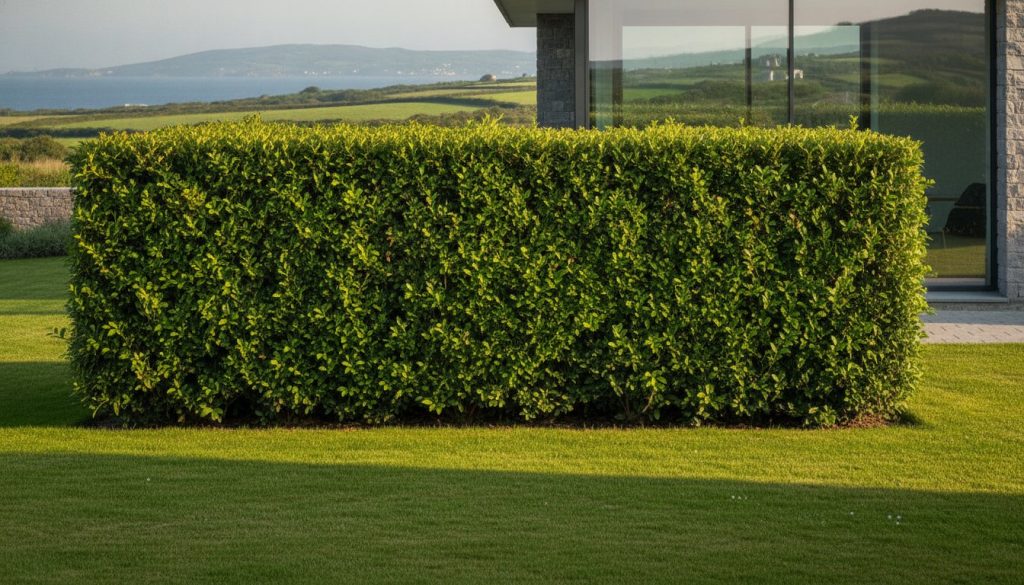
Griselinia is the undisputed champion of the Irish coast, yet many inland gardeners still worry that a single harsh winter could wipe out their entire investment. It’s a valid concern for anyone who has seen a tender hedge struggle after a heavy frost or sit stagnant in waterlogged clay. You likely want that signature apple-green foliage for year-round privacy, but you need to know that your site selection and soil preparation are up to the task.
Choosing griselinia hedging plants Ireland is a smart move for those seeking a fast-growing, salt-tolerant screen that maintains its colour through every season. This 2026 guide will give you the confidence to plant, prune, and protect your hedge effectively. We’ll examine the best spacing requirements for a dense finish, the correct timing for maintenance under current wildlife regulations, and the practical steps needed to help this New Zealand native thrive in the unique Irish climate. Whether you’re dealing with coastal wind or heavy inland soil, you’ll discover how to establish a resilient, professional-looking boundary that lasts for decades.
Key Takeaways
- Select the best variety for your garden by comparing the growth habits and visual characteristics of standard and variegated cultivars.
- Assess your local micro-climate to protect griselinia hedging plants Ireland from inland frosts and heavy clay conditions.
- Calculate the exact number of plants per metre needed to create a thick, wind-resistant privacy barrier that lasts.
- Determine the best times for planting and pruning to ensure quick establishment whilst complying with 2026 wildlife regulations.
- Understand why specialist nursery stock provides superior hardiness and survival rates compared to mass-produced retail options.
Why Griselinia Littoralis is a Favourite for Irish Gardens
Griselinia littoralis is an evergreen shrub known for its leathery, apple-green leaves. Most gardeners in Ireland simply refer to it as Griselinia. This plant originated in New Zealand, where it is known by the Māori name Kapuka. This origin is significant for growers. The species evolved in maritime conditions very similar to the Irish coast. It handles high winds and salt spray with ease. This makes griselinia hedging plants Ireland a staple for gardens in exposed areas from Donegal down to West Cork.
Whilst many evergreen options have dark, heavy foliage, Griselinia offers a brighter alternative. It provides a softer look than traditional Cherry Laurel. The botanical characteristics of Griselinia littoralis allow it to remain vibrant even in tough sites. It doesn’t suffer from the “salt burn” that turns other species brown after a winter storm. It’s a hardworking plant that maintains its appearance with minimal fuss.
The Distinctive Apple-Green Foliage
The leaves are the primary reason for this plant’s popularity. They have a glossy, light-reflecting surface. This property helps brighten up shaded corners of a garden by bouncing available light. The leathery texture is a functional trait. It acts as a physical barrier against the elements. This waxy coating prevents salt and wind from drying out the plant’s internal tissues. Because it stays dense and leafy throughout the year, it is often recommended as the best hedging for privacy Ireland homeowners can choose. It creates a solid wall of green that looks as good in January as it does in June.
Growth Rate and Final Height
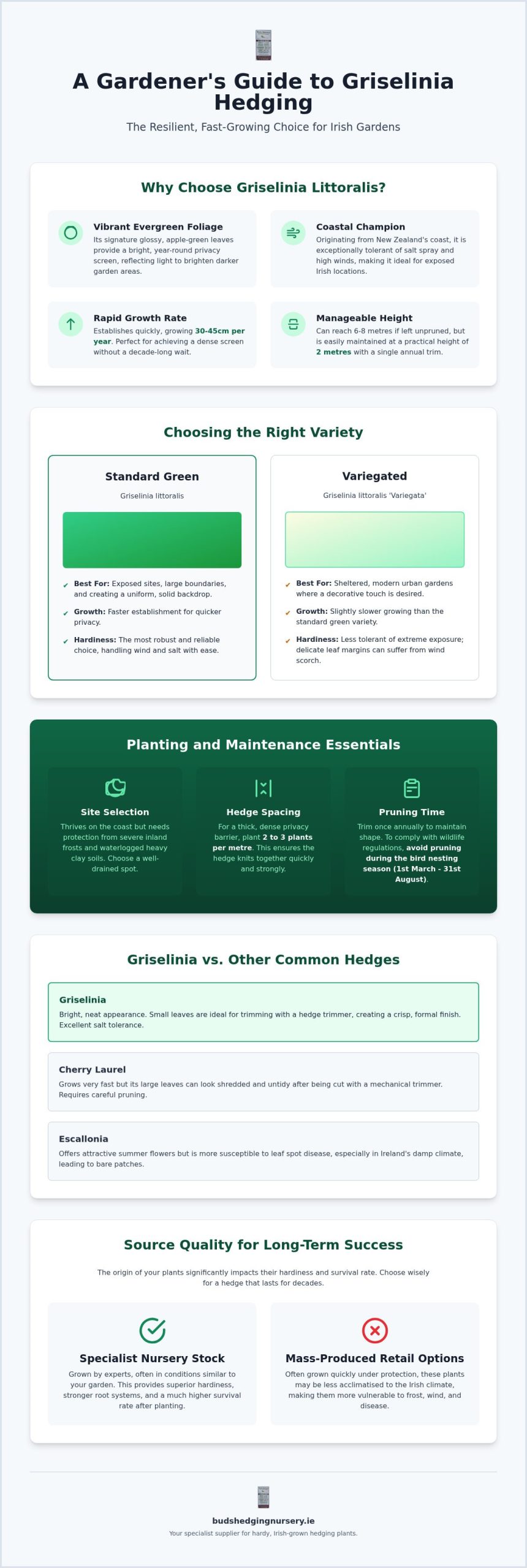
Griselinia is a relatively fast grower. In typical Irish soil and weather, you can expect between 30cm and 45cm of new growth every year. This speed is ideal for establishing a screen without waiting a decade. If you leave griselinia hedging plants Ireland to grow naturally, they can reach heights of 6 to 8 metres. However, most residential gardens don’t need that much scale. The plant is easily maintained at a height of 2 metres with a single annual trim. This flexibility makes it suitable for small urban boundaries and large rural windbreaks alike. It’s a practical choice for those who want height without losing control of the hedge’s footprint.
Choosing the Right Variety for Your Garden
Selecting the right variety of griselinia hedging plants Ireland depends on your garden’s exposure and your aesthetic goals. While the common species is the most frequent sight across the country, several cultivars offer different growth habits and colours. Understanding these subtle differences ensures you don’t plant a variety that might struggle in your specific micro-climate or clash with your existing landscape design.
Standard Green Griselinia littoralis remains the most reliable choice for a functional screen. It grows quickly and handles the brunt of Atlantic winds with minimal stress. For those wanting a decorative look, Griselinia littoralis “Variegata” features creamy-white margins on the leaves. These light edges provide a striking contrast against darker garden plants. As noted in the BBC Gardeners’ World guide to growing griselinia, choosing the right cultivar is the first step toward a healthy hedge. Variegated types grow slightly slower and are generally less tolerant of extreme exposure than their green counterparts.
Standard Green vs Variegated Options
Green varieties are the workhorses of the hedging world. They establish faster in exposed sites and provide a more uniform, solid wall of colour. These are best suited for large rural boundaries or traditional garden designs where a consistent backdrop is required. Variegated options add a decorative touch that works well in modern, smaller urban gardens. They help break up the visual weight of a solid fence or wall. If you choose a variegated variety, place it in a spot with slightly more shelter to protect the delicate leaf margins from wind scorch during the winter months.
Griselinia vs Other Privacy Hedges
Comparing griselinia hedging plants Ireland with other evergreens helps clarify if it’s truly the best fit for your soil. Cherry Laurel grows faster but has much larger leaves. These can look untidy and “shredded” if you use a hedge trimmer rather than hand shears. Escallonia is a fine choice if you want summer flowers amongst your screen, but it is more prone to leaf spot in damp conditions. If you prefer a hedge that changes with the seasons whilst keeping its leaves, beech hedging plants Ireland are a traditional alternative. However, beech does not offer the same lush, tropical feel as Griselinia.
For gardens located further inland where temperatures drop significantly, Portuguese Laurel is often a safer bet. It offers similar evergreen privacy but with higher frost tolerance. Selecting the right stock is vital for success. Plants grown in a local nursery environment are better adapted to the Irish climate than imported stock. You can find a range of these varieties amongst our 60-acre stock at Buds Nursery Cavan. If you need expert advice on plant selection, our team is available on-site from Tuesday to Saturday.
Site Selection: Coastal Hardiness vs Inland Frost Risks
Successful establishment of griselinia hedging plants Ireland depends heavily on where you put them in the ground. In maritime regions, this plant is considered the gold standard for hedging. It typically survives temperatures down to -10°C, which covers the vast majority of Irish winters. However, the difference between a thriving hedge and a struggling one often comes down to micro-climate factors like wind direction and soil drainage.
Whilst it is remarkably adaptable, Griselinia has specific soil preferences. It thrives best in well-drained soil but is quite tolerant of different pH levels, whether your ground is slightly acidic or alkaline. The main threat to its health isn’t the soil chemistry, but rather the physical structure of the earth. If the ground remains saturated for weeks on end, the root system will suffer. This makes site preparation essential for anyone planting in the heavier soils found in the Irish midlands.
Thriving in Coastal Exposure
Griselinia is uniquely suited to the salt-laden air of the Irish coast. Unlike rigid timber fencing that can catch the wind and buckle, a Griselinia hedge acts as a natural filter. It slows the wind speed without creating the turbulent “eddy” effect that often damages plants behind solid walls. Its leathery leaves are famously resistant to salt burn. This is a condition that turns many other evergreens brown and brittle after a storm. This resilience is why you see it used so frequently in large-scale coastal landscaping projects across the country.
Protecting Inland Hedges
Inland sites present a different set of challenges, specifically frost pockets and heavy soil. If your garden is in a low-lying area where cold air settles, your hedge faces a higher risk during extreme cold snaps. When planting griselinia hedging plants Ireland away from the coast, try to choose a position sheltered from harsh north-easterly winds. These winds can desiccate young foliage before the root system is fully established.
Drainage is the most critical factor for inland success. Griselinia “hates wet feet” during the long, damp months of an Irish winter. If your soil is heavy clay, you must improve the drainage before planting. Waterlogged soil prevents oxygen from reaching the roots, which can lead to root rot or hedge death during a freeze. For young plants, using horticultural fleece during an unusual cold snap (below -10°C) can provide just enough protection to prevent leaf drop. This extra care in the first two years often makes the difference between a permanent privacy screen and a failed project. Taking the time to assess your site’s micro-climate before you dig will save a lot of frustration later on.
Planting and Maintenance for a Thick, Healthy Hedge
Establishing a hedge requires more than just digging a hole. The timing of your planting dictates how quickly the root system takes hold. For griselinia hedging plants Ireland, the best windows are autumn or early spring. Autumn planting benefits from soil that still holds summer heat, whilst spring planting allows the hedge to establish just as the growing season begins. Avoid planting during periods of prolonged waterlogging or when the ground is frozen solid.
The Step-by-Step Planting Process
Following a methodical process ensures your plants survive the first year. A common mistake is planting too deep or failing to firm the soil. Use these steps for the best results:
- Step 1: Dig a trench twice the width of the root ball. Incorporate well-rotted organic matter into the bottom of the trench to improve soil structure and drainage.
- Step 2: Space your plants 45cm to 60cm apart. This equates to roughly 1.5 to 2 feet between each stem. This spacing ensures the foliage knits together quickly to form a solid privacy screen.
- Step 3: Backfill the soil around the roots, firming it down with your heel as you go. This removes air pockets that can cause roots to dry out. Water the area thoroughly immediately after planting.
- Step 4: Apply a layer of mulch, such as bark or compost, around the base. This suppresses weeds and helps the soil retain moisture during the first critical summer.
Annual Care and Pruning Schedule
Pruning is the key to maintaining a neat, formal shape. The best time to clip your Griselinia is late spring or early summer. By this time, the risk of a late frost has passed. You should avoid pruning in late autumn. Any new growth stimulated by a late trim will be soft and highly vulnerable to winter cold. A single annual trim is usually sufficient to keep the hedge at a manageable 2-metre height.
Feeding your hedge ensures it reaches its full potential. Apply a balanced fertiliser in early spring to kickstart growth. During the first two seasons, keep a close eye on watering, especially during dry spells in May and June. Once established, the hedge is remarkably self-sufficient. If you are ready to start your project, you can buy griselinia hedging plants directly from our specialist nursery in Cavan for national delivery across Ireland.
Sourcing Quality Griselinia from a Specialist Plant Nursery
Sourcing your griselinia hedging plants Ireland from a dedicated grower makes a significant difference in the long-term health of your garden boundary. Whilst “big box” retail stores often stock mass-produced imports, a specialist nursery focuses on the vigour of the root system and the hardiness of the foliage. Plants that have been tended by professionals for several seasons develop a much stronger foundation, leading to higher survival rates once they are moved to your site and subjected to the Irish elements.
You generally have two main options when buying: pot-grown or bare root. Pot-grown plants offer the flexibility of being planted at any time of the year, provided the ground isn’t frozen or waterlogged. For those planning a large-scale project or a long rural boundary, the bare root tree season Ireland is often the most cost-effective choice. This window typically runs from November to March and allows for the transplanting of dormant stems that establish quickly as the soil warms in the spring months.
The Benefits of Hardened, Irish-Grown Stock
Choosing a specialist plant nursery Ireland ensures your hedge is already acclimated to our specific weather patterns. At Buds Nursery Cavan, we grow our stock across 60 acres, meaning the plants have already survived the damp winters and unpredictable frosts they will face in your garden. This “hardening off” process makes them far more resilient than plants brought in from warmer European climates that often struggle with the transition to a wetter, windier environment.
Our 30 years of horticultural experience allows us to select and cultivate only the most vigorous specimens for our customers. This expertise ensures that every plant leaving the nursery has a well-developed root structure capable of supporting rapid growth in its new home. We prioritise the health of the plant over high-volume retail turnover, which is why our stock often outperforms general garden centre alternatives.
Professional Advice and Delivery
Visiting a nursery in person allows you to see mature specimens and gauge the final scale of your hedge before you commit to a purchase. The team at Buds Nursery Cavan is available on-site from Tuesday to Saturday to provide practical guidance on plant selection. We can help you match your griselinia hedging plants Ireland to your specific site conditions, whether you are dealing with heavy clay in the midlands or salt spray on the coast. Consulting with an expert before you plant can prevent costly mistakes regarding spacing or soil preparation.
For those unable to visit our Cavan site, we offer a comprehensive national delivery service. We organise the logistics to ensure your hedging arrives safely and in peak condition, regardless of the order size. Whether you are planting a small urban screen or a kilometre-long rural windbreak, we have the capacity to deliver the required volume directly to your door. This professional approach to sourcing and delivery ensures your project starts with the best possible material for a lifetime of privacy and shelter.
Securing Your Garden’s Future with Griselinia
Choosing the right hedge is a long-term investment in your property’s privacy and shelter. As we have explored, Griselinia provides an unparalleled combination of vibrant colour and maritime resilience, provided you manage the site’s drainage and winter exposure correctly. For those who appreciate how bold botanical tones can transform an environment, you can discover Flowers Alley and their vibrant floral designs. By following the 2026 guidelines for spacing and seasonal maintenance, you can ensure your griselinia hedging plants Ireland develop into a dense, professional-grade screen that withstands the Atlantic elements.
At Buds Nursery Cavan, we bring over 30 years of Irish growing experience to help you make the right choice for your specific landscape. Our 60-acre specialist nursery stock is grown to be hardy and reliable, and our experts are available on-site from Tuesday to Saturday to offer tailored advice. Whether you are dealing with coastal wind or inland frost, we can help you select the most vigorous plants for your project.
Explore our range of Griselinia hedging and order for national delivery to begin transforming your garden boundary today. With the right stock and professional guidance, your new hedge will provide a lush, apple-green backdrop for many years to come.
Frequently Asked Questions
How fast does a Griselinia hedge grow in Ireland?
A healthy specimen of griselinia hedging plants Ireland typically grows between 30cm and 45cm per year. In optimal maritime conditions with mild temperatures, it can establish even faster. This rapid growth rate makes it an excellent choice for homeowners who want to create a functional privacy screen within just a few growing seasons. Regular watering during the first two years is essential to maintain this pace.
Is Griselinia hedging frost hardy?
Griselinia is hardy down to approximately -10°C, which makes it suitable for the vast majority of Irish gardens. Whilst it thrives on the coast, it can struggle in severe inland frost pockets where temperatures drop further. If you live in a particularly cold midland area, providing shelter from north-easterly winds or using horticultural fleece during extreme cold snaps will help protect young foliage from damage.
How far apart should I plant Griselinia for a privacy screen?
You should space your plants between 45cm and 60cm apart to achieve a dense, knit-together finish. This spacing, roughly 1.5 to 2 feet, ensures that the branches overlap quickly without the plants competing too aggressively for nutrients. Planting in a single row at this distance usually provides a solid evergreen wall within three to four years of establishment.
Can Griselinia grow in shade or does it need full sun?
Griselinia prefers full sun but will tolerate partial shade quite well. Its glossy, apple-green leaves are excellent at reflecting light, which helps to brighten up darker corners of the garden. However, you may find that a hedge grown in deep shade is slightly less dense than one grown in a bright, south-facing position. It’s best to avoid areas that receive no direct sunlight at all.
What is the difference between Griselinia and Laurel?
The main differences are leaf size, colour, and salt tolerance. Griselinia has smaller, leathery, apple-green leaves and is much more resistant to coastal salt spray. Cherry or Portuguese Laurel have larger, darker green foliage and are generally more frost-hardy for deep inland sites. Griselinia offers a softer, more contemporary look, whilst Laurel provides a traditional, heavy-duty screen that handles severe cold better.
Why are my Griselinia leaves turning yellow or dropping?
Yellowing leaves are almost always a sign of poor drainage or waterlogged soil. This plant is highly sensitive to “wet feet” and requires a well-drained site to thrive. If the soil remains saturated for long periods, the roots cannot breathe, leading to leaf drop. Other causes can include a lack of nutrients in early spring or stress following an unusually harsh frost during the winter months.
Is Griselinia safe for pets and livestock?
Griselinia is generally considered non-toxic to common domestic pets like dogs and cats. It doesn’t carry the same high-toxicity risks associated with species like Yew or Laurel. However, it is not a traditional hedging plant for livestock boundaries. If you are planting near grazing animals, it’s always best to use native species like Hawthorn or ensure a secondary fence prevents animals from browsing on the foliage.
When is the best time of year to plant a Griselinia hedge?
The best time to plant griselinia hedging plants Ireland is during the autumn or early spring. Planting in autumn allows the root system to settle in whilst the soil still holds some summer warmth. Spring planting is also highly effective as it coincides with the start of the new growing season. You should avoid planting during the height of summer or when the ground is frozen during mid-winter.