

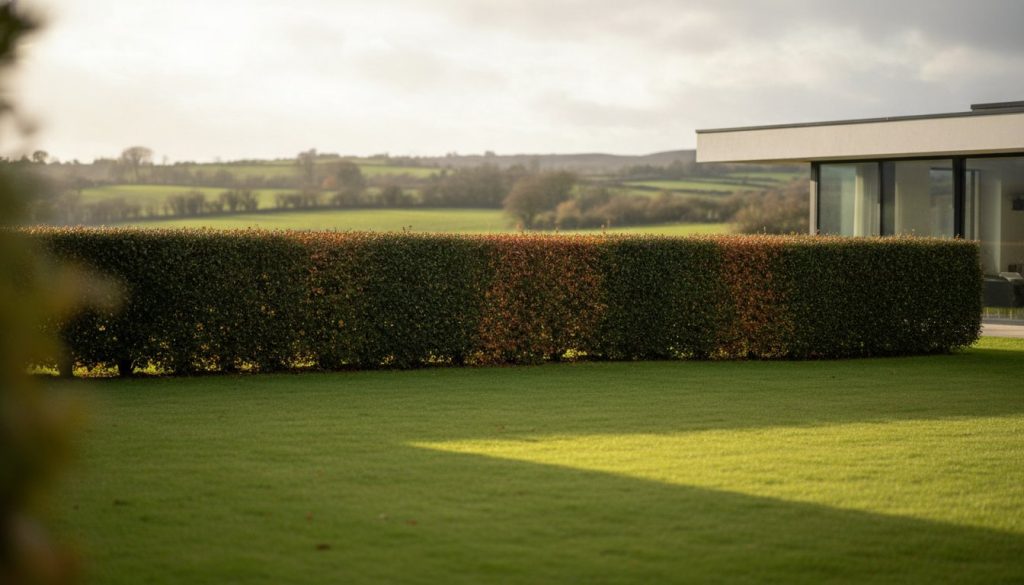
The classic Beech hedge you’ve always admired might actually be the wrong choice for your garden’s soil. If you’re dealing with heavy clay or damp ground, Hornbeam is the resilient alternative that delivers that same architectural look without the risk of failure. When looking for hornbeam hedging for sale, it’s important to choose a variety that can handle the specific challenges of the Irish climate. Carpinus Betulus is that plant, offering a sturdy, reliable boundary where other species often falter.
We know that most homeowners prioritise privacy and a neat, formal appearance above all else. You want a boundary that stays thick and provides a sense of enclosure whilst keeping its structure throughout the winter. This guide will help you discover why Hornbeam is the resilient, architectural choice for Irish gardens and how to establish a thriving hedge that lasts a lifetime. We’ll preview the benefits of bare-root stock, explain the simple pruning requirements, and show you how to get the best results from your planting.
Key Takeaways
- Discover why Hornbeam is the ideal solution for difficult Irish soils, thriving in heavy clay and damp conditions where other hedges struggle.
- Learn how to distinguish Hornbeam from Beech and why its unique leaf retention offers essential winter privacy and wind protection.
- Identify the best options for hornbeam hedging for sale by choosing hardy, acclimatised stock grown specifically for the local climate.
- Master the professional planting and spacing rules needed to create a dense, architectural boundary that provides a lifetime of security.
- Access practical maintenance advice on trimming and soil care to keep your hedge looking its best year-round with minimal effort.
What is Hornbeam Hedging (Carpinus Betulus)?
Carpinus betulus, commonly known as Hornbeam, is a hardy native tree that has served as a cornerstone of European landscaping for centuries. Whilst it’s technically a deciduous species, it behaves much like an evergreen when maintained as a hedge. It’s often the first choice for those seeking hornbeam hedging for sale because of its remarkable ability to tolerate difficult conditions that would kill off more sensitive plants. It produces a dense, interwoven network of branches that provides an impenetrable screen once established.
The aesthetic appeal of Hornbeam lies in its unique texture. During the spring and summer, the foliage is a vibrant, pleated green that catches the light beautifully. As autumn approaches, these leaves shift into a rich palette of copper and gold. Unlike many other deciduous trees, Hornbeam retains these dried leaves throughout the winter months, a trait known as marcescence. This provides year-round interest and privacy, even in the depths of January. Its architectural nature allows it to be clipped into razor-sharp, formal lines, making it a favourite for structured garden designs and traditional boundaries.
For those participating in environmental initiatives, this species is a key component of the Native Trees Scheme in Ireland. It supports local ecology whilst offering all the functional benefits of a traditional boundary. It’s a plant that feels deeply rooted in the landscape, offering a sense of permanence and maturity to even the newest garden projects.
Key Characteristics of Hornbeam
The foliage is easily identified by its serrated edges with deep, distinctive veins that give the leaves a corrugated appearance. This species has an upright, dense growth habit and is incredibly responsive to pruning, allowing you to maintain it at almost any height or width. It’s also a plant of immense longevity; a well-established hedge can last for centuries if the ground is prepared correctly and the plants are given a good start.
Why Gardeners Choose Hornbeam
Privacy is the primary driver for many homeowners looking for hornbeam hedging for sale. During the growing season, the overlapping leaves create a solid visual barrier that blocks out neighbours and noise. Beyond aesthetics, it serves as an exceptional windbreak. The stiff branches and thick foliage filter wind efficiently, reducing its speed rather than blocking it entirely, which protects more delicate plants in exposed garden sites. From an ecological perspective, the wildlife value is significant. It provides secure nesting sites for birds, whilst its leaves serve as a vital food source for various moth caterpillars and local insects.
Hornbeam vs. Beech: Which Should You Choose?
Many gardeners browsing for hornbeam hedging for sale do so because they’ve been told it looks exactly like Beech. While they share a similar architectural silhouette and leaf shape, the two plants are botanically distinct and have very different survival requirements. Choosing between them isn’t just about aesthetics; it’s about matching the right plant to your garden’s specific environment. If you mistake one for the other in the wrong soil, you might find yourself replacing an entire boundary within two years.
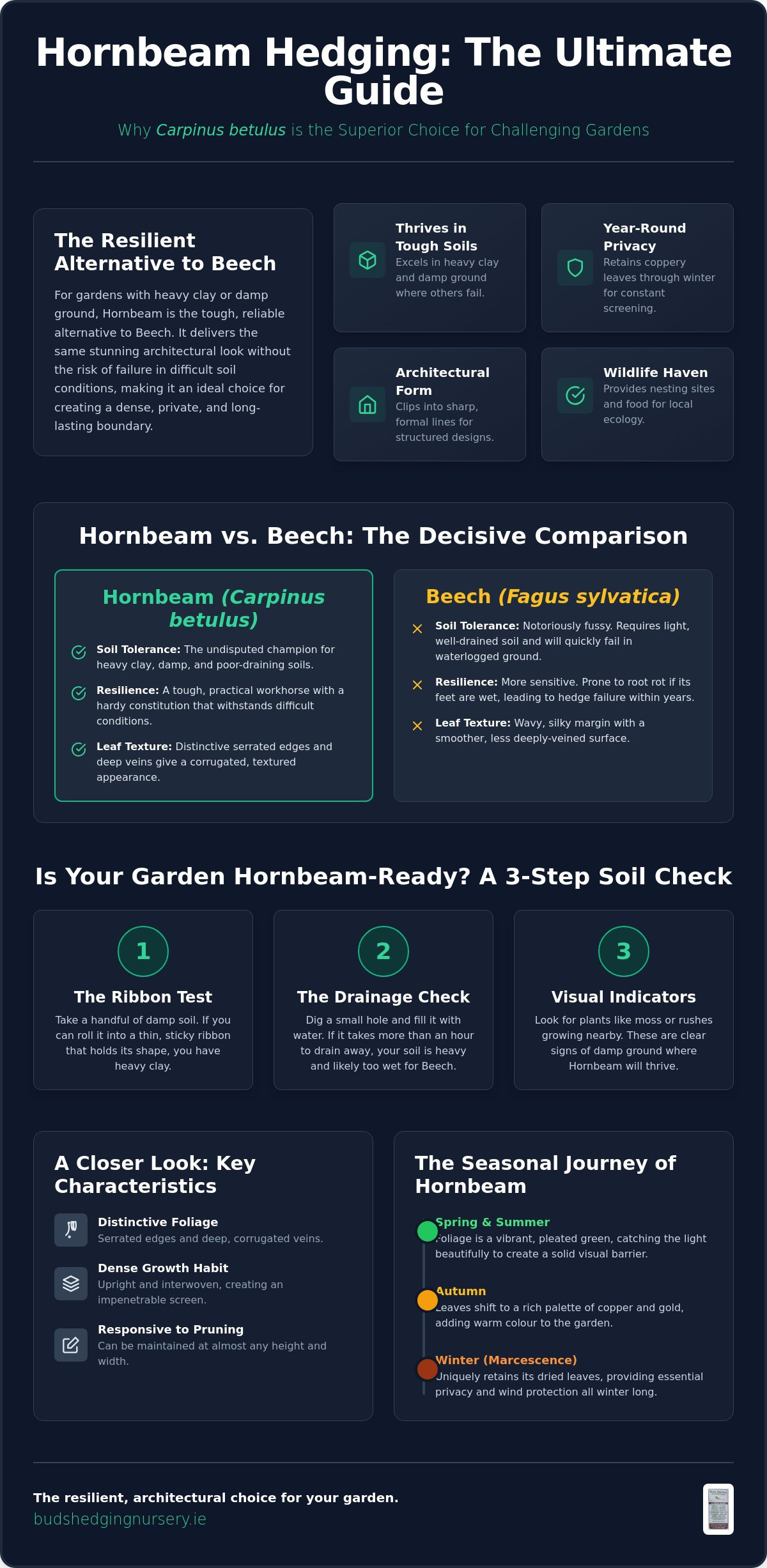
The primary difference lies in their resilience. Beech is a magnificent hedging plant, but it’s notoriously fussy about drainage. It demands light, well-drained soil and will quickly fail if its roots sit in water. Hornbeam is the practical workhorse of the hedging world. It offers that same structured, formal look but possesses a much tougher constitution, particularly when faced with the heavy, damp conditions common across many Irish gardens.
The Soil Factor: Where Hornbeam Wins
Hornbeam is the undisputed champion for heavy clay and damp, low-lying areas. Whilst Beech roots will rot in anaerobic, waterlogged ground, Hornbeam thrives. It’s often the only viable choice for sites near streams or in valleys where frost and moisture settle. According to the NC State Extension Gardener Plant Toolbox, this species is highly adaptable to various soil textures and pH levels, making it a safer bet for sites with unpredictable soil quality.
Before you commit to a purchase, use this quick checklist to identify your soil type:
- The Ribbon Test: Take a handful of damp soil and try to roll it into a thin ribbon. If it holds its shape and feels sticky, you have heavy clay.
- Drainage Check: Dig a small hole and fill it with water. If it takes more than an hour to drain, your soil is likely too heavy for Beech.
- Visual Indicators: Look for moss or rushes growing nearby; these are clear signs of damp ground where Hornbeam will outperform Beech.
Winter Appearance and Leaf Retention
Both species exhibit marcescence, which is the botanical term for retaining dead leaves through the winter. However, the visual effect differs. Beech leaves turn a bright, fiery copper that glows in the winter sun. Hornbeam leaves take on a more muted, parchment-like grey-brown. Whilst Beech is often praised for its winter colour, Hornbeam is slightly less ‘clingy’ with its foliage; it may lose a few more leaves in very exposed or windy sites.
The secret to maximising leaf retention for both species is the timing of your maintenance. Trimming your hedge in late August or early September encourages the plant to hold onto its leaves until the new buds push them off in spring. If you’re unsure which variety will suit your boundary best, it’s worth speaking with a specialist about our hornbeam and beech stock to ensure you get the right fit for your local microclimate.
Site Suitability: Is Your Garden Ready for Hornbeam?
Hornbeam is often called the “all-rounder” for a reason. While we’ve already established its preference for heavier ground, its adaptability extends far beyond just soil texture. It’s a plant that thrives in full sun but is surprisingly tolerant of partial shade, making it a reliable choice for north-facing boundaries or gardens shaded by larger mature trees. This versatility is why many homeowners specifically look for hornbeam hedging for sale when dealing with complex, multi-aspected sites where other species might struggle to maintain uniform growth.
Inland regions of Ireland often struggle with frost pockets where cold air settles in low-lying ground. Hornbeam is safer here than many other species. It tends to leaf out slightly later in the spring, which protects its fresh, bright green foliage from the late-season frosts that can scorch the early growth of Beech. It’s also a robust choice for urban environments. It possesses a high tolerance for atmospheric pollution, allowing it to maintain its health and vigour even in busy town centres or alongside main roads.
Coastal gardens present a different challenge. Whilst it isn’t as salt-tolerant as Escallonia or Griselinia, Hornbeam is remarkably wind-firm. It can handle the buffeting of sea winds on secondary coastal sites without the branches becoming brittle or the shape becoming distorted. Its strength lies in its flexible but tough wood, which was historically used for making heavy-duty tool handles and cogwheels. It provides a sturdy, reliable framework that won’t snap under the pressure of a winter gale.
Damp and Heavy Soil Management
In compacted or wet earth, Hornbeam develops a shallow but incredibly dense and fibrous root system. This allows the plant to “breathe” even when the lower soil levels are saturated. If you’re planting in a particularly waterlogged spot, we recommend planting into a slight mound or “ridge” to keep the base of the stem out of standing water during the first winter. Sourcing your stock from a specialist plant nursery ensures you receive plants that have been hardened off in similar conditions, giving them a much higher success rate than mass-produced imports.
Using Hornbeam for Privacy and Screening
One of the biggest advantages of this species is its ability to provide a thick screen without taking up half the garden. It can be kept very narrow, often as slim as 50cm, which is ideal for smaller urban plots where space is at a premium. If you’re looking to enhance local biodiversity, it works perfectly when mixed with other native species like Whitethorn or Holly. This creates a “tapestry” effect that looks natural whilst providing a year-round visual barrier for your home. When searching for hornbeam hedging for sale, consider the eventual height you need; it can easily reach four or five metres if allowed, making it perfect for blocking out overlooking windows.
Planting and Maintenance for a Thick Hornbeam Hedge
Selecting the right hornbeam hedging for sale is only half the battle; the work you put in during the first six months determines the success of your boundary for decades. Establishing a thick, healthy hedge starts with ground preparation. You should clear a one-metre wide strip of all grass and weeds to prevent competition for nutrients. Dig a trench twice the width of the root mass and break up the soil at the base to help the roots penetrate the deeper layers quickly. When you place the plant, ensure the “nursery line” on the stem sits exactly at soil level. Backfill with a mix of native soil and well-rotted organic matter, then firm it in with your heel to remove air pockets.
Timing is everything. Most gardeners prefer to buy bare-root stock because it’s cost-effective for long boundaries, but this is strictly limited to the planting season between November and March. If you miss this window, potted plants can be used year-round, though they require much more frequent watering during their first summer. Regardless of when you plant, a thick layer of bark mulch will help retain moisture and suppress weeds whilst the hedge establishes its root system.
Spacing and Density Calculations
To achieve a dense, privacy-providing screen, we recommend a ratio of 3 to 5 plants per metre. For a standard garden hedge, a single row with plants spaced 33cm apart is sufficient. However, if you want an “instant” thick screen, the staggered double row technique is superior. This involves planting two parallel rows about 40cm apart, with the plants in the second row positioned in the gaps of the first. This “zig-zag” pattern creates a much deeper visual barrier and a sturdier windbreak. To calculate your requirements, simply multiply your boundary length by your chosen density factor.
Ongoing Care: Pruning and Feeding
The “Golden Rule” for a thick Hornbeam hedge is formative pruning. Don’t be afraid to cut the leading shoots back by about a third immediately after planting. This might feel counterintuitive, but it forces the plant to produce multiple side shoots from the base, preventing a “leggy” look later on. For established hedges, the best time to prune is mid-to-late August. Trimming at this time allows the plant to recover before winter whilst encouraging it to hold onto its brown leaves until spring, providing that essential winter screening.
Keep your hedge vigorous by applying a general-purpose fertiliser every spring. If your soil is particularly poor, a top-dress of composted manure will improve the structure and help the plants reach their full growth potential of 30cm to 60cm per year. Ready to start your project? You can order your bare-root hornbeam today directly from our nursery for national delivery.
Sourcing Quality Hornbeam for Sale
Buying plants from a general retailer often means getting stock that has spent too much time in transit or sitting on a concrete shelf. When you look for hornbeam hedging for sale, sourcing directly from a specialist nursery is the only way to guarantee the health and vigour of your boundary. Our 60-acre site allows us to grow hardy, acclimatised stock that is already adapted to the local climate and soil conditions. With over 30 years of experience in the trade, we’ve refined our growing methods to produce fibrous root systems that are ready to take off the moment they hit your soil.
The scale of a dedicated nursery also means you get consistency. If you’re planting a long boundary, you need plants that are uniform in height and maturity to ensure the hedge grows at an even rate. Sourcing from a single, large-scale grower prevents the “patchy” look that often occurs when mixing stock from different suppliers. It also allows us to offer expert on-site guidance, helping you choose the right specimens for your specific garden aspect or soil type.
The Specialist Nursery Advantage
The main benefit of a dedicated grower is the “lifted to order” process. For bare-root Hornbeam, we don’t dig the plants from the field until they are ready for dispatch or collection. This keeps the roots moist and dormant, significantly reducing the risk of transplant shock. It’s a level of freshness you simply won’t find in mass-market garden centres. We also produce a wide range of complementary species, such as Portuguese Laurel, which can be used to add evergreen interest or varied textures to your landscaping project.
Understanding your size options is a balance between budget and the need for an immediate screen. We provide everything from 60cm-90cm whips, which are cost-effective and easy to plant, to much larger, more mature specimens. Whips are usually the best choice for large rural boundaries because they establish very quickly and catch up to larger plants within a few seasons. If you need an instant architectural impact for an urban garden, our larger pot-grown options provide immediate privacy without the wait.
Next Steps for Your Garden Project
Whilst you wait for the bare-root season to begin, you can focus on clearing your site and improving the soil as discussed in our planting guide. If you’re managing a large-scale project or need to meet the requirements of the Native Trees Scheme, we recommend contacting us early. We can provide bespoke advice on plant numbers and organise delivery logistics to ensure your stock arrives exactly when you’re ready to plant.
The best way to judge the quality of our hornbeam hedging for sale is to see it in the ground. We invite you to visit the nursery between Tuesday and Saturday to walk the rows and speak with our experienced team. Seeing the plants in their growing environment gives you a clear sense of the quality and scale you can expect for your own garden. Our staff are always on hand to help you load your vehicle or to arrange national delivery for larger orders.
Establish a Resilient Boundary for Your Garden
Choosing a hedge is a long-term investment in your property’s privacy and structure. As we’ve explored, Hornbeam provides a practical solution for difficult Irish soils whilst maintaining a crisp, architectural finish year-round. By selecting the right planting density and timing your maintenance for late summer, you’ll ensure your boundary remains thick and healthy for decades to come.
When you browse our hornbeam hedging for sale, you’re buying directly from a 60-acre specialist nursery with over 30 years of growing experience. We prioritise root health and plant vigour to give your project the best possible start. Whether you need a few plants for a garden gap or a large-scale rural boundary, Buds Nursery Cavan provides expert guidance and national delivery for all hedging orders.
View our range of Hornbeam Hedging for sale at Buds Nursery Cavan and start planning your project today. With the right preparation and quality stock, your new hedge will quickly become a thriving, permanent feature of your landscape.
Frequently Asked Questions
When is the best time to buy and plant hornbeam hedging?
The best time to plant bare-root hornbeam is between November and March whilst the plants are dormant. This is the most cost-effective way to establish a boundary and ensures the best survival rate. If you miss this window, pot-grown stock is available for year-round planting. When looking for hornbeam hedging for sale, aim to plant during the cooler months to reduce watering needs and help root systems settle.
How fast does hornbeam grow per year?
Hornbeam has an average to fast growth rate of approximately 30cm to 60cm per year. This makes it an excellent choice for gardeners wanting to establish a tall screen within a few seasons. Once the hedge reaches your desired height, you can easily maintain it with a single annual trim. Regular feeding in the spring will help younger plants reach their full growth potential more quickly.
Is hornbeam evergreen or deciduous?
Hornbeam is technically a deciduous tree, but it behaves similarly to an evergreen when kept as a clipped hedge. It retains its dried, brown leaves throughout the winter months, providing year-round privacy and wind protection. These old leaves only fall when the new green buds begin to push through in the spring. This characteristic makes it a popular, hardy alternative to beech for screening purposes.
Will hornbeam grow in wet or boggy soil?
Hornbeam is highly resilient and will thrive in heavy clay or damp soils where other species might fail. It is far more tolerant of “wet feet” than beech. However, it will not survive in permanently waterlogged or boggy ground where there is no drainage at all. If your site is particularly wet, planting into a slightly raised mound can help the root system establish successfully.
How far apart should I plant hornbeam for a thick hedge?
For a standard, single-row hedge, you should plant three specimens per metre. If you require a denser, more immediate screen, we recommend a staggered double row using five plants per metre. This zig-zag pattern creates a thicker visual barrier and improves the hedge’s performance as a windbreak. Proper spacing ensures each plant has enough light and nutrients to develop a strong, interwoven structure.
Does hornbeam need a lot of maintenance?
This is a low-maintenance hedging choice that typically requires only one trim per year. The best time for this is mid-to-late summer, which encourages the plant to retain its winter foliage. Beyond pruning, you should keep the base of the hedge clear of weeds and grass during the first two years of growth. An annual mulch of organic matter will provide all the nutrients the plants need.
Can I grow hornbeam as a standalone tree instead of a hedge?
You can certainly grow Carpinus betulus as a standalone specimen tree rather than a hedge. When left unpruned, it develops into a magnificent, medium-sized tree with a rounded crown, reaching heights of over 20 metres. It’s often used in parklands or as a feature tree in larger gardens. We provide various sizes for those looking for hornbeam hedging for sale or individual trees for landscaping projects.
Why is my hornbeam hedge losing its leaves in winter?
Whilst hornbeam usually retains its leaves, it may lose them if it’s very young or planted in an exceptionally exposed, windy site. The timing of your pruning also plays a role; trimming in late summer helps the plant “lock” its leaves in place. It’s also worth noting that some leaf loss is natural as the plant matures. This won’t affect the health or the spring regrowth of your hedge.