

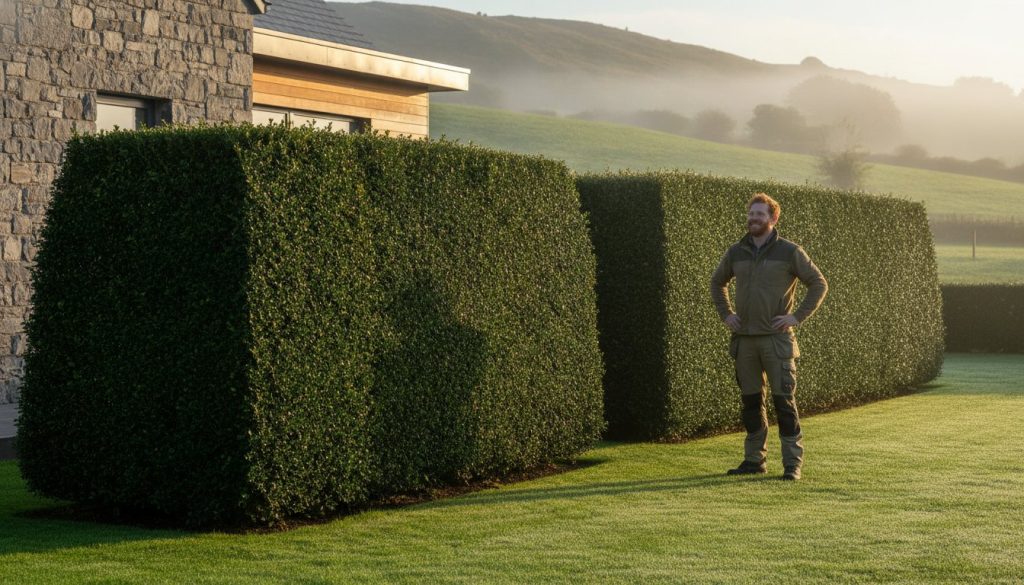
If you think Taxus baccata is too temperamental for the damp Irish climate, you might be overlooking the most resilient evergreen in our horticultural history. While it’s true that yew won’t tolerate standing water, it remains the gold standard for privacy and longevity when planted with the right preparation. Choosing taxus baccata hedging ireland for your garden is a commitment to a legacy hedge that can last centuries. You likely want that classic, deep green backdrop but worry about the risk of root rot in heavy soil or the safety of pets and livestock. It’s a common concern that often prevents gardeners from choosing the best material for the job. This guide will show you how to master the art of growing the “King of Hedges” with confidence. We’ll clarify the differences between Common Yew and the upright Irish Yew, explain the exact spacing required for a dense screen, and provide a practical plan for soil preparation. By the end, you’ll have a clear understanding of growth rates and the maintenance steps needed to keep your hedge healthy through the 2026 season and beyond.
Key Takeaways
- Distinguish between Common Yew and the upright Irish Yew to ensure you select the correct variety for a traditional, dense garden boundary.
- Identify the essential drainage requirements and soil preparation steps needed to successfully establish taxus baccata hedging ireland in damp conditions.
- Learn how to calculate the perfect spacing for bare root and rootballed plants to achieve a seamless, high-privacy screen.
- Master the annual maintenance schedule and safety considerations to maintain a healthy hedge while protecting local livestock and pets.
Understanding Taxus Baccata: The King of Irish Hedging
Taxus baccata (Common Yew) is a long-lived, evergreen conifer that has earned its reputation as the “King of Hedges.” Investing in taxus baccata hedging ireland provides a sense of permanence that few other plants can match. Common Yew is an exceptionally hardy (RHS H7) evergreen capable of living for centuries. Its historical significance amongst Irish landscapes is profound, with specimens found in ancient monastic sites and the country’s oldest grand estates. It’s a “legacy” plant, often chosen by gardeners who want to create a structure that endures for generations. The primary aesthetic benefit is the perfectly neat, formal finish it offers; when clipped correctly, it forms a crisp, dark green wall that serves as the ultimate backdrop for colourful herbaceous borders. This species is remarkably versatile, thriving in both the shade of large trees and the bright, open spaces of an Irish garden. Beyond its beauty, the dense structure provides a year-round windbreak and an excellent sound barrier. The sheer thickness of the needle growth is capable of absorbing high-frequency noise, making it a practical choice for properties near busy roads or exposed coastal sites.
Botanical Traits and Seasonal Interest
The foliage consists of flat, dark green needle-like leaves that maintain a consistent colour throughout the year. As the plants mature, they develop a beautiful, flaking red-brown bark. In spring, inconspicuous flowers appear, which develop into striking red arils, or berries, on female plants by late summer. While the seeds are toxic, the fleshy red coating is a vibrant seasonal highlight that contrasts against the deep green needles.
Biodiversity and Wildlife Value
Yew is a powerhouse for Irish biodiversity, making taxus baccata hedging ireland a great choice for eco-conscious gardeners. Its dense canopy provides vital nesting sites for small birds like the Goldcrest and Robin, offering shelter from predators. During winter, the red berries are a crucial food source for thrushes and waxwings. Although an ancient species, it supports a wide range of local insects, bridging the gap between formal design and native ecological needs.
Adapting to the Irish Climate: Hardiness and Soil Needs
Taxus baccata is one of the toughest plants available for the Irish landscape. It possesses an exceptional level of hardiness, easily surviving temperatures that drop below -20°C. While our winters rarely reach such extremes, this resilience ensures the hedge remains vibrant even after a harsh frost. It’s also remarkably versatile regarding light. Unlike many evergreens that thin out in the shade, Yew maintains its density in everything from full sun to deep, north-facing shadows. This makes it a reliable choice for gardens with complex light patterns or overhanging trees.
The primary challenge for taxus baccata hedging ireland isn’t the cold or the light; it’s the water. Yew is famously intolerant of “wet feet.” In a country with high annual rainfall, ensuring your soil doesn’t become waterlogged is the most critical part of the planting process. If the roots sit in stagnant water, they quickly succumb to rot. According to the European Commission’s Atlas of Forest Tree Species, this species naturally prefers well-drained soils, often thriving on limestone outcrops where water moves freely. If you’re unsure about your garden’s suitability, you can browse our range of hardy hedging to see which stock best fits your specific ground conditions.
The Drainage Dilemma: Preparing Your Ground
Before you dig, check your drainage. A simple test involves digging a hole and filling it with water; if it hasn’t drained within a few hours, you have a problem. You can improve heavy clay soil by incorporating plenty of coarse grit and well-rotted organic matter. This opens up the soil structure and allows oxygen to reach the roots. In particularly damp gardens, we recommend planting your hedge on a slight mound. This raised position keeps the base of the stem and the upper roots above the saturation zone during heavy winter downpours.
Exposure and Salt Tolerance
Yew is a superior choice for exposed or coastal sites. Its small, tough needles have a low surface area, which prevents the wind scorch often seen on large-leafed plants like Cherry Laurel. It also handles salt spray remarkably well, making it suitable for gardens along the Atlantic or Irish Sea coasts. For those establishing a hedge on a north-facing boundary, the key is patience. Whilst it will grow in the shade, it does so more slowly than in a sunny spot. Providing a good mulch and ensuring the soil is clear of competing weeds will help a young taxus baccata hedging ireland establish its root system more effectively in these tougher conditions.
Common Yew vs. Irish Yew: Selecting the Right Variety
Many gardeners and landscapers use the terms “Common Yew” and “Irish Yew” interchangeably. This is a mistake that can lead to poor results when establishing a boundary. When you are sourcing taxus baccata hedging ireland, you must distinguish between the species and its cultivars. Common Yew (Taxus baccata) is the natural species. It has a spreading, bushy growth habit with needles arranged in two flat rows along the twigs. This horizontal reach is exactly what you need for a traditional hedge because it allows the plants to knit together into a solid, gap-free wall.
In contrast, the Irish Yew (Taxus baccata ‘Fastigiata’) is a specific cultivar with a strictly upright, columnar habit. Its needles grow all around the twig, giving it a fuller, bottle-brush appearance. Whilst it is a beautiful plant, it is generally unsuitable for a standard boundary hedge. If you plant Irish Yew in a row, the columns will struggle to merge at the base, leaving you with a series of vertical pillars rather than a unified screen. For detailed advice on identifying these varieties, the RHS Yew Growing Guide provides excellent visual markers for each type.
The “Fastigiata” Factor
The Irish Yew has a fascinating history, originating from two seedlings found on the slopes of Cuilcagh Mountain in Co. Fermanagh in 1767. Because of its vertical nature, ‘Fastigiata’ is best used as a “punctuation mark” in garden design. It works well when framing a doorway, marking the end of a path, or acting as a centre-piece in a formal bed. Don’t use it for a boundary that you intend to top at a specific height; its internal structure isn’t designed to fill out horizontally after pruning in the same way the Common Yew does.
Growth Rates: Managing Expectations
There’s a persistent myth that Yew is too slow for modern gardens. This often leads people to choose Leylandii, which frequently becomes an unmanageable liability. Once established, taxus baccata hedging ireland typically grows between 20cm and 30cm per year. It isn’t a “set and forget” plant in its first two seasons, but with proper care, it reaches a functional height surprisingly quickly. You can accelerate this early progress by following a few practical steps:
- Apply a high-quality fertiliser in early spring to kickstart the growing season.
- Maintain a 5cm layer of organic mulch, such as bark or compost, to retain moisture and suppress weeds.
- Keep the area around the base clear of grass, which competes for vital nutrients and water.
By choosing the species Taxus baccata and providing these basic needs, you’ll achieve a dense, manageable hedge that offers far more long-term value than faster-growing, thinner alternatives. If you’re weighing up your options, our guide to laurel hedge ireland varieties offers a useful side-by-side comparison of the most popular evergreen screening plants.

Planting and Spacing Your Yew Hedge for Success
Timing is everything when establishing a new boundary. The ideal window for planting taxus baccata hedging ireland falls during the bare root tree season Ireland, which typically runs from November to March. During this dormant phase, the plants experience minimal stress. This allows them to focus their energy on root development before the spring flush begins. Planting while the ground is cold but not frozen gives the hedge the best possible start in our temperate climate.
For a long boundary, digging a continuous trench is far more efficient than individual holes. It ensures consistent soil quality and makes alignment much easier. Ensure the trench is at least twice the width of the root system. If your soil is heavy, remember the drainage advice from earlier and break up the bottom of the trench with a fork to prevent compaction. We also recommend using mycorrhizal fungi at the time of planting. These beneficial organisms form a symbiotic relationship with the roots, significantly improving nutrient and water uptake. While Yew is drought-tolerant once mature, it requires consistent watering during its first two growing seasons. Don’t let the soil dry out completely, especially during dry spells in April or May.
Calculating Density and Spacing
For a standard garden hedge, the rule of thumb is 3 plants per metre. This provides enough room for each plant to grow without excessive competition for resources. If you need an impenetrable, thick screen quickly, consider a double-staggered row. This involves planting two parallel rows with the plants offset in a zig-zag pattern. This method requires more plants but results in a much deeper, more robust barrier. For more precise numbers based on your specific garden dimensions, consult our hedging plant spacing guide.
Rootball vs. Bare Root vs. Potted
Bare root Yew is the most cost-effective option for large-scale rural boundaries. It’s lightweight and easy to transport, though it must be planted immediately upon delivery to prevent the roots from drying out. For those seeking an “instant impact,” rootballed or potted specimens are the better choice. Rootballed plants are lifted with a large ball of soil intact, usually wrapped in hessian. This protects the delicate root system and reduces transplant shock. When handling rootballs, never lift the plant by the stem. Always support the weight from beneath to keep the soil structure intact and avoid damaging the fine feeder roots. If you are also considering a complementary evergreen species for a mixed boundary, our professional guide to sourcing from a Portuguese laurel nursery Ireland gardeners trust covers stock selection and soil preparation in equal detail.
You can order your Taxus baccata stock today to ensure you get the best selection for the upcoming planting season.
Maintenance, Pruning, and Safety Considerations
Maintaining taxus baccata hedging ireland is a straightforward process once the root system is established. A regular pruning schedule is essential for keeping the foliage dense and the shape crisp. We recommend pruning once a year, ideally in late summer or early autumn. This timing avoids the peak bird nesting season and gives the plant enough time to recover before the first hard frosts. One of the most significant advantages of Yew is its ability to withstand “hard pruning.” Unlike Leylandii or most other conifers, Yew will regrow from old, bare wood. This makes it incredibly forgiving; if a hedge becomes overgrown or misshapen, you can cut it back severely and it will eventually flush with new green growth. To maintain that deep, healthy green colour, apply a generous layer of mulch every spring. This keeps moisture in the soil and provides a steady release of nutrients throughout the growing season.
Expert Pruning Techniques
When you’re clipping your hedge, always aim for a slight taper, making the hedge wider at the bottom than at the top. This “A” shape ensures that sunlight reaches the lower branches, preventing the base from becoming thin or “leggy.” If you’ve inherited an old, neglected hedge, don’t try to fix it all at once. The best approach is to rejuvenate it over three years. Cut one side back to the main stem in the first year, the other side in the second, and the top in the third. This staggered method ensures the plant remains healthy throughout the process. Always use sharp, clean tools. Blunt blades can crush the needles, leading to unsightly browning at the tips that takes months to grow out.
Safety and Toxicity Facts
It’s vital to handle taxus baccata hedging ireland with respect. All parts of the plant, including the needles and the seeds inside the berries, contain taxine alkaloids which are highly toxic if ingested. The only non-toxic part is the fleshy red aril surrounding the seed; however, because the seed itself is poisonous, children and pets should be taught to stay away from the berries. If you have livestock, never plant Yew along a boundary fence where animals can reach it. Even dried clippings remain toxic and can be fatal to horses and cattle. We also suggest wearing gloves whilst you work. Some gardeners find the sap or the dust from the needles causes mild skin irritation or rashes. By following these simple safety steps, you can enjoy the classic beauty of a Yew hedge without unnecessary risk.
Secure Your Garden’s Legacy with Taxus Baccata
Choosing a boundary is a long-term investment in your property’s privacy and structure. You now have the practical knowledge to ensure your taxus baccata hedging ireland thrives, from identifying the correct drainage needs to selecting the spreading Common Yew over its columnar cousins. While its toxicity requires sensible management, the reward is a “King of Hedges” that offers unmatched formal beauty and resilience against the Atlantic wind. This species doesn’t just provide a screen; it creates a permanent green backdrop that improves with every passing decade.
We’ve spent over 30 years growing robust, acclimatised plants on our 60-acre specialist nursery. Our experience ensures you receive plants ready to handle the Irish climate, backed by professional guidance on spacing and soil preparation. We provide a reliable national delivery service for all hedging orders, from cost-effective bare root stock to mature specimens. View our range of Taxus baccata and order for national delivery to start your project. With the right foundation, your yew hedge will stand as a dark green masterpiece for generations to come.
Frequently Asked Questions
How fast does a Taxus baccata hedge grow in Ireland?
Taxus baccata typically grows at a rate of 20cm to 30cm per year once it has settled into its new environment. While often considered slow, it reaches a functional height quite reliably in the Irish climate if provided with a spring mulch. This steady growth is an advantage, as it means the hedge only requires one tidy-up per year to stay in shape.
Is Yew hedging better than Laurel for privacy?
Yew provides a much denser and more formal privacy screen than Laurel. Its small, tightly packed needles create an opaque wall that is excellent for noise reduction and wind protection. While Cherry Laurel grows faster, its large leaves can look ragged when shredded by the wind or hedge trimmers. Yew maintains a crisp, dark green finish that looks superior in traditional Irish gardens. For a full breakdown of how the two laurel species compare against each other, see our detailed guide on choosing the right laurel hedge ireland variety for your garden.
When is the best time of year to plant Yew hedging?
The ideal window for planting taxus baccata hedging ireland is during the dormant season, which runs from November through to late March. This is when bare root and rootballed plants are available and can establish their roots without the stress of summer heat. Potted plants can go in the ground at any time of year, but they require much more frequent watering if planted during the summer.
How far apart should I plant Taxus baccata for a thick hedge?
For a standard garden boundary, you should space your plants at a density of three per linear metre. If you want a particularly thick or “instant” screen, you can use a double-staggered row. This involves planting five specimens per metre in a zig-zag pattern. This method ensures the base of the hedge knits together quickly, leaving no gaps for wind or prying eyes to pass through.
Will Yew grow in heavy clay or wet soil?
Yew is famously intolerant of “wet feet” and will not survive in waterlogged ground. If your soil is heavy clay, you must improve the drainage by adding plenty of grit and organic matter to the planting trench. In gardens prone to temporary pooling after heavy rain, it’s a good idea to plant the hedge on a slightly raised mound to keep the primary root system above the water level.
Is Yew hedging poisonous to dogs or horses?
Yes, all parts of the Taxus baccata plant are highly toxic to humans, dogs, and livestock if ingested. The needles and the seeds inside the red berries contain alkaloids that can be fatal. It’s critical to ensure that clippings are disposed of safely and that the hedge is not planted where horses or cattle can reach over a fence to graze on the foliage.
How often should I trim a Yew hedge to keep it formal?
You only need to trim a Yew hedge once a year to maintain its formal appearance. The best time for this is late summer or early autumn, typically in August or September. This single annual clip is enough to keep the lines sharp because the plant doesn’t produce the long, unruly “water shoots” that you often see on faster-growing species like Privet or Griselinia.
Can I prune an old Yew hedge back hard if it becomes too wide?
You can prune an old Yew hedge back very hard, even into the bare, brown wood. It is one of the few conifers that has the ability to regrow from old timber. If a hedge has become too wide for its space, you can cut one side back to the main trunk. Once that side has turned green again after a season or two, you can then repeat the process on the other side.