

Why do so many Irish gardeners struggle to get a decent harvest when the local climate is actually well-suited for traditional fruit production? Most failures don’t stem from a lack of effort, but from choosing the wrong variety or planting at the wrong time of year. If you’ve been searching for fruit trees for sale Ireland, you’ve likely encountered the confusion of pollination groups or the worry that your soil is too waterlogged for a young sapling to survive.
We understand that you want a reliable orchard that provides fresh fruit without constant fuss. It’s common to feel uncertain about whether to choose bare root stock or pot-grown trees, especially when the planting window is so specific to our seasons. This guide is designed to clear up that confusion and provide a practical roadmap for your garden. You’ll discover how to select hardy varieties tailored for the Irish climate, understand the benefits of the dormant season, and learn the maintenance steps needed for a successful harvest. From navigating plant passport regulations to choosing between a Bramley or a Cox’s Orange Pippin, we’ll cover the essentials of growing your own fruit with confidence.
- Understand why soil drainage is the most critical factor for fruit tree health in the Irish climate.
- Identify the best apple and plum varieties for local gardens, from culinary staples to sweet dessert fruit.
- Learn the cost and health advantages of choosing bare root stock during the winter planting season.
- Follow a practical guide to planting and staking that ensures your new trees establish quickly and grow strong.
- Discover where to find quality fruit trees for sale Ireland from an established nursery with over 30 years of specialist experience.
Growing Fruit Trees in Ireland: Understanding the Climate and Conditions
Growing a fruit tree in Ireland requires a practical understanding of our specific environment. Our Atlantic climate brings mild winters but also damp, cool summers and high winds. These conditions directly impact how fruit ripens. Without enough consistent sunshine, sugars don’t develop fully; this is why choosing varieties suited to our local light levels is vital. When you’re looking for fruit trees for sale Ireland, it’s essential to prioritise hardy stock that can handle high rainfall and lower temperatures.
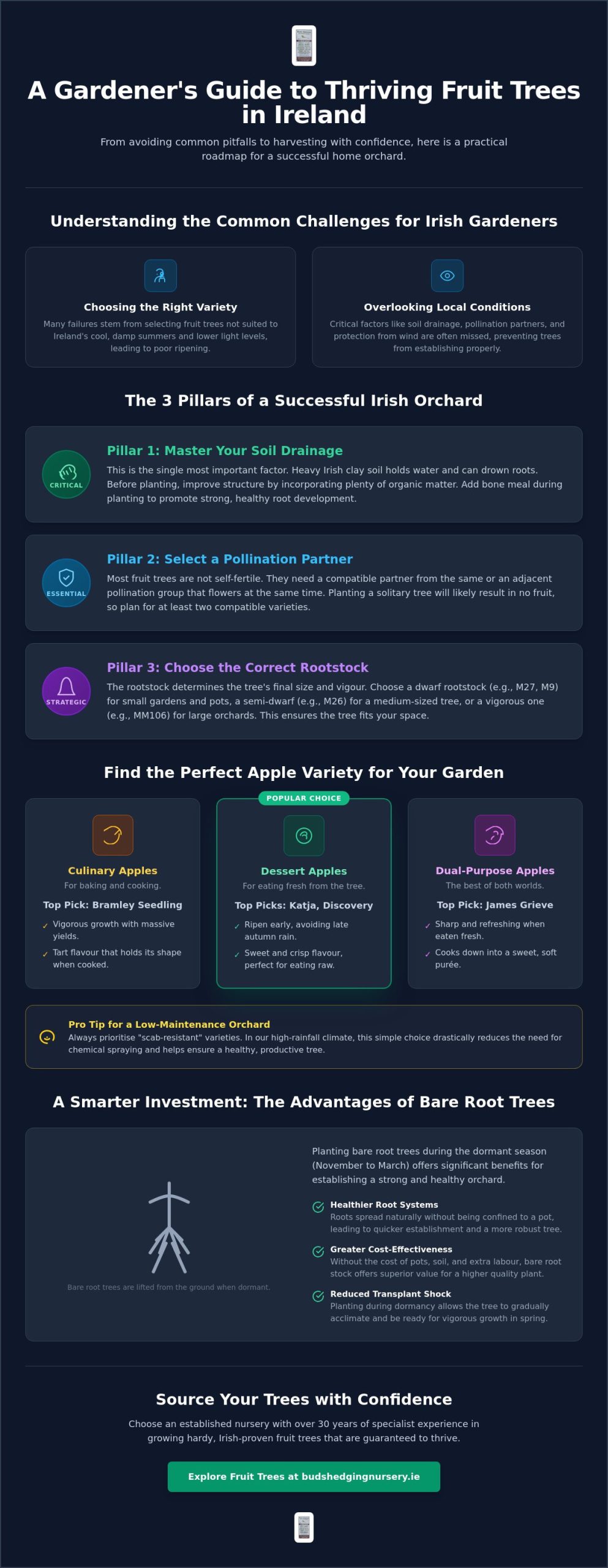
Pollination and rootstock selection are the two technical pillars of a successful orchard. Most fruit trees aren’t self-fertile and need a partner from a compatible pollination group that blossoms at the same time. If you plant a solitary apple tree without a neighbour nearby, you likely won’t see a crop. Rootstocks are equally important. These are the root systems onto which a specific variety is grafted. They determine the final scale of your project:
- Pollination Groups: Trees are categorised by when they flower. You need trees from the same or adjacent groups for successful cross-pollination.
- Rootstock Vigour: Codes like “M26” or “MM106” tell you how large the tree will eventually become. A dwarf rootstock is better for small gardens, whilst a vigorous one suits large fields.
- Disease Resistance: Certain varieties are bred to resist scab and canker, which are common fungal issues in damp Irish orchards.
Managing Wind and Late Frosts
Wind is a constant challenge for Irish growers. Strong gusts can snap young branches or blow blossoms off before they’ve been pollinated. It’s best to avoid “frost pockets,” which are low-lying areas where cold air settles. These pockets can kill off the early blossoms on plum and cherry trees. A sturdy windbreak is often the solution. Planting a hedge, such as Portuguese Laurel, provides excellent protection. It filters the wind rather than blocking it entirely, which prevents the turbulence that solid walls can create.
Soil Preparation for Irish Gardens
Drainage is the single most important factor for success. Irish soil often leans towards heavy clay; this holds water and can drown roots during a wet winter. You should test your soil before you start digging. If you have heavy clay, you’ll need to incorporate plenty of organic matter to open up the structure. This ensures young roots can breathe whilst still having access to nutrients. We recommend adding bone meal at the time of planting. It’s a traditional, slow-release fertiliser that encourages strong root development. Getting the soil right at the start saves years of poor growth later on.
The Best Fruit Tree Varieties for Sale in Ireland
Choosing the right variety is the most important decision you’ll make for your orchard. It isn’t just about the fruit you like to eat; it’s about what will actually ripen in your garden. When browsing fruit trees for sale Ireland, you’ll find that certain cultivars have stood the test of time because they can handle our cool, damp summers. Professional growers often look to the patterns of commercial fruit production in Ireland to see which trees yield consistent crops year after year. Selecting a variety that is proven to perform locally reduces the need for chemical interventions and ensures a more reliable harvest.
You generally have two main categories of apples to consider: dessert and culinary. Dessert apples are sweet and meant for eating fresh, whilst culinary varieties are tart and hold their shape when baked. Some people prefer a “dual-purpose” variety. A dual-purpose apple, such as the James Grieve, is a variety that can be eaten fresh from the tree for its sharp flavour or cooked into a sweet, soft purée. If you’re limited on space, focusing on these versatile trees is a practical way to get the most from your garden without needing dozens of different specimens.
Reliable Apple Cultivars
Traditional favourites like the Bramley Seedling remain the gold standard for cooking because of their vigorous growth and massive yields. For eating, varieties like Katja or Discovery are excellent because they ripen early, often before the autumn weather turns too cold and wet. You should also look for “scab-resistant” labels when selecting your stock. In our high-rainfall climate, fungal diseases like scab can ruin a crop; resistant varieties don’t require the same intensive spraying as standard orchard trees to stay healthy and productive. These hardy choices are often the best starting point for a low-maintenance home orchard.
Stone Fruits and Pears
Plums and pears can be more temperamental than apples, but the right choice makes all the difference. Damson plums are particularly well-suited to the Irish damp. They’re incredibly hardy and produce a tart fruit that’s perfect for jams and gins. For pears, the Conference variety is the most reliable. It’s a tough tree that produces long, sweet fruit even in years with less sunshine. If you only have room for one cherry tree, choose a self-fertile variety like Stella. These don’t need a partner tree to produce fruit, making them ideal for smaller, standalone gardens. You can view our full range of hardy stock at Buds Nursery Cavan to see what’s currently available for the coming season.
Bare Root vs. Pot Grown: Making the Right Investment
When searching for fruit trees for sale Ireland, you’ll encounter two main types of stock: bare root and pot-grown. Bare root trees are grown in open fields and lifted from the soil once they enter their winter dormancy. They’re sold without any compost around the roots, usually wrapped in a bundle. Pot-grown trees are cultivated in containers and can be moved or planted at any time of the year. Both have their place, but the choice often comes down to the scale of your project and your budget.
Bare root trees offer a significant cost advantage, especially if you’re establishing a larger orchard. For those participating in the ACRES scheme, which requires planting ten traditional trees to create a small orchard, the savings compared to pot-grown alternatives are substantial. Beyond the price, they’re the more sustainable choice. There’s no plastic waste from heavy pots, and they’re much lighter to transport. Because they’re dormant when planted, they often establish a more resilient root structure than their container-bound counterparts. You’ll find excellent guidance on planting apple trees from local conservation projects that favour this traditional method.
The Bare Root Planting Window
The primary season for bare root stock runs from November to March, though availability can sometimes extend into May depending on the nursery. Planting during these colder months allows the tree to settle into its new home before the energy-intensive growth of spring begins. If you receive your trees but the ground is frozen or waterlogged, you must store them correctly. “Heeling in” the trees involves digging a temporary shallow trench and covering the roots with loose soil or sand to keep them moist until the weather improves.
When to Choose Pot-Grown Trees
Pot-grown trees provide flexibility. If you’ve missed the winter window, these trees can go into the ground during the summer. This allows you to see the tree in leaf and get a better sense of its shape before buying. However, summer planting requires discipline; you’ll need to water them consistently throughout their first dry spell. When buying container stock, always check that the tree isn’t “root-bound,” where the roots have started circling the inside of the pot. Teasing these roots out gently before planting is essential to ensure they grow outwards into the surrounding soil.
Planting and Staking: A Practical Step-by-Step Guide
Properly planting the fruit trees for sale Ireland that you’ve selected is the most critical step in ensuring a long-lived orchard. Success begins with the hole you dig. It should be twice the width of the root system but no deeper than the roots themselves. We recommend digging a square hole rather than a round one. In heavy Irish clay, round holes can cause roots to circle as if they were still in a pot. Squaring the edges allows the roots to penetrate the corners and push out into the surrounding soil more easily.
Before you backfill, examine the roots. For pot-grown stock, use the “teasing” method to gently pull the outer roots away from the central ball. This encourages them to grow outwards immediately. For bare root stock, ensure the roots are spread out naturally and not cramped. Identifying the correct planting depth is vital. Look for the “soil line” on the trunk, which indicates how deep the tree sat in the nursery. The graft union, which is the visible bump near the base, must remain above the soil level to prevent rot or unwanted rooting from the scion.
Once you’ve positioned the tree, backfill with the original soil mixed with a small amount of organic matter. Firm it down with your heel to remove air pockets. If you’ve recently looked for fruit trees for sale Ireland, you’ll know that quality stock deserves a strong start. View our selection of hardy fruit trees to find varieties that are ready for planting this season.
Essential Staking Techniques
Staking is non-negotiable in the windy Irish landscape. A young tree with a loose root ball won’t establish properly. We often recommend a low stake driven in at a 45-degree angle, pointing into the prevailing wind. This method secures the base of the tree whilst allowing the upper trunk to flex. This natural movement triggers the tree to thicken its trunk and develop its own strength. Use flexible rubber tree ties rather than wire or twine. These ties allow for trunk expansion and won’t cut into the bark as the tree matures.
Feeding and Mulching
A newly planted tree needs steady access to nutrients without being overwhelmed. A handful of slow-release fertiliser like bone meal is perfect for the first year. Avoid high-nitrogen feeds early on, as these produce lush, soft growth that struggles in harsh weather. Bark mulch is your best tool for weed suppression and moisture retention. Apply a thick layer of bark mulch in a wide circle around the base, ensuring the material does not touch the trunk to prevent rot. This simple step keeps the root zone cool and damp through the summer months.
Why Source Your Fruit Trees from Buds Nursery Cavan?
At Buds Nursery Cavan, we’ve spent over 30 years refining our growing processes on our 60-acre specialist site. We don’t just sell plants; we grow them from the ground up. This long-standing experience allows us to project quiet confidence in every tree we provide. For those looking for fruit trees for sale Ireland, buying from an established grower means you’re getting stock that’s already acclimatised to local conditions. We’re deeply committed to Irish biodiversity and actively support the Native Trees Scheme. This commitment ensures our heritage varieties contribute to a healthier local ecosystem and meet the strict requirements for national environmental grants like ACRES.
Our approach is straightforward and unpretentious. We provide practical, no-nonsense advice rooted in decades of physical work on the land. Whether you’re a hobbyist planting a single apple tree or a landowner establishing a large orchard, we prioritise utility and clarity. We understand the practicalities of the industry and value the quality of the output above trendy marketing. This focus on the fundamentals of the craft means you get honest answers about what will grow in your specific soil type.
From Our 60-Acre Nursery to Your Garden
Buying direct from our nursery ensures you receive fresher, hardier stock. We organise our 60-acre site with precision to ensure every specimen is handled with professional care from the moment it’s grafted to the day it’s lifted. This direct-from-grower model eliminates the stress that plants often face in long retail supply chains. Alongside our fruit varieties, we offer a wide range of complementary hedging to protect your orchard from the elements. Options like Photinia Red Robin and Copper Beech are excellent for creating the sheltered microclimates that fruit trees need to thrive. These hedging plants serve as a productive windbreak, as discussed in our climate management sections.
National Delivery and Expert Support
We’ve developed a reliable national delivery service that covers every corner of Ireland. Our packaging methods are designed to keep roots moist and branches protected during transit, ensuring your order arrives in peak condition. For those involved in large-scale planting or specific farm schemes, we offer expert guidance on variety selection and layout. We can help you navigate the paperwork and plant passport requirements that are essential for modern horticultural compliance. You’re also welcome to visit Buds Nursery Cavan in person from Tuesday to Saturday. Seeing our extensive range first-hand allows you to appreciate the scale and health of our stock before making your final selection for your garden or farm. For those scaling up their operations and requiring durable agricultural infrastructure for equipment or storage, read more about custom steel building solutions.
Starting Your Irish Orchard Today
A productive orchard is a long-term investment that begins with the right decisions during the dormant season. By selecting varieties like Conference or Discovery that are proven to thrive in the Irish climate, and by following practical planting steps like square-hole digging and low staking, you set your trees up for decades of health. Whether you’re planting under a farm scheme or simply adding a few dessert apples to a small garden, the fundamentals of drainage and shelter remain the same. When you’re browsing fruit trees for sale Ireland, choosing stock grown locally ensures your trees are already adapted to our specific weather patterns.
At Buds Nursery Cavan, we use our 30+ years of experience on our 60-acre site to grow trees that meet these exact standards. We provide the technical support and hardy plants needed for a successful harvest, backed by reliable national delivery across the country. View our full range of fruit trees and hedging to find the right specimens for your next project. With the right preparation and quality stock, you’ll soon enjoy the satisfaction of picking fresh fruit from your own garden.
Frequently Asked Questions
When is the best time of year to buy fruit trees in Ireland?
The best time to buy is during the bare-root season, which typically runs from November to March. This is the period when trees are dormant and can be lifted and replanted with minimal stress to the root system. You’ll often find a much wider selection of fruit trees for sale Ireland during these winter months compared to the summer retail season. Some specialist nurseries may have stock available until May, provided the weather remains cool enough for the trees to stay dormant.
Do I need two different apple trees to get fruit?
Most apple varieties require a second, different variety from a compatible pollination group to produce a successful crop. This cross-pollination ensures that bees can move viable pollen between blossoms. If you only have space for one tree, look for self-fertile varieties or “family trees” where multiple varieties are grafted onto a single rootstock. In many urban areas, a neighbour’s tree or a nearby crab apple may also provide the necessary pollen.
How much space does a standard fruit tree require?
The space required depends on the rootstock rather than the fruit variety. A tree on a dwarfing rootstock needs approximately 2 to 3 metres of space, whilst semi-vigorous trees require 4 to 5 metres to ensure good light and air circulation. It’s vital to check the eventual height and spread of the rootstock before planting. Proper spacing prevents the canopy from becoming overcrowded, which reduces the risk of fungal diseases like scab.
Can I grow fruit trees in large pots or containers?
You can grow fruit trees in containers if you choose a variety grafted onto a dwarfing rootstock, such as M27 or M9 for apples. These rootstocks limit the tree’s vigour, making them suitable for life in a large pot on a patio or balcony. Pot-grown trees need more attention than those in the ground; they require regular watering throughout the summer and annual feeding to replace nutrients that leach out of the compost. If you are exploring more advanced cultivation methods or controlled environments for your plants, you can discover Discount Hydro for a wide selection of professional grow room supplies.
What is the most low-maintenance fruit tree for a beginner?
Cooking apples like ‘Bramley’ and hardy ‘Damson’ plums are generally the easiest for beginners to grow in Ireland. These trees are exceptionally resilient and can handle the damp, cool conditions that might cause more delicate dessert varieties to struggle. They don’t require the same level of precise pruning or chemical intervention to stay healthy. Once established, they provide a reliable and heavy harvest with very little annual fuss.
How long will it take for a new tree to start producing fruit?
Most young trees will begin to produce a small harvest within 2 to 3 years of planting. If you purchase a “feathered maiden,” which is a tree that has already begun to develop side branches in the nursery, you’ll see fruit sooner than with a younger whip. It’s often recommended to remove any fruit that forms in the very first year. This allows the tree to direct all its energy into building a strong root system rather than fruit production.
Is it possible to plant fruit trees in heavy clay soil?
Planting in heavy clay is possible if you improve the drainage to prevent the roots from sitting in water. You should avoid digging a deep, narrow hole that can act as a water-holding “bucket” in clay soil. Instead, plant the tree on a slight mound or incorporate plenty of organic matter to open up the soil structure. This ensures the roots have access to the oxygen they need whilst still benefiting from the nutrient-rich nature of clay.
What should I do if my fruit tree blossoms are hit by a late frost?
If a frost is forecast whilst your trees are in bloom, you should cover them with horticultural fleece overnight to protect the flowers. If a frost has already occurred, the damaged blossoms will likely turn brown and drop off, which can reduce or eliminate your crop for that year. The tree itself will survive the frost without long-term damage. Focus on maintaining the tree’s health with proper mulching and watering to ensure it has the energy to produce a better crop the following season.