

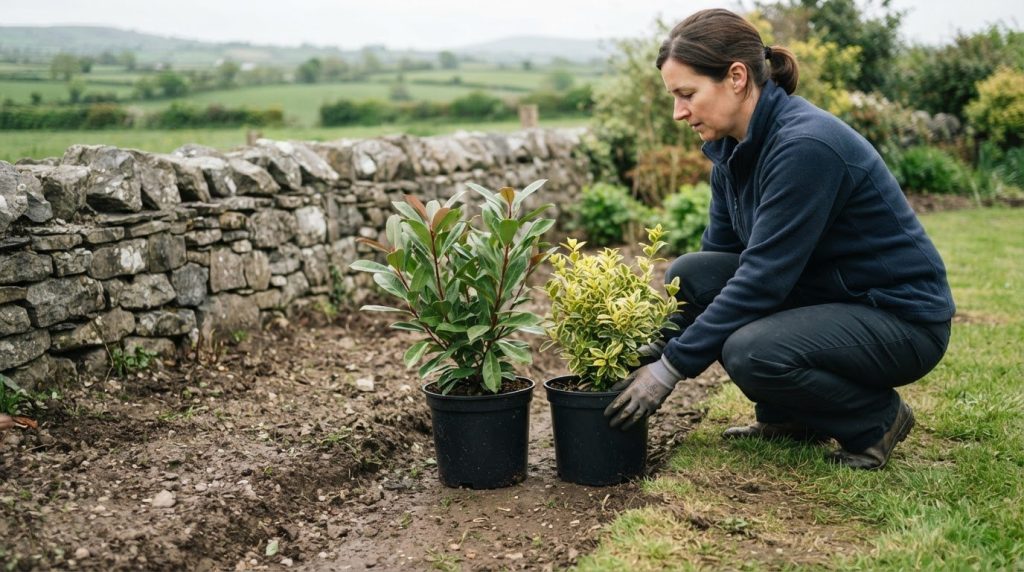
Choose the right hedge for your garden by starting with the ground, not just the leaves. Consider the soil, exposure and available space, then decide how much privacy or shelter you need. In Ireland, plant bare-root hedging in October; container-grown plants can be planted at any time of year.
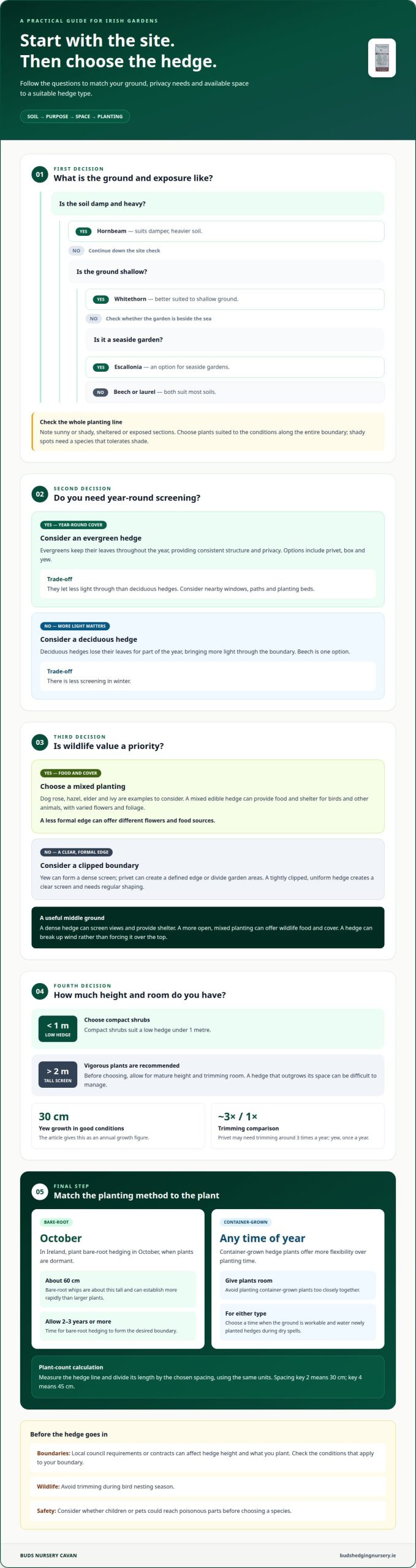
Your site can quickly narrow the options. Hornbeam suits damper, heavier soil, while whitethorn is better suited to shallow ground. Escallonia is an option for seaside gardens. Consider the hedge’s mature size too: a fast-growing plant may work for a tall screen but be harder to manage in a small space.
This guide explains how to match hedge types to your garden and site, from formal evergreen boundaries to flowering, wildlife-friendly choices. You’ll also learn when to plant, helping you choose a hedge that suits the conditions on your plot.
Key Takeaways
- Match a hedge to the ground and exposure, not just the look you want.
- Choose plants that can provide wildlife with useful shelter and food.
- Weigh year-round privacy against light, flowers and the formality of a clipped boundary.
- Compare varieties for your garden’s terrain, then choose a planting time that suits the plant type.
1. When is the Best Time to Plant a Hedge?
In Ireland, plant bare-root hedging in October, when plants are dormant. Container-grown hedge plants can be planted at any time of year. Choose a time when the ground is workable, and water newly planted hedges during dry spells.
Bare-root whips are about 60 cm tall and can establish more rapidly than larger plants. Allow 2-3 years or more for bare-root hedging to form the desired boundary. Container-grown plants offer more flexibility over timing, but avoid planting them too closely together.
Start with the job the hedge must do. Compact shrubs suit a low hedge under 1 metre, while vigorous plants are recommended for a screen over 2 metres. Also consider mature height and the room available for trimming. A hedge that outgrows its space can be difficult to manage.
Match plants to conditions along the entire planting line. A shady spot calls for a species that tolerates shade; damp, heavy soil needs one suited to those conditions. Check whether the site is sunny or shady, sheltered or exposed. Plants suited to the soil and exposure are more likely to establish well.
Rules on hedge heights and boundaries can depend on local council requirements or contracts, which may limit what you plant or how high it grows. Avoid trimming during bird nesting season. For a specific boundary, check the conditions that apply to it.
Plant costs depend on the type, size and number of plants. Professional planting costs also vary with the site and work involved, so there is no single figure for every hedge.
There is no single best hedge for Ireland’s varied sites. Choose according to your soil, exposure and purpose, then consider suitable examples, such as hornbeam for damper, heavier soil or whitethorn for shallow ground.
Growth and trimming vary by plant and conditions. Yew can grow 30 cm annually in good conditions; privet may need trimming around 3 times a year, compared with once a year for yew.
To calculate plant numbers, measure the hedge line and divide its length by the chosen spacing, using the same units. For example, spacing key 2 means 30 cm, while key 4 means 45 cm.
Potential risks depend on the species. Avoid plants that may spread beyond their intended area, and consider whether children or pets could reach poisonous parts before choosing.
2. Which hedge is right for my garden?
Start by deciding what the boundary needs to do. A dense hedge can screen views and provide shelter, while a more open, mixed planting can offer food and cover for wildlife. Unlike a solid fence, a hedge can break up wind rather than forcing it over the top. This may make an exposed garden more usable without closing it off completely.
For a wildlife-friendly mix, consider shrubs such as dog rose, hazel, elder and ivy. A mixed edible hedge can provide food and shelter for birds and other animals. Different plants bring varied flowers, foliage and colour, adding seasonal interest beyond a single-species line. Choose a combination that suits the space and the level of screening you need.
Native hedging can help make a garden feel connected to its wider landscape. Hazel and dog rose, for example, can feature in mixed planting, alongside other suitable native species. Mixed hedges and hedgerows are valuable habitat features: their loss over the last 100 years has contributed to wildlife habitat loss. A mixed boundary is one practical way to bring more variety back into a garden.
Think about the balance between privacy and wildlife access. A tightly clipped, uniform hedge creates a clear screen, while a mixed row offers a less formal edge with different flowers and food sources. You can also combine a hedge with ground cover plants to create a planted strip beneath it, adding another layer of cover. Keep the hedge’s purpose in mind as you choose: screening, shelter, wildlife value, or a workable mix of all three.
For native planting, the Native Trees Scheme is a relevant option to explore alongside your hedge choices. The right combination depends on the boundary’s role and the character you want in the garden, rather than on choosing a single “best” species.
3. Evergreen, deciduous, flowering and formal hedges
Evergreen hedges keep their leaves throughout the year, providing consistent structure and privacy. They also let less light through than deciduous hedges, so consider nearby windows, paths and planting beds before choosing one. Evergreen privet, box and yew can divide a garden into distinct areas, with clipped lines creating a neat, traditional layout.
Deciduous hedges lose their leaves for part of the year. This brings more light through the boundary, but provides less screening in winter. Beech is one option if you want a hedge with seasonal foliage. Your choice depends on whether year-round cover or a lighter garden feel matters more.
Formal hedges need regular shaping to maintain a clear outline. Yew forms a dense screen and can suit a clipped boundary; overgrown yew can often be restored through hard pruning in late winter. Privet is another option for a defined edge or garden division. Both can provide a uniform green backdrop for flowering plants.
Flowering hedges add seasonal colour as well as structure. Rosa rugosa flowers from May to September and grows to around 5 feet high and wide, so allow room for its spread. Its flowers make it a useful choice where a looser, less formal boundary suits the garden better than a tightly clipped line.
Golden Privet and Green Privet are available as straightforward evergreen hedge options. Match the variety to the finish you want, then consider its mature height and the space needed for trimming. Green Beech is another choice for a deciduous boundary. A formal row creates a different effect from a flowering hedge, so decide whether privacy, seasonal interest or garden structure matters most before choosing.
4. Choosing hedge varieties for different gardens and terrain
Let the site guide your first choices. Soil, exposure and available width can rule out unsuitable varieties before appearance becomes the deciding factor. Beech and laurel suit most soils, making them useful options where conditions vary along a boundary. Check the entire planting line, as it may run through both open and sheltered areas.
For a garden overlooking fields, a windbreak may be more useful than a solid screen. Hardy native choices such as hazel, dog rose and field maple can break up an exposed edge. Their mixed growth also creates a less uniform appearance. Consider whether the hedge needs to shelter a seating area, protect plants or mark the garden’s outer limit.
Coastal gardens call for a different choice. Escallonia suits seaside gardens, while bamboo is not recommended near the sea. Bamboo needs careful consideration wherever it is planted: some types, including Sasa, can creep into lawns if unmanaged. This spreading habit may make it a poor fit for smaller gardens or narrow boundaries.
Space and intended height matter as much as terrain. Leyland cypress grows rapidly and can form a tall screen, but is less suitable as a smaller hedge that needs frequent trimming. It also needs careful planting and maintenance. Choose it for screening only where its vigorous growth and upkeep suit the site.
In autumn, consider whether seasonal changes in leaves suit the garden. A deciduous hedge can give a more open boundary at some times of year, while an evergreen option keeps its screening. The practical choice is the plant that fits the site and the work you can maintain, not simply the fastest-growing variety. For a suitable range of hedge plants, explore hedging choices and compare them with your garden’s soil, exposure and available space.
Buds Nursery Cavan
Buds Nursery offers hedge plants for different garden layouts and planting plans. Its range includes Portuguese Laurel, Cherry Laurel and Golden Privet, giving you options for a boundary or screen. Fruit trees, including Apple, Pear and Plum, are available potted throughout the season if you’re planning a mixed garden with productive planting.
Use the guide to narrow down your priorities: the site’s soil and exposure, the height you want, and whether you prefer evergreen cover or seasonal change. Considering these factors helps you identify suitable plants rather than choosing on appearance alone.
If you’re ready to discuss hedge choices for your garden, contact Buds Nursery Cavan.
Turn your hedge choice into a planting plan
Turn your preferred look into a short planting brief. Note where the hedge will run, what you want it to contribute to the garden, and how much ongoing trimming suits your routine. This gives you a clear basis for choosing the right hedge for your garden rather than deciding on impulse.
Bring that brief to your plant selection. Portuguese Laurel, Cherry Laurel and Golden Privet are among the hedge options offered by Buds Nursery Cavan. The best fit depends on how each option meets the priorities you have set for your boundary and garden.
You don’t need to settle every detail before taking the next step. A conversation can help you focus your shortlist and move from a general idea to a considered planting choice. Contact Buds Nursery Cavan for hedge advice, and take the next step towards a boundary that works for your garden.
Frequently Asked Questions
Which hedge is right for my garden?
Choose a hedge that suits the garden’s main constraint, such as limited space, exposed ground or a need for privacy. To choose the right hedge for your garden, first decide what the boundary must do, then rule out plants unsuited to its soil and conditions. For a compact plot, avoid vigorous choices intended for tall screens. For a rural boundary, a mixed hedge can create a more natural edge.
As a backdrop for garden colour?
A simple green hedge can help brightly coloured flowers stand out without competing for attention. Consider the planting bed in front: a restrained backdrop suits mixed flower colours, while a flowering hedge adds another layer of interest. Leave enough room for both the hedge and flowers to grow and be maintained. In a smaller border, avoid letting the hedge overwhelm the flowers.
Evergreen or deciduous?
Choose evergreen if you want the boundary to screen through winter; choose deciduous if seasonal change and more winter light matter more. Consider the garden’s orientation too. An evergreen hedge beside a window may reduce light, while a deciduous hedge changes appearance as its leaves fall. A mixed planting can soften the contrast between these approaches.
When is the Best Time to Plant a Hedge?
In Ireland, plant bare-root hedging in October. Container-grown plants can be planted at any time of year. Before planting, clear weeds and grass from the line, then prepare the ground so roots can spread. Space the plants evenly and water them in. A suitable planting window helps, but preparation and aftercare matter too.
Which hedge is in fashion now?
No single hedge style suits every Irish garden, and a trend should not outweigh site conditions. A mixed hedge can suit an informal garden, while a clipped row creates a more ordered look. Choose a style you’ll be happy to maintain and that suits the house and boundary. Beech, privet and laurel offer different looks to consider.
Which hedge is best for privacy, security, or shelter?
For year-round privacy, an evergreen hedge is a practical starting point. For shelter, a hedge can break up wind across a garden rather than directing it over a solid barrier. Security needs depend on the boundary and wider property, so don’t rely on a hedge alone for security. Consider its density, mature size and position before planting.