

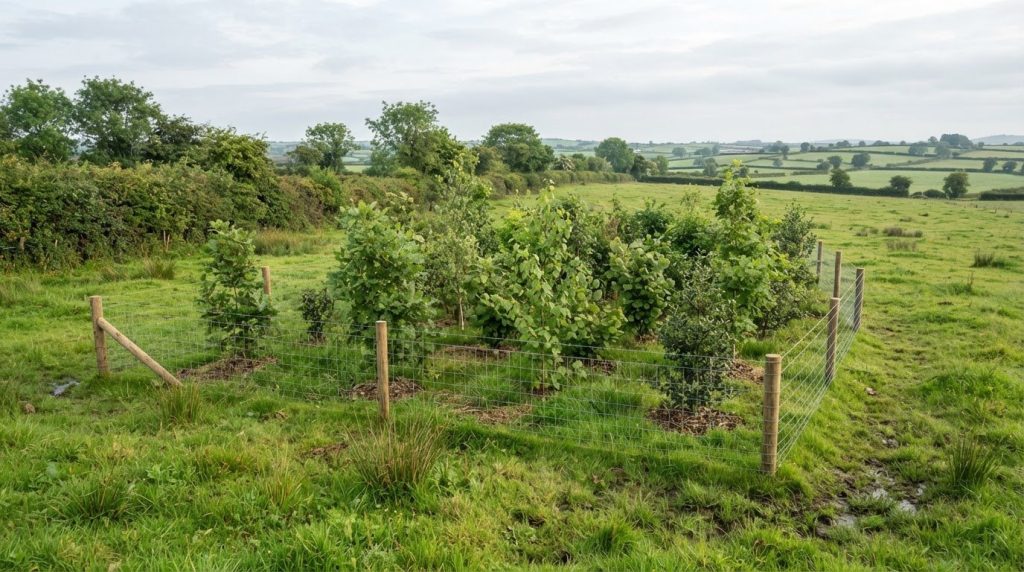
Grant approval depends on more than the tree species: the applicant and the land must also fit the scheme. In Ireland, grant-approved native trees can be planted through the Native Tree Area Scheme, which supports small native woodlands of up to 1 ha on farms. Applicants must be over 18.
It’s understandable to want a clear answer before deciding what to plant or whether your land is suitable. This guide explains which broadleaf species may qualify, which land rules matter and who can apply for free native trees in Ireland.
You’ll also learn how the Native Tree Area Scheme works and how its two planting options differ, helping you consider which may suit your land.
Key Takeaways
- Learn why grant eligibility depends on the approved species mix, not simply whether a tree is native.
- See how planting area and width affect whether land may fit the scheme.
- Understand the applicant criteria and the distinction between the two Native Tree Area options.
- Find out how grant payments differ and when Buds Nursery Cavan’s Native Trees Scheme may be relevant.
Broadleaf species eligible for afforestation grants
Grant aid depends on the approved species, planting purpose and site. In Ireland, grant approved native trees must meet the relevant scheme’s criteria; being native alone does not make a tree eligible.
Eligible broadleaf species
Eligible broadleaf species are those approved for grant aid and capable of producing high forest stands. The planting mix must meet the scheme’s requirements, not simply reflect the landowner’s preferences.
The Forest Service approves species for afforestation grant aid if they can produce high forest stands and have proven timber production potential. Oak and birch are included in the Native Tree Area Scheme mix for dry mineral soil, alongside Scots pine and other native species. The right mix depends on site conditions and planting purpose.
Scots pine is regarded as a native conifer in Ireland, although it died out before being reintroduced. It can therefore feature in a native planting mix. For a broadleaf-focused project, distinguish eligible grant species from other trees that might add colour or variety but are not on the afforestation grant-aid list.
Grant approved native trees for afforestation are not necessarily the only trees that can be planted on a site. Other broadleaf species may be planted in small groups along road edges or beside dwellings, adding variety without being treated as grant-aided species.
Eligibility and environmental compliance
Eligibility and environmental compliance depend on matching the proposed planting to the scheme’s requirements. Choosing eligible species alone does not make a project eligible.
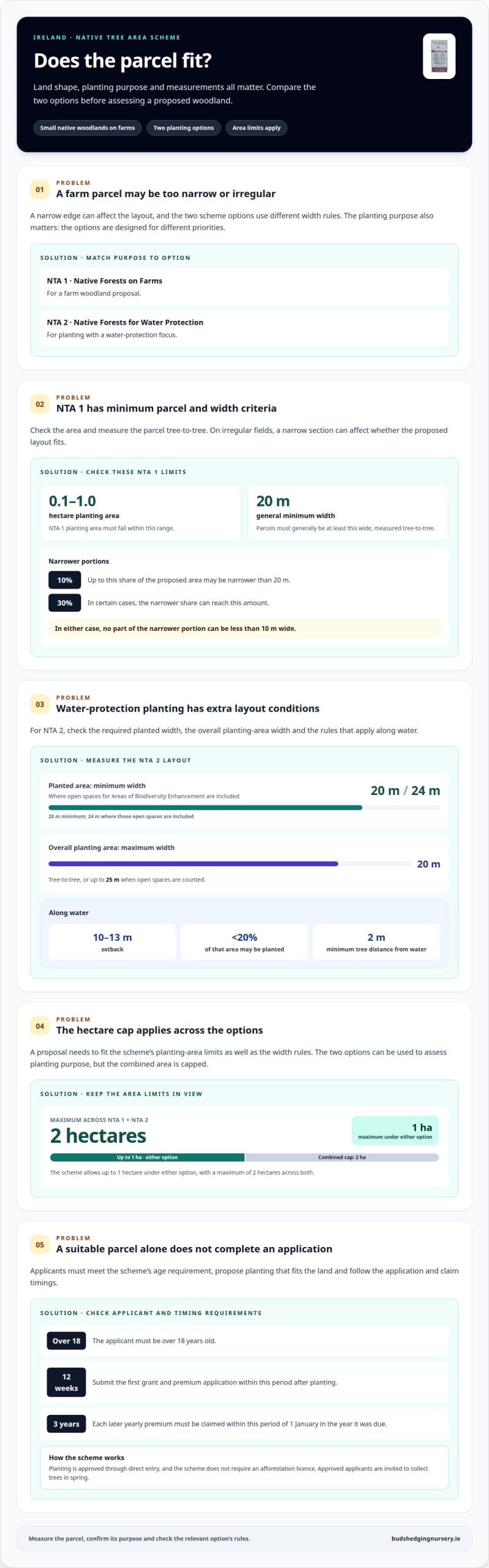
For NTA 1, the planting area must be between 0.1 and 1.0 hectare. The Native Tree Area Scheme allows up to 1 hectare under either NTA 1 or NTA 2, with a maximum of 2 hectares combined. These limits help determine whether a proposal fits the scheme.
Grant approved native trees must suit the planting purpose and site. A mismatch in species, land area or environmental conditions can put an application at risk. The Forest Service’s species approval criteria focus on the potential to produce high forest stands and proven timber production.
Scheme purpose and land eligibility
Ireland’s Native Tree Area Scheme supports small native woodlands on farms, while the Native Woodland Scheme supports existing and new native woods. The right option depends on the land’s shape and the woodland’s purpose.
Under the Native Woodland Scheme, landowners can protect and enhance existing native woodlands or establish new ones. Its focus is native forest cover, rather than treating every tree-planting project as the same type of afforestation. The Native Tree Area Scheme has two options: NTA 1, Native Forests on Farms, and NTA 2, Native Forests for Water Protection. Their names reflect different priorities, including woodland creation on farms and environmental protection around water.
For NTA 1, parcels must generally be at least 20 metres wide, measured tree-to-tree. Up to 10% of a proposed area may be narrower, but no part of that portion can be less than 10 metres wide. In certain cases, the narrower share can reach 30%, while the 10-metre minimum still applies. These measurements matter on irregular fields, where a narrow edge could affect the planting layout.
NTA 2 also has width rules. The planted area must be at least 20 metres wide, or 24 metres where open spaces for Areas of Biodiversity Enhancement are included. Its overall planting area can be no more than 20 metres wide tree-to-tree, or 25 metres when open spaces are counted. Along water, the setback is 10-13 metres; less than 20% of that area may be planted, and trees must remain at least 2 metres from the water.
These distinctions help match a particular parcel to the scheme’s climate and environmental purpose. For example, a field beside a watercourse may suit NTA 2’s water-protection focus, while a farm woodland proposal may align with NTA 1. The boundaries and intended planting layout are central to assessing land eligibility.
Who can apply for free native trees in Ireland
For Ireland’s Native Tree Area Scheme, an applicant must be over 18 years old. The scheme supports small native woodlands on farms, so the proposed planting needs to fit a farm-based woodland project. Being interested in planting a native tree is not, by itself, the same as qualifying for scheme support. The land and planting proposal matter too.
The scheme’s two options serve different planting purposes. NTA 1 supports native forests on farms, while NTA 2 supports native forests for water protection. An applicant can apply for a maximum of 1 hectare under either option, with a maximum of 2 hectares across both. These limits help establish whether the area proposed fits the scheme, rather than determining eligibility by age alone.
“Free native trees” may refer to a tree distribution, while the Native Tree Area Scheme provides grant and premium support for planting. These are different routes, so first identify which programme you mean. For the Native Tree Area Scheme, planting is approved through direct entry, as with other agri-environmental schemes. The scheme does not require an afforestation licence.
Timing matters after planting. Applicants must submit the first grant and premium application within 12 weeks of planting. Each later yearly premium must be claimed within 3 years of 1 January in the year it was due. For example, a missed annual claim is governed by that claim period, not by the initial application deadline.
Applicants whose Native Tree Area Scheme applications are approved are invited to collect their trees in spring. That collection applies after approval; it does not mean every applicant receives trees automatically. In practical terms, an applicant must meet the age requirement, propose eligible farm planting, and follow the scheme’s application and claim timings. The land’s fit with NTA 1 or NTA 2 also shapes the application.
What grants are available in Ireland for planting native trees?
Ireland’s Native Tree Area Scheme combines establishment grants with annual premiums. These payments support planting and ongoing woodland management, so the grant and premium figures relate to different parts of the support.
This is the Native Forests on Farms option.
NTA 2 is the Native Forests for Water Protection option.
The payment area has its own limit: the maximum for either NTA 1 or NTA 2 is 1.15 hectares. This is distinct from the scheme planting limit, which allows a maximum of 1 hectare under either option and 2 hectares combined. The planting area and payment area should therefore not be treated as interchangeable when estimating support.
Funding can also include fencing support. These separate rates show why the chosen option and fencing type affect the payment calculation.
To understand the likely support, distinguish establishment grants from annual premiums, then identify the NTA option and eligible area. Each payment has its own rate and limit.
Buds Nursery Cavan: Native Trees Scheme
Buds Nursery Cavan offers native trees through its Native Trees Scheme for people planning native tree planting. It’s a practical next step once you’ve considered your land, planting purpose and which scheme may fit. Keep the nursery’s role separate from grant approval: scheme eligibility and payment rules determine whether a project qualifies. Your tree choice still needs to suit the planting plan and site. Portuguese Laurel, Cherry Laurel and Golden Privet are also available, but they are not substitutes for grant-approved native species. Matching trees to the project’s purpose is central, whether you’re preparing a native woodland or considering another planting plan.
Contact Buds Nursery Cavan to discuss its Native Trees Scheme and your planting plans.
Make your planting plan the next step
Choosing grant-approved native trees is one part of a planting decision. Next, shape a plan around the land’s intended use, site conditions and the woodland outcome you want. This gives you a practical basis for considering suitable trees and how the project fits your goals.
Treat grant eligibility and tree selection as related but separate decisions. Buds Nursery can help with tree selection, while scheme rules determine whether land and applications qualify for support. A clear plan makes it easier to discuss what you want to plant and its purpose on your land.
If you’re ready to move from research to planning, talk through your native planting plans with Buds Nursery Cavan. A considered start can help you take the next step with confidence.
Frequently Asked Questions
Do I qualify for the scheme?
You may qualify if you’re over 18 and your proposal meets the Native Tree Area Scheme’s land and planting conditions. For example, a farm woodland proposal may fit NTA 1, while planting intended for water protection may fit NTA 2. The scheme’s purpose, eligible area and planting layout all matter, so age alone doesn’t establish eligibility.
How do I apply?
Applications to the Native Tree Area Scheme use direct entry, rather than an afforestation licence application. Once planting is complete, submit the first grant and premium application within 12 weeks. Later yearly premiums have a separate claim deadline: each must be claimed within 3 years of 1 January in the year it was due. Keep those two deadlines distinct.
How much do I get?
The amount depends on the scheme option, eligible area and payment type. Fencing and deer-shelter support have separate rates and limits, so they are not included in the premium figures.
What is the Native Tree Area Scheme?
The Native Tree Area Scheme is an Irish programme supporting the creation of small native woodlands on farms. It has two options: NTA 1 for Native Forests on Farms and NTA 2 for Native Forests for Water Protection. Each option has its own planting and payment rules. Approved applicants are invited to collect their trees in spring.
Who is eligible for an approved native tree grant in Ireland?
For the Native Tree Area Scheme, the applicant must be over 18. The proposal must also fit the relevant option and its land criteria. For instance, a farm planting intended to protect water may be considered under NTA 2, while another farm woodland proposal may align with NTA 1. The applicant’s age is only one part of eligibility.
Which native tree species are approved for Irish planting grants?
Species approval depends on the grant scheme and planting purpose. Oak and birch feature in the Native Tree Area Scheme mix for dry mineral soil, alongside Scots pine and other native species. Scots pine is regarded as a native conifer in Ireland. The Forest Service approves afforestation grant-aid species based on their potential to produce high forest stands and timber.