

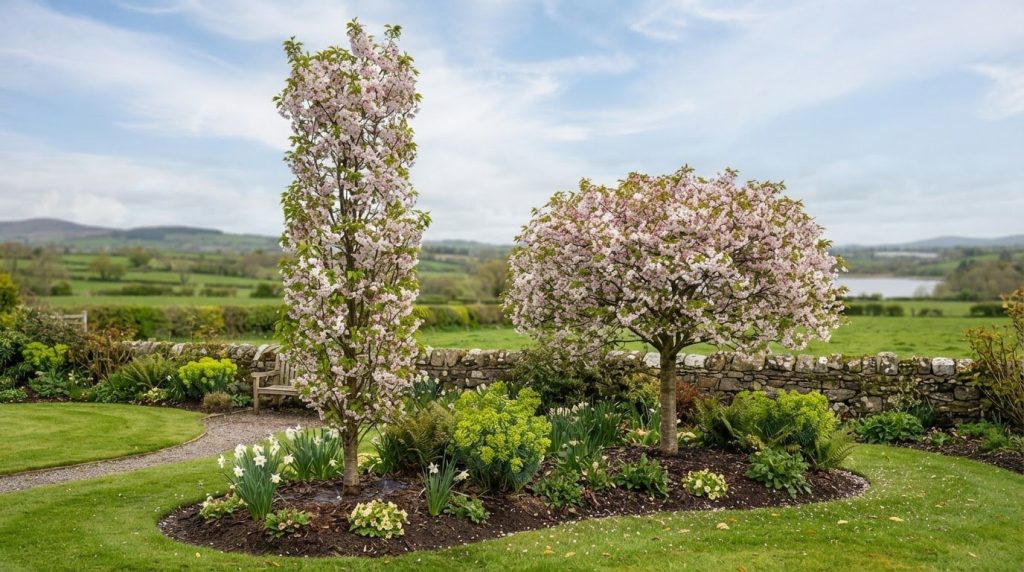
A compact cherry can be a better fit for an Irish garden than a broad, spreading tree. Cherry tree varieties in Ireland include upright Prunus ‘Amanogawa’, which reaches 6 metres high and 2 metres wide in 20 years, and the smaller Prunus ‘Kojou-no-mai’, reaching 2 metres by 2 metres in 20 years. Both suit a sunny, sheltered spot with moist, well-drained soil.
Choosing a cherry tree variety involves more than spring blossom. Its mature shape and spread determine where it can grow, while flowers, summer foliage and autumn colour bring seasonal changes to the garden. Fruit production matters too: wild cherry trees are self-sterile, so a group of fertile trees is needed to collect cherries.
This guide compares ornamental cherry varieties by form, growth and seasonal display, then explains how Irish growing conditions affect their care. It also covers the difference between flowering cherries and wild cherry if fruit is part of your plan.
Key Takeaways
- Match a tree’s mature shape and spread to the space available, not just its size when planted.
- Choose a sunny, sheltered position with moist, well-drained soil to suit flowering cherries.
- Compare blossom, summer shade and autumn foliage when deciding which seasonal display matters most in your garden.
- If you want cherries from wild trees, account for their self-sterility and the need for a group of fertile trees.
- Use the variety guide to narrow down suitable ornamental forms, from upright options to smaller trees.
Growing conditions for flowering cherry trees
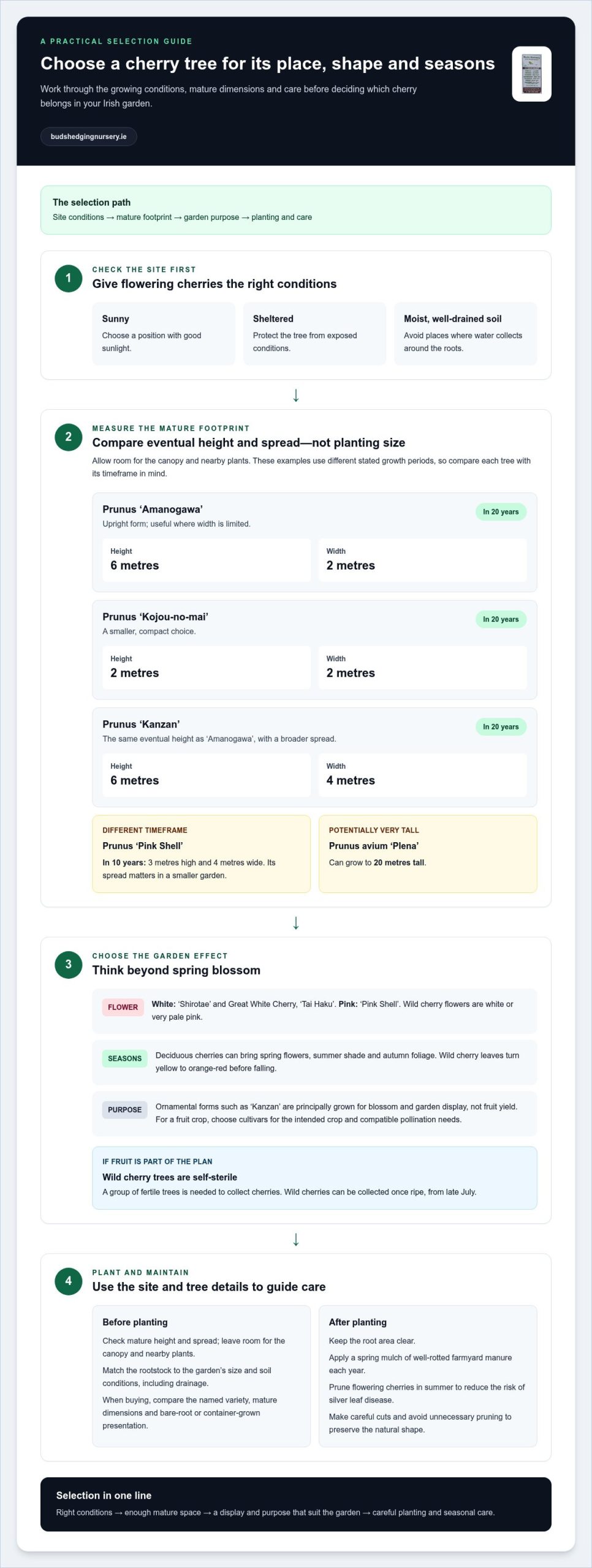
Flowering cherry trees suit sunny, sheltered positions with moist, well-drained soil. Avoid spots where water collects around the roots. Before planting, check the tree’s mature height and spread, and allow enough room for its canopy and nearby plants.
Size varies considerably between varieties. Prunus ‘Pink Shell’ reaches 3 metres high and 4 metres wide in 10 years, making its spread important in a smaller garden. Check the tree’s expected mature size when choosing a place for it. By contrast, Prunus avium ‘Plena’ can grow to 20 metres tall. These measurements describe different growth periods, so use the stated timeframe when comparing varieties.
White-flowering choices include Prunus ‘Shirotae’ and Great White Cherry, Prunus serrulata ‘Tai Haku’. ‘Pink Shell’ offers pink blossom, while Prunus ‘Kanzan’ is another familiar flowering form. For purple foliage, cherry plum, Prunus cerasifera ‘Nigra’, provides a different effect from green-leaved flowering cherries. Compare each tree’s eventual form and seasonal display before choosing.
For orchards and commercial growing in Ireland, choose fruiting cultivars suited to the intended crop and compatible pollination needs. Ornamental forms such as ‘Kanzan’ are principally grown for blossom and garden display, not fruit yield.
Flowering cherries bloom in spring, and wild cherry produces clusters of white flowers in early to mid-spring in Ireland. Wild cherries can be collected once ripe, from late July. Blossom and ripening times vary by species and variety, so distinguish ornamental flowering trees from fruiting cherries when planning seasonal interest.
Rootstock affects a tree’s eventual vigour and suitability for the space available. Match it to the garden’s size and soil conditions, including drainage, rather than choosing by variety name alone. No rootstock is best for every Irish garden, so use the tree’s expected mature size and the site conditions to guide your choice.
When buying cherry trees in Ireland, compare the named variety, mature dimensions and whether the tree is bare-root or container-grown. Prices vary with factors such as tree size and presentation, so compare like with like. Bare-root trees may suit a planting site and season where that option is appropriate.
After planting, keep the root area clear and apply a spring mulch of well-rotted farmyard manure each year. Prune flowering cherries in summer to reduce the risk of silver leaf disease. Make careful cuts and avoid unnecessary pruning, which can spoil the natural shape of upright ‘Amanogawa’ or compact ‘Kojou-no-mai’.
Spring blossom and autumn foliage
Ornamental cherry trees are deciduous, so their display changes after spring flowering. Wild cherry, Prunus avium, produces clusters of small white flowers in Ireland during early to mid-spring. Each flower has five petals. The blossom comes before the tree’s summer shade and autumn foliage, extending its interest beyond flowering.
Flower colour varies between species and cultivars. Wild cherry blossom is white or very pale pink, while named ornamental choices include white-flowering Prunus ‘Shirotae’ and Great White Cherry, Prunus serrulata ‘Tai Haku’. For pink blossom, Prunus ‘Pink Shell’ is one example. Compare flower colour and mature shape to find a tree suited to its position and the garden’s planting.
Spring blossom also has a practical role. Wild cherry flowers provide nectar and pollen for early-emerging bees, butterflies and moths. A sunny view makes the flowers easier to appreciate, while nearby planting can frame the display. After flowering, foliage provides summer shade before autumn colour develops.
Wild cherry leaves are dark green through the growing season. In autumn, they turn yellow to orange-red before falling. This gives Prunus avium a second seasonal feature after its white spring flowers. Ornamental cherries can also provide autumn foliage and summer shade, though the display varies by variety and growing conditions. Leave room to see the canopy as its foliage changes.
To plan a sequence of seasonal interest, consider where blossom will be visible and how the summer canopy will sit beside paths, windows or other plants. Pale-flowered ‘Shirotae’ creates a different spring effect from pink ‘Pink Shell’. Both are deciduous, so consider their autumn display and bare winter outline when choosing a position.
For a practical selection, compare flower colour, foliage and the available space together rather than judging a cherry by blossom alone. Wild cherry offers white or pale-pink flowers, pollinator food and yellow-to-orange-red autumn leaves. Ornamental varieties extend the choice of blossom colour and form. Planning seasonal garden planting can help you consider how trees and lower planting work together.
Ornamental cherry trees offer more than spring blossom: they can provide summer shade and autumn foliage, carrying interest into later seasons.
Upright and columnar cherry trees
An upright cherry suits a garden where width is limited but height is welcome. Prunus ‘Amanogawa’ is a useful example, reaching 6 metres high and 2 metres wide in 20 years. Its narrow spread distinguishes it from broader forms, but it still needs room to develop. Measure the planting space before choosing, including clearance from paths, walls and other trees.
Compare that form with Prunus ‘Kanzan’, which reaches 6 metres high and 4 metres wide in 20 years. The same eventual height can occupy very different ground space. ‘Kanzan’ needs more lateral clearance, whilst ‘Amanogawa’ can fit a narrower position. These figures describe growth over 20 years, not the tree’s size at planting.
Shape affects how blossom sits in the garden. An upright tree draws the eye upwards and can mark an entrance or boundary without occupying as much width. A spreading canopy creates a broader display and may provide more summer shade. Decide whether you want vertical structure, seasonal blossom or a wide canopy before comparing varieties.
Do not confuse a narrow ornamental cultivar with the native wild cherry, Prunus avium. Wild cherry can grow up to 30 metres high in Ireland, so it needs a very different setting from a compact garden selection. It is native to Ireland, the UK and most of Europe, except the Far North. Its natural scale makes mature dimensions especially important in domestic gardens.
Use this simple selection process when comparing upright forms:
- Measure the site: record the available width and height around the planting position.
- Compare mature dimensions: use the stated timeframe, such as ‘Amanogawa’ at 6 by 2 metres in 20 years.
- Check the display: match the tree’s blossom and foliage to the view from nearby windows or paths.
- Allow for its surroundings: consider buildings, boundaries and neighbouring planting as the canopy develops.
Flowering cherries suit sunny, sheltered positions with moist, well-drained soil. These conditions matter for narrow varieties too: a small footprint does not mean the tree can thrive in poor soil or a cramped corner. Leave space around the trunk and canopy, and avoid spots where water remains around the roots.
For a smaller garden, ‘Amanogawa’ offers a more measured alternative to broader ‘Kanzan’. Wild cherry has a different scale and role, and suits a naturalistic space with room for a large native tree. Consider mature height and spread together, since neither figure alone shows how much space the tree will occupy.
Cherry tree fertility and self-sterility
Wild cherry, Prunus avium, is self-sterile, so a single tree cannot reliably produce cherries by pollinating its own flowers. To collect fruit, plant a group of fertile trees so pollen can move between flowers. When choosing a cherry, remember that blossom alone does not indicate whether fruit will follow.
Pollination depends on flowers opening at compatible times and pollen reaching them. Insects, including bees, visit cherry flowers and help transfer pollen. First decide whether fruit is an aim. If it is, plan for several suitable fruiting trees rather than relying on one wild cherry.
Ornamental cherries are generally chosen for their blossom, shape and foliage. A tree planted chiefly for display may not meet the aim of gathering cherries. Start with the purpose of the planting, then assess the space available for a group. Trees need room for their canopies and flowers to develop rather than being crowded together.
For a fruit-focused planting, consider these points before choosing:
- Set the objective: decide whether spring flowers or a harvest matters most.
- Plan for more than one tree: wild cherry is self-sterile, so a group of fertile trees is needed for cherries.
- Consider flowering overlap: choose trees whose flowering periods allow pollen transfer between open flowers.
- Allow for mature growth: place trees where their canopies can develop without crowding.
Overlapping flowering is important, but it does not replace checking the trees’ fertility. Several trees in one garden will not automatically produce fruit if their flowers do not coincide or the trees are not suitable pollination partners. Keep variety labels and planting plans together to distinguish trees chosen for fruit from those planted for ornamental blossom.
Wild cherry also has value beyond a harvest. Its flowers provide nectar and pollen for early-emerging bees, butterflies and moths, while birds eat the cherries and disperse seeds. If there is room for a group, it can support wildlife as well as fruit production. Where space is limited, a single ornamental tree may be more practical, with blossom as its main purpose.
After planting, observe flowering and fruiting over the seasons. Note which trees flower together and whether fruit develops. These observations show how the planting performs without assuming every cherry has the same fertility. For a garden centred on one specimen, choose for form and blossom. For fruit, plan a group around fertility and compatible flowering.
Ornamental cherry tree varieties
Ornamental cherries differ in mature size, shape and blossom colour. Compare these features with the space available and the seasonal display you want. The named cultivars below are examples for assessing growth habit, not a universal ranking for every Irish garden.
Ornamental variety choices
For gardeners comparing cherry tree varieties in Ireland, Prunus ‘Kojou-no-mai’ is a compact option, reaching 2 metres high and 2 metres wide in 20 years. The upright ‘Amanogawa’ reaches 6 metres high and 2 metres wide over the same period. Broader ‘Taihaku’ reaches 6 metres high and 5 metres wide in 20 years, while ‘Kanzan’ reaches 6 metres by 4 metres. These deciduous trees differ in the space their canopies occupy.
Use eventual dimensions to judge whether a cultivar suits a border, lawn or narrow planting area. Then weigh blossom colour and shape against existing trees and views. A narrow form adds vertical interest, while a broader canopy makes a stronger feature in open space.
Disease and cracking resistance
The varieties discussed here cannot be ranked for disease or fruit-cracking resistance. Ornamental cherries are chiefly selected for blossom and form; fruiting cherries need separate consideration of crop performance. In Ireland, summer pruning reduces the risk of silver leaf disease in flowering cherries, but this care measure does not establish a resistance ranking.
For a fruit crop, distinguish disease resistance from cracking resistance. They are separate traits, and ornamental appearance alone says nothing about either. Choose according to the problem you need to manage, rather than assuming a showy flowering cultivar will also suit fruit production.
Sweet cherries for Ireland
Among cherry tree varieties in Ireland, native wild cherry, Prunus avium, is a fruiting option, though the flavour varies between trees. Ripe wild cherries can taste sweet and may be eaten fresh or processed. Choose this species for fruit only if its eventual size fits the site; it can grow up to 30 metres high.
Wild cherry is self-sterile, so a group of fertile trees is needed to collect cherries. Plan for fruit production and suitable pollination, not blossom alone.
Sour cherries for Irish gardens
Wild cherry fruit can taste sour or sweet depending on the tree, so its fruit flavour can vary. The varieties discussed here do not identify a named sour-cherry cultivar as best for Ireland. Decide how you intend to use the fruit, then consider the tree’s scale and pollination needs.
For ornamental interest, compare compact ‘Kojou-no-mai’ with broader ‘Taihaku’. Keep fruiting aims separate from blossom-led planting.
Buds Nursery Cavan: Portuguese Laurel
Buds Nursery Cavan offers options for a garden plan that includes more than ornamental cherries. Alongside Portuguese Laurel, its range includes Cherry Laurel, Golden Privet and Fruit Trees. These choices can help you plan how other planting fits around a tree selected for blossom, form or fruit.
Turn to Buds Nursery Cavan when planning a broader planting scheme and considering trees and hedging together. If fruit is part of your plan, explore the Fruit Trees range separately from ornamental cherry varieties, which are selected mainly for seasonal display.
For information, contact Buds Nursery Cavan or visit budshedgingnursery.ie.
Plan your next planting step
Choose a cherry tree for the role you want it to play, then consider how the rest of the garden can support it. A clear planting plan allows for the tree’s mature form and helps surrounding hedging and shrubs feel considered rather than crowded. Keep the intended purpose in view as you settle on the scheme.
If you’re planning wider garden planting alongside cherry tree varieties in Ireland, Buds Nursery Cavan offers Portuguese Laurel, Cherry Laurel and Golden Privet. These options can shape boundaries and provide a backdrop for a feature tree without distracting from its seasonal display.
Take the next step by setting out the space and planting priorities you have in mind. Contact Buds Nursery Cavan to discuss your planting plans and explore suitable options. A well-considered choice now can help your garden develop with purpose through the seasons.
Frequently Asked Questions
What cherry varieties are self-fertile and suitable for small gardens in Ireland?
For a small garden, Prunus ‘Kojou-no-mai’ is a compact ornamental option, reaching 2 metres high and wide in 20 years. Its size doesn’t establish that it will produce fruit or pollinate itself. Wild cherry is self-sterile, so don’t choose it as a single-tree solution for a cherry harvest. Decide whether blossom or fruit is your priority before selecting a variety.
What soil, drainage, shelter and sunlight do cherry trees need in Ireland?
Choose a sunny, sheltered spot with moist, well-drained soil. Check the planting area after rain: if water remains around the proposed root zone, choose a better-drained position. Avoid exposed sites where strong winds can affect growth and flowering. Consider the soil alongside the variety’s eventual size, leaving suitable space for roots and canopy.
What Irish climate zones or regions are best for growing cherries?
Choose according to your garden’s conditions rather than relying on a county or regional label. Sunny shelter and well-drained soil are practical priorities for flowering cherries. Exposure, shade from buildings and soil drainage can vary between nearby sites. Assess these features at the planting spot before deciding where a cherry tree will grow.
How many cherry trees are needed for pollination, and which varieties pollinate each other?
Wild cherry is self-sterile, so a group of fertile trees is needed to collect cherries; one tree alone is not enough. Choose fruiting varieties with compatible pollination and overlapping flowering periods. Do not assume two trees will pollinate each other simply because both flower in spring. Use variety names and pollination information to plan a suitable group.
Which cherry varieties are best for Irish orchards and commercial growing?
For orchards and commercial growing in Ireland, choose fruiting cultivars suited to the intended crop and compatible pollination needs. Wild cherry is self-sterile, so collecting cherries requires a group of fertile trees.
Where can you buy cherry trees in Ireland, and what are typical prices?
You can buy cherry trees from a retailer offering free nationwide delivery.
Which cherry tree rootstocks are best for Irish soil and garden sizes?
No single rootstock suits every Irish soil or garden. Match its vigour to the available space and consider the site’s soil conditions, including drainage.