

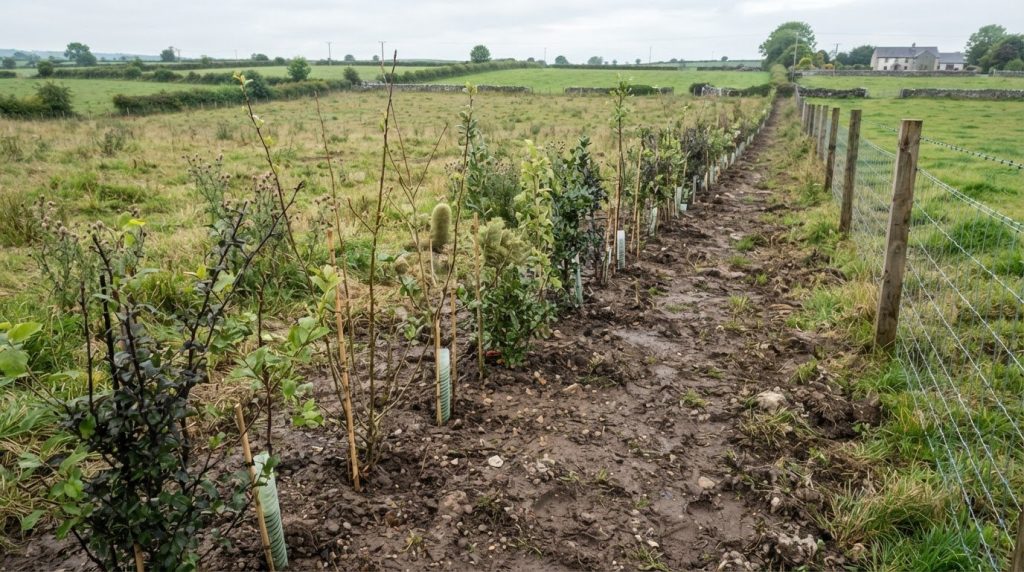
A compliant ACRES hedge is about more than planting a familiar line of whitethorn. The ACRES hedgerow species list in Ireland centres on a recommended mix of at least three species, with whitethorn required and no single species making up more than 85% of the hedge. Planting is at five plants per metre in a double staggered row.
It’s understandable to focus first on the species mix: the choice affects how well a hedge suits its site and what it can provide for wildlife. This guide explains the ACRES planting requirements, lists native Irish trees and shrubs suitable for hedgerows, and shows how to plan a suitable mix. It also compares species, including their tolerance of wet ground and flowering periods, to help you choose for your farm.
Key Takeaways
- Plan a double staggered row at five plants per metre, and allow for site preparation and livestock protection.
- Choose native trees and shrubs to suit the ground, including species that tolerate wetter soils where needed.
- Build a diverse mix around required whitethorn, keeping any single species within the permitted share.
- Use the approved species list to guide your choices, then match plant sourcing and records to ACRES requirements.
What is required for my ACRES Hedgerow?
An ACRES new hedgerow must meet requirements for planting method, species, protection and aftercare. Choosing eligible species is only one part of meeting the action conditions.
New hedgerow planting requirements
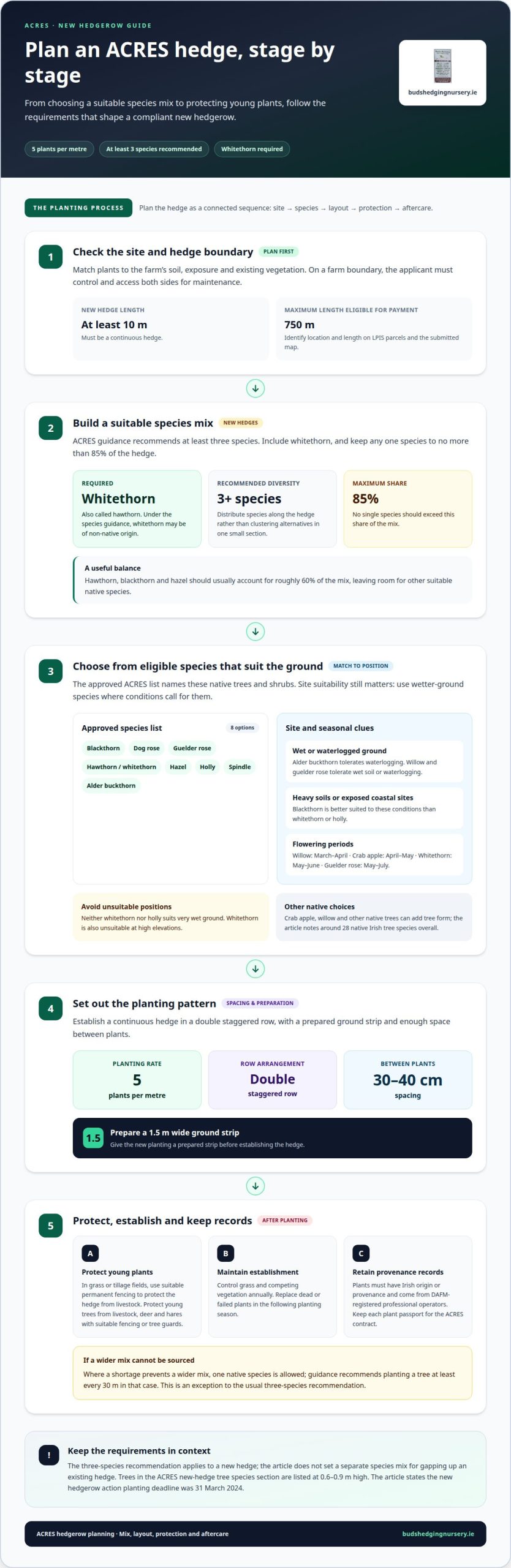
New hedgerow planting means establishing a continuous hedge that meets ACRES action conditions. Plant at five plants per metre in a double staggered row, with 30-40 cm between plants. Prepare a ground strip 1.5 m wide, and plant at least 10 m of continuous hedge; the maximum length eligible for payment is 750 m. In grass or tillage fields, protect the hedge from livestock with suitable permanent fencing. On a farm boundary, the applicant must control and access both sides for maintenance.
Eligible hedgerow species
Eligible hedgerow species are the native trees and shrubs approved for ACRES planting: blackthorn, dog rose, guelder rose, hawthorn or whitethorn, hazel, holly, spindle and alder buckthorn. Choose species that grow locally where possible. Plants must have Irish origin or provenance and come from DAFM-registered professional operators. Under the species guidance, whitethorn may be of non-native origin.
Planting a new hedge and gapping up an existing one are separate situations. The three-species recommendation applies to a new hedge; the available requirements do not set a separate species mix for gapping up. If a shortage prevents a wider mix, one native species is allowed. Keep each plant passport for the duration of the ACRES contract.
The new hedgerow action planting deadline was 31 March 2024. Its location and length must be identified on LPIS parcels and marked on the submitted map.
Control grass and competing vegetation annually while the hedge establishes, and replace dead or failed plants in the following planting season. A mix that does not meet the stated conditions can put compliance and payment eligibility at risk; no specific penalty amount is given here.
Native Irish trees and shrubs suitable for hedgerows
A native species is one that occurs naturally in Ireland. For Irish agriculture, choose hedgerow plants that suit the farm’s soil, exposure and existing vegetation, then combine flowering shrubs with suitable trees. A list of around 28 native Irish tree species offers planting options, but local conditions should shape the final selection.
Hawthorn, also called whitethorn, is a core hedge shrub that flowers from May to June. Blackthorn can be considered as another hedge shrub, with suitability depending on local conditions. It is better suited to heavy soils and exposed coastal sites than whitethorn or holly. Neither whitethorn nor holly suits very wet ground, and whitethorn is also unsuitable at high elevations.
For wetter sites, consider alder buckthorn, willow or guelder rose. Alder buckthorn tolerates waterlogging. Willow is a pollinator-friendly tree that flowers from March to April and tolerates wet soil. Guelder rose is a pollinator-friendly shrub that flowers from May to July and also tolerates waterlogging. Match each species to its position rather than treating every part of the hedge alike.
Crab apple is a pollinator-friendly hedgerow tree with April to May blossom. It can add a tree form amongst lower shrubs, whilst dog rose, hazel and spindle provide further native choices. Trees in the ACRES new-hedge tree species section are listed at 0.6-0.9 metres high. Place tree species where their mature form fits the hedge plan, and protect young trees from livestock, deer and hares with suitable fencing or tree guards.
Plant origin matters alongside site suitability: ACRES plants must have Irish origin or provenance, with plant passports retained for the contract. If a crab apple or another plant has failed, replace it in the following planting season. For farm planting plans that include native trees, explore the Native Trees Scheme.
Required mix of hedgerow species
A hedgerow species mix is the combination of woody plants used along a new hedge. ACRES guidance recommends at least three species, with whitethorn included and no single species exceeding 85% of the mix. Hawthorn, blackthorn and hazel should usually account for roughly 60%. This leaves room for other suitable native species and helps avoid a hedge dominated by one plant.
Use the species mix as a planting plan, not just a list of names. Distribute the plants along the hedge so each species appears throughout its length. For example, hawthorn, blackthorn and hazel can make up the main share, with other suitable species placed between them. This creates structural variety and supports biodiversity. Soil and exposure help determine which plants suit each position.
A shortage of hedging plants can affect the mix. Where species other than whitethorn cannot be sourced, ACRES requirements allow one native species; guidance recommends planting a tree at least every 30 m in that case. This is an exception to the usual three-species recommendation, not a reason to omit suitable alternatives when they can be obtained.
The 85% limit is a useful check when apportioning plants across the full hedge. If one species forms nearly all the planting, adjust the plan by including other suitable species rather than concentrating them in a small cluster. The length of the hedge and the plants’ suitability for its climate and ground conditions both shape a workable distribution.
Species choice is only one part of establishing an ACRES hedge. Protect the new hedge from livestock where required, and control competing vegetation so young plants can establish. Keep each plant passport for the contract and replace failed plants in the following planting season. These steps help the planted mix survive and remain identifiable.
Which native trees and shrubs qualify for ACRES hedgerow planting?
An eligible hedgerow species is a tree or shrub named for ACRES planting. The approved list includes blackthorn, dog rose, guelder rose, hawthorn or whitethorn, hazel, holly, spindle and alder buckthorn. These options are a starting point for a new hedge, but suitability still depends on the farm’s site and local planting conditions.
Native origin describes plants belonging to Ireland’s naturally occurring flora. ACRES guidance recommends choosing native species already growing locally, so the hedge fits its surroundings. A wider reference of around 28 native Irish tree species gives farmers further planting choices to consider. Use that broader selection as context, rather than assuming every tree is automatically an approved hedgerow shrub.
Irish provenance means plants have Irish origin or provenance. ACRES planting requirements call for plants of Irish origin or Irish provenance, sourced from DAFM-registered professional operators. Retain each plant passport for the duration of the contract. Keep the passports with the purchasing documentation so the records remain together throughout the agreement.
The species guidance makes a specific exception for whitethorn, which may be of non-native origin. This does not make every non-native plant suitable. Keep the hedge centred on the named native options, using whitethorn where applicable. The choice must also suit the ground: alder buckthorn, for example, tolerates waterlogging.
Separate trees from shrubs when planning the hedge. A crab apple, willow or other suitable native tree can provide a taller element, while approved shrubs form the hedgerow body. ACRES new-hedge guidance recommends choosing native species already established locally. For help exploring native tree planting options, use the available planting information to guide your farm’s selection.
Buds Nursery Cavan
Buds Nursery Cavan can help with wider planting needs around a farm. Its range includes hedging plants, trees and shrubs, including Portuguese Laurel, Cherry Laurel, Golden Privet and fruit trees. These nursery offerings are not substitutes for the native species required for an ACRES hedgerow.
Use the approved species list and site conditions to guide ACRES hedge choices. For other farm planting, Buds Nursery Cavan’s tree and hedging range can help you plan suitable additions. Contact Buds Nursery Cavan to discuss your planting needs.
Plan your next planting step
Use the ACRES hedgerow species list for Ireland as a starting point, then consider how each planting decision fits the wider farm. Keep scheme hedge plants separate from other boundary or garden planting so the purpose of each choice stays clear. A plant suitable for general screening is not automatically suitable for an ACRES hedge.
Buds Nursery Cavan offers Portuguese Laurel, Cherry Laurel and Golden Privet for other hedging needs. Consider these separately from the native species in an ACRES planting plan, keeping the scheme requirements central to the eligible hedge.
If you’re planning additional hedging or tree planting, take the next step with a clear idea of the site and its purpose. Contact Buds Nursery Cavan to discuss your planting requirements, and move ahead with a plan that suits the job.
Frequently Asked Questions
What hedgerow species are included in Ireland’s ACRES scheme species list?
The listed species are blackthorn, dog rose, guelder rose, hawthorn or whitethorn, hazel, holly, spindle and alder buckthorn. A farm with wet ground could consider alder buckthorn, while hawthorn or hazel may suit other hedge positions. Choose according to the site. Whitethorn has a specific origin exception; the other plants must meet the relevant Irish-origin or provenance requirements.
Where can I find the official ACRES hedgerow species list for Ireland?
Consult the Department of Agriculture, Food and the Marine’s ACRES scheme guidance for the hedgerow action requirements. Read the species information alongside the planting and documentation conditions, rather than treating a nursery catalogue as the eligibility list. The approved species names and origin rules determine scheme suitability. A plant sold for ordinary hedging is not eligible for ACRES on that basis alone.
What species mix and minimum number of species are required under ACRES hedgerow rules?
For a new hedge, the recommendation is at least three species, with whitethorn included and no one species exceeding 85% of the mix. Hawthorn, blackthorn and hazel should usually form roughly 60%. If other hedging species cannot be sourced, one native species is allowed; in that case, plant a tree at least every 30 m. These figures guide the mix across the hedge, not just one short section.
Are non-native or ornamental species permitted in ACRES hedgerows?
ACRES hedgerow planting is intended for native species, with whitethorn the stated origin exception. Whitethorn may be of non-native origin, but this exception does not extend to ornamental hedging plants generally. Portuguese Laurel and Golden Privet, for example, should not be treated as substitutes for species on the ACRES list. Keep ornamental planting separate from the scheme hedge.
What are the ACRES hedge planting specifications for spacing, plant size and layout?
Plant five plants per metre in a double staggered row, with 30-40 cm between plants. The ground preparation strip is 1.5 m wide, and trees in the new-hedge tree species section are specified at 0.6-0.9 metres high. For a 50-metre hedge, the planting density means 250 plants. These layout figures describe the hedge planting, not the distance between standard trees.
Which hedgerow species are best suited to different Irish soils and regions?
Match species to soil and exposure. Blackthorn tolerates waterlogging and suits heavy soils and exposed coastal sites better than whitethorn or holly. Alder buckthorn, willow and guelder rose also tolerate wet ground. Whitethorn and holly are unsuitable for very wet soils, while whitethorn is also unsuitable at high elevations. Local growing conditions matter more than using the same mix on every farm.