

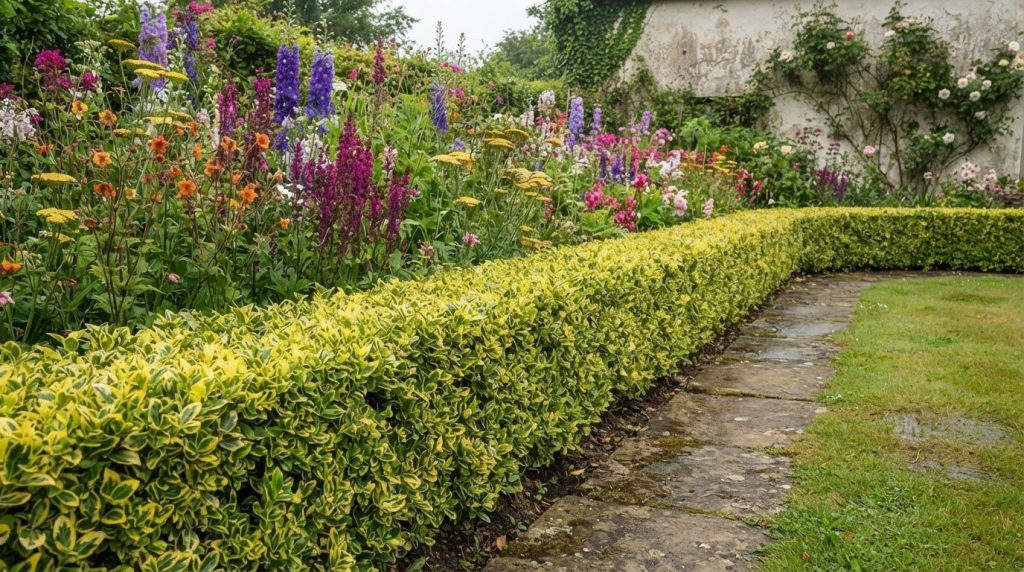
The best cottage garden hedge ideas don’t have to hide the flowers behind a tall, clipped wall. A low hedge can frame colour while leaving room for borders, and lavender hedges suit heights of 30-90 cm. For a softer, wildlife-friendly boundary, choose native shrubs and allow the growth to stay informal.
It’s easy to see why a neat hedge appeals: it gives a garden structure and a clear edge. The key is to match the hedge to its setting and surrounding plants, so it frames the display rather than competing with it.
Here are practical ways to choose native, informal and low-growing hedges for an Irish cottage garden. Explore options for wildlife and year-round structure, along with ways to set a low hedge against garden colour.
Key Takeaways
- Choose hedge plants to suit your soil and garden conditions so they establish well and provide useful structure.
- Use a mixed native hedge to bring flowers, berries and shelter into the garden.
- Let an informal hedge keep a softer outline, with climbers woven through established growth for added interest.
- Set a low-growing hedge in front of taller planting to frame the border without making it feel flat.
1. Choosing native hedge plants
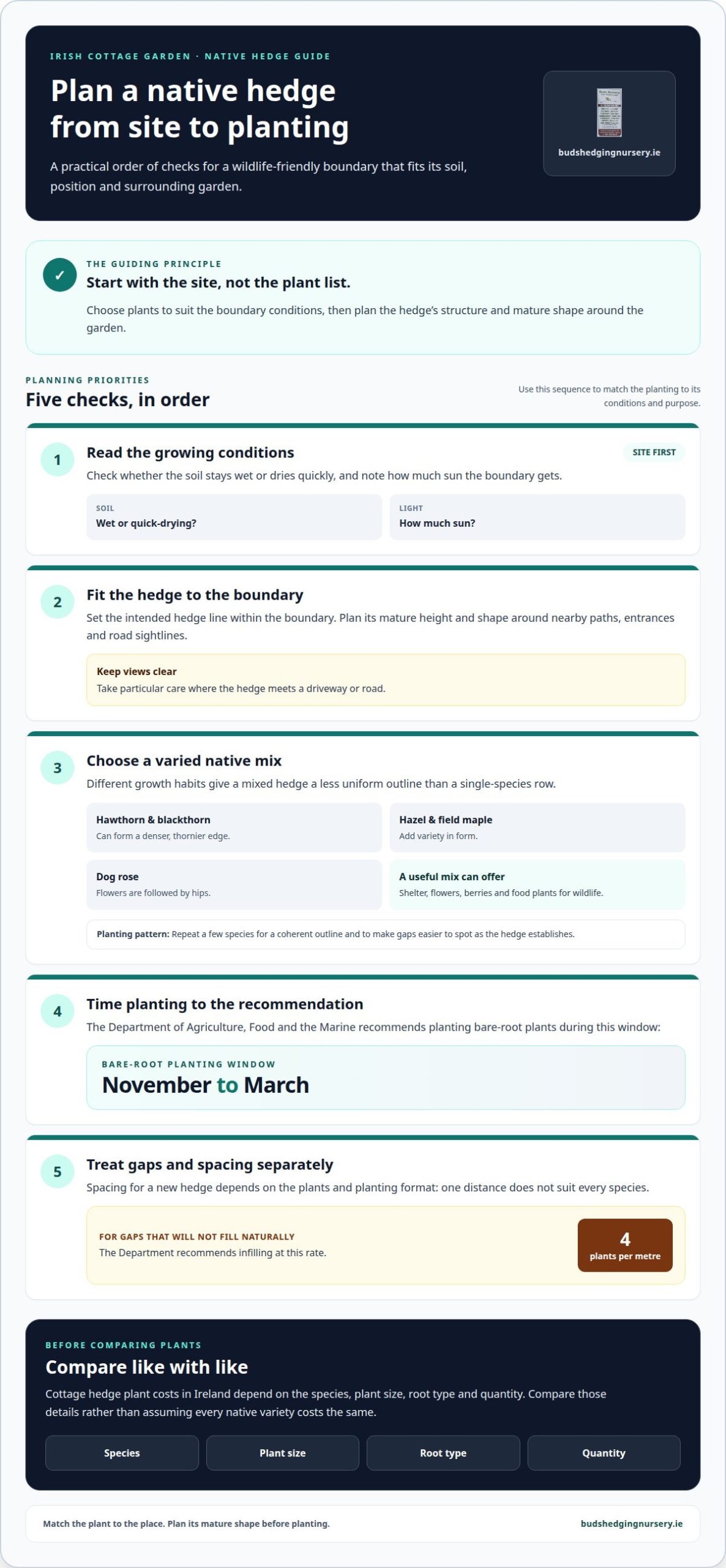
Start with the site, not the plant list. Check whether the soil stays wet or dries quickly, and note how much sun the boundary gets. Some native hedge plants can also help form a windbreak. Their different growth habits give a mixed hedge a less uniform outline than a single-species row.
A native wildlife hedge can provide shelter, flowers, berries and food plants. Hawthorn, blackthorn and hazel add variety, while dog rose brings flowers followed by hips. Choose plants suited to the boundary conditions, then arrange them to give the hedge a sound structure as it grows. The Department of Agriculture, Food and the Marine recommends planting bare-root plants from November to March. For gaps that natural regrowth cannot fill, it recommends infilling at four plants per metre.
Spacing for a new hedge depends on the plants and planting format, so don’t use one distance for every species. For repairing gaps that won’t fill naturally, the Department of Agriculture, Food and the Marine gives four plants per metre as a practical figure. Cottage hedge plant costs in Ireland depend on species, plant size, root type and quantity. Compare plants on those details rather than assuming every native variety costs the same.
For an Irish garden, hazel, dog rose, field maple, hawthorn and blackthorn are useful native examples. Set the intended hedge line within the boundary and plan its mature height around nearby paths, entrances and road sightlines. Keep views clear where a hedge meets a driveway or road. Height and boundary considerations depend on the site, so plan the position and eventual shape before planting rather than treating every boundary alike.
2. As a backdrop for garden colour?
A hedge behind a cottage border gives flowers a steady background. Green foliage sets off pink roses, blue delphiniums and pale foxgloves, while a flowering hedge adds colour of its own. For cottage garden hedge ideas that frame blooms, keep the hedge outline simple if the border already has varied heights and shapes. This contrast lets the planting hold attention without leaving the boundary bare.
Flowering currant, Ribes sanguineum, brings spring flowers to a boundary and can sit behind lower perennials. Leave room between it and the front row, so stems and blooms don’t crowd the path. Place taller plants, such as hollyhocks, towards the hedge, then use mid-height roses and low growers at the front. These cottage garden hedge ideas create layers while keeping the flowering currant visible in the display.
For bare-root hedge plants, the Department of Agriculture, Food and the Marine recommends planting from November to March. Prune flowering currant after its flowers fade, so you can shape it without cutting away that season’s display. Use clean, sharp tools and remove crossing or damaged stems first. Then shorten selected growth to keep the outline in proportion with the flower bed.
Consider a shrub’s spread and potential hazards before planting. A plant that grows beyond its space can crowd border flowers, while poisonous berries or leaves can pose a risk if eaten. Identify each plant before planting, and keep potentially harmful growth away from children’s play areas and pets. Check how much room each shrub needs at maturity rather than judging its eventual size by its container.
To keep the backdrop balanced, repeat a few flower colours through the border instead of introducing a different shade at every point. Roses, foxgloves and delphiniums stand out against a consistent green screen. At the hedge’s base, ground cover plants can soften exposed soil and connect the boundary to the flower bed. This gives cottage garden hedge ideas a practical finishing touch.
3. Informal and wildlife-friendly hedges
A mixed hedge gives a cottage garden a more varied edge than a single-species screen. Hawthorn, blackthorn, hazel, dog rose and field maple can combine to create different forms and seasonal features. Flowers, berries and shelter make this planting useful to wildlife, while a naturally uneven outline suits informal borders. Choose a mix that fits the boundary and soil, then allow enough room for its mature spread.
Informal growth can mean fewer trims than a tightly clipped hedge. That suits a garden where a softer boundary matters more than a sharp, level face. Keep a clear route beside the hedge, and remove growth that blocks paths or crowds nearby flowers. A relaxed shape needn’t mean neglect: occasional selective pruning can contain spreading stems and preserve space for plants such as roses and foxgloves.
Once the woody hedge is established, honeysuckle or ivy can grow through it. These climbers add another layer without needing a separate support along the boundary. Use them selectively so they don’t overwhelm smaller shrubs or hide the hedge’s structure. Lavender adds another kind of wildlife value: its flowers provide pollen and nectar for pollinating insects. Brushing past lavender releases its aroma.
Consider the whole boundary before choosing a mix. Hawthorn and blackthorn can form a denser, thornier edge, while hazel and field maple add variety in form. Dog rose contributes flowers and berries. Repeat a few species rather than placing each plant randomly; this gives the hedge a coherent pattern and makes gaps easier to spot as it establishes. Leave room for climbers only where established growth can support them.
For an informal cottage hedge, balance its purpose with the garden’s layout. Keep taller shrubs behind low border planting, and don’t let a spreading hedge swallow the flower bed. A mix of hawthorn, hazel and dog rose can create a wildlife-friendly boundary without a rigid, clipped outline.
4. Low-growing hedges for cottage gardens
A low hedge can edge a path, define a small lawn or separate flowers from a seating area. It gives the garden structure without hiding the planting. For cottage garden hedge ideas that frame a small garden, consider a low, narrow boundary that keeps the flower display visible. Choose plants to suit the available width as well as the intended height; a hedge spreading into a narrow path can make it feel cramped.
Lavender suits a sunny, well-drained boundary and brings an aromatic edge. Potentilla grows in sun or partial shade, and its flowers attract bees. Both offer a softer look than a tightly clipped evergreen. Place either in front of taller flowers, such as roses or foxgloves, to keep the border layered and visible from the path.
For a more formal line, yew can be clipped as a substitute for box and grows well in full sun. In good conditions, it can make 30 cm of growth annually, so allow for clipping when choosing it for a small plot. Keep a narrow hedge in proportion to nearby beds, and shape it so its base remains accessible for weeding and planting.
The best low-maintenance choice for a small garden depends on light, soil and the finish you want. Potentilla suits a spot where partial shade rules out sun-loving lavender. In a sunny position, lavender provides a defined edge; yew suits a formal shape but needs clipping to maintain it. These cottage garden hedge ideas work best when the plant suits the site and the upkeep fits your routine.
To integrate a low hedge, plant ground cover along its base rather than leaving a bare strip. This softens the boundary between hedge and path while keeping the main flower display visible. Explore ground cover plants to find options for planting around a low hedge. Used this way, cottage garden hedge ideas can make a small border feel clearly framed without closing it in.
Buds Nursery Cavan
Buds Nursery Cavan offers hedging plants and planting options for a cottage garden. First consider the boundary’s purpose: a leafy screen, a defined edge, or space for flowers and wildlife. Portuguese Laurel, Cherry Laurel and Golden Privet are among the available hedge plants, while fruit trees can add another layer to the garden. The right choice depends on the space, site conditions and the look you want to create.
Use these points to narrow your selection before choosing plants. A formal boundary calls for a different shape and upkeep from a mixed, informal hedge. For a cottage garden, consider how the hedge will sit beside flower beds and paths, and how much room it needs as it grows.
For help choosing plants for your garden, contact Buds Nursery Cavan.
Make a plan for your garden boundary
Before choosing plants, sketch the boundary and note what you want it to do. A simple plan can show where you need privacy, where flowers should remain visible and where a low edge would suit the layout. Mark paths, seating areas and existing borders too, so the hedge works with the garden rather than taking space from it.
Use your favourite cottage garden hedge ideas as a starting point, then narrow them down by the site and the amount of trimming you’re prepared to do. A clear plan makes it easier to choose a hedge with the right shape and character for your garden.
If you’d like help considering suitable hedge plants, contact Buds Nursery Cavan for hedge advice. Take the next step at a pace that suits your plans, and build a boundary that feels part of your garden.
Frequently Asked Questions
As a backdrop for garden colour?
Yes, a hedge can give colourful borders a defined background without distracting from their flowers. Consider the view from a kitchen window or favourite seat, not just the approach to the garden. Then place the hedge where it frames the display, leaving taller blooms visible above or in front. Repeating a few flower colours nearby can help the planting feel connected.
Evergreen or deciduous?
Choose an evergreen hedge if you want foliage to remain through winter; choose deciduous plants for a boundary that changes with the seasons. Evergreen leaves provide a consistent visual screen, while a deciduous hedge can let more light through after leaf fall. Consider the garden’s winter use, nearby planting and preferred appearance before settling on one type. A mixed hedge can combine both qualities.
Which hedge is in fashion now?
There isn’t one fashionable hedge that suits every Irish garden. Instead, choose a style that fits the house, boundary and time available for trimming. A crisp, clipped outline gives a formal finish; a looser mix suits a more relaxed planting scheme. Rather than following a short-lived trend, decide whether the hedge should provide structure, seasonal interest or a clear edge.
Which hedge is right for my garden?
Start by deciding what the hedge needs to do: screen a view, mark a boundary or frame a flower bed. Then consider the space it can occupy at maturity, access for trimming and how it will look beside existing plants. A narrow path needs a restrained shape, while a wide border can accommodate a fuller hedge with layered planting.
Which cottage garden hedge plants are evergreen and provide year-round privacy?
Portuguese Laurel, Cherry Laurel, Griselinia, Holly and Taxus baccata are evergreen options for a screening hedge. The privacy they provide depends on the hedge’s growth, spacing and upkeep, so plan for its mature form rather than the size of young plants. An evergreen screen can also create a steady backdrop for seasonal flowers in front.
What flowering hedge plants attract bees and wildlife in Irish gardens?
Lavender and Potentilla are flowering options for pollinating insects, while native shrubs such as hawthorn, blackthorn and dog rose can add flowers and berries. To extend interest, combine plants with different flowering periods rather than relying on one short display. Include flowering plants near the hedge too, so the boundary and border provide varied food and shelter across the garden.