

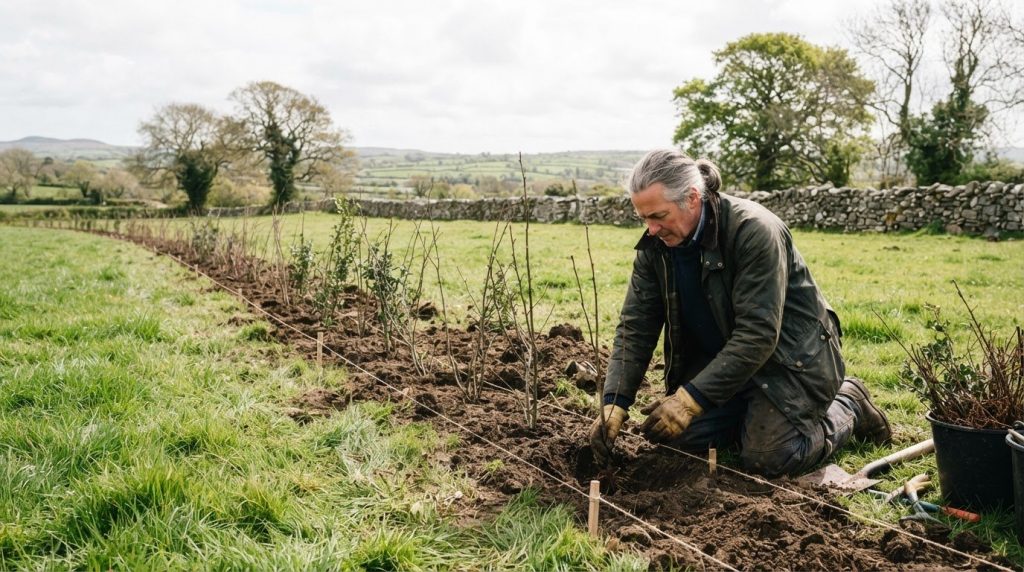
The planting pattern changes the count. The answer to how many hedging plants per metre are needed in Ireland is six plants per metre for bare-root hedging, while a new hedge planted in a double-staggered row under Ireland’s ACRES scheme uses five plants per metre. In that staggered layout, rows sit 25 cm apart and plants are spaced 45 cm apart within each row.
It’s easy to assume every hedge needs the same spacing, but the plant type and layout both matter. A single row and two staggered rows use space differently, and bare-root hedging has its own general planting rate.
This guide explains how to calculate quantities for different hedge types and layouts. You’ll learn how ACRES double-staggered spacing works, what to allow for bare-root plants, and what to decide before measuring your hedge line.
Key Takeaways
- Choose a single or staggered layout to suit the hedge’s purpose and the space available along the boundary.
- Measure the full hedge line before working out your bare-root order, so the planting plan matches the length to be filled.
- For pot-grown or instant hedging, base your plan on plant size and the coverage you want rather than assuming the bare-root spacing applies.
- If Portuguese Laurel is your preferred hedge, Buds Nursery Cavan offers it alongside other hedging options.
2. Double-staggered row spacing
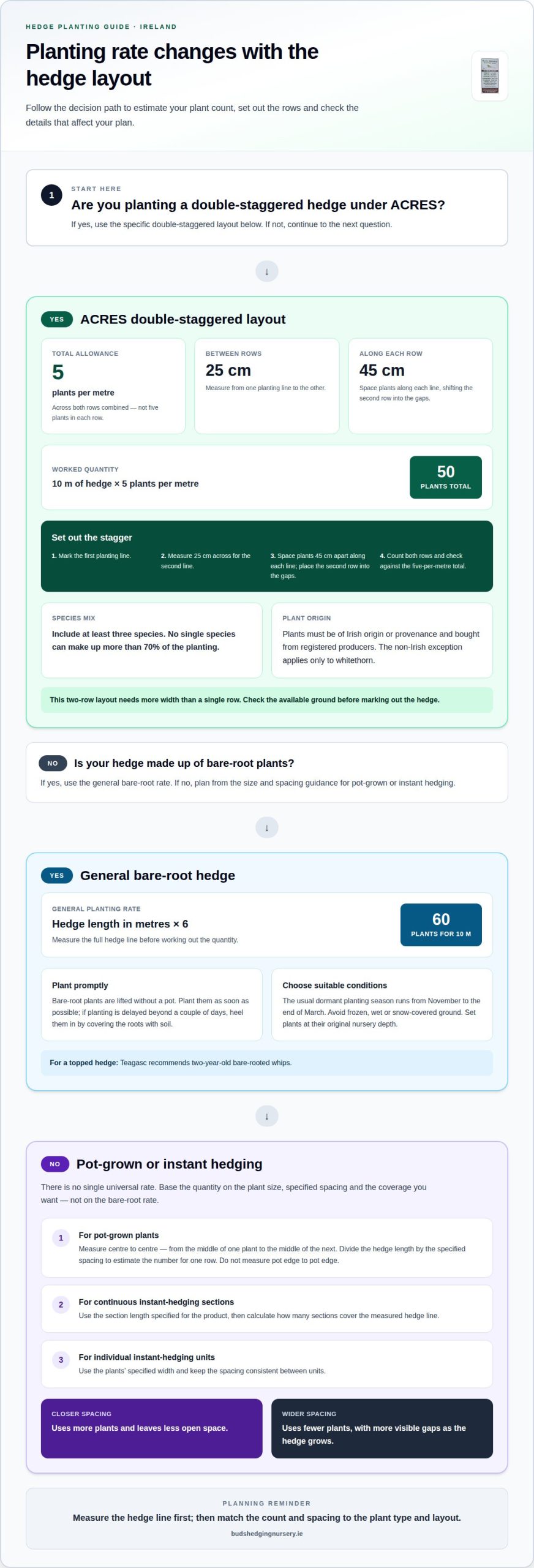
For a double-staggered hedge under Ireland’s ACRES scheme, plan five plants per metre. This total applies across both rows, not five plants in each row. Set the rows 25 cm apart, then space plants 45 cm apart within each row. Stagger the positions so plants in one row sit opposite the gaps in the other. This alternating layout distributes plants across the hedge line instead of placing them directly opposite one another.
Measure the full hedge line before calculating the quantity. For a 10 m stretch, five plants per metre gives a total of 50 plants across the two rows. The 25 cm measurement is the gap between the row lines, while 45 cm is the spacing between plants along each line. Keeping those measurements separate helps prevent the two-row layout from being mistaken for a single row with plants 25 cm apart.
Mark out both rows before planting. Use these steps to keep the stagger consistent:
- Mark the first row along the planned hedge line.
- Measure 25 cm across to mark the second row.
- Set plants 45 cm apart along each row, shifting the second row’s positions into the gaps.
- Count the plants across both rows and compare the total with the five-per-metre allowance.
The ACRES planting pattern also affects species choice. A new hedge under the scheme must contain at least three species, and no single species can make up more than 70% of the planting. These requirements apply to the hedge composition as well as the spacing plan. Work out the mix before laying out plants, so the arrangement across both rows reflects the intended species proportions.
Plant origin is another ACRES consideration. Hedge plants must be of Irish origin or provenance and purchased from registered producers. The flexibility for non-Irish plants applies only to whitethorn; other species must meet the Irish-origin or provenance requirement. Keep these conditions in mind when selecting plants for a scheme hedge, rather than treating the five-per-metre figure as the only planning rule.
A double-staggered layout uses more width than a single row because it needs two planting lines. The 25 cm gap between rows gives the stagger room, while 45 cm spacing within each line sets the plant positions. Measure the available ground first, then calculate the overall quantity and species mix for the hedge length.
3. What spacing should bare-root hedging plants have in Ireland?
For a straightforward hedge, allow six bare-root plants per metre. This is the general planting rate for hedges in Ireland. Bare-root plants are lifted from the nursery without a pot, so handle and plant them promptly. To estimate the total, multiply the hedge length in metres by six.
For example, a 10 m hedge at six plants per metre needs 60 plants. This general rate is separate from the layout for an ACRES hedge. Under Ireland’s ACRES scheme, plants should be about 40 cm apart, with about 40 cm between rows. Keep the scheme’s spacing instructions distinct from the general six-per-metre guide when planning a planting for that programme.
Prepare the hedge line before planting and organise the plants so their roots are not left exposed. Plant bare-root hedging as soon as possible. If you cannot plant within a couple of days, heel in the plants by covering their roots with soil. Set each plant at the same depth it grew at when lifted from the nursery.
Timing and soil conditions matter in Ireland. The usual dormant planting season runs from November to the end of March. Avoid planting when the soil is frozen, wet or covered in snow. These conditions make it harder to prepare the ground and position roots properly.
For a topped hedge, Teagasc recommends choosing two-year-old bare-rooted whips. A whip is a young, slender plant used to establish a hedge. This recommendation is for topped hedges, so consider the intended form when selecting planting stock. The plant count alone does not determine the finished hedge: the plant type and how it will be managed matter too.
Use this sequence to work out a practical planting plan:
- Measure the hedge line in metres and multiply its length by six for the general bare-root rate.
- For an ACRES planting, plan the row spacing and plant positions using the scheme’s 40 cm measurements.
- Prepare the ground, then plant promptly or heel in bare-root stock if planting is delayed.
- Set roots at their original nursery depth and avoid frozen, wet or snow-covered ground.
These steps help align the quantity, layout and planting method. For an ACRES hedge, follow the scheme spacing; for a general hedge, start with six plants per metre.
4. How many plants per metre for instant or pot-grown hedging?
Pot-grown and instant hedging have no single universal planting rate. Use the plant’s size and the spacing recommended for that stock. A compact pot-grown plant and a larger, fuller one occupy different amounts of hedge line. Treating them as interchangeable can leave gaps or crowd the plants, so base your count on plant dimensions and the intended hedge form.
For pot-grown plants, measure between plant centres, from the middle of one plant to the middle of the next. Divide the hedge length by this spacing to estimate the number needed for one row. If the planting instructions give a centre-to-centre distance, use it consistently along the whole line. Don’t measure from pot edge to pot edge, as pot width affects that distance.
If instant hedging comes in continuous sections rather than as individual plants, calculate the quantity using the section length specified for the product. Measure the hedge line and work out how many sections will cover it. For individual units, use the plants’ specified width and keep the spacing consistent between units.
Before setting out either type, consider the intended density of the finished hedge and the available space. Larger plants can occupy more width along the line, while smaller plants leave more room between their centres. Closer spacing uses more plants and leaves less open space; wider spacing uses fewer plants, with more visible gaps as the hedge grows.
Use this practical sequence to make the estimate:
- Measure the length of the hedge line.
- Identify whether the stock is supplied as individual pots or continuous instant-hedging sections.
- Use the stated plant width or recommended centre spacing to calculate coverage.
- Mark the positions along the line before planting, then check that the final position reaches the end of the measured length.
Consider plant size and spacing together. A count based only on hedge length ignores the space each plant occupies. For a mixed hedge, calculate each section using the relevant plant size and spacing, then add the quantities. This gives you a more accurate layout without automatically applying the bare-root rate to pot-grown or instant stock.
Buds Nursery Cavan: Portuguese Laurel
Buds Nursery Cavan offers Portuguese Laurel for new hedges. Once you’ve settled on the hedge type and layout, it’s one option to consider. Cherry Laurel and Golden Privet are also available, while fruit trees are a separate choice for planting plans that include fruit.
Match your plant choice to the hedge’s purpose and the available space, then use the spacing guidance above to calculate the quantity. This connects your plant selection to the metre-by-metre layout, rather than choosing a variety without considering how it will be planted.
For Portuguese Laurel and other listed options, visit Buds Nursery Cavan online.
Make your hedge plan ready for planting
Once you know how many hedging plants per metre you need in Ireland, turn your measurements into a clear planting list. Decide which hedge type suits the boundary, note where each section begins and ends, and keep the plant choice matched to the space. A written plan makes it easier to organise the work and keep the layout consistent along the whole line.
Buds Nursery Cavan offers Portuguese Laurel, Cherry Laurel and Golden Privet for hedging. Choose a variety that suits your planting plan, then discuss your requirements directly with the nursery.
Contact Buds Nursery Cavan for advice and take the next step towards a well-planned hedge.
Frequently Asked Questions
How many hedging plants per metre in Ireland?
How many hedging plants per metre are needed in Ireland depends on the planting format. For general bare-root hedging, use six plants per metre as a guide. An ACRES double-staggered hedge uses five plants per metre across both rows. Identify the plant type and layout before calculating the total, so you use the relevant rate rather than combining different methods.
How many hedge plants per metre for a single-row hedge?
For a single-row hedge, the general rate for bare-root hedging is six plants per metre. Multiply the measured row length by six to estimate the quantity, then space the plants evenly along the line. This guide is not a universal rate for pot-grown plants. Plant size and recommended spacing affect how many plants fit along the same boundary.
How many hedge plants per metre for a double-row hedge?
For a double-staggered hedge under ACRES, plan five plants per metre in total across both rows. Keep the rows 25 cm apart, with plants 45 cm apart along each row, and stagger their positions. The total is not five plants in each row. This distinction matters when ordering stock, since counting five per metre per row would overestimate the requirement.
What planting spacing is recommended for common Irish hedge species?
Spacing depends on the plant format and hedge layout, not just the species. The general guide for bare-root hedging is six plants per metre, while ACRES layouts have their own spacing rules. Portuguese Laurel, Cherry Laurel and Golden Privet are examples of hedge plants to consider, but choose the planting distance to suit the stock size and whether you’re planting one row or a staggered layout.
When is the best time to plant a hedge in Ireland?
The usual dormant planting season in Ireland runs from November to the end of March. Avoid planting when the soil is frozen, wet or covered in snow. Clear weeds along the planned hedge line three or four weeks before planting to give yourself time to prepare the ground before setting out bare-root or pot-grown plants.
How do I calculate the number of hedge plants needed for a garden boundary?
Measure each straight section of the boundary, then add the lengths to find the total hedge line. Multiply that length by the rate for your chosen planting format and layout. For a mixed boundary, calculate each section separately when plant types or spacing differ, then add the totals. For a double row, use the rate for both rows, not a per-row figure.