

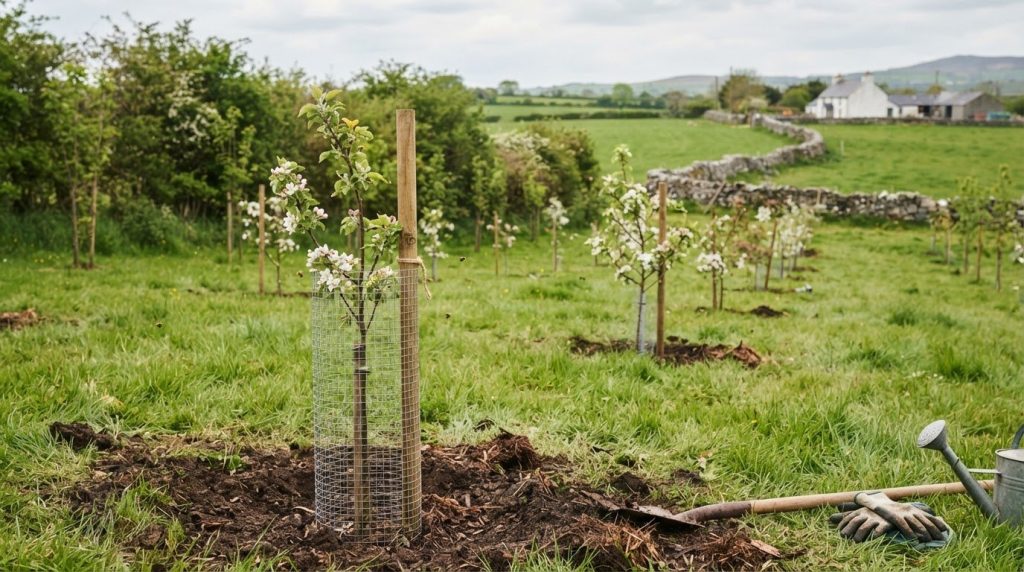
A small orchard begins with trees suited to Irish growing conditions, sourced from a nursery or garden centre. For planting a small orchard in Ireland, consider apples, pears, plums, cherries, walnuts or sweet chestnuts, and let your space and each tree’s mature size guide the choice. For reliable apple fruit set, plant at least three varieties with similar flowering seasons nearby.
Choosing trees is only part of the job. The site, soil, spacing and planting season all affect how well an orchard becomes established, so plan these details before you plant.
This guide explains how to assess a site, choose fruit trees, allow room for growth and support pollination. It also covers planting and early care, helping you make practical decisions for a small orchard in Ireland.
Key Takeaways
- Choose fruit and nut trees suited to Irish growing conditions, and use mature size to plan the orchard layout.
- Plant bare-root fruit trees from November to later February, while they are dormant.
- Allow roughly 2-6 metres between fruit trees, adjusting the spacing to their eventual height.
- Plant at least three apple varieties with similar flowering seasons nearby, and protect young trunks from rabbits and hares.
Where to get your fruit and nut trees?
In an orchard, watch for insect damage and fungal problems on leaves, shoots and fruit. Inspect trees regularly, remove affected material and keep growth open to improve airflow. These steps make problems easier to spot and help limit conditions that favour disease.
- Choose trees for the space and harvest you want. Irish options include native apple trees, pears, plums, cherries, walnuts and sweet chestnuts. Compare each tree’s mature size with the room available, and include different fruits to spread the harvest and provide blossom and food for wildlife.
- Buy bare-root trees during dormancy and plant promptly. Bare-root fruit trees are available from November to early April, while apples are typically planted in Ireland from December to February. Most apple trees are sold bare-root from December to March. Unpack trees within a day of arrival and plant them, or keep their roots damp until planting.
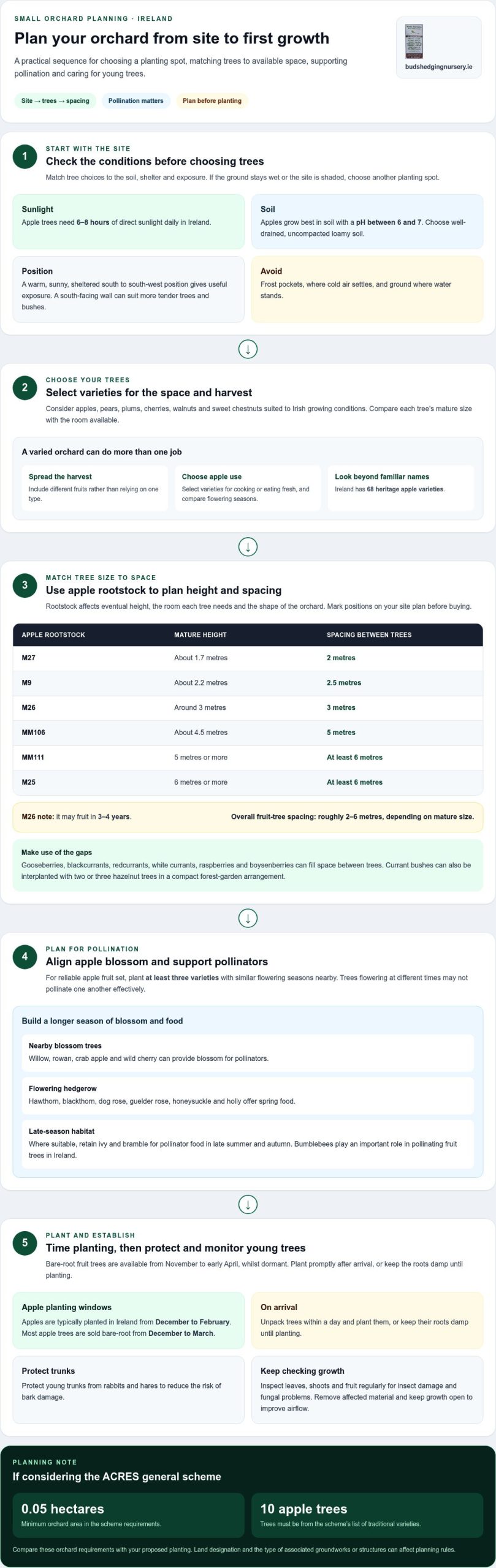
- Match apple rootstock to your available space. M27 trees grow to about 1.7 metres and need 2 metres between trees; M9 trees reach about 2.2 metres and need 2.5 metres. M26 trees grow to around 3 metres, need 3 metres’ spacing and may fruit in 3-4 years. Larger MM106 trees reach about 4.5 metres and need 5 metres’ spacing.
- Consider larger rootstocks only where there’s room. MM111 trees can reach 5 metres or more and need at least 6 metres between trees. M25 trees grow to 6 metres or more and also need at least 6 metres’ spacing. These mature sizes help you avoid crowding as the orchard develops.
- Use the gaps for fruit bushes. Gooseberries, blackcurrants, redcurrants, white currants, raspberries and boysenberries can fill space between trees. Their blossom and berries add food for wildlife, while currant bushes can also be interplanted with two or three hazelnut trees in a compact forest-garden arrangement.
Choosing fruit varieties for their place of origin
When planting a small orchard in Ireland, match your fruit-tree choices to the site’s soil, shelter and exposure. Allow for the space each tree will need as it matures.
-
Choose apple varieties and rootstocks
Select apple varieties for their intended use, such as cooking or eating fresh, and compare their flowering seasons. Ireland has 68 heritage apple varieties, offering options beyond familiar shop varieties. Match each rootstock to the available room and the mature tree size you want. Avoid choosing by fruit name alone: rootstock affects eventual height, spacing and the shape of the orchard.
-
Match varieties to Ireland’s climate and soil
Choose fruit trees suited to Irish growing conditions, then assess the planting spot. Apples, pears, plums, cherries, walnuts and sweet chestnuts are options to consider. Apple trees grow best in soil with a pH between 6 and 7. A warm, sunny, sheltered position facing south to south-west gives trees useful exposure. Avoid frost pockets, where cold air settles.
-
Check drainage and sunlight before planting.
Choose well-drained, uncompacted loamy soil rather than ground where water stands. Apple trees need 6-8 hours of direct sunlight daily in Ireland, so observe the site throughout the day. A south-facing wall can create a suitable warmer position for more tender trees and bushes. If the ground stays wet or the site is shaded, choose another planting spot.
-
Set spacing according to mature size.
Allow roughly 2-6 metres between fruit trees, depending on their eventual height. Smaller rootstocks suit tighter spaces, whilst more vigorous trees need room for their canopies. For planting a small orchard in Ireland, mark each position before buying and leave access for picking and pruning. Compare fruit tree options with your site plan before settling on varieties.
Pollinator-friendly planting and orchard management
Consider flowering times when choosing varieties, and provide food and shelter for pollinators throughout the growing season.
-
Choose varieties for pollination
Plant at least three apple varieties with similar flowering seasons in the vicinity for reliable fruit set. Check flowering times before choosing varieties, since trees that blossom at different times may not pollinate one another effectively. Bumblebees play an important role in pollinating fruit trees in Ireland, so plan the orchard to support them as well as the crop.
-
Select pollination partners
Nearby trees such as willow, rowan, crab apple and wild cherry can provide blossom for pollinators. A flowering hedgerow with hawthorn, blackthorn, dog rose, guelder rose, honeysuckle and holly offers spring food. Where suitable, retain ivy and bramble, which can provide pollinator food in late summer and autumn.
-
Make the planting plan before breaking ground.
For a straightforward orchard, consider whether planning permission applies to any associated structures or groundworks. Land designation and the type of work can affect the rules, so distinguish planting trees from making changes to the site itself.
-
Explore whether an orchard support scheme fits your plan.
The ACRES general scheme includes orchard requirements: the orchard must cover at least 0.05 hectares and include 10 apple trees from a list of traditional varieties. These criteria describe the scheme’s orchard requirements, so compare them with your proposed planting before building them into your plan.
-
Maintain habitat as trees establish.
Retain suitable flowering hedgerows and late-season ivy or bramble around the orchard. These plants extend food sources beyond apple blossom, while rowan and wild cherry add further flowers. Allow access to care for the trees without removing useful pollinator habitat.
Protecting trees from grazers and bark damage
Fruit-tree costs depend on the species, rootstock, tree size and protective materials required. Plan for the trees and their protection together, as fencing and trunk guards are separate parts of orchard preparation.
- Source trees suited to Irish growing conditions. Choose fruit trees from a garden centre or specialist supplier, and compare the tree’s mature size with your planting plan. Bare-root trees are available while dormant, from November to early April. Bare-rooted fruit trees should be planted from November to later February, so arrange planting within that season.
- Keep bare roots damp before planting. Unpack apple trees within a day of arrival, then plant them or keep their roots damp until planting. Make the planting hole wide enough to accommodate the root ball without forcing the roots. Spread the roots carefully, backfill with soil, and set the tree at its previous soil level, just above its top roots.
- Position the stake before the tree. Put the stake in before planting an apple tree to avoid damaging its roots. Set the tree beside the stake, then secure it so the trunk is supported without being tightly fixed. Check ties as the trunk grows and loosen them if they begin to restrict it.
- Protect trunks from rabbits and hares. Young apple trees need lower-trunk protection from hares and rabbits for the first few years of the tree’s life. Fit a guard around the base, making sure it protects the bark without pressing against it. Inspect the guard as the trunk thickens and adjust it when needed.
- Fence against deer where they can reach the orchard. Deer fencing around an orchard should be 2.5-3 metres high. Plan the fence before planting, leaving room to reach trees for pruning and harvesting. For a smaller plot, assess likely grazing pressure and protect vulnerable trunks individually.
For planting stock, explore bare-root trees for your orchard and match your selection to the site.
Buds Nursery Cavan: Portuguese Laurel
Buds Nursery Cavan sells fruit trees for a home orchard. Choose trees to suit your available space, soil and preferred fruit, then plan their positions before planting. Bare-root trees are planted during dormancy, so factor the season into your orchard plans.
Portuguese Laurel is a separate option from fruit trees and may suit a boundary planting, while fruit trees provide blossom and harvest within the orchard. Cherry Laurel and Golden Privet are also available as distinct planting options. Keep these roles in mind when deciding which plants belong in the orchard and which belong around its edges.
Contact Buds Nursery Cavan to discuss fruit trees for your orchard.
Take the next step with your orchard plan
Decide what you want from your orchard before adding more trees. Consider how you will use the harvest, which parts of the garden should remain open and whether you also need boundary planting. These choices help you create a small orchard in Ireland that suits your garden over time.
If boundary planting is part of your plan, Buds Nursery Cavan sells Portuguese Laurel, Cherry Laurel and Golden Privet. These are distinct from the fruit trees themselves, so choose plants according to the role they need to fill.
Set out your planting positions, note the varieties you’re considering, and make your next choice from that plan. For help with suitable nursery options, contact Buds Nursery Cavan. A well-planned start gives your orchard room to develop naturally.
Frequently Asked Questions
When is the best time to plant fruit trees in Ireland?
Plant bare-root fruit trees during dormancy, generally from November to later February. For apple trees, the usual Irish planting period is December to February. Choose a mild day when the ground is neither waterlogged nor frozen, and prepare the planting hole before unpacking the tree. Potted trees are less restricted by the dormant season, so planting time is more flexible.
How much space and what tree spacing are needed for a small orchard?
Allow roughly 2-6 metres between fruit trees, with the final spacing guided by each tree’s eventual height. For example, an M27 apple tree needs 2 metres between trees, whilst an MM106 needs 5 metres. Draw the layout to scale before planting, including room to walk between canopies for picking and pruning. A compact plot can use smaller-rootstock trees and fruit bushes between them.
How do rootstocks affect tree size and fruit production?
Rootstocks influence an apple tree’s mature height, spacing needs and likely time to fruit. An M27 tree grows to about 1.7 metres, whilst an M25 can reach 6 metres or more. M26 trees may fruit in 3-4 years; MM106 trees may take about 5 years. Use these differences to balance limited space with the size and growing habit you want.
How should I prepare the soil and plant bare-root fruit trees?
Prepare a hole about 200 millimetres wider and deeper than the root ball, then loosen the base and sides. A trowel full of compost or manure can be mixed with the excavated soil. Set the tree at its previous soil level, just above its top roots, and spread the roots before backfilling. Water the planting area and mulch around the tree without piling material against its trunk.
What pollination partners do apple, pear, plum and cherry trees need?
For reliable apple fruit set, plant at least three apple varieties with similar flowering seasons nearby. Bumblebees help pollinate fruit trees, and nearby blossom can support their activity. For pear, plum and cherry trees, choose compatible partners that flower at the same time. The right match depends on the varieties, so compare flowering periods when planning a mixed-fruit orchard.
How should a young orchard be watered, mulched, pruned and protected?
Water newly planted trees if dry weather follows leaf emergence, particularly during dry spells in spring. Weed around trees through the summer after planting and renew mulch annually. Prune apple trees once a year, and inspect ties twice a year to ensure they do not constrict growing trunks. Protect young trunks from rabbits and hares during the first few years.