

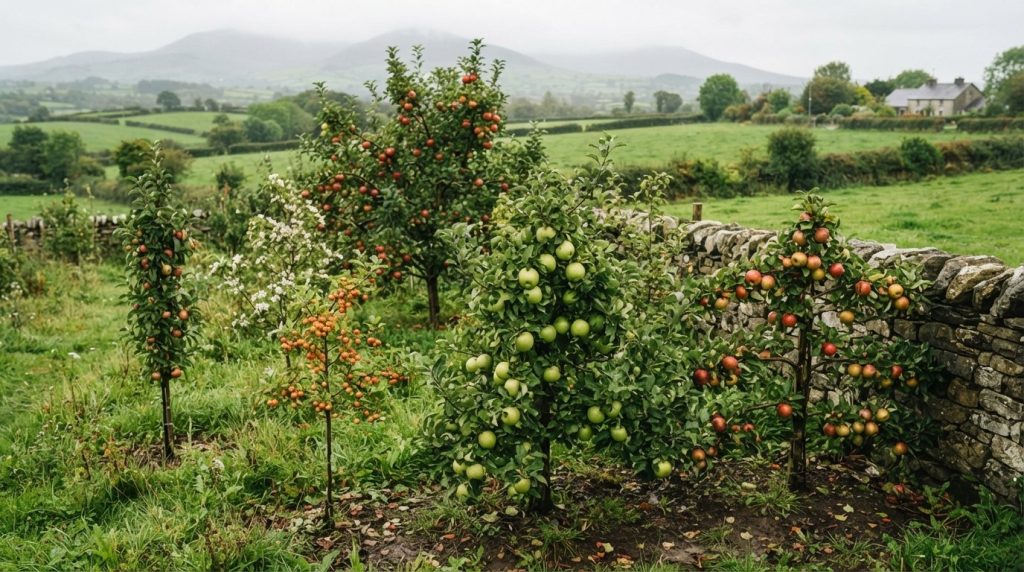
One apple tree can be enough to get started, but a nearby pollination partner can improve the crop. Most apple trees crop better with an apple or crab apple that flowers at the same time, so planting two or three different varieties is a practical choice. That’s a useful starting point when choosing the best apple trees for the Irish climate.
It’s easy to focus on the fruit you like best, but the variety, rootstock and planting site all affect how well a tree suits your garden. This guide explains how to match those choices to Irish conditions, your available space and pollination needs.
You’ll find advice on varieties suited to damp conditions, rootstocks for different garden sizes, and what to consider when planning an orchard site. The aim is to help you choose fruit trees that fit the ground you have and the harvest you want.
Key Takeaways
- Choose apple varieties with Irish conditions in mind: damp weather can make scab a serious concern, so compare varieties such as Discovery, Katy, Red Windsor and Bramley’s Seedling.
- Plan for pollination by choosing two or three varieties, or consider a nearby crab apple that flowers at the same time.
- Match the rootstock to your available space. M27 and M9 suit more compact gardens, whilst M26, MM106 and MM111 produce larger trees.
- Assess the planting site before choosing a tree. Soil drainage, pH, shelter and the risk of waterlogging all affect suitability.
- Use the article’s variety and rootstock comparisons to narrow your choice to trees that fit your garden and the harvest you want.
1. What Makes a Good Fruit Tree for Ireland?
The best apple trees for the Irish climate combine suitable growth habits with tolerance of common local problems. Damp spring and summer weather can make apple scab particularly damaging. Discovery, Katy, Red Windsor and Bramley’s Seedling are identified as scab-tolerant choices. That tolerance helps inform your selection, but the tree still needs a suitable site and sensible care.
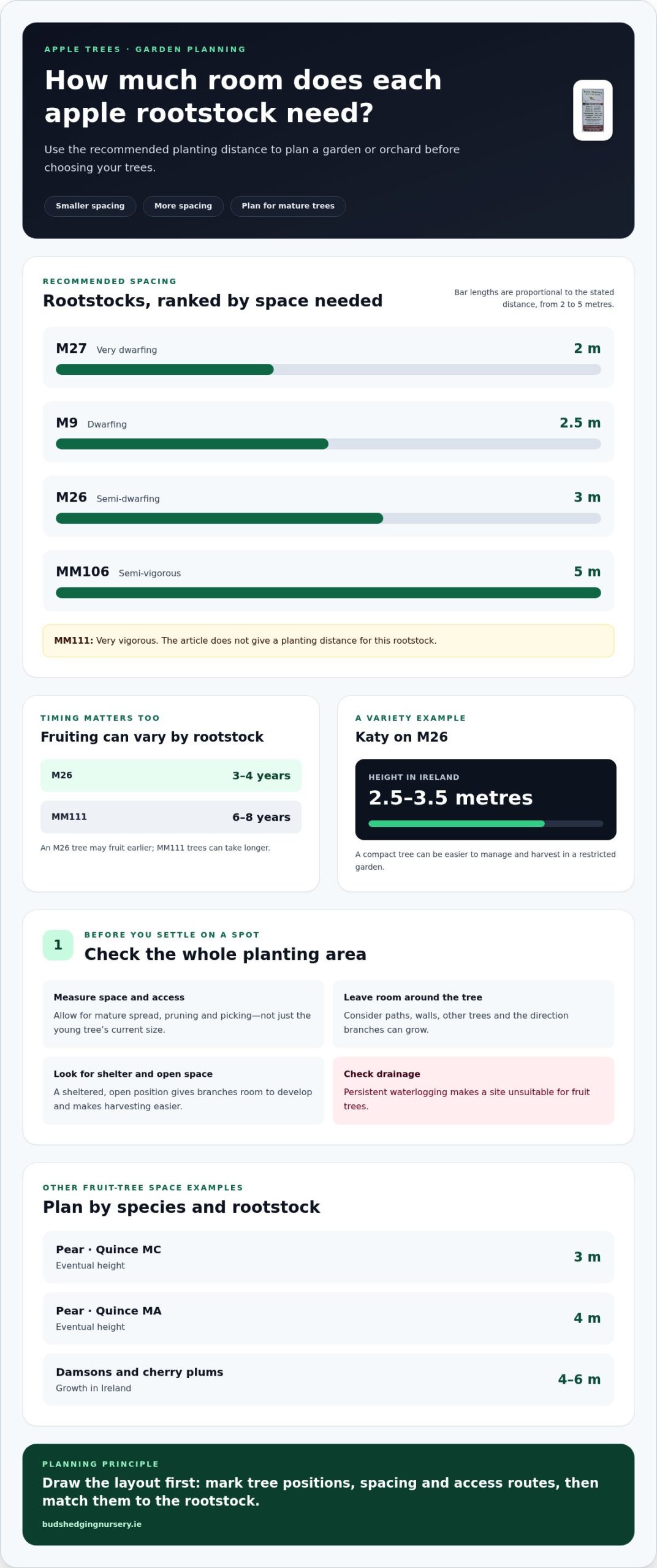
Consider the rootstock as well as the named apple variety. Rootstock influences vigour, mature size and how much room the tree needs. M27 is very dwarfing, whilst M9 is dwarfing; M26 is semi-dwarfing, MM106 semi-vigorous and MM111 very vigorous. An M26 tree may fruit in 3 to 4 years. By comparison, MM111 trees can take 6 to 8 years to fruit.
For a compact garden, a less vigorous tree is generally easier to manage and harvest. Katy on semi-dwarf M26 reaches 2.5 to 3.5 metres in Ireland. A Sunset on the same rootstock grows to about two-thirds the size of a Bramley. Look for a compact, non-lanky cultivar if pruning access and picking height matter. Around 15-25 centimetres of new growth at branch ends each year indicates balanced growth.
Most apple trees crop better with a pollination partner nearby. Choose two or three different varieties whose flowering times overlap, or use a crab apple flowering at the same time. Check flowering compatibility before planting: a second tree that blooms at a different time may not provide the pollination needed for a reliable crop.
Protect young trunks from browsing animals with a suitable tree guard. Where deer can enter an orchard, a surrounding fence should be 2.5 to 3 metres high. Keep the ground around young trees weed-free within a radius of at least 1 metre during their first few years. This reduces competition around developing roots.
Apple trees are sold by Irish nurseries, including as bare-root trees. Cost depends on the variety, rootstock and tree size, so compare those details when choosing rather than judging by the name alone.
Plant bare-root fruit trees in Ireland from November to March, whilst they’re dormant. Choose a day when the ground isn’t frozen or waterlogged. Make the planting hole wider than the roots, but no deeper, and spread the roots out before backfilling. Keep the graft union at least 10 centimetres above ground.
After planting, water the tree and maintain its weed-free area as it establishes. Prune apples in winter, removing damaged or crossing growth to keep the centre open. In areas affected by winter moth, a sticky grease band about 15 centimetres wide around the trunk can catch females climbing the tree. These steps support healthy growth without replacing careful variety and site selection.
2. Choosing trees for garden size and conditions
Start with the space available, then choose a rootstock whose eventual spread and planting distance suit it. A small garden may accommodate one compact apple tree, while an orchard can allow room for several trees. Measure the planting area, including access for pruning and picking. Don’t plan around the young tree’s current size: its rootstock influences how much space it will need as it grows.
For apple trees, the recommended spacing changes with rootstock. M27 trees should be planted 2 metres apart, and M9 trees 2.5 metres apart. Allow 3 metres between M26 trees. MM106 trees need 5 metres between them. These distances help you plan a row or group without crowding the trees as they mature.
Use those figures as a practical guide when drawing a garden plan. Mark each tree’s position and leave clear space between its planting point and paths, walls or other trees. Consider the direction branches can grow, too. A tight corner can make pruning awkward, even if the trunk fits. Compact cultivars are often easier to manage in restricted spaces.
Rootstock also affects how quickly a tree fills its allotted space. A more dwarfing rootstock suits a smaller plot or a closely spaced planting, while a more vigorous tree needs greater separation. Don’t choose by height alone. Branch spread, the shape of the tree and the room needed to reach fruit all influence whether a variety fits.
Other fruit trees need their own space allowance. Pears on Quince MC rootstock eventually reach 3 metres tall, whilst pears on Quince MA eventually reach 4 metres. Damsons and cherry plums in Ireland grow to 4 to 6 metres. These examples show why a mixed fruit garden needs planning by species and rootstock, not just by the number of trees.
Next, match the planting position to the tree. A sheltered, open spot gives branches room to develop and makes harvesting easier. Avoid placing a tree where its mature canopy will be boxed in by buildings or existing planting. For damp ground, assess drainage before planting: persistent waterlogging makes a site unsuitable for fruit trees.
Draw the layout before buying. Add the tree positions, spacing and access routes, then compare that plan with the rootstock options. If you’re weighing up suitable fruit trees for your garden, use the available space and planting conditions to guide your choice.
3. Crab apples as pollination partners
A crab apple can provide a pollination partner when its flowers open at the same time as an eating or cooking apple. Most apple trees crop better with a nearby apple or crab apple flowering concurrently. This makes a crab apple useful where a garden has room for one fruit tree, but flowering overlap still matters.
Start by identifying the apple variety you already have or plan to plant. Then compare its flowering period with the crab apple’s, rather than choosing by fruit colour or tree shape. Pollen must be available while both trees are flowering. A crab apple blooming earlier or later won’t serve the same purpose.
Malus sylvestris is the crab apple, also known as wild apple. It can be considered as a pollination partner, but the name alone doesn’t establish a match for every cultivated apple. Check the flowering period of both trees as part of the selection process. Compatibility depends on shared flowering time.
For a new planting, sketch the garden and mark the position of each apple tree. Include existing trees in neighbouring gardens if their blossoms are visible nearby, then consider whether your own planting needs another partner. A nearby tree can contribute pollen, but relying on one makes your crop dependent on its flowering overlap.
If space allows, planting two or three different apple varieties gives you more than one potential pollen source. Choose varieties with overlapping blossom periods, not simply different fruiting seasons. Picking apples at different times extends the harvest, but harvest timing doesn’t tell you whether blossoms will coincide.
A crab apple may suit a garden where the main goal is pollination rather than a large crop of eating apples. Before planting, consider its eventual position, canopy and access for maintenance. Keep it close enough to function as a neighbour to the apple trees, while allowing both trees room to grow.
Flowering conditions can vary between sites. A sheltered position may experience different conditions from an exposed garden, so local timing can affect how well two trees overlap. Observe existing blossom in your area and use that alongside the variety’s stated flowering period when planning a match.
Finally, review the pollination plan whenever you add or replace an apple tree. Write down each variety and its flowering period, then check whether at least one partner overlaps. This simple record helps avoid choosing a crab apple solely for its name, appearance or fruit, without considering its role in the orchard.
4. Apple varieties and rootstocks
Choose the apple variety for fruit use, flowering time and disease tolerance. Discovery, Katy, Red Windsor and Bramley’s Seedling are identified as scab-tolerant choices for Ireland. Discovery and Katy suit eating, while Bramley’s Seedling is a cooker. These varieties offer a practical starting point where damp spring and summer weather makes scab a concern.
For a cooler, wetter garden affected by spring frosts, Pitcher’s apple is a useful variety to consider. It flowers late, which helps it avoid spring frosts in those conditions. Coastal exposure is a separate challenge: no single named variety suits every exposed site, so consider shelter and planting position alongside the variety.
Rootstock determines much of a tree’s vigour and eventual height. MM111 has a 25% dwarfing effect and eventually reaches 6-7 metres. MM106 has a 35% dwarfing effect and reaches 5-6 metres. These vigorous options need more room than dwarfing rootstocks and suit larger gardens or orchard layouts.
For a smaller tree, M26 has a 50% dwarfing effect and eventually reaches 4-4.5 metres. M9 is a dwarfing rootstock that can help keep an apple tree compact. The very dwarfing M27 has a 75% dwarfing effect and eventually reaches 2 metres. Match those mature heights to your garden, rather than relying on the young tree’s size.
Pair variety and rootstock deliberately. A Bramley’s Seedling on a vigorous rootstock needs more room than a compact tree on M27. Rootstock also influences support needs and how soon a tree fruits. M26 trees may fruit in 3 to 4 years, whilst M9 and M27 are options where limiting height matters more.
For an exposed site, assess wind direction and shelter before settling on a variety. A protected position can reduce direct exposure to strong winds, while open, cold locations can increase frost risk during flowering. Pitcher’s late flowering is relevant to frost-prone, cooler and wetter areas, but doesn’t replace choosing a suitable planting position.
Make a shortlist before buying: select fruit type, check scab tolerance, compare flowering periods, then choose the rootstock height that fits. For example, a gardener wanting a compact dessert apple might compare Discovery on M9 with a larger tree on MM106. The right combination depends on the harvest you want and the room available.
5. Orchard site suitability
Check drainage before choosing an orchard position. In Ireland, apple trees should not be planted in ground that is frozen or waterlogged. A site can look workable after dry weather yet hold water beneath the surface, so test the soil before preparing planting positions. Good drainage helps prevent roots sitting in saturated ground.
Dig a test hole 50 cm square and 50 cm deep, then observe how quickly water drains. If water remains after 90 minutes, the site has unsuitable drainage for an orchard. Test more than one part of a large area, since a low patch can behave differently from higher ground. Use the results to decide where trees can establish.
Soil acidity matters too. Apple trees grow best in soil with a pH between 6 and 7, and the recommended orchard soil pH is approximately 6.5. Test the intended planting area rather than assuming the whole garden has the same soil. If readings vary, use the planting positions with conditions closest to that range.
For a wet planting site, raise the root zone with a mound about 30 centimetres above the surrounding garden. The recommended soil mound is 50 centimetres wide all around. This gives the tree a drier planting position than the surrounding ground. It won’t make deeply waterlogged land suitable across the whole orchard, so use drainage observations to guide placement.
Choose a position with enough open ground for the trees and access between rows. Consider how the site changes after rain, where water collects and whether nearby structures restrict airflow or light. A gentle slope can help surface water move away, while a hollow may stay wet. Match the layout to the drainage pattern rather than planting in a straight line regardless of conditions.
Before planting, check the ground conditions again. Frozen soil makes planting difficult, while waterlogged soil can compact underfoot and around roots. Wait until the ground is workable, then prepare each position without turning wet soil into a dense planting bed. This simple timing decision protects soil structure as well as the young tree.
Use the site checks together, not in isolation. A pH near 6.5 is useful, but poor drainage can still rule out a planting spot. Likewise, a raised mound can improve the root zone, but a persistently wet hollow remains a poor choice for an orchard. Record test-hole drainage and soil pH for each area before finalising the plan.
For a new orchard, mark the proposed trees only after checking drainage, pH and ground conditions. A 50 cm test hole, a 90-minute drainage check and a soil reading within the 6 to 7 pH range give you practical criteria for comparing possible sites. Choose the best-drained suitable area first, then set out the trees around it.
Buds Nursery Cavan: Portuguese Laurel
Buds Nursery Cavan offers Fruit Trees for gardeners choosing apple varieties and rootstocks for Irish conditions. If you’ve used this guide to narrow your options, its fruit trees are a practical next step when selecting what to plant. Portuguese Laurel is also available for gardeners planning the surrounding garden alongside their orchard.
Consider the planting site and purpose of each tree before making your selection. An apple tree needs suitable pollination, space and drainage; Portuguese Laurel can be considered separately as part of the garden’s planting plan. Keeping those decisions distinct helps you focus on the orchard’s needs first.
For fruit trees or Portuguese Laurel, contact Buds Nursery Cavan or visit budshedgingnursery.ie.
Make your garden plan your next step
Choosing the best apple trees for the Irish climate is only part of shaping a productive garden. Think about how you want to use the space around the orchard, and whether you also need planting for shelter, screening or structure. Keeping those aims in mind can help you make a plan that works as a whole, rather than choosing each tree in isolation.
Buds Nursery Cavan offers Portuguese Laurel, Cherry Laurel and Golden Privet for hedging and garden structure, alongside Fruit Trees. These options serve different purposes, so decide what each planting needs to do before choosing where it belongs. A clear plan helps you balance fruit production with the wider layout of your garden.
If you’re ready to discuss your planting choices, ask Buds Nursery Cavan for advice. Take your garden plan and priorities into the next conversation, then move ahead with a choice that suits the space and the way you want to use it.
Frequently Asked Questions
Do I need two fruit trees for pollination?
Not always, but most apple trees crop better with a nearby apple or crab apple flowering at the same time. If your garden has space for one new tree, first consider whether an existing apple or crab apple nearby could provide a matching blossom period. If there’s no suitable partner, planting two compatible varieties is a practical way to support pollination and broaden your choice of fruit.
What makes a good fruit tree for Ireland?
A good choice suits the garden’s soil, exposure, available space and intended harvest. For apples, consider scab tolerance, since damp spring and summer weather can make scab damaging. Check the rootstock’s eventual size before planting, and assess drainage where the tree will grow. For example, a compact tree is easier to manage in a small garden than a vigorous tree needing more room.
Which apple varieties grow best in Ireland’s cool, wet climate?
Discovery, Katy, Red Windsor and Bramley’s Seedling are scab-tolerant varieties identified for Irish conditions. Pitcher’s apple flowers late, making it a consideration for cooler, wetter areas affected by spring frosts. Choose according to the site as well as the fruit you want. A damp garden raises the value of scab tolerance, while a frost-prone position makes flowering time relevant.
What are the best disease-resistant apple trees for Irish gardens?
For scab tolerance, consider Discovery, Katy, Red Windsor or Bramley’s Seedling. Scab tolerance is a useful selection factor in Ireland’s damp spring and summer conditions, but it shouldn’t be treated as immunity to disease. Site and care still matter. Give the tree room for its mature size, and avoid planting where waterlogged ground could hinder its establishment.
Which apple varieties are suitable for cooking, eating, and cider in Ireland?
For cooking, Bramley’s Seedling is a named cooker suited to that purpose. Choose an eating variety according to the flavour and harvest you prefer, then check its pollination needs and rootstock size. Cider-making depends on the juice you want and how varieties work together in a blend. Plan for pressing and processing as well as fruit production, rather than choosing an apple solely for its name.
Which apple varieties flower at the same time for pollination in Ireland?
Choose varieties whose flowering periods overlap, because simultaneous blossom allows pollen to pass between suitable partners. The variety names alone don’t establish that match. Compare flowering information for the specific trees you’re considering, then record the pairings before planting. A crab apple can also serve as a partner if its blossom coincides with the apple variety’s flowering period.
Are self-fertile apple varieties suitable for small Irish gardens?
A single apple tree can suit a small garden, but most apple trees crop better with a nearby apple or crab apple flowering at the same time. If there’s no room for another tree, consider whether a compatible tree grows nearby. If planting a partner is possible, choose a compact rootstock and varieties with overlapping blossom periods to make better use of limited space.
What rootstocks and tree sizes are best for Irish gardens and orchards?
Choose according to the space available: M27 eventually reaches 2 metres, M9 3 metres, M26 4-4.5 metres, MM106 5-6 metres and MM111 6-7 metres. M27 and M9 suit more compact planting plans, whilst MM106 and MM111 need more room. Allow for the tree’s mature size when planning paths, access and neighbouring trees, not just its height at purchase.