

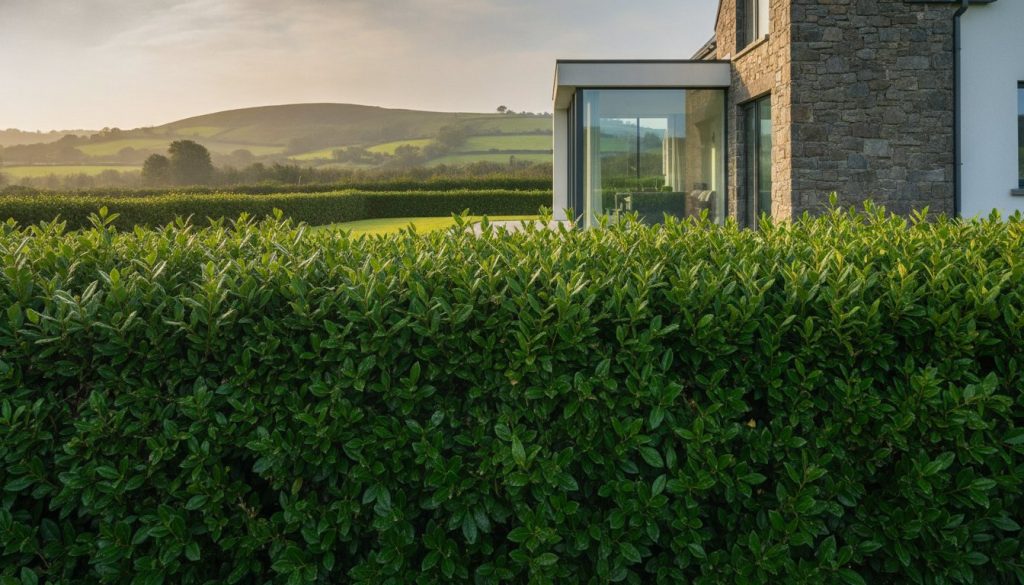
You shouldn’t have to retreat indoors just because the neighbours are out in their garden or cars are passing by your front gate. True privacy is a priority for any homeowner, but finding a screen that grows fast and stays green all year isn’t always straightforward. If you’re searching for cherry laurel hedging Cavan gardeners recommend, you’re likely looking for a hardy, dependable plant that can handle the specific demands of the Irish climate. It’s a common frustration to invest in hedging only to see it fail due to poor drainage or thin, patchy growth.
We understand that you want a dense, evergreen boundary without the high costs or constant maintenance of slower varieties. This guide will walk you through the practical steps to select the right stock, from bare root plants to mature pot-grown options, and how to get them established in your soil. You’ll learn the best planting techniques to prevent waterlogging and the simple pruning routines that keep your hedge thick from top to bottom. We’ll provide a clear, no-nonsense roadmap to creating a cost-effective privacy screen that looks professional and performs reliably for years to come.
Key Takeaways
- Identify the ideal soil conditions and site requirements to help your hedge achieve its vigorous growth rate of up to 60cm per year.
- Learn why sourcing cherry laurel hedging Cavan directly from a specialist nursery provides the best chance for a healthy, 100% success rate.
- Compare the practical differences between pot-grown, rootball, and bare root stock to choose the right maturity level for your budget and privacy needs.
- Master professional planting techniques, including trench preparation and root health supplements, to ensure your screen thrives in the Irish climate.
- Discover the essential pruning and maintenance routines that keep your evergreen boundary dense, glossy, and manageable throughout the seasons.
What is Cherry Laurel and Why is it Ireland’s Favourite Privacy Hedge?
The Cherry Laurel (Prunus laurocerasus), specifically the ‘Rotundifolia’ variety, is a vigorous evergreen shrub that has become a staple in gardens across the country. It’s easily identified by its large, leathery, glossy green leaves that remain vibrant through the harshest winter months. For homeowners seeking cherry laurel hedging Cavan, the appeal lies in its ability to form a solid, impenetrable wall of green in a relatively short timeframe. Unlike deciduous hedges that leave your garden exposed in winter, laurel provides a permanent visual barrier.
Choosing this species over alternatives like Privet or Leylandii is often a matter of practicality. Privet can struggle to stay fully evergreen in very cold Irish winters, often thinning out when you need the cover most. Leylandii, on the other hand, grows at an aggressive rate that quickly becomes unmanageable for a standard residential boundary. Cherry Laurel strikes the right balance. It’s hardy enough to survive frost and resilient enough to handle the damp, heavy soils often found in the midlands and north-west. If you’re still weighing up your options, our guide to the best hedging for privacy Ireland homeowners can rely on covers a broader range of evergreen varieties to help you make the right choice for your site.
The Benefits of an Evergreen Screen
A thick laurel hedge does more than just block a view. The sheer density of the foliage makes it an excellent tool for noise reduction. If your property borders a busy road or a noisy housing estate, the broad leaves help deflect and absorb sound waves. It also acts as a robust windbreak. In exposed gardens, a well-established hedge creates a microclimate, protecting more delicate garden plants and livestock from the biting winds that sweep across the landscape.
- Year-round privacy: No seasonal leaf drop means your garden stays private 365 days a year.
- Low maintenance: Once established, it only requires one or two trims a year to maintain its shape.
- Versatility: It thrives in both full sun and deep shade, making it ideal for planting under trees or against tall walls.
Creating a quiet, private outdoor space is the first step toward a more peaceful lifestyle. To complement the tranquillity of your new garden, you might also consider enhancing your indoor comfort with a high-quality mattress from the Belfast Bed Superstore, ensuring your rest is uninterrupted both inside and out.
Cherry Laurel vs Portuguese Laurel
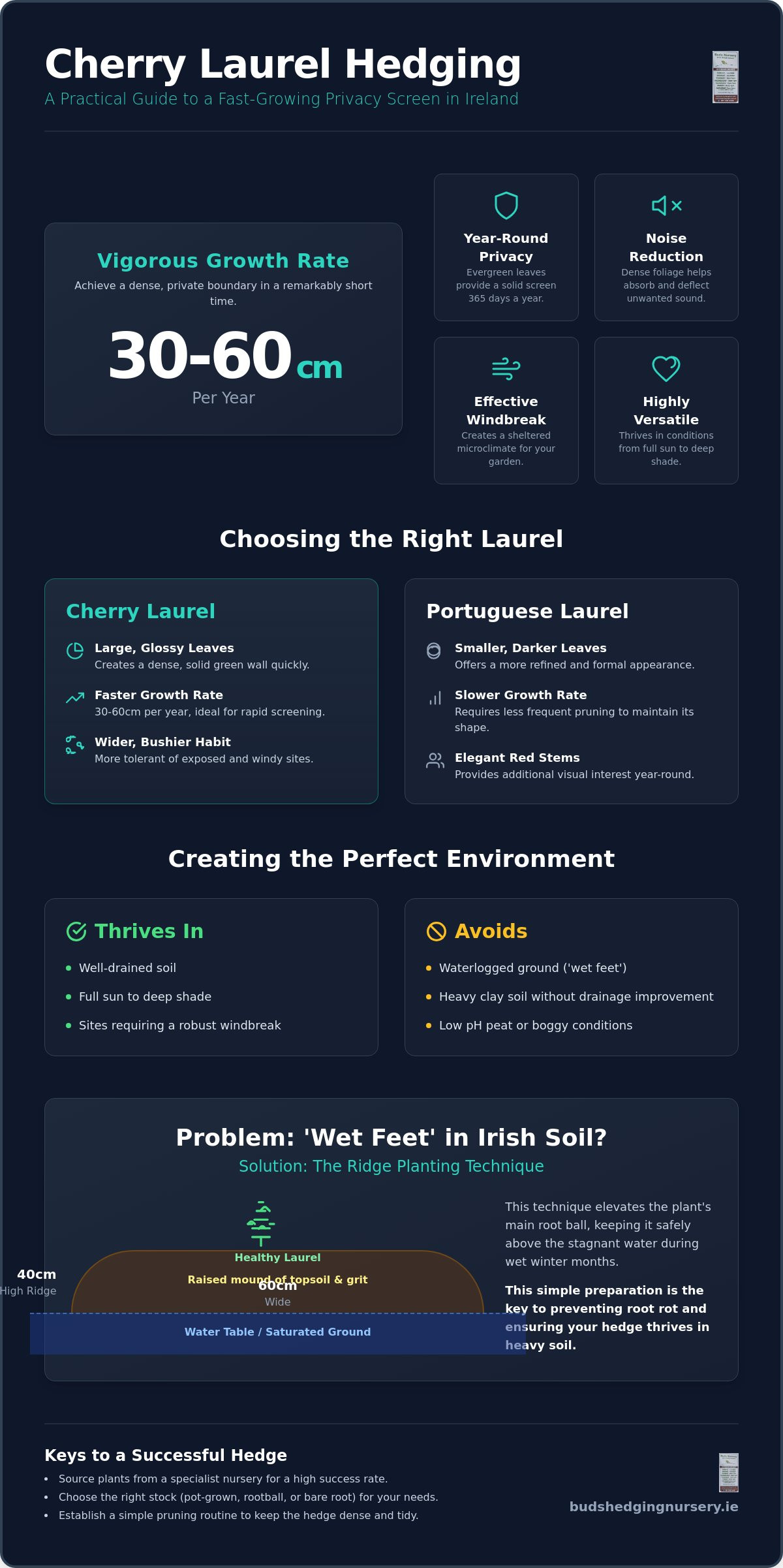
While both are excellent choices, there are clear differences. Cherry Laurel has much larger leaves and a faster growth rate, typically putting on 30cm to 60cm of height annually. It’s also slightly more tolerant of exposed, windy sites. If you need a screen quickly and have the space for a wider hedge, it’s the superior option. By contrast, Portuguese Laurel has smaller, darker leaves and red stems, offering a more formal look but growing at a slower pace. For those looking for cherry laurel hedging Cavan, the speed of growth is usually the deciding factor. At our 60-acre nursery, we’ve seen that Cherry Laurel remains the top choice for those who want a no-nonsense privacy solution that delivers results fast. Homeowners who want a colourful alternative with striking seasonal interest often also consider photinia red robin plants Ireland growers have found success with, as the vivid crimson new growth offers a dramatic contrast to the classic deep green of laurel.
Understanding Growth Rates and Site Requirements for Optimal Results
Achieving the best results with cherry laurel hedging Cavan requires an understanding of how the plant interacts with its environment. Under the right conditions, you can expect a vigorous growth rate of between 30cm and 60cm per year. This speed makes it ideal for those who don’t want to wait a decade for a functional boundary. However, this growth is entirely dependent on meeting specific site and soil requirements. While the plant is famously versatile, thriving in everything from full sun to deep shade, it has one major weakness: ‘wet feet’.
In many parts of Ireland, particularly on sites with heavy clay or poor natural drainage, waterlogging is the primary cause of plant failure. When roots sit in stagnant water, they cannot breathe, leading to root rot and characteristic yellowing of the leaves. Cherry Laurel prefers well-drained soil and generally avoids low pH peat or boggy ground. If your garden holds water after a heavy downpour, you’ll need to take corrective action before planting to ensure your investment survives the winter.
Solving Drainage Issues with Ridge Planting
If your soil is heavy clay, we recommend ridge planting. This involves creating a raised mound or ridge approximately 40cm high and 60cm wide. By planting into this ridge, the main root ball stays above the water table during wet winter months. You should incorporate horticultural grit or well-rotted organic matter into the topsoil to improve the structure. This ensures the young roots can establish quickly without being smothered by compacted clay. If you’re unsure about your soil type, visiting our nursery for a practical demonstration can help you get the preparation right.
Managing Soil pH and Nutrients
While Cherry Laurel isn’t overly fussy, highly acidic soil can stunt its development. You can identify acidity by the presence of certain mosses or through a simple pH test kit; a neutral to slightly acidic range is best. For the first two growing seasons, we suggest using a balanced fertiliser to support the rapid foliage production. Soil pH levels directly influence the chemical availability of essential minerals, determining how effectively Prunus species can absorb nutrients from the earth. Keeping the soil healthy ensures that glossy green colour remains consistent across the entire hedge.
Choosing Between Pot-Grown, Rootball, and Bare Root Laurel Hedging
Deciding on the right stock type for your cherry laurel hedging Cavan project depends on two factors: your budget and how quickly you need that privacy screen. At Buds Nursery, we’ve spent over 30 years growing these varieties across our 60-acre site. We see first-hand how different planting methods perform in the local climate. While the plant itself is the same, the way it’s grown and delivered changes the success rate and the time it takes to establish.
Pot-grown laurel is the gold standard for reliability. Since the root system is entirely contained within the pot, there’s zero transplant shock when moved to your garden. You get a 100% success rate, provided you follow basic pruning and care instructions. These are plantable any day of the year, making them the only choice for summer garden projects when other stock isn’t available.
Rootball plants are dug directly from the field with a ball of earth around the roots, then wrapped in hessian. These are best for ‘instant’ impact. They’re often available in much larger sizes, sometimes up to 175cm. They offer a practical middle ground between cost and immediate privacy, but they’re strictly limited to the cooler months of the year.
Bare root laurel is the most economical way to plant a long run, such as a 100-metre farm boundary. However, it comes with a risk. Laurel can be temperamental when moved without soil. It’s common to see a higher percentage of losses with bare root laurel compared to other species like Beech or Whitethorn. If you’re only planting a standard garden boundary, the cost of replacing failed plants often means pot-grown is the more cost-effective long-term investment.
When to Buy and Plant
Timing is everything for field-grown stock. The bare root tree season Ireland typically runs from November to March. This is the dormant period when plants can be moved with minimal stress. Once the buds begin to break in April, you must switch to pot-grown stock. This ensures the plants have a developed root system ready to take up water during the drier summer months.
Sizing and Spacing Recommendations
For a thick, impenetrable screen, we recommend spacing plants at two per metre. This 50cm gap allows the individual shrubs to knit together quickly without competing too aggressively for nutrients. If you’re covering a 10-metre run, you’ll need 20 plants. For a 50-metre boundary, 100 plants will create a solid wall. Choosing a 60cm plant is a great way to save money if you’re patient, but starting with a 120cm pot-grown specimen gives you a functional screen from the first day it’s in the ground.
Planting and Maintenance: Spacing, Pruning, and Rejuvenation Techniques
The long-term success of your cherry laurel hedging Cavan depends on the care taken during the first few hours it spends in the ground. While we’ve discussed site requirements and stock types, the physical act of planting determines how quickly those roots bridge the gap into your garden soil. We recommend digging a continuous trench rather than individual holes; this loosens the surrounding earth and allows roots to spread laterally without resistance. Incorporating mycorrhizal fungi into the planting hole is a practical way to boost root health, as these beneficial organisms form a symbiotic relationship with the laurel, helping it find moisture and nutrients more efficiently.
Backfilling the trench requires a methodical approach. You must firm the soil around the roots with your heel to eliminate air pockets, which can cause root desiccation. However, you must be careful not to over-compact the soil, especially in heavy clay. A consistent watering schedule is the most critical factor during the first 12 months. Even in the damp Irish climate, a new hedge can dry out quickly during a breezy spring or a dry spell in June. Deep, thorough watering twice a week is more effective than a light daily sprinkle, as it encourages roots to grow deeper into the profile.
Step-by-Step Planting Guide
Start by clearing a one-metre wide strip of all grass and weeds. This eliminates competition for water and nitrogen during the establishment phase. Use a string line stretched between two pegs to keep your trench perfectly straight; a wandering hedge is very difficult to correct once it matures. The top of the root ball must sit flush with the surrounding soil level to prevent the root flare from being buried too deep. Once the plants are in, a layer of bark mulch will help retain moisture and keep the root zone cool.
Pruning and Rejuvenation
One of the greatest advantages of Cherry Laurel is its ability to recover from hard pruning. Unlike Leylandii, which will not regrow from old wood, laurel is incredibly resilient. If you inherit an overgrown, leggy hedge that has become unmanageable, you can use the ‘Stump Method’. This involves cutting the entire plant back to within 30cm of the ground in late spring. Within a single growing season, the dormant buds on the main stem will erupt with fresh, vigorous growth, allowing you to start your hedge again from scratch.
For regular maintenance, pruning should be carried out in late spring or early autumn. Using secateurs is often better than a petrol hedge trimmer for this species. Trimmers tend to slice through the large, glossy leaves, leaving ragged brown edges that take months to disappear. Secateurs allow you to cut the stems individually, keeping the foliage intact and the hedge looking pristine. If you need advice on the right tools or soil conditioners for your project, you can browse our nursery supplies or speak with our team on-site.
Sourcing Quality Cherry Laurel from a Specialist Irish Nursery
Buying your plants direct from the grower is the only way to ensure they arrive fresh and healthy. When you source cherry laurel hedging Cavan from a local producer, you avoid the risks associated with stock that has been transported multiple times or stored in dry retail environments. At Buds Nursery, we’ve been operating our 60-acre site since 1994. This scale of production is essential for maintaining consistent quality across thousands of plants. Our 30 years of experience allows us to provide a no-nonsense assessment of your site. We’ll tell you plainly if a specific variety isn’t right for your soil or if you need to address drainage issues, as discussed in previous sections, before you start planting.
Sourcing from a specialist nursery means you’re getting plants that have been hardened to the Irish climate from day one. We focus on the fundamentals of the craft: strong root systems, healthy foliage, and biosecurity. This practical approach ensures that the plants you take home are ready to establish quickly. Our nursery provides several key advantages for the serious gardener:
- 60 acres of dedicated production land ensuring high stock availability.
- Specialist knowledge in both bare root and pot-grown varieties.
- Direct access to the growers who raised the plants.
- Practical, expert guidance on site preparation and long-term maintenance.
National Delivery and Collection
Moving large quantities of hedging requires careful logistics. We handle the transport of everything from small pot-grown orders to heavy rootball loads for delivery across Ireland. If you prefer to collect, you can visit our Glassdrummon site. Seeing the nursery in person gives you a better understanding of the scale and care involved in our growing process. Our opening hours are designed to accommodate both professional contractors and weekend gardeners:
- Tuesday to Saturday: Open for collection and site visits.
- Monday and Sunday: Closed.
The Buds Nursery Difference
We maintain a strict focus on plant health and biosecurity across our entire 60-acre production area. This ensures that every plant leaving the nursery is robust and free from pests or disease. Our commitment extends to the wider environment through our participation in the Native Trees Scheme and various regional conservation projects. When you choose a specialist plant nursery Ireland residents have relied on for decades, you’re investing in plants grown for longevity. We don’t follow trends; we focus on delivering a product that performs exactly as promised in the Irish landscape.
Establish Your Permanent Evergreen Boundary
Creating a functional, year-round screen requires more than just selecting a fast-growing plant. You’ve seen that success with cherry laurel hedging Cavan depends on honest site assessment, particularly regarding drainage and correct planting depth. Whether you opt for the immediate impact of rootball stock or the year-round flexibility of pot-grown plants, the key is consistent early maintenance and a no-nonsense approach to soil health. This species remains a favourite for a reason; its resilience and ability to recover from hard pruning make it the most reliable choice for the Irish landscape.
At Buds Nursery, we back our plants with over 30 years of Irish growing expertise across our 60-acre site. We have the scale to guarantee stock availability and the practical experience to help you avoid common planting pitfalls. We provide national delivery for large orders, making it easier to secure quality hedging no matter where you’re located. Contact our expert team at Buds Nursery to discuss your hedging project and get started on your new garden screen. We’re here to ensure your boundary stays green, thick, and private for years to come.
Frequently Asked Questions
How fast does Cherry Laurel hedging grow in Ireland?
Cherry Laurel typically grows between 30cm and 60cm annually in the Irish climate. This vigorous rate allows a young hedge to form a solid privacy screen within three to four growing seasons. Regular trimming helps manage this speed whilst ensuring the base remains thick and doesn’t become leggy. It is one of the fastest evergreen options available for local gardens.
Is Cherry Laurel toxic to horses or pets?
Yes, Cherry Laurel is toxic to horses, livestock, and domestic pets if the leaves or berries are ingested. The plant contains cyanogenic glycosides that release cyanide when the foliage is chewed or crushed. It’s best to avoid planting it directly adjacent to paddocks or areas where curious animals might graze. Always dispose of clippings carefully to prevent accidental ingestion by livestock.
When is the best time of year to plant Laurel hedging?
The best time to plant depends on the stock type you choose for your cherry laurel hedging Cavan project. Bare root and rootball plants must be planted during the dormant season, which runs from November to March. Pot-grown specimens offer more flexibility and can be planted at any time of year, provided they are watered during dry spells in the summer months.
Can I plant Cherry Laurel in a very wet or boggy garden?
Cherry Laurel will not survive in permanently waterlogged or boggy ground as the roots will quickly rot. If your garden has heavy clay that holds water, you must improve the drainage or use the ridge planting method. This involves raising the root ball above the water table on a mound of soil to keep the plant healthy during wet winters.
How many Laurel plants do I need per metre for a thick hedge?
We recommend planting two Laurel shrubs per linear metre to achieve a thick, impenetrable hedge. This 50cm spacing ensures the plants knit together quickly without competing too aggressively for nutrients or space; sticking to this industry standard prevents gaps from forming at the base of the screen. For a very dense result, some gardeners use a staggered double row.
Why are my Laurel leaves turning yellow or brown?
Yellow or brown leaves are usually a sign of environmental stress, most commonly caused by waterlogging or a lack of essential nutrients. If the soil is too wet, the roots cannot breathe, leading to leaf discolouration. Alternatively, a lack of nitrogen or a soil pH that is too acidic can prevent the plant from maintaining its glossy green appearance and vigorous growth.
Can you cut a Cherry Laurel hedge back hard if it gets too big?
You can cut a Cherry Laurel hedge back very hard, even down to a stump, and it will regrow. This is a significant advantage over conifer hedges like Leylandii, which don’t sprout from old wood once cut back. If your hedge has become too wide or tall, a hard prune in late spring will encourage fresh, vigorous growth from the main stems.
Do I need to use a fertiliser when planting my new hedge?
Using a balanced fertiliser is highly recommended during the first two growing seasons to support rapid establishment. While not strictly essential in very fertile soil, a slow-release feed helps the root system develop and ensures the foliage remains vibrant. We suggest applying fertiliser in early spring just as the new growth begins to appear to maximise the plant’s potential.