

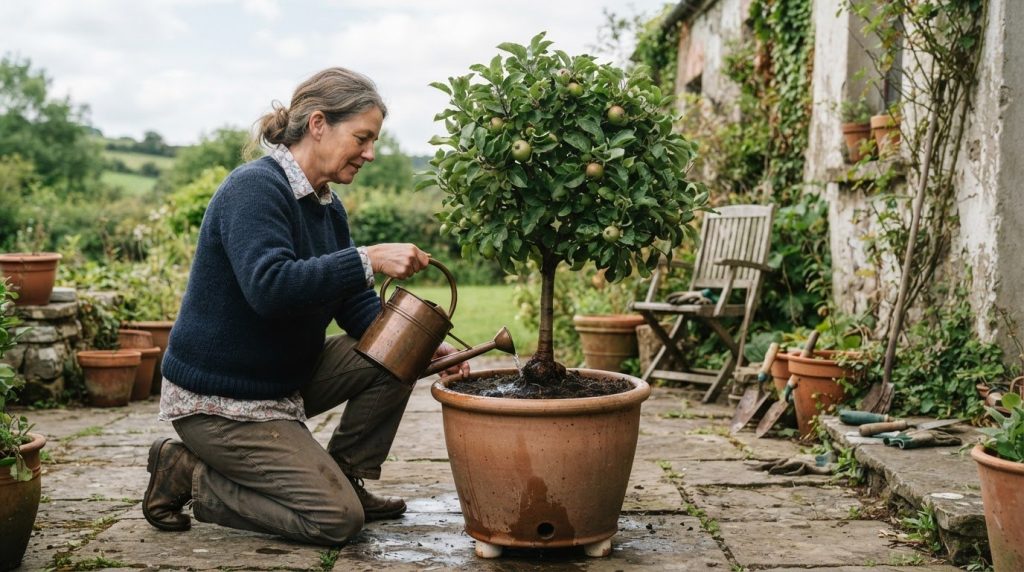
What makes a patio tree a good choice? It needs to suit the space, the container and the care you can provide as it grows. Choosing container grown trees for patios means looking beyond a young tree’s appearance to consider its eventual size, growth habit and water needs. It’s also worth planning for roots that will remain within the pot and compost that can dry out faster than garden soil.
Start by deciding how you want to use the space and where the tree will sit. Then compare tree options, choose a suitable container and plan for regular moisture checks. This guide covers those decisions, along with planting and seasonal care.
Buds Nursery Cavan has over 30 years of experience, with six acres dedicated to containerised production. Its container sizes range from two litre to 45 litre, and its nursery stock includes ornamental and fruit trees. Fruit trees, Apple Pear and Plum available potted throughout the season. Read on to find a practical fit for your patio and understand the ongoing care it involves.
Key Takeaways
- Compare container grown trees for patios by purpose: evergreen structure, flowers, foliage interest or fruit.
- Check a tree’s growth habit and eventual size, rather than choosing by its current appearance alone.
- Plant in a clear order: check drainage, position the tree, fill around the roots and water well.
- Check compost moisture regularly. A tree in a container needs different attention from one planted in garden soil.
What makes a container-grown tree work on a patio?
A container-grown tree has its roots within a limited volume of compost. Unlike a tree planted directly in garden soil, it can’t extend its roots into the surrounding ground. That makes container grown trees for patios a practical option where paving, limited space or flexibility rules out planting in the ground.
A potted tree can add height above lower planting, provide foliage or flowers, or produce fruit without taking up a garden bed. The trade-off is that the container limits the roots’ access to water and nutrients. Compost can dry out, so you’ll need to monitor moisture and maintain suitable growing conditions. The basic principles of container gardening, including drainage and choosing a suitable pot, apply to trees as well as smaller plants.
What should you consider before choosing a patio tree?
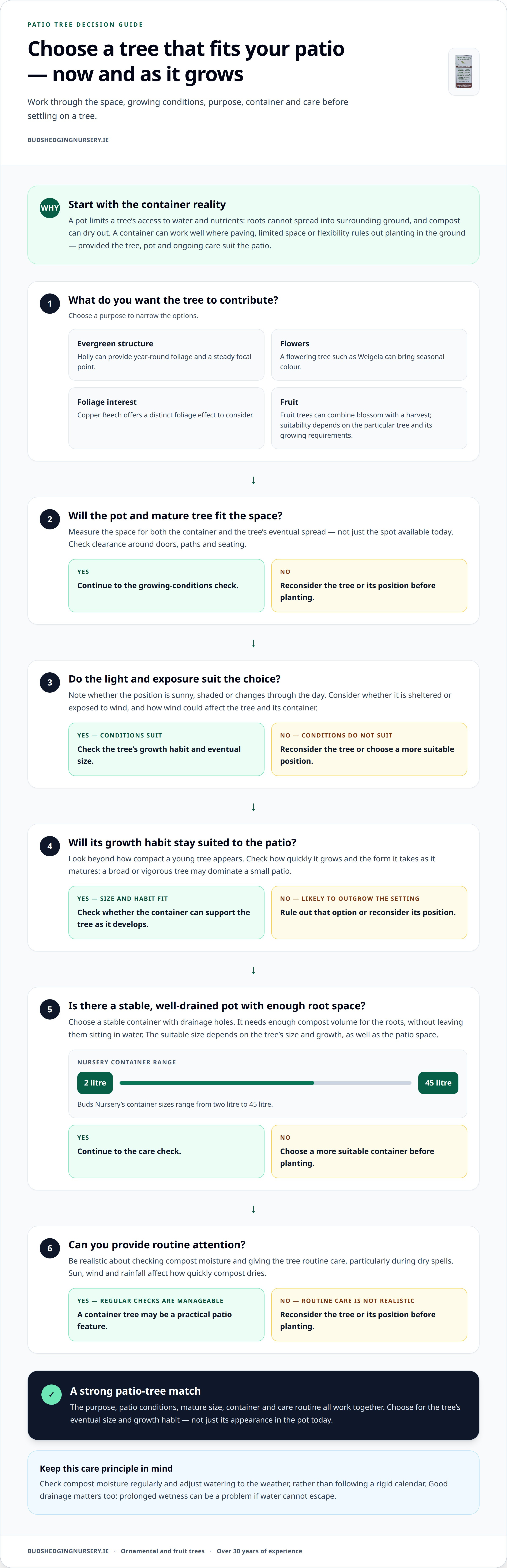
Measure the space the pot and mature tree will occupy, not just the spot where the pot could sit today. Check clearances around doors, paths and seating, then consider how much light the position gets and whether it is sheltered or exposed to wind. Finally, decide what you want the tree to contribute. A clear purpose makes it easier to compare options.
- Available space: Allow for the container and the tree’s eventual spread. Check that branches won’t crowd a route or seating area as the tree grows.
- Light and exposure: Note whether the position is sunny, shaded or changes through the day. Consider how wind could affect both the tree and its container.
- Appearance: Decide whether you want evergreen structure, seasonal foliage, flowers or fruit. Each gives the patio a different focus.
- Ongoing care: Be realistic about checking compost moisture and giving the tree routine attention, particularly during dry spells.
If the space, conditions and care you can provide suit the tree’s needs, a container can make it a practical patio feature. If they don’t, reconsider the tree or its position before planting.
How to choose a container-grown tree for your patio
First decide what you want the tree to do, then check whether its growth habit and mature size suit the patio. A young tree can look compact in its pot, but that won’t show how much room it may need later. With container grown trees for patios, the right choice is one that fits the space over time, not just on planting day.
- Evergreen structure: Holly can provide year-round foliage and a steady focal point.
- Flowers: A flowering tree such as Weigela can bring seasonal colour.
- Foliage interest: Copper Beech offers a distinct foliage effect to consider.
- Fruit: Fruit trees can combine blossom with a harvest. Suitability depends on the particular tree and its growing requirements.
Which tree characteristics matter most in a pot?
Check how quickly a tree grows and the form it takes as it matures. A broad or vigorous tree may dominate a small patio even if it starts at a manageable size. The pot also confines the roots, so consider whether the container can accommodate the tree as it develops and whether you can provide the necessary care. The UC Agriculture and Natural Resources advice on potted trees discusses container sizing and ongoing root care.
Choose by purpose, growth habit and patio space. This helps rule out a tree that looks appealing but is likely to outgrow its setting.
How should you match a pot to the tree?
Choose a stable container that can support the tree and has drainage holes for excess water to escape. It should provide enough compost volume for the roots without leaving them sitting in water. Buds Nursery’s container sizes range from two litre to 45 litre, which can help you compare the scale of a tree and its container. The right fit depends on the tree’s size and growth, as well as the space available on your patio.
With those checks in mind, explore ornamental and fruit tree options at Buds Nursery and compare them with the conditions on your patio.
Planting and caring for a patio tree in a container
Once you’ve chosen a tree and pot, plant it carefully and make regular checks part of your routine. A container holds less growing medium than open ground, so the tree has less access to moisture and nutrients. Sun, wind and rainfall on the patio all affect how quickly compost dries.
- Check drainage. Make sure the container has clear drainage holes so excess water can escape.
- Position the tree. Set it upright in the pot at a suitable depth, with the roots spread naturally.
- Fill around the roots. Add suitable compost around the root ball. Firm it gently to remove large air gaps without packing it hard.
- Water well. Water after planting so the compost settles around the roots, then allow excess water to drain away.
What changes when a tree grows in a pot?
In a pot, roots can’t draw moisture or nutrients from a wider area of soil. Compost may dry faster in warm, exposed conditions, while prolonged wetness can also be a problem if drainage is poor. Check the compost and adjust watering to the weather rather than following a rigid calendar. Regular observation is more useful than watering to a fixed schedule.
When might a container-grown tree need attention?
Check that water drains freely and note whether the compost is drying unusually quickly. Roots circling at the surface or emerging from drainage holes may indicate that they’re filling the container. If growth seems restricted, repotting into a more suitable container is one possible response. Assess the tree and root system first; don’t repot simply because a set period has passed.
Keep checking your tree as conditions change, and explore Buds Nursery’s ornamental and fruit trees as you plan your patio planting.
Explore container-grown tree options at Buds Nursery
Buds Nursery grows ornamental and fruit trees as part of its nursery stock, giving patio gardeners options to consider for structure, foliage, flowers or fruit. Container sizes range from two litre to 45 litre. When comparing options, think about how the tree’s current size relates to the patio, how it may grow and where the container will sit. Don’t choose on appearance alone.
Fruit trees, Apple Pear and Plum available potted throughout the season. Mature root-ball and bareroot trees available on request. These root-ball and bareroot trees are options for other planting plans, rather than container-grown stock. Delivery is available, pending quantity and site location.
What practical details help you plan a visit?
The nursery is open Tuesday to Friday, 9 am to 1 pm, and Saturday, 9 am to 1 pm and 2 pm to 6 pm. It is closed on Sundays and Mondays. Plan your visit within these hours to view tree options and consider how they might fit your patio.
Where can you find more tree-buying guidance?
If you’re weighing up what to look for when sourcing trees, the specialist plant nursery guide offers further buying guidance. If your plans shift from a patio pot to planting in open ground, use the bare-root tree planting guide to explore that approach.
For a patio project, focus your shortlist on trees that suit the space and the care you can provide. Explore ornamental and fruit tree options at Buds Nursery as you plan your planting.
Make your patio plan the starting point
Before choosing a tree, think about how you use the patio and where a new feature could sit without getting in the way. Measure the available space and note the light and exposure to turn a general idea into a practical shortlist. Decide whether you want year-round structure, seasonal interest or fruit, then use that purpose to compare container grown trees for patios.
Matching a tree to its position and the care you can provide is a sound first step towards patio planting you can enjoy over time. Explore trees and plants at Buds Nursery to find an option for your plans.
Frequently Asked Questions
Can container-grown trees stay outside all year?
Many can, but suitability depends on the tree and the conditions where it will stand. Roots in a container experience temperature changes more directly than roots in garden soil. Consider whether the patio is exposed, whether the pot can drain freely and what care the species needs. A sheltered position may help in harsh weather, but don’t assume every tree is suited to year-round outdoor conditions.
Do fruit trees need another tree nearby to produce fruit?
It depends on the variety. Some fruit trees can produce without a different compatible tree nearby, while others need or benefit from cross-pollination. Before choosing, find out the pollination requirements of the specific variety and whether a suitable pollinating tree is close enough. Apple, pear and plum trees don’t all share the same needs, so the fruit type alone isn’t a reliable guide.
Can I plant a container-grown tree in the ground later?
In many cases, yes, provided the tree suits the planting site and has room to grow. If you move one of your container grown trees for patios into open ground, handle the rootball gently and avoid letting it break apart during planting. Choose a position with space for the tree as it matures. Timing and aftercare depend on the tree and the conditions at the site.
What should I do if roots are growing through the container’s drainage holes?
Check the whole rootball and the tree’s growth before deciding what to do. A root at a drainage hole may indicate limited root space, but on its own it doesn’t show how crowded the container is. Avoid pulling hard on a root that has grown through an opening. Depending on the tree’s condition, repotting or planting it in the ground may be suitable.