

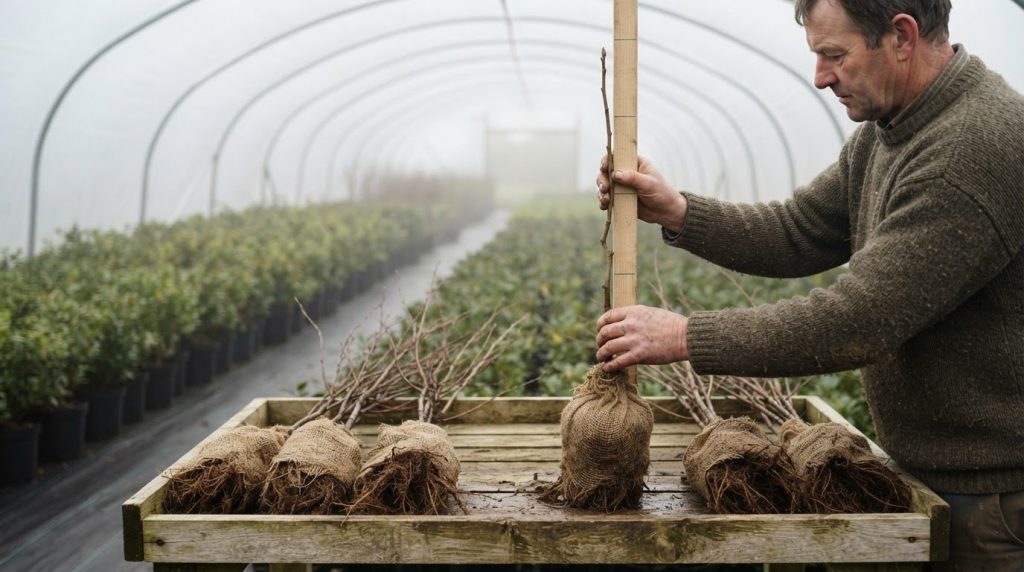
Getting the tree count right is only the first part of ACRES planting. When buying trees for the ACRES scheme in Ireland, plan around the action selected: general planting starts at 10 trees, priority planting at 100, and the maximum is 300. Tree height, spacing and species selection also matter when choosing trees for an ACRES planting action.
It’s easy to focus on the number of trees you need, but the ACRES action also determines which trees are suitable. Species, minimum height, spacing and sourcing all matter when matching an order to your planting plan.
This article explains how ACRES tree planting works and what to consider when buying trees. It covers quantities and spacing, minimum height, eligible species and how planting actions affect your choice, helping you keep the key requirements in view.
Key Takeaways
- Match your planned tree order to the ACRES action selected, and account for the holding’s cumulative planting limit.
- Allow for spacing, minimum height and site layout when planning where trees will go.
- Choose species from the eligible list and build the required mix into your selection.
- Explore Buds Nursery Cavan’s Native Trees Scheme as a next step when sourcing trees for your planting plans.
Tree planting quantities and spacing
ACRES tree-planting actions set requirements for quantity, spacing and eligible planting areas. Match your order to the action you have selected rather than treating every ACRES planting as the same project.
Planting quantities
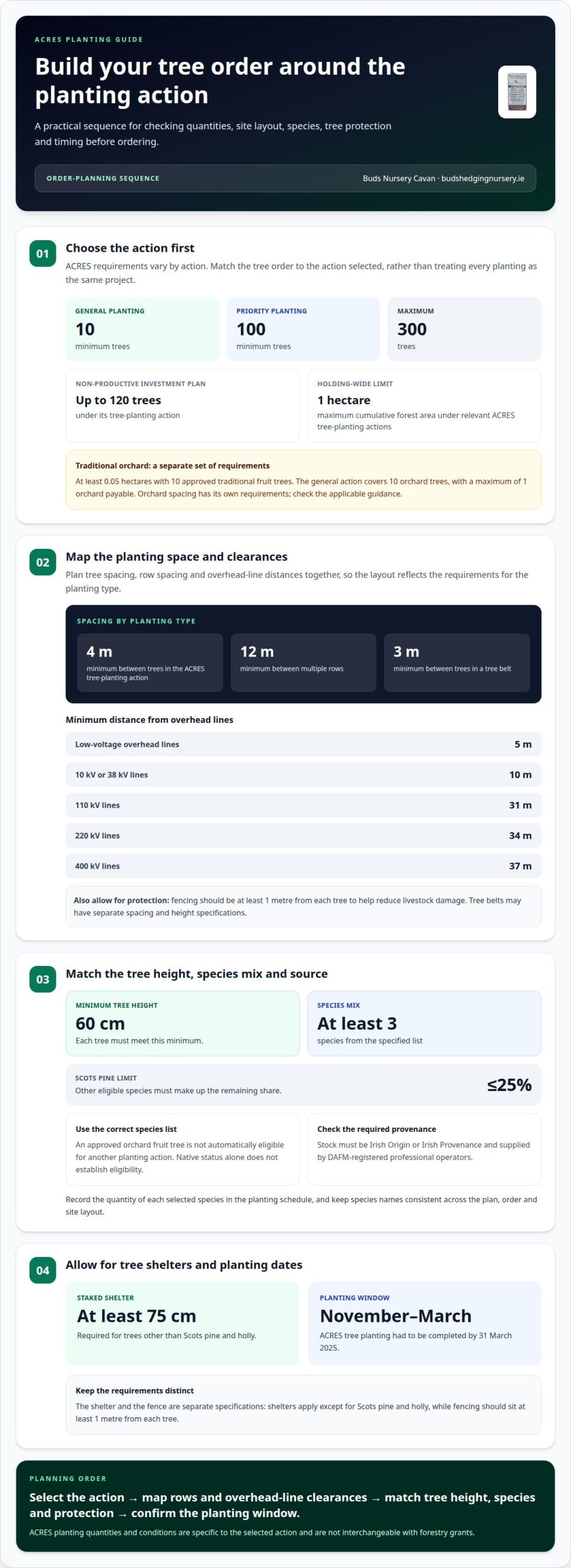
For general tree planting, the minimum is 10 trees; for a priority action, it is 100. The maximum is 300 trees, while a non-productive investment plan can include up to 120 trees under its tree-planting action. The Department of Agriculture, Food and the Marine limits the total cumulative forest area planted on a holding under relevant ACRES tree-planting actions to 1 hectare.
A traditional orchard must cover at least 0.05 hectares and contain 10 approved traditional fruit trees. The general action covers 10 orchard trees, with a maximum of 1 orchard payable. ACRES is an agri-environment action, so its quantities and conditions are specific to the selected action, rather than interchangeable with forestry grants. Tree purchases must be Irish Origin or Irish Provenance stock from DAFM-registered professional operators.
Spacing requirements
For the ACRES tree-planting action, leave at least 4 metres between trees and 12 metres between multiple rows. Traditional orchard planting has its own spacing requirements, so check the applicable guidance before planting. Tree belts use a separate spacing rule: plant trees at least 3 metres apart. These distinctions matter when calculating how many trees fit the planned area.
Trees should be planted between November and March, and ACRES tree planting had to be completed by 31 March 2025. Protection and aftercare also affect the planting specification: fencing should sit at least 1 metre from each tree to reduce livestock damage. The conditions supplied here give no survival-rate target or replacement figure.
Planting specifications
ACRES trees must be at least 60cm high and come from at least 3 species on the specified list. Except for Scots pine and holly, trees need a staked shelter at least 75 centimetres high. Scots pine may make up no more than 25% of the trees. The specified species mix therefore affects both selection and ordering.
Payment depends on the selected action; the scheme-wide figure of up to €10,500 annually applies to specified environmental actions, not as a stated tree-planting rate. Tree quantities, sourcing, spacing and protection are the measurable conditions described here; no penalty or clawback amount is provided. Nursery prices vary, but ACRES stock must meet the Irish Origin or Irish Provenance and registered-operator requirements.
Tree spacing and minimum height
Spacing and height affect the layout, tree count and stock required for an ACRES planting. Tree spacing should be planned to suit the requirements of the planting action. Multiple rows must be at least 12 metres apart, so a planting plan needs to allow for both distances rather than simply fitting trees into available ground.
Tree height is measured against a separate minimum: each tree must be at least 60cm high. Tree belts may have separate spacing and height specifications, so check the requirements for that planting type. These are distinct specifications. The tighter tree-belt spacing should not be carried over to a standard action, or vice versa.
Overhead lines can further limit where trees can be planted. Keep trees at least 5 metres from low-voltage overhead lines. For lines rated at 10 kV or 38 kV, the minimum distance is 10 metres. Higher-rated lines require greater separation: 31 metres for 110 kV, 34 metres for 220 kV and 37 metres for 400 kV.
Protection also needs room in the layout. Fencing should be at least 1 metre from a tree to help prevent livestock damage. Except for Scots pine and holly, each tree needs a staked shelter at least 75 centimetres high. The shelter and fence are separate requirements, so the planned position must accommodate both.
For a professional tree order, the useful sequence is to establish the action, map rows and overhead-line clearances, then match tree height and protection to the specification. This helps avoid ordering trees for positions that cannot meet the required spacing. For areas around a planting scheme, ground cover plants are another planting category to consider separately.
Tree species selection
ACRES planting requires native tree species, with trees drawn from at least 3 species on the specified list. Species choice is therefore a mix decision, not simply a preference for one familiar tree. The planting schedule needs to identify each selected species and its share of the total, so the final order matches the action’s requirements.
First, match the planting purpose to eligible species. A traditional orchard, for example, requires traditional fruit trees from its approved list. Other tree-planting actions have their own species lists, so a tree approved for an orchard is not automatically eligible for another action. Use the relevant list to guide your selection: a native tree does not qualify simply because it is native.
Next, check the proportions in the proposed mix. Scots pine may make up no more than 25% of trees under the ACRES tree-planting action. This cap affects the order as well as the planting plan: when Scots pine is included, other eligible species must make up the remaining share. The minimum of 3 species also means that a two-species mix is insufficient, even if both species are suitable individually.
Species selection can also affect the planting specification. Scots pine and holly are exceptions to the tree-shelter requirement, which applies to other trees. Identify each species accurately and keep its name consistent across the planting plan, order and site layout. Before changing the mix, check it against the action’s species list and proportion limits.
Prepare a schedule that groups the selected native trees by species and records the quantity of each. This makes the three-species minimum and the Scots pine cap easier to apply when ordering and receiving the trees. For an orchard, use the approved fruit-tree list; for other actions, follow that action’s specified list.
What tree species are eligible for planting under Ireland’s ACRES scheme?
Eligibility depends on the ACRES action, so a species suitable for one planting type may not qualify for another. The tree-planting action requires native species from its specified list, while traditional orchards use traditional fruit trees from their own approved list. Confirm that your species schedule matches the action before ordering.
For a standard tree-planting action, include at least 3 eligible species in the mix. Scots pine is permitted, but it can account for no more than 25% of the trees. This means the remainder of a mix containing Scots pine must be made up of other eligible species. Holly is also relevant to the planting specification, as it is one of the exceptions to the staked-shelter requirement.
Orchard planting follows a distinct selection route. The orchard must contain 10 traditional fruit trees from the approved list, so choosing fruit trees based only on preference is not enough. The selected varieties need to fit that approved category and the orchard action. Do not transfer a species choice from an orchard plan to another ACRES action without checking that action’s list.
Eligibility also depends on the trees’ origin and supplier. Trees purchased for the ACRES tree-planting action must be of Irish Origin or Irish Provenance and purchased from DAFM-registered professional operators. A suitable species alone does not meet this separate sourcing requirement.
For a practical order schedule, separate trees by action, species and intended quantity. Record Scots pine’s share where included, and distinguish traditional orchard fruit trees from other native planting. This gives the professional handling the order a clear basis for matching stock to the planting plan. To explore native tree options, use the relevant planting category as your starting point.
Buds Nursery Cavan: Native Trees Scheme
Buds Nursery Cavan’s Native Trees Scheme is a relevant option when planning a native tree-planting project. Use your selected ACRES action, species list and proposed mix to guide your purchase, so the trees you source align with the requirements. The nursery also offers Portuguese Laurel, Cherry Laurel and Golden Privet, which are separate planting choices and should not be assumed eligible for an ACRES tree action.
When you’re ready to discuss tree options for your planting plan, contact Buds Nursery Cavan to enquire about the Native Trees Scheme.
Turn your planting plan into a considered order
When buying trees for the ACRES scheme, turn your approved planting plan into a clear order schedule. Keep the selected action and species mix together when arranging the trees, so the order matches the project’s purpose. This also helps separate stock intended for ACRES planting from trees selected for other areas.
Buds Nursery Cavan offers Portuguese Laurel, Cherry Laurel and Golden Privet, as well as its Native Trees Scheme. These are distinct planting options, so choose according to the purpose of each area rather than assuming every nursery offering belongs in an ACRES mix. A clear schedule also helps you discuss the native tree options needed for your planting plan.
Contact Buds Nursery Cavan about ACRES trees to discuss your next step. A well-planned order gives your planting project a practical start.
Frequently Asked Questions
How does the ACRES scheme work?
ACRES supports farmers to carry out environmental actions on their holdings. Tree planting is one available action, with requirements that depend on the action selected and the planting type. For example, a traditional orchard has different criteria from a standard tree-planting action. The scheme also includes Co-operation areas, organised into 8 zones. A participant’s approved plan determines which actions apply to their holding.
What are the ACRES tree planting requirements for spacing, area and planting density?
Requirements vary by planting type. For small woodland options, the specified examples are 160 trees on 0.05 hectares or 300 trees on 0.09 hectares. An ammonia-capture tree belt must cover at least 0.18 hectares, with payment capped at 0.5 hectares, and contain at least 1 tree per 10m2. The relevant ACRES tree-planting actions also limit cumulative forest area on a holding to 1 hectare.
What tree stock specifications and certification are required for ACRES planting?
When buying trees for the ACRES scheme, ensure the stock is of Irish Origin or Irish Provenance and purchased from DAFM-registered professional operators. ACRES planting requirements also include a plant passport. Keep it with your purchase records to document the plants’ identity and origin. These sourcing conditions apply alongside the action’s species and physical specifications, so the trees must meet both the stock and planting requirements.
How do I apply for approval to plant trees under ACRES, and what documents are needed?
ACRES applications were made through qualified Farm Advisors, with the application deadline in December 2022. That deadline has passed, so the original application route is not an open application window. The available information does not set out a document checklist for tree planting. Application and planting records are separate matters: keep the plant passport accompanying purchased trees as part of the planting documentation.
Does ACRES cover the cost of trees, fencing, guards and planting labour?
ACRES offers payments for specified environmental actions, but the scheme-wide figure of up to €10,500 annually is not a tree-planting rate or a breakdown of costs. The available payment information does not give separate amounts for trees, fencing, guards or planting labour. Treat the selected action’s payment terms separately from the purchase and installation costs when planning the project budget.
What maintenance, replacement and survival-rate rules apply to ACRES trees?
Trees other than Scots pine and holly need a staked shelter at least 75 centimetres high, and fencing should be at least 1 metre from each tree. No survival-rate target or replacement figure is provided.