

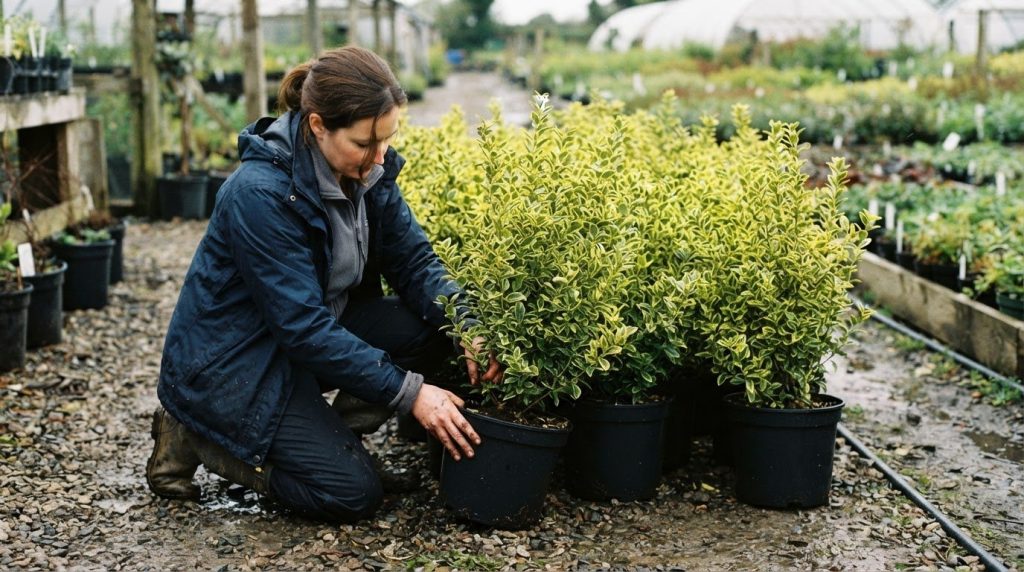
A narrower hedge isn’t always a better hedge. Narrow hedging for small spaces can be maintained below 1 m wide, but keeping it that narrow can stress plants and reduce foliage density. Evergreen and deciduous choices each have a place: the deciding factor is whether you want year-round cover or seasonal change.
A tight boundary makes every centimetre count, so it’s tempting to choose the smallest plants available. But plant size affects how quickly a hedge establishes. Weigh establishment time against the height and coverage you want.
This guide explains how narrow a hedge can be, how plant size affects establishment, and how evergreen, deciduous and columnar options compare. You’ll also learn why an upright growth habit can suit a confined garden and how yew, beech and hornbeam differ.
Key Takeaways
- Keeping a hedge very narrow can affect its health and density, so choose a plant suited to regular clipping.
- Smaller transplants can establish more quickly, while larger plants need careful attention as they settle in.
- Compare evergreen and deciduous choices by the cover and seasonal look you want, as well as the conditions in your garden.
- Columnar growth can make better use of a tight boundary; explore suitable hedging plants, including privet and laurel.
1. How narrow can a hedge be?
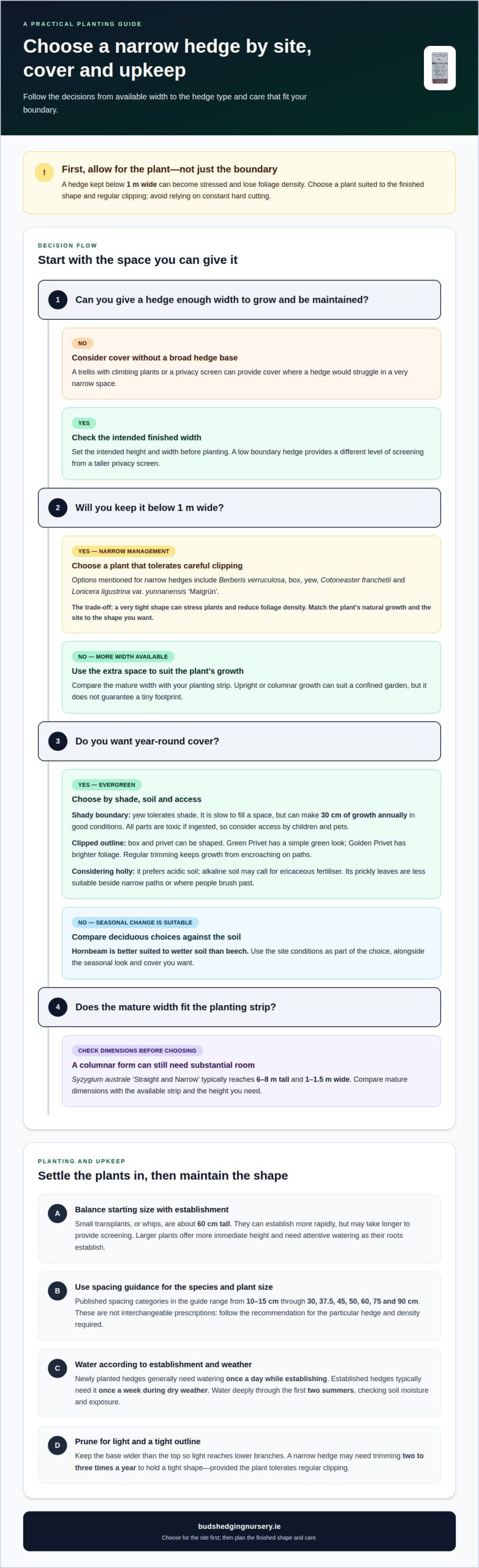
A hedge kept below 1 m wide can become stressed, with less foliage. Berberis verruculosa, box and yew can suit narrow hedges when clipped carefully. Cotoneaster franchetii and Lonicera ligustrina var. yunnanensis ‘Maigrün’ are other clipped options. Choose a plant whose natural growth and site suit the finished shape, rather than relying on constant hard cutting.
Set the intended height before planting. A low boundary hedge gives a different level of screening from a taller privacy screen. Gas Networks Ireland’s plan specifies 5 hedging trees per metre in a double staggered row. Treat this as a planting specification, not a universal spacing rule for every species or garden.
Consider shade and soil when choosing a plant. Yew tolerates shade, while sunny boundaries offer different growing conditions. Hornbeam is better suited to wetter soil than beech. Where a hedge would struggle in a very narrow space, a trellis with climbing plants or a privacy screen can provide cover without a broad hedge base.
In Ireland, don’t assume one hedge height automatically settles every boundary question. Keep growth within the available space, and consider sightlines and access when deciding on height. Plant prices depend on species, plant size and quantity, so compare those factors when planning your spend.
Newly planted hedges generally need watering once a day while establishing; established hedges typically need it once a week during dry weather. Water deeply through the first two summers. Check soil moisture and exposure, as sheltered shade and exposed sun dry differently.
Prune to maintain the chosen width, keeping the base wider than the top so light reaches the lower branches. Narrow hedges may need trimming two to three times a year to hold a tight shape. This approach suits small-space hedging only if the plant tolerates regular clipping.
2. Plant sizes and establishment
Plant size affects both the hedge’s starting appearance and how it settles into the site. Small transplants, often called whips, are about 60 cm tall and can establish more rapidly than larger plants. They may take longer to provide screening, but their smaller root systems are easier to settle into the ground. Larger specimens offer more immediate height, yet need attentive watering as their roots establish.
Spacing depends on the species, plant size and desired density. Follow guidance for the particular plant rather than treating one distance as suitable for every hedge. Planting too widely can leave gaps as plants grow; crowding can increase competition for water and space.
Spacing guidance for hedges includes categories from 10–15 cm for the closest planting to 30, 37.5, 45, 50, 60, 75 and 90 cm. These are not interchangeable prescriptions. Use the spacing that matches the hedge type and planting material, and keep the row straight so each plant has room to develop evenly.
Prepare the planting strip before setting out the plants. Remove competing weeds, loosen compacted ground and check that water can drain away. Set each plant at the same depth it grew previously, firm the soil around the roots, then water the row thoroughly. In exposed or windy positions, stake young hedge trees through their first year to limit movement while roots take hold.
After planting, keep the root area clear of weeds and watch for dry soil, particularly around small transplants. A consistent row and suitable spacing make later pruning easier. The best spacing for a narrow hedge is therefore the recommended distance for its species and plant size, adjusted for the density required. Ground cover plants can also help cover bare soil beside a developing hedge.
3. Box, privet, holly and yew
Box and yew both tolerate clipping, making them options for a formal, controlled outline. Evergreen hedges such as box and yew are best pruned from late spring to early summer. Trim little and often to preserve the intended shape rather than cutting deep into old growth. A suitable feeding routine can help support healthy growth after trimming.
Yew is slow to fill a space, but it can make 30 cm of growth annually in good conditions. It tolerates shade, so it suits a boundary where direct sunlight is limited. Allow for its eventual width when planning the row; clipping controls the outline, but the plant still needs room to grow. All parts of yew are toxic if ingested, so consider access by children and pets.
Privet offers another clipped option. Green Privet keeps a simple green look, while Golden Privet brings brighter foliage. Both can be shaped to suit a confined boundary, but regular trimming is needed to keep growth from encroaching on paths. A dense hedge depends on suitable spacing as well as pruning. The listed narrow hedging species are planted 1 m apart for a dense hedge.
Holly provides evergreen structure and berries on female plants when pollination conditions are met. It prefers acidic soil; alkaline soil may call for ericaceous fertiliser. Check the planting strip before choosing holly, since unsuitable soil can make long-term growth difficult. Its prickly leaves also make it less suitable beside narrow paths or where people brush past.
Choose for the site first, then for appearance. Yew is a clear candidate for shade; for a clipped, compact outline, consider box or privet. Match holly to acidic soil and keep its spiny foliage away from tight walkways. This comparison helps narrow your options before settling on a plant and pruning routine.
4. Columnar hedging species for narrow gardens
Columnar growth keeps a hedge upright, but doesn’t guarantee a tiny footprint. Compare mature width with the planting strip before choosing. Syzygium australe ‘Straight and Narrow’ typically reaches 6 to 8 m tall and 1 to 1.5 m wide. That height may exceed the needs of a small boundary, even with its narrow form.
Other examples show why dimensions matter. Magnolia grandiflora ‘Teddy Bear’ typically grows 3 to 5 m tall and 1.5 to 2.5 m wide. Banksia integrifolia ‘Sentinel’ reaches 6 to 8 m tall and 1 to 1.5 m wide. Laurus nobilis ‘Miles Choice’ grows 4 to 6 m tall and 1 to 1.5 m wide.
Murraya paniculata is the fastest-growing of these listed narrow hedging plants. It typically reaches 2 to 3 m tall and 1 to 1.5 m wide. For a dense hedge, plant it 80 cm apart. Its speed can help create coverage sooner, but also means the pruning routine must keep pace with growth.
These examples aren’t interchangeable in every Irish garden. Use mature height and width to judge whether each plant will fit, then consider local soil, exposure and winter conditions. A columnar habit can reduce side growth, but it won’t stop a tall plant from outgrowing a low boundary. Choose for the space available at maturity, not just the plant’s young shape.
For a confined garden, the clearest takeaway is to treat “columnar” as a growth habit, not a promise of narrow dimensions. Check the expected width, height and planting distance together. Keep the base accessible for trimming, and avoid placing the row where mature growth will block a path or window. Where bare soil remains beside the hedge, choose ground cover plants to cover the strip without extending the hedge line.
Buds Nursery Cavan
Buds Nursery Cavan offers a range of hedging plants to help you plan for a confined garden. Start with the available space, your preferred finished height and whether the boundary is sunny, shaded or exposed. These details help narrow the choice between evergreen and deciduous plants, and between a clipped hedge and a naturally upright form.
The hedging range includes Portuguese Laurel, Cherry Laurel, Golden Privet and Green Privet. Compare their growth habits with the available planting space before choosing: a plant’s eventual width matters as much as its height in a narrow garden. Bare root trees are another option for a planting scheme.
If you’re weighing up plants for a tight boundary, contact Buds Nursery Cavan to discuss your options.
Plan for the garden you want to use
Put your planting decision to a practical test: picture the hedge at maturity, then consider how you use the space beside it. A narrow boundary may need to leave room for opening gates, carrying bins or keeping a path clear. The right choice should suit everyday access as well as the look you want.
Be clear about what you need the planting to do. A defined edge, filtered privacy and year-round screening call for different expectations. Consider how much ongoing trimming you can manage too, since a neat outline takes regular care.
Planning narrow hedging for small spaces is easier when you set these priorities before choosing plants. You’ll have a clear basis for deciding what fits your garden and routine.
Contact Buds Nursery Cavan to talk through your planting plans. A well-chosen hedge can make a tight boundary work better for you.
Frequently Asked Questions
Evergreen or deciduous?
Choose evergreen plants for year-round foliage, or deciduous plants if seasonal change suits the garden. In a tight space, consider what the hedge will screen in winter as well as summer. An evergreen boundary provides a consistent backdrop, while beech or hornbeam offers a seasonal look. Weigh up how much trimming you can manage and whether you want a formal outline.
How narrow can a hedge be?
A clipped hedge can be kept below 1 m wide, but maintaining that width may stress plants and reduce foliage density. The practical limit depends on the species and its natural growth habit. For narrow hedging for small spaces, allow enough room for healthy foliage and consider a trellis or screen if the planting strip is too tight.
What are the best narrow hedge plants for small gardens in Ireland?
Yew, box and privet are useful starting points for a clipped hedge, but the right choice depends on the site and the look you want. For narrow hedging for small spaces, choose plants suited to the garden’s light and soil. Compare evergreen cover with seasonal foliage, and consider Portuguese Laurel, Cherry Laurel or Golden Privet for a boundary.
Which hedging plants stay narrow without regular trimming?
No clipped hedge is maintenance-free. A naturally upright or columnar habit can reduce side growth, but mature plants still need room and may spread beyond their intended line. Check each species’ mature width before planting. If you want to minimise trimming, a trellis or freestanding screen may suit better than a living hedge.
How tall and wide do compact hedge varieties grow?
There is no single size for compact hedging: dimensions vary by species and growing conditions. Separate the height you plan to maintain from the plant’s potential mature height and width. For example, a low hedge can be maintained at 30–90 cm, whilst taller screens need more space. Assess width as well as height before planting.
Which narrow hedges grow well in Irish soil and climate?
Match the plant to the garden’s actual conditions rather than choosing by name alone. Yew suits shaded positions, while hornbeam is better suited to wetter soil than beech. Check drainage, exposure and available light along the planting line, since conditions can vary within one garden. These factors help guide your choice for an Irish boundary.